Your new post is loading...

|
Scooped by
Gilbert C FAURE
May 22, 4:28 AM
|
Les métriques Zenodo viennent de tomber : 260 vues, 58 téléchargements. Dans une démarche de recherche citoyenne et moins d'une semaine après la publication de mon preprint « Open Source 2.0 : From Open Source Software to Open Source Resources? », probablement un joli début ❤️🔥
Pour continuer la valorisation/promotion, lien article: https://lnkd.in/dVHusvF3
Avec déjà des échanges au sein de communautés qui ont plutôt tendance à confirmer ma thèse autour des « ressources open source », ces ressources numériques qui fournissent leurs fichiers source.
J'ai diffusé ces travaux dans une variété de communautés au sein de l'éducation ouverte, de la science ouverte et du logiciel ouvert en plus d'une publication sur LinkedIn et Mastodon.
Un bon intérêt sur ce concept de ressources open source du côté de l'open education où Alex Klinger, Alan Levine, Paola Corti et Italo Vignoli (cc Gilbert C. FAURE) sont alors venus me partager leurs problèmes/enjeux autour de la gestion des fichiers source et de leurs formats: https://lnkd.in/dKBQg5UR
Du côté science ouverte, 4-5 réactions du genre 👍 ou 👀. Des partages notamment auprès de la communauté Framework for Open and Reproducible Research Training (FORRT), des groupes linkedin comme l'Open Science Community Madrid ou Transform to Open Science de la NASA.
Espérons qu'ils soient en train d'analyser ça! Et comme c'est aujourd'hui le fonctionnement de la recherche toujours à la recherche d'évaluation par les pairs: https://lnkd.in/dXW8GH7B
Du côté des informaticiens, c'est intéressant. J'ai eu le droit à mon débat autour de l'Open Source Initiative et de leur Open Source Definition (OSD) dans la mailing list Teaching Open Source ! Lien échange: https://lnkd.in/d5pWxrZW
Avec un enseignant-chercheur, Dr. Bryan G. Behrenshausen, dont je viens de découvrir à la rédaction de cette publication qu'il est/était Senior Open Source Program Manager à GitLab. Je crois que j'ai bien défendu mon argumentaire dans cet échange intellectuel. Pas d'accords sur les terminologies, mais pas non plus de contradiction sur ma théorie autour des fichiers sources pour les autres typologies de ressources numériques.
Dans cette tradition, on m'a invité à appeler ça autrement ce à quoi je réplique que cela semble une évolution naturelle, déjà existante, avec une fin cordiale en concluant avec Descartes. Ils restent enfermés dans leurs convictions, je l'ai probablement déstabilisé, mais ces soutiens d'acteurs du logiciel open source à l'OSD me paraissent plutôt simples à contredire. Des arguments d'autorité avec un raisonnement un peu fragile...
Défi de ce vendredi : présenter ces réflexions au directeur de l'OSI qui a eu la mauvaise idée de proposer des créneaux de visio! Souhaitez-moi bon courage, j'ai quand même un peu peur du big boss 😅
|
|
Scooped by
Gilbert C FAURE
May 22, 4:02 AM
|
Le meilleur prédicteur du succès d’un article scientifique n’est pas le prestige de l'université, l'expérience du chercheur, la méthodologie utilisée, ni même le talent de vos collaborateurs.
Le meilleur prédicteur... c'est les personnes que vous remerciez à la fin.
Cette découverte étonnante vient de paraître dans PNAS. Les chercheurs ont mesuré l'impact de 130 000 articles publiés par 86 000 chercheurs (à l'aide de différentes mesures comme le H-index ou le score Euclide).
Résultat : le meilleurs prédicteur de succès, c'est le réseau des gens qui apparaissent dans les remerciements – ce petit “merci à Jean-Michel pour ses précieux commentaires” que personne ne lit à la fin.
C'est interessant car ça montre à quel point les discussions de couloir, les retours rapides sur une intuition, les conseils donnés après un séminaire ou les échanges à la machine à café sont importants.
Je m'étais déjà fait la remarque à titre personnel. Ces petits bavardages informels, c'est comme une couche invisible de soutien intellectuel qui circule en dehors des structures officielles et qui fait émerger les meilleurs idées.
Bref, veillez sur votre réseau informel, c’est une véritable infrastructure cognitive. | 58 comments on LinkedIn
|
|
Scooped by
Gilbert C FAURE
May 21, 10:47 AM
|
Congressman Greg Murphy, MD wrote: “ Unless our Medical Schools do a better job screening admissions candidates, we won’t have any doctors. If you don’t want to practice FULL time for at least 20-25 years, pick another profession.”
His comment was in response to a new study which shows 20% of physicians quit after 5 years.
My dad practiced gastroenterology for more than 40 years. His physician friends mostly did the same. Some talked about retiring for a decade. Some retired and came back multiple times. Some “cut back” to a schedule that still looked suspiciously like full time. You could not get them to stop.
That older model of medicine clearly had pride, purpose, identity, and endurance built into it.
But something has changed.
Maybe younger physicians are less willing to sacrifice their whole lives for the job. Maybe the job itself has become harder to recognize. Maybe full-time clinical medicine now includes so much inbox work, administrative friction, moral injury, and corporate pressure that comparing generations misses the point.
I don’t think the answer is simply screening medical students for who will tolerate the most pain.
The better question is why so many talented people are leaving so early.
What changed: the doctors, the job, or the deal medicine made with them?
Nisha Mehta, MD | 293 comments on LinkedIn
|
|
Scooped by
Gilbert C FAURE
May 21, 4:14 AM
|
Mapify transforme tout contenu en carte mentale. Idéal pour synthétiser un cours ou organiser une recherche. Lisez l’article pour des exemples concrets et une prise en main rapide.
|
|
Scooped by
Gilbert C FAURE
May 20, 6:24 AM
|
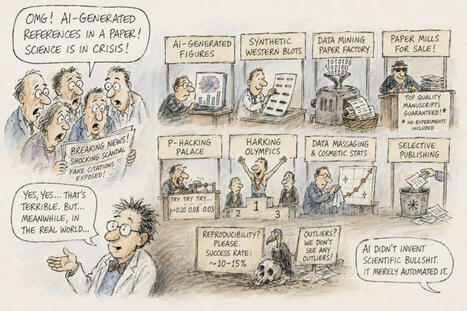
Holy crap. This bizarre graphic looks like the nastiest possible conspiracy view of scientific corruption, with multiple pathways for fabricated or irrelevant citations to get through all the filters and into the literature and even review articles. But if you read this post, it's not fictional: it's actually documented. And it has significantly expanded since the arrival of LLM's. What the heck can we do about this? Peer review and tough editors were supposed to save us but that clearly is not working. Now what??
Peter Frishauf Charlotte Blease, PhD Amy Price MS, MA, MS, DPhil
|
|
Scooped by
Gilbert C FAURE
May 19, 4:29 AM
|
📣 L’AUF Moyen-Orient signale que l’Université Saint-Joseph de Beyrouth - USJ met à disposition des ressources libres relatives à la pédagogie universitaire, accessibles à travers le lien https://lnkd.in/drPMfiiS
🗒️ Ces ressources portent sur de nombreuses thématiques pédagogiques dans le contexte de l’enseignement supérieur, notamment sur l’usage de l’intelligence artificielle centré sur le développement des compétences.
Beaucoup d’entre elles ont été produites grâce au soutien de l’AUF, comme le Manuel de pédagogie universitaire et le Guide d’évaluation des compétences.
Une sélection de références et liens utiles est également mise à disposition.
🔗 Découvrez-les via ce lien : https://lnkd.in/dfT6yR9k
|
|
Scooped by
Gilbert C FAURE
May 17, 5:33 AM
|
The promise of AI in medicine is real. So are the risks.
In my latest KevinMD op-ed, I describe my own brief encounter with an AI health platform that was polite, fast, and superficially reassuring, but did not do what physicians are trained to do: interrogate uncertainty, synthesize context, and assume responsibility for clinical judgment.
The experience raised larger questions about autonomous AI in health care. If a system can renew prescriptions, suggest diagnoses, and present itself as an “AI doctor,” then convenience is not enough. We need clear standards for validation, scope of practice, supervision, transparency, and accountability.
AI can assist clinicians. It can streamline care. It may help expand access. But "speaking" fluently does not demonstrate competence, and passing along information does not replace the application of seasoned judgment.
Until autonomous clinical AI is held to standards commensurate with the authority it seeks, patients and physicians should remain cautious about confusing speed with care.
“AI Clinical Judgment is What AI Chatbots Still Lack.” Read it below.
#ArtificialIntelligence #AIinMedicine #HealthcareAI #ClinicalJudgment #PatientSafety #DigitalHealth #MedicalEthics #HealthPolicy #PhysicianLeadership #KevinMD
|
|
Scooped by
Gilbert C FAURE
May 16, 2:35 AM
|
🚨 EARLY GIVEAWAY ALERT 🚨
We are giving you a head start to celebrate UNESCO #lightday2026 with our shareable banner! 🎨
Download them from our website and share them on your socials tomorrow and join the celebration of light science and technology worldwide 💡🎊
Remember to tag us, as you share your events
and outreach updates on socials💥
May 16 Banner
➡️ https://lnkd.in/enEDRWqZ
Official hashtag: #lightday2026
🎯 9th edition focus theme: Light for a Sustainable Future
📣 It’s never too late to register your event, every effort matters!
➡️https://lnkd.in/ev9_FA8a
Best wishes all 🤩
Team IDL2026
#lightday2026 #eventoutreach
📸May 16 Banner Credits: Carmen Daalman | ASTRON
Thank you Carmen🤩
|
|
Scooped by
Gilbert C FAURE
May 15, 11:13 AM
|
Interesting viewpoint. (and I agree that the AI-generated references problem is much easier to fix than the others cited below...)
|
|
Scooped by
Gilbert C FAURE
May 13, 4:23 AM
|
Claims that medical AI is improving care must be backed by appropriate evidence.
|
|
Scooped by
Gilbert C FAURE
May 12, 10:17 AM
|
What feels obvious to you… might not be obvious to someone else.
That gap shows up more often than we think.
Our latest blog explores the 𝗖𝘂𝗿𝘀𝗲 𝗼𝗳 𝗞𝗻𝗼𝘄𝗹𝗲𝗱𝗴𝗲 and why experts often struggle to explain things clearly. Once we understand something deeply, it’s hard to remember what it felt like not to.
So we skip steps.
We use language that feels natural to us.
We move faster than others can follow.
And that’s where learning breaks.
In learning design, expertise isn’t the goal. Clarity is.
That means slowing things down.
Breaking ideas into steps.
Saying things simply, even when they feel obvious.
Because what’s clear to you isn’t always clear to someone else.
And the moment it becomes clear… that’s when learning actually happens.
📌 Write to 𝗲𝗹𝗲𝗮𝗿𝗻𝗶𝗻𝗴@𝗹𝗲𝗮𝗿𝗻𝗻𝗼𝘃𝗮𝘁𝗼𝗿𝘀.𝗰𝗼𝗺 to craft learning that transforms behaviour.
#LearningDesign #LearningScience #WorkplaceLearning #InstructionalDesign
https://lnkd.in/g98_6pha

|
Suggested by
LIGHTING
May 11, 9:48 AM
|
Spread the loveIntroduction to Social Media Mining in Health The advent of social media has transformed how we communicate, share information, and engage with health-related topics. As we delve into the years 2015 to 2025, the phenomenon known as social media mining in health emerges as a critical...
|
|
Scooped by
Gilbert C FAURE
May 11, 7:38 AM
|
#PositiveAcademia #288: This one is for academics in the later stages of their careers in particular: an article to help you reflect about how you want to shape your career and life after 20+ years in academia.
We recently discussed transitioning to retirement in our CYGNA Senior meeting (see: https://lnkd.in/eKmP3mN5) and this article came up. It is a fascinating discussion about the difference between fluid and crystallised intelligence that is highly relevant for academic careers.
We all agreed we'd rather be Bach than Darwin:
"When Darwin fell behind as an innovator, he became despondent and depressed; his life ended in sad inactivity. When Bach fell behind, he reinvented himself as a master instructor. He died beloved, fulfilled, and—though less famous than he once had been—respected."
https://lnkd.in/gsv_TXD
|
|
|
Scooped by
Gilbert C FAURE
May 22, 4:27 AM
|
Longévité : la science valide (enfin) ce que nous constatons sur le terrain.
Une étude récente des chercheurs d'Oxford met en lumière la méthode « S-MEDS », un acronyme qui résume les 5 piliers incontournables pour vivre plus longtemps et, surtout, en meilleure santé :
👉 Sleep (Le #sommeil)
👉 Meditation (La gestion du #stress)
👉 Exercise (Le #mouvement)
👉 Diet (L'#alimentation)
👉 Social interaction (Le lien social)
Si les quatre premiers piliers relèvent souvent de choix individuels, le dernier – le #liensocial – est une responsabilité collective. L’isolement accélère la vulnérabilité, tandis que le #lien social protège et prolonge la vie.
En tant qu’acteurs de l’économie sociale et solidaire ou de l’#urbanisme, nous ne pouvons pas ignorer cette réalité scientifique.
Pour que nos #aînés activent ce levier de longévité, nos territoires doivent concevoir un habitat qui favorise la rencontre, brise l’#isolement et maintient chaque individu pleinement intégré au cœur de la cité.
C’est précisément tout l’enjeu des projets d'#habitat #inclusif que nous devons porter dans nos #communes. Le logement ne doit plus être un simple toit isolé, mais un vecteur d'animation, de #mixité et d'échange. Permettre à une #personneâgée ou fragile de rester actrice du #bourg, consultée et entourée, c'est directement agir sur sa #santé globale.
La #longévité ne dépend pas uniquement de la #médecine, elle dépend de notre capacité à créer des environnements inclusifs.
#SilverEconomie #S_MEDS #Sante #Inclusion #LienSocial #ESS #Oxford #smeds #senior
|
|
Scooped by
Gilbert C FAURE
May 22, 4:02 AM
|
The impact of AI is already producing a massive flood of content in so many creative industries--I don't know how we are going review or evaluate all this stuff. The peer review system was already at a breaking point.
https://lnkd.in/eQzDUrEQ | 13 comments on LinkedIn
|
|
Scooped by
Gilbert C FAURE
May 21, 4:53 AM
|
Lego was losing $1 million a day. 💸
Warehouses were overflowing.
Costs were out of control.
Even billion-dollar franchises like Star Wars and Harry Potter couldn’t save them once the movie hype wore off.
By 2003, Lego was staring bankruptcy in the face.
Then in 2004, something radical happened:
They hired Jørgen Vig Knudstorp — the first non-family CEO in Lego’s history.
And he made bold, uncomfortable moves most leaders would avoid:
• Cut Lego’s unique bricks from nearly 12,000 down to less than 7,000.
• Slashed the product development cycle from 2 years to 1.
• Sold off theme parks, clothing lines, and video games.
• Shut down factories and cut 1,000 jobs — saving $600M in two years.
• Outsourced manufacturing so the company could focus on design.
• Introduced “war room” accountability: every product head posted results and action steps for all to see.
The message was simple:
Stop chasing distractions.
Get back to the brick.
But Knudstorp didn’t just cut — he rebuilt Lego’s culture around fans and innovation.
• Superfans were invited into R&D through programs like LEGO Ideas (where fans could submit and vote on new sets).
• Expensive, over-engineered parts like micro-motors and fiber optics were scrapped.
• Creativity, not complexity, became the guiding principle.
The results were staggering.
Within 5 years, Lego was profitable again.
By 2015, it had overtaken Mattel to become the #1 toy company in the world. 🚀
And then came The Lego Movie in 2014.
What could’ve been a 90-minute commercial turned into a global cultural hit — spawning sequels, spin-offs, and billions in new sales.
The lesson?
Turnarounds don’t always come from doing more.
Sometimes they come from doing less.
From stripping back to your core.
From focusing on what made you great in the first place.
Because the thing that saves your business might already be in your hands.
#Leadership #BusinessGrowth #TurnaroundStory | 1,335 comments on LinkedIn
|
|
Scooped by
Gilbert C FAURE
May 21, 3:49 AM
|
The Chinese translation of Metaliteracy: Reinventing Information Literacy to Empower Learners, the first book introducing the metaliteracy model that I co-authored with Trudi Jacobson, has been published (https://lnkd.in/gNxkpnii). Many thanks to Wu Changhong (Bella Wu) at Northeast Normal University for initiating and completing the translation, and to ALA Editions for supporting the project. This new translation expands the global reach of metaliteracy among students and educators across academic and library communities in China. #metaliteracy #infolit #InformationLiteracy #HigherEducation #AcademicLibraries #GlobalLearning #DigitalLearning
|
|
Scooped by
Gilbert C FAURE
May 19, 4:39 AM
|
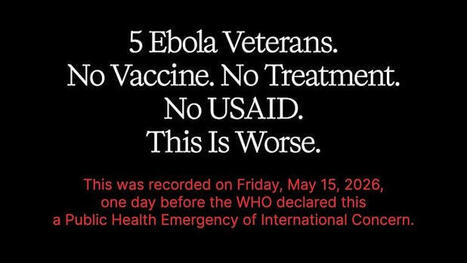
Five friends and Ebola veterans sat down to talk about Bundibugyo. The operational details are where this gets scary.
|
|
Scooped by
Gilbert C FAURE
May 18, 3:51 AM
|
“The concern isn’t that AI will produce obviously bad papers. It’s that it will produce, at scale and at speed, the kind of papers that are already crowding the journals: technically adequate, marginally novel, epistemically forgettable, those “modal” papers that get a handful of citations throughout their lives.”
https://lnkd.in/eVqiqbND
|
|
Scooped by
Gilbert C FAURE
May 16, 2:38 AM
|
The domestic cat may be a far more recent arrival to Europe than previously thought, arriving roughly 2000 years ago and not because of the Paleolithic expansion of Near East farmers.
The findings in Science offer new insight into one of humanity’s most enigmatic animal companions and identify North Africa as the cradle of the modern housecat.
Learn more during #NationalPetMonth: https://scim.ag/4f44pPw
|
|
Scooped by
Gilbert C FAURE
May 16, 2:23 AM
|
As more people turn to chatbots for medical guidance, the technology is revealing both its promise and its risks
|
|
Scooped by
Gilbert C FAURE
May 15, 11:08 AM
|
Last year, scientists stumbled on a fascinating, troubling finding: people are steadily speaking less with one another.
Lots of studies use "passive sensing," recording (with their permission) audio from people's everyday lives. Data like this allows scientists to quantify people's conversations--which, it turns out, are dwindling.
Between 2005 and 2019, people spoke an average of 338 words less to each other *per day.* This is the equivalent of 120,000 unspoken words per year. Jane Austen's Sense and Sensibility is around that long. Imagine reading it aloud. That's how many words of conversation people are losing each year.
Connection and social health depends on real, live interactions, making all this silence (perhaps interrupted by typing) a real problem. And a reversible one. Nicholas Epley, Gillian Sandstrom and many others are on a quest to get people talking more. If you heed their advice, you are also fighting back against a lonelier world of unspoken words. | 36 comments on LinkedIn
|
|
Scooped by
Gilbert C FAURE
May 13, 3:33 AM
|
Just published in Science (!!), and a landmark achievement for ARISE.
An LLM (o1-preview) outperformed physicians on multiple clinical reasoning tasks, including blinded second opinions on real emergency department cases from BIDMC.
Also notable: physician raters were unable to tell whether a differential came from AI or a human. One rater responded “can’t tell” in 83.6% of cases, the other in 94.4%.
Most likely near-term use case: AI as a high-quality second-opinion and reasoning support tool, especially early in the diagnostic process when physicians have incomplete information.
Peter Brodeur, MD, MA, Thomas Buckley, Adam Rodman, Jonathan H. Chen, Arjun Manrai
With a fantastic team: Robert Gallo, Zahir Kanjee, Evelyn Bin Liang, Priyank Jain, Stephanie Cabral, Raja-Elie Abdulnour, Adrian Haimovich, Andrew Olson, Daniel Morgan, Haadi Mombini, Liam McCoy, Christopher Lucas, Jason Hom, Jason Freed, MD, Daniel Restrepo, Eric Horvitz
+ would not have been possible without Yevgeniya Nusinovich's guidance and support throughout entire process. | 54 comments on LinkedIn
|
|
Scooped by
Gilbert C FAURE
May 12, 3:24 AM
|
2031. Vous êtes consultant senior depuis 15 ans. L'IA fait votre recherche, vos slides, vos premiers jets. Vous validez. Depuis 5 ans, vous n'avez pas rédigé un paragraphe seul. Un matin, le système tombe. Vous ouvrez un document vierge. Rien ne vient. 🧠
L'étude du MIT Media Lab l'a montré. 54 adultes suivis pendant 4 mois. Connectivité neuronale réduite de 55% chez les utilisateurs de LLM. Time Magazine l'a titré. Le Data Science Collective a parlé de "47% Collapse in Brain Activity".
Ce qui est en train de mourir :
👉 Le muscle de la rédaction. 83% des utilisateurs de LLM sont incapables de citer un passage du texte qu'ils viennent d'écrire. Ils ne reconnaissent pas leur propre travail.
👉 La connectivité même après arrêt. Quand les utilisateurs habituels reprenaient une tâche sans assistance, leur connectivité restait réduite. Le cerveau peinait à redémarrer seul.
👉 La capacité à détecter les erreurs. Harvard et BCG : +40% de performance dans la zone de compétence de l'IA. Moins 19% en dehors. Le danger n'est pas que l'IA se trompe. C'est que vous ne sachiez plus repérer où.
Trois antidotes :
1️⃣ Faire avec, pas faire après. Si vous n'intervenez qu'à la fin pour valider, vous êtes un dirigeant qui lit un rapport sans avoir participé à aucune réunion. Réintroduisez des checkpoints humains.
2️⃣ Orchestrer, pas subir. Construire le système, définir les étapes, choisir où intervenir. La première posture construit de l'expertise. La seconde accumule de la dette cognitive.
3️⃣ Garder une discipline de pensée autonome. Régulièrement, fermez l'IA. Rédigez seul. C'est la salle de musculation du jugement. Par hygiène cognitive.
Ma conviction : la dette cognitive est le danger silencieux de l'ère agentique. Invisible au début. Catastrophique quand on découvre qu'on ne sait plus évaluer si les résultats sont bons.
Série "La Mort du Conseil" [6/10]. Le muscle intellectuel est mort. Demain : la confiance passe sur la table.
🚀 Dirigeants : votre consultant valide-t-il encore ce qu'il produit, ou appuie-t-il sur un bouton ? 👉 https://lnkd.in/e6k46944
🎓 Consultants : -55% de connectivité neuronale. Votre cerveau est votre outil. Protégez-le. 👉 https://lnkd.in/eaJd3bZ8
🎯 Masterclass gratuite : de consultant à architecte IA en 1h. 👉 https://lnkd.in/eZGGrvvY
🚀 Un projet IA ? Un séminaire CODIR ? Un bootcamp interne 👉 https://decisionia.com/rdv
-55% de connectivité neuronale. 83% incapables de citer leur propre texte. Et vous, vous savez encore ce que vous avez écrit ce matin ? 👇 | 79 comments on LinkedIn
|
|
Scooped by
Gilbert C FAURE
May 11, 7:39 AM
|
🎓 10 Educational Leadership Mistakes That Kill Teacher Productivity — And How I Would Fix Them
Most schools don’t struggle because teachers lack talent.
They struggle because leadership systems reduce teacher productivity.
When teachers lose:
❌ time
❌ clarity
❌ motivation
❌ ownership
students eventually pay the price.
These are the 10 leadership mistakes I frequently observe in schools — and how I would address them as a principal. 👇
1️⃣ Unclear Priorities
👉 Too many tasks, little focus
✔ Fix: Define 3 clear school priorities and align work accordingly
2️⃣ Excessive Administrative Load
👉 Teachers spend more time on paperwork than planning
✔ Fix: Simplify and digitize routine processes
3️⃣ Last-Minute Communication
👉 Sudden updates create stress and poor execution
✔ Fix: Weekly communication system with advance planning
4️⃣ Meetings Without Outcomes
👉 Long discussions, no decisions
✔ Fix: Agenda-based, time-bound meetings with action points
5️⃣ Micromanagement
👉 Constant checking kills ownership
✔ Fix: Trust + accountability + coaching culture
6️⃣ Slow Decision-Making
👉 Small issues remain pending too long
✔ Fix: Fast escalation and quick resolution systems
7️⃣ Lack of Recognition
👉 Consistent effort goes unnoticed
✔ Fix: Monthly appreciation and recognition culture
8️⃣ Fear-Based Leadership
👉 Teachers stop innovating when fear increases
✔ Fix: Safe feedback and learning environment
9️⃣ Weak Collaboration
👉 Departments work in silos
✔ Fix: Cross-team planning and peer learning systems
🔟 Ignoring Teacher Well-Being
👉 Burnout silently reduces productivity
✔ Fix: Balanced workload and supportive leadership
🎯 My Leadership Belief
If I become principal, my first goal would not be control.
It would be removing the barriers that stop teachers from doing their best work.
Because when teachers thrive:
✔ students perform better
✔ culture improves
✔ parents trust more
✔ results become sustainable
A strong principal doesn’t just manage operations.
A strong principal multiplies teacher productivity.
— Mohini Sudarshan Bedge
#SchoolLeadership
#PrincipalLeadership
#EducationLeadership
#SchoolImprovement
#TeacherProductivity
#EducationalManagement
#innovation
#cbseschool
|