In the last week, Kay Sambell and I have been exploring what kinds of alternative assessments can be used by universities when face-to-face attendance for exams and other assessments isn’t possible. I was very grateful to the #LTHEchat in adding to our work with very helpful comments via Thursday night’s additional tweetchat. Our preliminary guidance …
Derniers survivants sur Terre, les membres d'une communauté de zadistes ont le champ libre pour tout reconstruire. Eric Judor signe une fable drôle et régressive.
An American whose classroom in Beijing is now online shares what she and her team have learned since the coronavirus hit, just as U.S. teachers make the same shift.
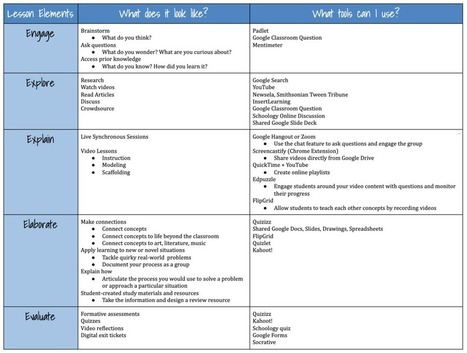
Covid 19 has educators and educational institutions worried about and preparing for possible school closures. What happens if students have to stay home for days or even weeks? How can we keep them learning remotely? What strategies and technology tools
Now that classes must be virtual zoom is a useful tool to hold important classes (Eg. when there is a new topic being introduced) its only downside is that you can hold mettings up to 40 minutes only with the free version, but there are ways to make those 40 minutes meaningful.
En raison du coronavirus, les institutions réfléchissent à des solutions pour permettre le bon fonctionnement des enseignements et des apprentisssages. Enseigner à distance s'impose comme une solution idéale, oui mais voilà, enseigner à distance est très différent d'enseigner en présence et on peut basculer d'un mode à l'autre du jour au lendemain. Pédagoscope en parle avec le Professeur Amaury Daele, de la Haute Ecole Pédagogique de Lausanne
Avec Twitter et Google Spreadsheet, identifier facilement les contenus les plus partagés et les comptes les comptes qui relaient le plus souvent vos articles.
Once upon a time, two teachers went together to an evening workshop on effective teaching strategies. The speaker was dynamic, her ideas were interesting, and everyone in the large audience enjoyed the speech. Afterwards, the two teachers drove back to the town where they lived. The driver talked excitedly with her friend about all the…
Réflexions concernant l'intérêt du concept de signal faible pour l'intelligence économique etqui s'appuie sur un article de Philippe Silberzahn et un seconde Camille Alloing et Nicolas Moinet.
AbstractThis reflection focuses on the position of distance education in today’s global higher education. Firstly, it identifies three types of convergence of distance and campus-based education
Fast, versatile, and engaging, micro-learning is an important trend in online education. This approach fragments information into "little bites" and can take now innovative forms to serve more structured online courses.
As universities respond to the COVID-19 outbreak by closing campuses and shifting to online forms of distance learning, many institutions and educators are scrambling to develop online engagement p…
Increasing access to information and communications technologies worldwide, along with the opportunities that they afford for learning and teaching, is changing the narratives of open and flexible learning. Two recent reports tracking the development of online and distance education in the United States suggest that while campus-based registrations are down overall, distance education enrolments are on the rise, with one in three students in the US higher education sector taking at least one online distance education course (Seaman, Allen, & Seaman, 2018; Legon, Gareett, & Fredericksen, 2019).
This picture is not that dissimilar in other developed as well as many developing countries. For instance, recent surveys of student access to information and communications technologies at the University of the South Pacific, which has fourteen campuses on very small island states of the southwest Pacific region, show that around 80% of its students have access to mobile devices such as laptops and smartphones along with reliable access to the Internet (Jione, Fong, & Naidu, 2019). Availability of this kind of infrastructure means that a wider range of students from high school graduates to those who are working fulltime can have access to educational opportunities. It also means access to flexible learning opportunities, and a chance to upskill and reorient while still in employment.
As a result, fewer and fewer students across the higher education sector, and around the world, are either studying or working at any one time. Instead, many are living their lives at the junction of multiple student identities, working and studying at the same time, and in search for a curriculum and qualification that will best meet their needs and career aspirations now and in the future. The implications of this kind of learning and teaching landscape for educational institutions are numerous. They include not only the
need for an understanding of contemporary learners and their learning contexts but also the design of a curriculum and its suitability for the complex learning environment that
To get content containing either thought or leadership enter:
To get content containing both thought and leadership enter:
To get content containing the expression thought leadership enter:
You can enter several keywords and you can refine them whenever you want. Our suggestion engine uses more signals but entering a few keywords here will rapidly give you great content to curate.


 Your new post is loading...