“The opening words of the United Nations Charter are: `We, the Peoples of the United Nations.’ This is the clearest possible statement that the United Nations does not belong to States alone. […] We live in an era in which international affairs are no longer dominated by States as the sole actors. The participants include non-governmental organizations, national parliaments, private companies, the mass media, universities, intellectuals, artists, and every woman and every man who considers him or herself to be part of the great human family.”
Secretary-General Kofi Annan
Messina, Italy, April 1997
What is an NGO?
A non-governmental organization (NGO) is any non-profit, voluntary citizens’ group which is organized on a local, national or international level. Task-oriented and driven by people with a common interest, NGOs perform a variety of services and humanitarian functions, bring citizens’ concerns to Governments, monitor policies and encourage political participation at the community level. They provide analysis and expertise, serve as early warning mechanisms and help monitor and implement international agreements. Some are organized around specific issues, such as human rights, the environment or health. Their relationship with offices and agencies of the United Nations System differs depending on their location and mandates.
Over 1,300 NGOs with strong information programmes on issues of concern to the United Nations are associated with the Department of Public Information (DPI), giving the United Nations valuable links to people around the world. DPI helps those NGOs gain access to and disseminate information about the range of issues in which the United Nations is involved, to enable the public to understand better the aims and objectives of the Organization.
How do NGOs and DPI cooperate?
The Department of Public Information and NGOs cooperate regularly. NGOs associated with DPI disseminate information about the UN to their membership, thereby building knowledge of and support for the Organization at the grassroots level. This dissemination includes, publicizing UN activities around the world on such issues as peace and security, economic and social development, human rights, humanitarian affairs and international law. Additionally, promote UN observances and international years established by the General Assembly to focus world attention on important issues facing humanity.
The NGO Relations Section within the Department of Public Information at the United Nations is the link with approximately 1,300 Non-governmental Organizations (NGOs) who are partners and members in association with the Department of Public Information and support the UN efforts to disseminate information on the priority issues on its agenda, including sustainable development, creating a safer and more secure world, the importance of prevention, helping countries in transition, empowering women and young people, and addressing poverty, among others.
Representatives of independent citizen organizations are increasingly active in policy making at the United Nations. These organizations - known at the UN as "non-governmental organizations" or "NGOs" - are often the most effective voices for the concerns of ordinary people in the international arena. NGOs include the most outspoken advocates of human rights, the environment, social programs, women's rights and more. This page links to information and analysis about NGOs at the UN and in global policy-making more broadly.Introduction to NGOsGPF Perspectives on NGOs
Are NGOs the "conscience of humanity" as UN Secretary General Kofi Annan has said, or are they unrepresentative and meddling elites as some critics like to argue?
NGOs finance their work through a variety of sources including membership dues, foundation and government grants, sales of services and business activities like credit cards, cruises and tee-shirt sales. How do funding sources influence NGO policy choices and public credibility?
This section discusses NGO access and physical participation in major UN organs such as ECOSOC, the General Assembly and the Security Council. It also covers speeches by the Secretary General and reports on NGOs.
NGOs face a perpetual struggle for access to UN bodies and meetings. This page follows NGO access issues and also includes in depth coverage of access to the Official Document System.
This section considers issues of accredited NGOs that challenge UN values and damage NGO reputation. It also considers problematic NGOs that seek accreditation or access to UN meetings and conferences.
This section looks at the challenges that NGOs face "in the field", providing humanitarian relief and development assistance in countries around the world.
The relationship between NGOs and states is linked to new issues in international law. Do NGOs threaten state sovereignty, or on the contrary are NGOs too weak and subordinate to more powerful forces in the international system?
The NGO Working Group on the Security Council brings together about thirty five major NGOs for an annual series of meetings with Council ambassadors and high-level UN officials. Since 1997, the NGO Working Group has provided this unique platform for NGOs to access the UN Security Council. As the Security Council's decisions affect nearly all NGO constituencies - including human rights, humanitarian relief, disarmament, governance, and the concerns of women and children - the Working Group works to maintain a diverse membership. Due in part to the diversity of its membership, the NGO Working Group as a whole does not undertake specific advocacy positions, but rather provides a forum for NGOs and members of the Security Council to come together to exchange information and build relationships for bilateral advocacy.
Currently, the NGO Working Group comprises about 37 members, and holds approximately 40-45 meetings per year with Council delegations and UN officials.
Secretariat Information
Joseph Donnelly, Caritas Internationalis, Chair
Renzo Pomi, Amnesty International, Vice Chair
Jelena Pia-Comella, Coalition for the International Criminal Court, Secretary
26 May-3 June: Committee on NGOs, 2015 Resumed Session
The 2015 Resumed Session of the Committee on NGOs is expected to consider new applications for status by NGOs as well as applications deferred from earlier sessions. It will also review quadrennial reports of NGOs in general or special consultative status. The Committee is expected to meet again on 12 June 2015 to adopt its report of the session. This session's recommendations will be sent to the Economic and Social Council for its approval in July 2015. More information: http://bit.ly/14ikmLrSee All Upcoming Events
New York 26 January - 04 February, 2015 The 2015 Regular Session of the Committee on NGOs will take place from 26 January to 4 February 2015. The session is expected to consider new applications for status by NGOs as well as applications deferred from earlier sessions. It will also review quadrennial reports of NGOs in general or special consultative status. The Committee is expected to meet again on 13 February 2015 to adopt its report of the session. This session's recommendations will be sent to the Economic and Social Council for its approval in April 2015. For updates on the event, click here.
IMPORTANT: - Please note that registration is now CLOSED. The deadline for registration was 12 January 2015.
- Please also note that there is a maximum of TWO representatives per organization. - No registration is required for organizations already in consultative status. - Only organizations with applications to be considered will be approved. Kindly refer to the information note document that is posted here.
Detailed Information
Date26 January - 04 February, 2015TimeLocationNew YorkOrganizerNGO Branch[ UN ENTITY ]External Link
Mr. Henry Ekwuruke, Executive Director of the Development Generation Africa International (DGAi) participated in the 2015 Regular Session, Committee on NGOs at the United Nations Headquarters in New York.He also participated in the 2015 ECOSOC Global Youth Forum #youth2015 as well as the 53rd Session of the Commission on Social Development, a youth meeting with the UN Secretary General Envoy on Youth on the post 2015 agenda and youth involvement, the launching of Building Bridges Initiative as well as UNCTAD event on Sovereign Debt Restructuring. Please sign in to Reply to this CommentbyShia Rights Watch Inc[NGO]
Henry Ekwuruke, Executive Director of the Development Generation Africa International (DGAi) and Olayinka Suleiman, Director of Communications will participate at the 2015 Regular session of the UN NGO Committee. Thank you Please sign in to Reply to this Comment
Mrs . Muna Rihani , Chairperson of the UNWomen For Peace, Association, will attend this 2015 regular Session of the NGO committee Please sign in to Reply to this Comment
28 April: ECOSOC civil society hearing on the longer-term positioning of the United Nations development system
The Economic and Social Council, pursuant to its resolution 2014/14 will convene a civil society hearing, with the participation of the representatives of NGOs in consultative status with ECOSOC, on the topic of “Longer-term positioning of the United Nations development system”. The hearing will be held on Tuesday, 28 April 2015, from 3:00 to 6:00 p.m., in Conference Room 3, at the United Nations Headquarters.
The hearing will provide representatives of civil society an opportunity to contribute to the ongoing ECOSOC dialogue on the longer-term positioning of the United Nations development system, taking into account the post-2015 development agenda, including the interlinkages between the alignment of functions, funding practices, governance structures, capacity and impact of the United Nations development system, partnership approaches and organizational arrangements.
The ECOSOC Dialogue process consisting of both formal and informal sessions held over an 18-month period, will serve as key input to the quadrennial comprehensive policy review (QCPR) of the General Assembly of operational activities of the UN system in 2016.
The QCPR is the mechanism through which the General Assembly assesses the effectiveness, efficiency, coherence and impact of the United Nations development system's support to national efforts of developing countries to pursue their priorities and meet their development needs. It establishes UN system-wide policy orientation for development cooperation and country-level modalities of the UN system in response to the evolving international development cooperation environment.
The most recent QCPR was conducted in 2012, culminating into the landmark General Assembly resolution 67/226. The QCPR replaced the TCPR.
As a policy instrument, the QCPR assesses and evaluates the implementation of policies established in relevant General Assembly and ECOSOC resolutions. It looks to the future, providing an opportunity to Member States and other stakeholders to engage in dialogue on how to adapt UN operational activities for development to the changing global development cooperation context.
The Secretary-General facilitates the QCPR process of the General Assembly by providing analysis on the implementation of existing policies through several methods: firstly, through surveys of programme country governments, UN resident coordinators and country team members, UN operations management teams at the country level and agency headquarters respectively; secondly, through a series of analytical studies on selected issues; thirdly, through desks review of relevant substantive areas; and, fourthly, through country visits to programme countries. Stakeholder consultations are also an integral part of the QCPR process.
ECOSOC Operational Activities for Development Segment
The next OAS segment will take place 23-25 February 2015 at the United Nations headquarters in New York.
20-24 April: 14th Session of the Committee of Experts on Public Administration (CEPA)
The 14th Session of the Committee of Experts on Public Administration of the United Nations Economic and Social Council (ECOSOC) will be held from 20 to 24 April 2015 at the United Nations Headquarters, in New York, United States of America. As approved by ECOSOC, the main issue for discussion will be “Building trust in government in pursuit of the sustainable development goals, what will it take?” The three sub-issues will be:
1. Redefining relationships and responsibilities to support participatory governance and responsive public service delivery, including through e-solutions; 2. Strengthening innovation, prioritization, informed decision-making and integration of policy development processes for enhanced impact; and 3. Promoting accountable institutions, ethical leadership and integrity to enhance confidence in efforts to deliver sustainable development.
Civil society hearing on the longer-term positioning of the United Nations development system
The Economic and Social Council, pursuant to its resolution 2014/14 will convene a civil society hearing, with the participation of the representatives of NGOs in consultative status with ECOSOC, on the topic of “Longer-term positioning of the United Nations development system”.
The hearing will be held on Tuesday, 28 April 2015, from 3:00 to 6:00 p.m., in Conference Room 3, at the United Nations Headquarters. Registration is not required for this civil society hearing. All NGOs in consultative status with ECOSOC are welcome to participate provided that they have a valid UN Grounds Pass. For information about requesting grounds passes please click here.
The hearing will provide representatives of civil society an opportunity to contribute to the ongoing ECOSOC dialogue on the longer-term positioning of the United Nations development system, taking into account the post-2015 development agenda, including the interlinkages between the alignment of functions, funding practices, governance structures, capacity and impact of the United Nations development system, partnership approaches and organizational arrangements.
The programme will be made available shortly on ECOSOC QCPR website. For additional information on the ongoing ECOSOC Dialogue on the longer-term positioning of the United Nations development system, please click here.
Economic and Social Council civil society hearing on the longer-term positioning of the United Nations development system – CALL FOR WRITTEN STATEMENTS
The Economic and Social Council, in its resolution 2014/14 of 14 July 2014, decided to convene a transparent and inclusive dialogue involving Member States and all relevant stakeholders on the longer-term positioning of the United Nations development system, taking into account the post-2015 development agenda, including the interlinkages between the alignment of functions, funding practices, governance structures, capacity and impact of the United Nations development system, partnership approaches and organizational arrangements.
Pursuant to ECOSOC resolution 2014/14, the Economic and Social Council, under the guidance of H. E. Ms. María Emma Mejía Vélez (Colombia), Vice-President of the Council, is convening a civil society hearing on the longer-term positioning of the United Nations development system on Tuesday, 28 April 2015, from 3:00 to 6:00 p.m., at the United Nations Headquarters.
The Office for ECOSOC Support and Coordination is pleased to announce an open call for written statements for the civil society hearing for NGOs in consultative status with ECOSOC. The deadline for written statements is 5:00 p.m. EST on 23 April 2015.
Redesigned multilingual UN portal launched - www.un.org
The new-look website has been completely redesigned and restructured resulting in a more intuitive, visually arresting and dynamic user experience that reflects a forward-looking United Nations in its 70th year. The website contains a wealth of information about the Organization, almost all of which is fully accessible for persons with disabilities.
The audience-driven taxonomy helps specific audiences such as delegates, journalists, the business community, the civil society, academia, students, job seekers and visitors to easily find links to relevant information with their own dedicated pages of resources. New sections such as ‘In Focus’, ‘In the Spotlight’ and ‘The UN System at Work’ promote the multifaceted work of the UN around the world and also enable the highlighting of prominent themes, events and personalities.
Third UN World Conference on Disaster Risk Reduction is a resounding success
On 18 March 2015, representatives from 187 UN member States adopted the Sendai Framework for Disaster Risk Reduction: 2015 - 2030, a far reaching new framework for disaster risk reduction with seven targets and four priorities for action and the first major agreement of the Post-2015 development agenda.
Margareta Wahlström, the Secretary-General’s Special Representative for Disaster Risk Reduction and the Head of the UN Office for Disaster Risk Reduction, said: “The adoption of this new framework for disaster risk reduction opens a major new chapter in sustainable development as it outlines clear targets and priorities for action which will lead to a substantial reduction of disaster risk and losses in lives, livelihoods and health.
“Implementation of the Sendai Framework for Disaster Risk Reduction over the next 15 years will require strong commitment and political leadership and will be vital to the achievement of future agreements on sustainable development goals and climate later this year. As the UN Secretary-General said here on the opening day, sustainability starts in Sendai.”
Over 6,500 delegates, including over 25 Heads of State, Vice Presidents, and Heads of Government, attended the intergovernmental and multi-stakeholder events and over 40,000 attended the public forum. In addition, 42 intergovernmental organizations, 236 non-government organizations, 38 UN entities; and over 300 private sector representatives were in attendance.
Informal briefings for non-governmental organizations in consultative status with the Economic and Social Council
There will be three consecutive informal briefings for non-governmental organizations in consultative status with the Economic and Social Council on Monday, 16 March 2015, at 3:00 p.m., in the Economic and Social Council Chamber.
The first will be a briefing by the Vice-President of the Council, Her Excellency María Emma Mejía Vélez (Colombia), on the Council’s ongoing dialogue on longer-term positioning of the United Nations development system, taking into account the post-2015 development agenda, including the interlinkages between the alignment of functions, funding practices, governance structures, capacity and impact of the United Nations development system, partnership approaches and organizational arrangements. The Vice-President will outline her vision for the ECOSOC dialogue and present its roadmap.
The second will be a briefing by the Vice-President of the Council, His Excellency Vladimir Drobnjak (Croatia), on the preparations for the Integration Segment to be held from Monday, 30 March, to Wednesday, 1 April 2015. The Integration Segment will consider the theme “Achieving sustainable development through employment creation and decent work for all”. The Segment aims to bring together Heads of States and Governments, ministers, the United Nations system, the tripartite constituents of the International Labour Organization, civil society and the private sector to focus on how the creation of good quality jobs could be a tool for promoting the economic, social and environmental dimensions of sustainable development, and to identify policy choices and possible trade-offs that could arise from an integrated approach.
The third will be a briefing by the Vice-President of the Council, His Excellency Mohamed Khaled Khiari (Tunisia), on the preparations for the Humanitarian Affairs Segment to be held from Wednesday, 17 June, to Friday, 19 June 2015, at United Nations Office in Geneva. Member States, UN agencies, humanitarian and development partners, civil society, the private sector and affected communities will discuss emerging and pressing humanitarian issues during two High-Level panel discussions, a Transition event, side-events and a humanitarian fair.
Committee on NGOs concludes its 2015 Regular Session on 13 February
The Committee on Non-Governmental Organizations today concluded its regular session with the adoption of its report, in which it recommended that the Economic and Social Council grant consultative status to 124 of the 330 applicants it considered during its session.
By the report, adopted without a vote, the Committee also recommended that the Economic and Social Council defer 176 applications for further consideration when it resumed its session, slated to be held in May, and close 29 applications after the non-governmental organizations in question had failed to respond to queries over two consecutive sessions. It also took note of one non-governmental organization that had withdrawn its application.
Among its other recommendations was that the Council grant two of the five requests for reclassification of consultative status, while taking note of five requests for a name change and also of 172 of the 210 quadrennial reports before it. It further took note of the requests from two non-governmental organizations to withdraw their consultative status. More information: http://www.un.org/press/en/2015/ecosoc6670.doc.htmSee All News
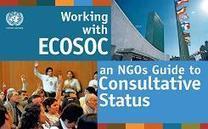
Working with ECOSOC" is an informational booklet that briefs Non-Governmental Organizations (NGOs) on the benefits of establishing a consultative relationship with ECOSOC, as well as to provide instructions on how to obtain this status within the framework provided by ECOSOC Resolution 1996/31.
The dual objective of this publication is to encourage relevant NGOs to apply for consultative status with the Council, as well as to help organizations already in consultative status to get the most of this relationship while increasing their contribution to the work of ECOSOC.
The booklet consists of 44 pages and provides basic information about the way in which NGOs can interact with the United Nations in general and with ECOSOC in particular. It describes the different formal and informal mechanisms that civil society can utilize in order to work with the different ECOSOC Commissions (i.e. attendance to meetings, submission of statements, side-events, oral interventions, etc.) as well as the obligations that NGOs assume by entering in this consultative relationship.
In a friendly language and modern tone, the booklet intends to show the multi-dimensional benefits of working with ECOSOC and how NGOs can maximize their contribution to the United Nations.
Welcome to CSONet.org, website of the UN-DESA NGO Branch. We service 4,045 non-governmental organizations (NGOs) in consultative status with the United Nations Economic and Social Council (ECOSOC) [list], and over 31,000 other NGOs working with the United Nations [search]. Information is currently available in English, French, Spanish and Arabic. Please also subscribe to our monthly email newsletter, DESA NGO News, available in English.
The NGO Working Group on UN-NGO Relations brings together key NGO representatives based at UN headquarters, including the leadership of the NGO-DPI Executive Committee, the Conference of NGOs in Consultative Relationship with the United Nations (CoNGO), and NGOs that have been active over many years on access issues. Founded in mid-2009, the Working Group advocates for a positive and open partnership between the United Nations and NGOs. The Working Group on UN Access brings together a number of active members with NGO participants in New York, as well as corresponding participants from other worldwide locations. The group addresses issues such as the accreditation process, NGO participation in UN meetings and conferences, and physical access to the Headquarters complex. The group has initiated several campaignsbetween the Working Group and UN officials on key NGO access issues. It maintains contact with a similar group in Geneva and other concerned NGOs worldwide.
The BJP Government action on Greenpeace India has raised quite a storm and now there is another crackdown. This time on NGOs receiving foreign funds as ...
4-15 May: 11th Session of the United Nations Forum on Forests (UNFF11)
According to resolution E/2000/35 that established the United Nations Forum on Forests (UNFF), the Forum is open to all States and operates in a transparent and participatory manner. The participation of a wide range of forest-related stakeholders is considered a key component of sustainable forest management. For this reason, the Forum welcomes the participation of the nine major groups as identified in Chapter 23 of Agenda 21. Major groups organizations that are accredited with the United Nations Economic and Social Council (ECOSOC) and the Commission on Sustainable Development (CSD) are encourage to participate in Forum Sessions.
The main theme of UNFF11 is entitled " Forests: progress, challenges and the way forward for the international arrangement on forests: (a) Reviewing the effectiveness of the international arrangement on forests (IAF) and consideration of all future options; (b) Reviewing the progress towards the achievement of the Global Objectives on Forests (GOFs) and the implementation of the non-legally binding instrument on all types of forests; (c) Reviewing the contribution of forests and the IAF, including the non-legally binding instrument on all types of forests, to the internationally agreed development goals.
As part of UNFF11, a Multi-Stakeholder Dialogue (MSD) will be held on Tuesday, 4 May 2015. This Dialogue will provide an opportunity for dialogue between member States of the Forum and representatives of major groups on the theme of UNFF11. More information: http://www.un.org/esa/forests/session.htmlSee All Upcoming Events
The United Nations Forum on Forests Secretariat DC2-2301, Two UN Plaza, New York, NY 10017, USA Tel: +1-212-963-3401 Fax: +1-917-367-3186 E-mail: Contact Us
27 April-22 May: 2015 Review Conference of the Parties to the Treaty on the Non-Proliferation of Nuclear Weapons (NPT)
The NPT is a landmark international treaty whose objective is to prevent the spread of nuclear weapons and weapons technology, to promote cooperation in the peaceful uses of nuclear energy and to further the goal of achieving nuclear disarmament and general and complete disarmament. The NPT represents the only binding commitment in a multilateral treaty to the goal of disarmament by the nuclear-weapon States.
Conferences to review the operation of the Treaty have been held at five-year intervals since the Treaty went into effect in 1970. Each conference has sought to find agreement on a final declaration that would assess the implementation of the Treaty’s provisions and make recommendations on measures to further strengthen it. More information: http://www.un.org/en/conf/npt/2015/See All Upcoming Events
The 2015 Review Conference of the Parties to the Treaty on the Non-Proliferation of Nuclear Weapons (NPT) will be held from 27 April to 22 May 2015 at UN Headquarters in New York. The President-designate of the Review Conference is Ambassador Taous Feroukhi from Algeria.
The NPT is a landmark international treaty whose objective is to prevent the spread of nuclear weapons and weapons technology, to promote cooperation in the peaceful uses of nuclear energy and to further the goal of achieving nuclear disarmament and general and complete disarmament. The NPT represents the only binding commitment in a multilateral treaty to the goal of disarmament by the nuclear-weapon States.
Conferences to review the operation of the Treaty have been held at five-year intervals since the Treaty went into effect in 1970. Each conference has sought to find agreement on a final declaration that would assess the implementation of the Treaty’s provisions and make recommendations on measures to further strengthen it.
The 2015 Review Conference is expected to consider a number of key issues, including: universality of the Treaty; nuclear disarmament, including specific practical measures; nuclear non-proliferation, including the promoting and strengthening of safeguards; measures to advance the peaceful use of nuclear energy, safety and security; regional disarmament and non-proliferation; implementation of the 1995 resolution on the Middle East; measures to address withdrawal from the Treaty; measures to further strengthen the review process; and ways to promote engagement with civil society in strengthening NPT norms and in promoting disarmament education.
Final Documents of the 2010 NPT Review ConferenceFinal Document - Volume I (NPT/CONF.2010/50 (Vol. I))
Part I — Review of the operation of the Treaty, as provided for in its article VIII (3), taking into account the decisions and the resolution adopted by the 1995 Review and Extension Conference and the Final Document of the 2000 Review Conference — Conclusions and recommendations for follow-on actions
Part II — Organization and work of the Conference
Final Document - Volume II (NPT/CONF.2010/50 (Vol. II))
Part III - Documents issued at the Conference
Final Document - Volume III (NPT/CONF.2010/50 (Vol. III))
Part IV - Summary records and list of participants
20 April-1 May: 14th Session of the Permanent Forum on Indigenous Issues
The fourteenth session of the Permanent Forum on Indigenous Issues will be held in UN Headquarters, New York from 20 April to 1 May 2015. This event is ONLY open to NGOs with ECOSOC Status, Accredited Indigenous Peoples Organizations (IPOs) and Academics to the Forum. More information: http://undesadspd.org/IndigenousPeoples/UNPFIISessions/Fourteenth.aspxSee All Upcoming Events
United Nations Permanent Forum on Indigenous Issues
Fourteenth Session of the Permanent Forum
The fourteenth session of the Permanent Forum on Indigenous Issues will be held in UN Headquarters, New York from 20 April to 1 May 2015.
Provisional Agenda (with Concept Notes to guide the discussions)
Election of officers
Adoption of the agenda and organization of work.
Follow-up on the recommendations of the Permanent Forum:
Outcome of the high-level plenary meeting also known as the World Conference on Indigenous Peoples; (Concept Note EN| ES | FR | RU)
Post-2015 development agenda; (Concept Note EN | ES| FR| RU)
Youth, self-harm and suicide (Concept Note EN | ES| FR | RU)
Half-day discussion on the Pacific region. (Concept Note EN| ES | FR | RU)
Half-day discussion on the expert group meeting on the theme “Dialogue on an optional protocol to the United Nations Declaration on the Rights of Indigenous Peoples”. (Report of the meeting AR | EN | ES | FR | RU | ZH)
Comprehensive dialogue with United Nations agencies and funds: Post-2015 Development Agenda, with special focus on Food, Hunger and Disease (Concept Note EN | ES | FR | RU)
Human rights with focus on Economic, Social and Cultural Rights: (Concept Note EN | ES | FR | RU)
Implementation of the United Nations Declaration on the Rights of Indigenous Peoples;
Dialogue with the Special Rapporteur on the rights of indigenous peoples and the Chair of the Expert Mechanism on the Rights of Indigenous Peoples.
Future work of the Permanent Forum, including issues of the Economic and Social Council and emerging issues. (Concept Note on Methods of Work of the Forum EN | ES| FR | RU)
Draft agenda for the fifteenth session of the Permanent Forum.
Adoption of the report of the Permanent Forum on its fourteenth session.
Message from the Expert Members of the Forum to Participants
Dear Participants,
Please draw your attention to the fact that this year's Forum session is primarily focused on the Reform of our Methods of Work.
In relation to our efforts to make the annual sessions more constructive and focused, we have prepared the following Concept Notes to draw your attention to specific topics and key questions related to four areas of focus for the Fourteenth Session.
We are especially keen to gain your Feedback & Ideas for Reform of the PFII. We respectfully request that you do not approach the Fourteenth Session in the same way that you may have engaged in previous sessions. We are genuinely trying to make the PFII a more effective mechanism within the UN system and request that you do not draft lengthy interventions for each item on the agenda and do your utmost on behalf of your respective constituency to remain focused on how to improve our overall work, both within and outside of the UN.
Therefore, please turn your thoughts and minds to two matters:
1. Feedback on how the Forum currently functions and operates;
2. Ideas for reform of Forum annual sessions; and
3. Constructive and substantive responses to the questions posed in the Concept Notes shown herein.
All interventions should be framed in light of the questions and ideas laid out in the following Concept Notes on the opening page of the PFII.
As you will see in the Program of Work for the Fourteenth Session, we have dedicated a majority of the morning and afternoon sessions to the topic of future work. We look forward to your innovative and creative ideas and proposals for reform. Thank you in advance for your cooperation.
Sincerely,
EXPERT MEMBERS OF THE PERMANENT FORUM ON INDIGENOUS ISSUES
Special event The Office of the Under Secretary-General for Economic and Social Affairs will hold an Interactive Dialogue on the follow-up to the World Conference on Indigenous Peoples on 22 April 2015, in Conference Room 4 from 3pm to 4.30pm. The meeting will be chaired by Mr. Lenni Montiel, Assistant Secretary-General for Economic Development in the Department of Economic and Social Affairs. Member States, indigenous peoples, representatives of United Nations bodies and specialized agencies, non-governmental organizations in consultative status and the academia attending the 14th session of the Permanent Forum on Indigenous Issues are invited to attend the dialogue. Participants are encouraged to provide inputs on the following:
-Development of a system-wide action plan “to ensure a coherent approach to achieving the ends of the United Nations Declaration on the Rights of Indigenous Peoples”. -Review of the mandates of existing UN mechanisms, in particular the mandate of the Expert Mechanism on the Rights of Indigenous Peoples, with a view to modifying and improving them to more effectively promote respect for the Declaration.
-Ways to enable the participation of indigenous peoples’ representatives and institutions in UN meetings relevant to them.
Media Backgrounders/Factsheets:
Indigenous Peoples and Post-2015 Development Agenda, with focus on Hunger and Disease (EN | ES | FR)
Economic, Social and Cultural Rights (EN | ES | FR)
Registration
The Registration Desk will be open on: Sunday, 19 April: 12 p.m. to 5 p.m. Monday, 20 April to Wednesday 22 April: 8.30 a.m. to 4 p.m. Thursday 23 April and for the duration of the Forum: 9 a.m. to 4 p.m. Please note: The Registration Desk will close each day from 1:00 p.m. to 2:00 p.m.
Online pre-registration has now closed.
For those who have preregistered, upon arrival at the United Nations Headquarters, representatives of indigenous peoples' organizations and non-governmental organizations (NGOs) requiring entry-passes for admission to the UN complex will be screened at the UN Visitors Entrance at 46th Street and 1st Avenue and then proceed to the registration desk to complete their registration and pick up their entry-passes. Remember to bring a printed copy of your confirmation letter and government ID, such as a passport or driver's license.
Registration open for the informal interactive hearings of the General Assembly in preparation for the United Nations summit for the adoption of the post-2015 development agenda
Registration IS NOW OPEN for the informal interactive hearings of the General Assembly with non-governmental organizations, civil society organizations, major groups and the private sector in preparation for the United Nations summit for the adoption of the post-2015 development agenda.
Please note that there are two registration pages – one for accredited NGOs and one for non-accredited NGOs.
Organizations with any of the following accreditation need to simply register, by clicking here: • Organizations with consultative status with ECOSOC; • Organizations on the Commission on Sustainable Development (CSD) Roster; and • Organizations accredited to the World Summit on Sustainable Development (WSSD).
Organizations that do not have one of these forms of accreditation need to apply for special accreditation, which involves two steps: • Completing a questionnaire by 5:00 p.m. EST on 29 April 2015 (click here); and • Completing the registration (click here).
Registration will remain open until 5:00 p.m. EST on 12 May 2015. Registration is limited to 6 representatives per organization. For further information please see the FAQ.
2015 ECOSOC High-Level Segment - Open Call for Oral and Written Statements (9 April - 27 April 2015)
The Office for ECOSOC Support and Coordination of the United Nations Department of Economic and Social Affairs is pleased to announce an open call for oral and written statements for the 2015 ECOSOC High-Level Segment (HLS) for NGOs in ECOSOC consultative status. The open call will be held from 9 April 2015 to 27 April 2015.
The theme for the 2015 session of the Economic and Social Council is “Managing the transition from the Millennium Development Goals to the sustainable development goals: what it will take”.
The HLS will be held from 6 July to 10 July 2015 at the United Nations Headquarters in New York. This is a unique opportunity for organizations in consultative status with ECOSOC - and for civil society at large - to be heard at ECOSOC deliberations, as well as to contribute to issues of critical concern to the global development agenda. It will also provide a platform to specifically address the transition to an ambitious, integrated, coherent, universal post-2015 development agenda through analysis and elaboration in terms of goals, policy choices, institutional adjustments and the assignment of roles and responsibilities among all partners.
The HLS will include the three-day ministerial meeting of the high-level political forum on sustainable development (HLPF), convened under the auspices of the Council, and the annual ministerial review. The theme of the 2015 HLPF “Strengthening integration, implementation and review - the HLPF after 2015” will provide an opportunity to advance the reflection on the elaboration of the overall framework to review and monitor progress on the post-2015 development agenda with the HLPF at its core.
Commission on the Status of Women concludes Fifty-ninth Session
The Commission on the Status of Women adopted a political declaration that strongly reaffirmed the landmark 1995 Beijing Declaration and Platform for Action, including by strengthening the involvement of civil society in the Commission’s work and by setting the tangible expiry date for gender inequality, with ministers’ pledges to take a number of concrete steps. Those included strengthening the implementation of laws, policies and strategies, increasing support for institutional mechanisms, addressing discriminatory norms and stereotypes and significantly raising investments for gender equality to close resource gaps.
The Commission took action on four draft resolutions, sending two texts — on working methods and on Palestinian women — to the Economic and Social Council. Among those texts, it approved, without a vote, a draft resolution on the future organization and methods of work of the Commission on the Status of Women (document E/CN.6/2015/L.5), by which, among other things, ECOSOCl would decide that the Commission’s annual session would include a ministerial segment to reaffirm and strengthen political commitment for the realization of gender equality and the empowerment of women and girls, as well as their human rights. The Commission also approved a resolution on the situation of and assistance to Palestinian women (document E/CN.6/2015/L.2), by a recorded vote of 27 in favour to 2 against (Israel, United States), with 13 abstentions.
14th session of the Committee of Experts on Public Administration Open Call for Oral and Written Statements (Deadline: 31 March 2015)
The Division for Public Administration and Development Management of the United Nations Department of Economic and Social Affairs is pleased to announce an open call for written statements for the 14th session of CEPA for NGOs in ECOSOC consultative status. The main item of discussion for CEPA this year is "Building trust in government in pursuit of the sustainable development goals, what will it take?" with sub-items: (1) Redefining relationships and responsibilities to support participatory governance and responsive public service delivery, including through e-solutions; (2) Strengthening innovation, prioritisation, informed decision-making and integration of policy development processes for enhanced impact; and (3) Promoting accountable institutions, ethical leadership and integrity to enhance confidence in efforts to deliver sustainable development. The 14th session will be held on 20-24 April at the United Nations Headquarters in New York. The submission of written statements on these issues is open through CSO-Net at http://bit.ly/1GrlUDd. Statements sent by e-mail cannot be accepted.
UN Women’s Fund for Gender Equality issues Call for Proposals
Innovative civil society initiatives seeking to spur women’s economic and/or political empowerment are invited to apply for funding. Interested applicants are encouraged to read the Call for Proposals and start preparing for the online application process that will open from 9 March to 5 April 2015. For more information please visit www.unwomen.org/FGE.
To know more about the Fund and the new Call you can participate in two events in New York:
Panel on "Civil Society at the Forefront of the Post-2015 Agenda" and official launching of the Call (17 March 2015 2015, 11.30am at the UN Secretariat, DHL auditorium - UN accreditation required for entrance)
Questions & Answers Session for Civil Society Organizations on how to apply to the Call for Proposals (18 March 2015, 2.30pm at the Church Center, 2nd Floor, 777 1st Avenue)
Committee on NGOs opens its 2015 Regular Session on 26 January
At the start of the meeting, the Committee adopted its agenda and programme of work (document E/C.2/2015/1). It elected by acclamation Jorge Dotta (Uruguay), on behalf of the Group of Latin American and Caribbean States as its Chair; and Farid Jabrayilov (Azerbaijan), on behalf of the Group of Eastern European States, and Forouzandeh Vadiati (Iran), on behalf of the Group of Asia-Pacific States, as Vice-Chairs.
Navid Hanif, Director of the Office for ECOSOC Support and Coordination in the Department of Economic and Social Affairs, said non-governmental organizations are increasingly sought out for their expertise and knowledge in shaping and implementing three major agreements: the post-2015 development agenda based on the sustainable development goals, a global agreement expected at the upcoming third International Conference on Financing for Development; and an agreement at the United Nations Climate Change Conference in December on measures to address climate change’s existential threat.
This session plans to consider a total of 177 new applications and 153 applications deferred from previous sessions, as well as 175 new quadrennial reports and 35 quadrennial reports deferred from previous sessions.
Please follow the steps below to complete your application for consultative status online.
1. Profile registration
Your organization must have a registered profile before starting the application for consultative status. Before registering your organization, please check first, if your organization has not already been included. Many organizations that have participated in United Nations sponsored conferences have been added to this database.
The profile registration will take about 10 minutes. Once completed, your profile will be reviewed by a substantive officer of our Branch. You will be informed by email when your registration has been accepted. It might take a few days for your profile to be approved. Please ensure that you do not submit your profile more than once.
As the next step, after you are notified that your profile registration was accepted, your organization has to submit the application, containing the online questionnaire and summary, and the supporting documents.
The online application form can only be accepted in the two UN Secretariat working languages: English and French. All required documents submitted excluding publications should also be translated in English or French. If a document is too long, a translated summary may be accepted. Before applying you may want to check out the questionnaire and some hints to fill it out.
Questionnaire of the Application for Consultative Status
Components of supporting documents are:
Copy of constitution/charter and/or statutes/by-laws and amendments to those documents (pursuant to paragraph 10 of ECOSOC resolution 1996/31).
Copy of certificate of registration. According to resolution 1996/31 an organization "should attest that it has been in existence for at least two years as at the date of receipt of the application by the Secretariat". Please provide a copy of the registration paper or, if your country does not require registration, please provide other proof of existence.
Copy of most recent financial statement and annual report.
Optional: Copy of examples of your publications and recent articles or statements.
Optional: Organization chart (if available).
Completed applications must be received by June 1st of the year before the NGO wishes to be considered for recommendation by the Committee. For example, complete applications (which include a completed questionnaire and all the required supporting documentation) submitted to the NGO Branch by 1 June 2015 will be taken up by the Committee on NGOs in the year 2016. Applications received between 2 June 2015 and 1 June 2016 will be taken up in the year 2017.
Click on the Consultative Status tab to start filling out the application form.
Supporting documents can be uploaded by using the Documents tab.
3. NGO Branch screening of applications
The period between 1st June and the date the Committee meets is dedicated by the NGO Branch to review the applications. During this time the NGO may be contacted and asked for more information or clarifications. Only after reviewed by an officer and considered complete, an application is submitted to the NGO Committee.
When an application becomes part of the agenda of the NGO Committee a letter is sent to the NGO informing them of the upcoming session and inviting to send no more than two representatives to be present during the session. The presence of NGO representatives in the room is in no way mandatory and it does not imply any advantages. NGOs simply have the right to be present when their applications are being considered. Considering the cost involved in traveling to New York most NGOs do not attend the first time they are being considered. If the application raises many questions from member countries and gets deferred to another session, NGOs might consider useful to be present at the following session in order to be able to reply in person and avoid being deferred again.
Among other requirements for obtaining consultative status are the following:
Applying organization's activities must be relevant to the work of ECOSOC;
The NGO must have been in existence (officially registered) for at least 2 years in order to apply;
The NGO must have a democratic decision making mechanism;
The major portion of the organization's funds should be derived from contributions from national affiliates, individual members, or other non-governmental components.
4. The Committee on Non-Governmental Organizations
The Committee meets twice a year to decide which NGOs applying for consultative status it will recommend to the ECOSOC Council. During its Session, the Committee may ask questions to the NGO. Such questions are sent to the NGO by the Secretariat and should be replied by the NGO as fast as possible in order to help the Committee make a decision and avoid getting deferred to future sessions.
The Committee Recommends
The Committee recommendations are published in a report and submitted to the next ECOSOC meeting for final approval. Official notification is sent to all reviewed NGOs, informing them about the Committee's recommendation.
The Committee may decide to defer an application review until the next session, pending clarifications and answers to questions asked to the NGO.
5. ECOSOC Final Decision When the Council finally approves the Committee recommendation to grant consultative status to an NGO, official notification is sent by the Secretariat. NGOs granted General or Special consultative status must submit to the Committee on Non-Governmental Organizations, every fourth year, a brief report of their activities, in particular regarding their contribution to the work of the United Nations (Quadrennial Report).
To get content containing either thought or leadership enter:
To get content containing both thought and leadership enter:
To get content containing the expression thought leadership enter:
You can enter several keywords and you can refine them whenever you want. Our suggestion engine uses more signals but entering a few keywords here will rapidly give you great content to curate.


 Your new post is loading...