Publication by our colleagues of the Open University. "Ad-hoc transient groups (AHTGs) seem to foster social capital on the level of relationship characteristics and mutual support. Results on sense of connectedness were inconclusive. It is concluded that AHTGs have a decentralising effect, making the network less dependent on a few key participants." Now my question is, within the Social capital way of thinking, whether connectedness is the key to long-term learning partnerships, or whether transience is an integral part of networked learning. In other words, what's the value of investing in long-term learning connections?
Quite interesting to see that you're investigating 'ad hoc' and 'transient' connections and end up with the question about lasting learning connections in networks. I guess that whenever the connections seem to outlast the fulfillment of primary short term goals and needs, network relations might transform to more 'community like' relations. This 'difference' in characterizing the relations does resonate with the gradual difference that Wenger, Trayner and De Laat make, when talking about networks and communities. And this difference can even be traced back to the way Howard Rheingold differentiated networks and communities.
With regard to the decentralising effect it could probably be interesting to investigate if this effect can be related to what Mejias calls paranodality, i.e. an effect residing in between nodes that can distort a nodocentric view or paradigm that is typical for the network. Mejias even states that paranodality is a necessity in order to prevent networks to turn into echo chambers, i.e. exert a nodocentric view. So not only the number of nodes that are influential might generate this decentralizing effect but probably also the paradigmatic 'space' between the nodes and paranodal tendencies of certain nodes.
Furhtermore I would like to point out the blogposts of Kai Pata, who is involved in the IST 7th Framework Learning Layers project, about differences between communities and networks and classical principles of CoP's (http://tihane.wordpress.com/).
Coming back to your questions about the 'value' of investing in long term learning connections. The answer may even be as simple as that people like to flock with like minded. The primary networkbased connection that was more 'object oriented' (the 'object oriented sociality' described by Knorr Cetina and elaborated by Engeström) can evolve to 'people oriented sociality' (can be traced back to Rheingolds concept of 'virtual community' and related to Jenkins' concept of 'participatory culture') were the 'learning' is more socially and culturally contextualised and determined and less professionally.
Paulo, it makes a lot of sense what your write. I have been thinking for several years already about i) how to differentiate communities and networks, ii) how to use these notions to describe the dynamics of online social networks. For me, but I don't think for Etienne Wenger, the network is the more encompassing entity, which consists of lots of partly overlapping communities. People constantly update their relationship with communities, strengthening or weakening the links with people in the communities. People in communities have a shared goal, and work together towards achieving that. Once that goal is reached, the community loses its function for them. Networks are not just collections of people who are organized in communities, they also are a valuable resource of people who could potentially become members of communities, helping to achieve the community's goal. I have never worked this out in full depth, however, the first attempt can be found here (http://hdl.handle.net/1820/1198). It is a paper given at a rather obscure conference in New Zealand, which is why it is difficult to access. I is called Fostering Sociability in Learning Networks through ad-hoc transient communities.
The most comprehensive case that has ever been made for why nearly everyone should become a polymath in a modern knowledge economy.
If being a generalist was the path to mediocrity, why did the most comprehensive study of the most significant scientists in all of history uncover that 15 of the 20 were polymaths? Newton. Galileo. Aristotle. Kepler. Descartes. Huygens. Laplace. Faraday. Pasteur. Ptolemy. Hooke. Leibniz. Euler. Darwin. Maxwell — all polymaths.
If being a generalist was so ineffective, why are the founders of the five largest companies in the world — Bill Gates, Steve Jobs, Warren Buffett, Larry Page, and Jeff Bezos — all polymaths (who also follow the 5-hour rule)? Are these legends just genius anomalies? Or are they people we could and should imitate in order to be successful in a modern knowledge economy?
While this article states that polymaths have a better chance of being relevant in the (near) future, and argues for avoiding too much specialisation, the author overlooks a number of things. (1) You will still need specialists to teach you about the domains that you want to combine as a polymath, (2) you can not go it alone. The author neglects the importance of collaborative learning, and the importance of a network of individuals working/learning together to overcome the barriers of disciplines.
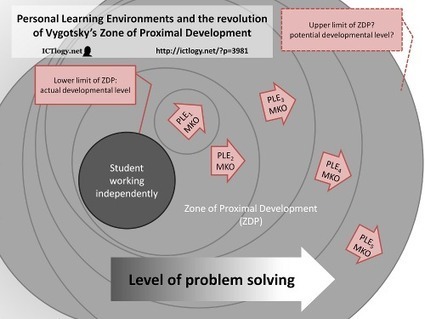
In other words, and summing up, I believe that it is likely that we see a decreasing need of instructors as more knowledgeable others in order to learn something, but an increasing need of instructors as more knowledgeable others in order to learn how to learn something. With Personal Learning Environments to cover the ground of one’s Zone of Personal Development, learning how to learn, how to design one’s own learning process may be more relevant than ever and require more help from third parties. This is, I think, the most promising future of teaching today.
David White (@daveowhite, http://twitter.com/daveowhite) of the University of Oxford explains how the Visitors and Residents model provides a framework to un... (RT @mhawksey: Looking for a framework to understand individuals' engagement with TEL?
David moves away from the digital native/immigrant discussion and suggests another lens for looking at differences in online network participation: are you more of a resident or more of a visitor? Very worthwhile.
Important quote: "And then there’s MOOCs. I can’t express adequately just how pissed off I am about MOOCs – not the concept, but all the hubris and nonsense that’s been talked and written about them. At a personal level, it was as if 45 years of work was for nothing. All the research and study I and many others had done on what makes for successful learning online were totally ignored, with truly disastrous consequences in terms of effective learning for the vast majority of participants who took MOOCs from the Ivy League universities. Having ignored online learning for nearly 20 years, Stanford, MIT and Harvard had to re-invent online learning in their own image to maintain their perceived superiority in all things higher educational. And the media fell for it, hook, line and sinker. This is a battle I no longer want to fight – but it needs fighting. [...] Lastly, I am concerned that the computer scientists seem to be taking over online education. Ivy League MOOCs are being driven mainly by computer scientists, not educators. Politicians are looking to computer science to automate learning in order to save money."
Lastly, I am concerned that the computer scientists seem to be taking over online education. Ivy League MOOCs are being driven mainly by computer scientists, not educators. Politicians are looking to computer science to automate learning in order to save money. - See more at: http://www.tonybates.ca/2014/04/15/time-to-retire-from-online-learning/#sthash.nbZTm0rt.9n4fINW3.dpufAnd then there’s MOOCs. I can’t express adequately just how pissed off I am about MOOCs – not the concept, but all the hubris and nonsense that’s been talked and written about them. At a personal level, it was as if 45 years of work was for nothing. All the research and study I and many others had done on what makes for successful learning online were totally ignored, with truly disastrous consequences in terms of effective learning for the vast majority of participants who took MOOCs from the Ivy League universities. Having ignored online learning for nearly 20 years, Stanford, MIT and Harvard had to re-invent online learning in their own image to maintain their perceived superiority in all things higher educational. And the media fell for it, hook, line and sinker. This is a battle I no longer want to fight – but it needs fighting. - See more at: http://www.tonybates.ca/2014/04/15/time-to-retire-from-online-learning/#sthash.nbZTm0rt.9n4fINW3.dpufAnd then there’s MOOCs. I can’t express adequately just how pissed off I am about MOOCs – not the concept, but all the hubris and nonsense that’s been talked and written about them. At a personal level, it was as if 45 years of work was for nothing. All the research and study I and many others had done on what makes for successful learning online were totally ignored, with truly disastrous consequences in terms of effective learning for the vast majority of participants who took MOOCs from the Ivy League universities. Having ignored online learning for nearly 20 years, Stanford, MIT and Harvard had to re-invent online learning in their own image to maintain their perceived superiority in all things higher educational. And the media fell for it, hook, line and sinker. This is a battle I no longer want to fight – but it needs fighting. - See more at: http://www.tonybates.ca/2014/04/15/time-to-retire-from-online-learning/#sthash.nbZTm0rt.9n4fINW3.dpufAnd then there’s MOOCs. I can’t express adequately just how pissed off I am about MOOCs – not the concept, but all the hubris and nonsense that’s been talked and written about them. At a personal level, it was as if 45 years of work was for nothing. All the research and study I and many others had done on what makes for successful learning online were totally ignored, with truly disastrous consequences in terms of effective learning for the vast majority of participants who took MOOCs from the Ivy League universities. Having ignored online learning for nearly 20 years, Stanford, MIT and Harvard had to re-invent online learning in their own image to maintain their perceived superiority in all things higher educational. And the media fell for it, hook, line and sinker. This is a battle I no longer want to fight – but it needs fighting. - See more at: http://www.tonybates.ca/2014/04/15/time-to-retire-from-online-learning/#sthash.nbZTm0rt.9n4fINW3.dpuf
The Architecture of Productive Learning Networks explores the characteristics of productive networked learning situations and, through a series of case studies, identifies some of the key qualities of successful designs. The case studies include networks...
Personal learning in networks is not easy, as it relies on self-organising your activities so as to maintain and grow your learning network. Organising, maintaining and growing non-personal open learning and knowledge networks takes a lot of more than just self-organisation, especially if you want the network to create value for its participants.
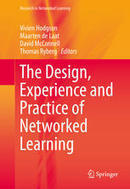
In the introductory chapter, we explore how networked learning has developed in recent years by summarising and discussing the research presented in the chapters of the book. The chapters are structured in three sections, each highlighting a particular aspect of practice. The first section focuses on the relationship between design and its influence on how networked learning practices are implemented. The second section extends this discussion by raising the notion of experiencing networked learning practices. Here the expected and unexpected effects of design and its implementation are scrutinised. The third and final section draws attention to a growing topic of interest within networked learning: that of networked learning in informal practices. In addition, we provide a reflection on the theories, methods and settings featured in the networked learning research of the chapters. We conclude the introduction by discussing four main themes that have emerged from our reading of the chapters and which we believe are important in taking forward the theory of networked learning. They are as follows: practice as epistemology; the coupling of learning contexts (the relationship and connection of learning contexts and spaces); the agency and active role of technology within networked learning; and the messy, often chaotic and always political nature of the design, experience and practice of networked learning.
Following on to the Networked Learning Conference 2012, selected papers have been upgraded and bundled into this interesting book, published by Springer. From practice to theory.
The paperback edition is now available from Lulu (where it will be printed on demand locally and shipped to your address). Price £15 + P&P Social Learning Handbook 2014: The Next Generation of ...
As usual, a nice piece of work by Jane Hart, bringing together her insights into Social Learning in the workplace, using online networks. Focus is on professional learning & development.
An interesting collection of 25 articles about content curation, selected and bundled by Robin Good, using the Gibbon platform. First exploration of the Gibbon platform.
This issue brings together five rather diverse papers focusing on the use of mobile and Web 2.0 technologies in an effort to engage learners. Two of the papers deal with messaging or response systems used by students in higher education, two papers deal with the use of (mobile) social media for professional development of teachers, and the final paper builds a theoretical model for Web 2.0-based workplace learning.
An interesting issue of Research in Learning Technology, containing results from two case studies of networked learning, and a theoretical model for the study of work-based professional development using Web2.0 tools.
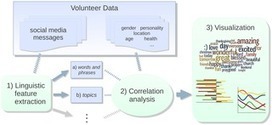
We analyzed 700 million words, phrases, and topic instances collected from the Facebook messages of 75,000 volunteers, who also took standard personality tests, and found striking variations in language with personality, gender, and age. In our open-vocabulary technique, the data itself drives a comprehensive exploration of language that distinguishes people, finding connections that are not captured with traditional closed-vocabulary word-category analyses. Our analyses shed new light on psychosocial processes yielding results that are face valid (e.g., subjects living in high elevations talk about the mountains), tie in with other research (e.g., neurotic people disproportionately use the phrase ‘sick of’ and the word ‘depressed’), suggest new hypotheses (e.g., an active life implies emotional stability), and give detailed insights (males use the possessive ‘my’ when mentioning their ‘wife’ or ‘girlfriend’ more often than females use ‘my’ with ‘husband’ or 'boyfriend’). To date, this represents the largest study, by an order of magnitude, of language and personality.
This is large scale! 75000 volunteers, 15.4 million Facebook messages. Interesting to see whether i can use their techniques for my own Facebook study (with 11000 messages).
If you're working in higher ed in the UK you will no doubt have seen that FutureLearn had its beta launch last week. Some disclosure - FutureLearn is owned by the OU & I've been partially involved in its development,...
If you ask me, this is the most sensible opinion / argument about the future of MOOCs that I have heard / read these past few weeks!
"But they haven't really fundamentally changed what we do in education, they've allowed new models and enhanced others." If we can reach a stage where the quality of e-learning and distance learning benefit from the MOOC hype, and - as Martin says - even a very small percentage of learners start a higher education degree after a positive MOOC experience, then MOOCs have been a worthwhile hype!
The entrance of Google onto the Massive Open Online Courses market this week has the potential to reignite the spirit of openness that saw these alternative routes into higher education emerge in the first…...
Interesting thought piece by Martin about where MOOCs are headed. The last few weeks I have attended a number of workshops and conference sessions discussing the future of MOOCs, and one thing has become clear: MOOCs at least stir up the world of online and distance learning, and bring a lot of attention to pedagogy.
Trends in digital technologies and new social practices are calling for innovative models of learning in education. A recent development in the learning sciences, which conceptualises learning activity as networked learning, can offer deeper insight into how digital learning spaces influence the ensuing activity of learners. The networked approach coupled with social semiotics is applied in the analysis of Peep – a computer-based platform with social networking features that supports an undergraduate design course. This article illustrates how the networked learning approach and social semiotics reveal elements of the platform that enable design learning and foster social connections amongst students and lecturers. The article also examines the distribution of students’ activity and changes in their patterns of interaction over time.
Learning as an inherently social activity, through novel ways of connecting with people around the globe. Learning in groups vs. networks vs. sets vs. collectives. Definitely worth a read. Freely available as usual from AU Press.
His work around the study of social and cognitive presence in distance learning contexts has been cited many times, and his research has led to a number of high profile keynote speech invitations around the globe. We are delighted that Terry will be delivering a keynote speech at this year's European Distance and E-Learning Network (EDEN) Conference in Zagreb in June.
One of the pioneers of distance and online learning, interviewed by one of the current figure heads of innovative teaching and learning. Always a delight to read!
As a part of Open Education Week 2014, Professor Gráinne Conole and I plan to hold a webinar (details to be announced shortly; watch this space) on the topic of A Pedagogical Look at MOOCs. This we...
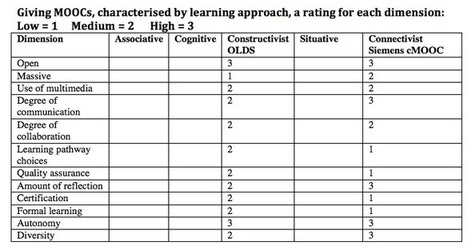
Interesting MOOC classification attempt by @Grainne Conoleand @Terese Bird. Worth looking into. Wonder if it can be extended to online learning in general.
Good to read some figures on Distance learning in the UK. Important quote at the end: "The opportunities to democratise education are enormous. But given that providers do not have a business model through which they can make money from free courses, it may not be the death of distance learning just yet."
Good to read some figures on Distance learning in the UK. Important quote at the end: "The opportunities to democratise education are enormous. But given that providers do not have a business model through which they can make money from free courses, it may not be the death of distance learning just yet." Thx for this short summary @Steven Verjans
Over the last decade online education has emerged as a way for students and faculty to collaborate more freely, attain greater flexibility, and utilize new media to learn. The burning debate lies in whether online educational options are harmful to traditional education or offer endless benefits necessary to accommodate a 21st century learner. Supporters of virtual learning environments suggest that 21st century learners require the construction and creation capabilities offered through Web 2.0 to succeed while critics suggest that asynchronous interactions are not engaging and rigorous enough for higher education. A balanced online environment should provide a blend of both asynchronous and synchronous opportunities, which promote communication and collaboration among classmates and instructors.
An interesting article by Sarah Reese, in which she discusses benefits and drawbacks of the current online education hype, and suggests requirements for the virtual learning environment in modern higher education. Not really evidence-based, but a good argumentation nevertheless.
El aprendizaje en los EVA de la educación superior, parece proponer este libro, debe combinar interacciones sincrónicas y asíncronas. En conjunto logran el compromiso y la profundidad requeridas.
Corinne Weisgerber, professeure associée à l'université St Edwards au Texas.A l'heure où l'utilisation des médias sociaux fait partie des pratiques quotidiennes des étudiants, on peut se poser la question de la place qu'ils pourraient occuper...
For the French-speaking part of the world, this recorded lecture by Corinne Weisgerber in Paris on how to set the example (as a teacher) of using social media in higher education and beyond. Interesting as always!
The annual NMC Horizon report preview for 2014 is out, listing 6 key trends accelerating EdTech, 6 significant challenges impeding EdTech adoption, and 6 important developments in EdTech, for the short, middle and long term horizon.
Usually I look in detail at the technologies predicted to become important, but this year I find the trends and challenges that the report identifies more interesting. I find that predicting technological development is much less useful, than looking at trends and challenges in the environment. Technology prediction is iffy at best.
Trends accelerating Educational Technology in HE for short, medium and long terms described. Also challenges for Educational technology adoption in HE, urgent, difficult and wicked. Finally, developments in Educational Technology, adoption in one year, 2-3 years and 4-5 years are summed up.
For 2014 this means:
Accelerating trends: Online, hybrid, and collaborative learning and Social media use in learning;
Challenges: Low digital fluency of faculty and Relative lack of rewards for teaching
Developments: Flipped Classroom and Learning Analytics
"The challenge [in Personal Knowledge management] is to find something that works for you and will last over time. This is probably the biggest hurdle in PKM."
Hybrid Pedagogy is an academic and networked journal of learning, teaching, and technology that combines the strands of critical pedagogy and digital pedagogy to arrive at the best social and civil uses of technology and digital media in education.
To get content containing either thought or leadership enter:
To get content containing both thought and leadership enter:
To get content containing the expression thought leadership enter:
You can enter several keywords and you can refine them whenever you want. Our suggestion engine uses more signals but entering a few keywords here will rapidly give you great content to curate.




 Scoop.it!


 Your new post is loading...































With regard to the decentralising effect it could probably be interesting to investigate if this effect can be related to what Mejias calls paranodality, i.e. an effect residing in between nodes that can distort a nodocentric view or paradigm that is typical for the network. Mejias even states that paranodality is a necessity in order to prevent networks to turn into echo chambers, i.e. exert a nodocentric view. So not only the number of nodes that are influential might generate this decentralizing effect but probably also the paradigmatic 'space' between the nodes and paranodal tendencies of certain nodes.
Furhtermore I would like to point out the blogposts of Kai Pata, who is involved in the IST 7th Framework Learning Layers project, about differences between communities and networks and classical principles of CoP's (http://tihane.wordpress.com/).
Coming back to your questions about the 'value' of investing in long term learning connections. The answer may even be as simple as that people like to flock with like minded. The primary networkbased connection that was more 'object oriented' (the 'object oriented sociality' described by Knorr Cetina and elaborated by Engeström) can evolve to 'people oriented sociality' (can be traced back to Rheingolds concept of 'virtual community' and related to Jenkins' concept of 'participatory culture') were the 'learning' is more socially and culturally contextualised and determined and less professionally.