


Heutagogy and lifelong learning: A review of heutagogical practice and self-determined learning...

Networked learning
4.7K views |
+0 today
News, posts and research on networked learning (for professionals). A topic co-curated with OUNL Professor Peter B. Sloep.
Curated by
Steven Verjans
 Your new post is loading...
 Your new post is loading...
Your new post is loading...
 Scoop.it!

How Personal Learning Networks meet Professional Development. Now, Professional Development needs to change to accommodate a new kind of learning journey that participants are on: ...

Scoop.it!
Elements of Connectivism Stephen Downes CMC11 - SUNY Empire State College September 22, 2011 (Check out this SlideShare presentation http://t.co/FQr2pw9f) #evomlit... Via Vasi Doncheva
Scoop.it!
Interesting summary presentation by George Siemens Presented to American University, January 2012. Gives a nice overview of trends shaping (higher) education and learning.
Scoop.it!

Based on a selection of the most relevant and high quality research papers from the 2010 Networked Learning Conference, this book is an indispensible resource for all researchers, instructional designers, program managers, and ...
Scoop.it!

MIT has been doing online access to education a lot longer than most people, largely due to their invaluable OpenCourseWare project. (Here’s an interview MIT did with me last year on how OCW strongly influenced my inverted-classroom MATLAB course.) Now they are poised to go to the next level by launching an online system called MITx in Spring 2012 that provides credentialing as well as content. Via Smithstorian
Scoop.it!
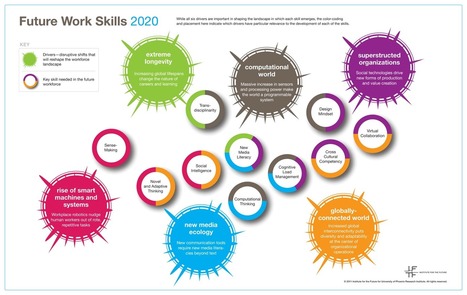
Inter-, multi-, trans- -disciplinary, -cultural, -media : Future work skills are all about crossing borders and boundaries. Pity that current organisations and institutions still stick to their borders so much.
Scoop.it!
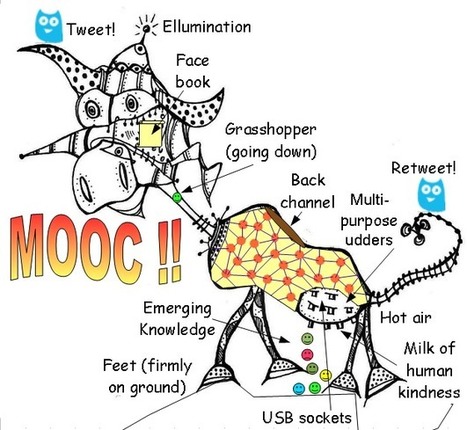
An interesting reflection on sensemaking artefacts, this blogpost also contains some valuable views on the future trends in education.
Scoop.it!
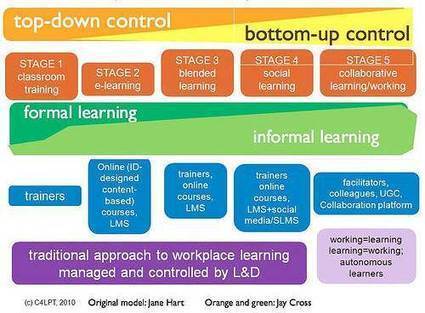
This revisited 5-stage model is an interesting perspective on current trends in Social Workplace Learning. If you add the Social Intranet diagram to this, you get a model that organisations can use to position themselves and develop from there.
Scoop.it!

Principles of networked learning, constructivism, and connectivism inform the design of a test case through which secondary students construct personal learning environments for the purpose of independent inquiry. Emerging web applications and open educational resources are integrated to support a Networked Student Model that promotes inquiry-based learning and digital literacy, empowers the learner, and offers flexibility as new technologies emerge. The Networked Student Model and a test case are described in detail along with implications and considerations for additional research. The article is meant to facilitate further discussion about K-12 student construction of personal learning environments and offer the practitioner a foundation on which to facilitate a networked learning experience. It seeks to determine how a teacher can scaffold a networked learning approach while providing a foundation on which students take more control of the learning process. Via Paulo Simões, Jim Lerman
Scoop.it!
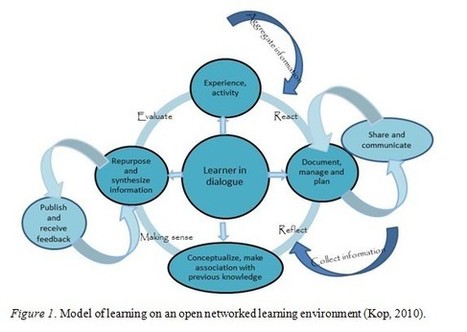
This paper examines how emergent technologies could influence the design of learning environments. It will pay particular attention to the roles of educators and learners in creating networked learning experiences on massive open online courses (MOOCs). The research shows that it is possible to move from a pedagogy of abundance to a pedagogy that supports human beings in their learning through the active creation of resources and learning places by both learners and course facilitators. This pedagogy is based on the building of connections, collaborations, and the exchange of resources between people, the building of a community of learners, and the harnessing of information flows on networks. This resonates with the notion of emergent learning as learning in which actors and system co-evolve within a MOOC and where the level of presence of actors on the MOOC influences learning outcomes.
Scoop.it!
An introduction in the world of Social Network Analysis and a view on how this may help learning networks.
Scoop.it!

Siemens, G., & Conole, G. (Eds.) (2011) Connectivism: Design and Delivery of Social Networked Learning. International Review of Research in Open and Distance Learning, 12 (3). Editorial.
|
Scoop.it!

This qualitative phenomenological study involving in-depth interviews with seven educators in K-12 and higher education examines the role that the microblogging service Twitter plays in the formation and development of Personal Learning Networks (PLN) among educators. A double hermeneutic data analysis shows that Twitter plays a role in the formation and development of PLNs by allowing educators to; engage in consistent and sustained dialogue with their PLN, access the collective knowledge of their PLN, amplify and promote more complex thoughts and ideas to a large audience, and expand their PLN using features unique to Twitter. This research also examines the nature of a PLN and shows that participants believe their PLN extends beyond their Twitter network to encompass both face-to-face and other ICT mediated relationships. Secondary research questions examine how Twitter differs from other social networking tools in mediating relationships within a PLN, what motivates an educator to develop a PLN, how trust is established in a PLN, what the expectations of reciprocity are within a PLN, and what is the nature of informal learning within a PLN. Via Let's Learn IT
Scoop.it!
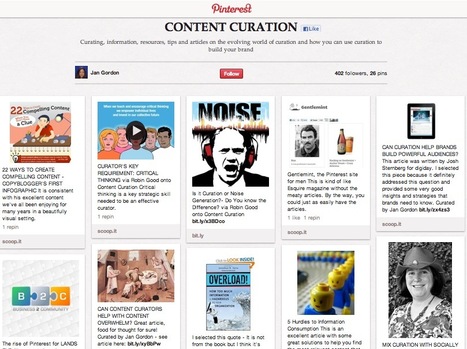
Jan Gordon: This is a post after my own heart, brought to my attention by gdecugis, thanks Guillaume, you know I love Scoopit, glad to spread the word about this winning duo, Pinterest and Scoopit.
Feel free to visit my other topic, Pinterest Watch to learn more about this social network
Here's my commentary based on my experience of using Scoopit and Pinterest
To me, Pinterest and Scoopit go hand and hand. They are both visual and it's important to consider if you're on Scoopit already or thinking about it, expressing yourself on both platforms, (if it makes sense for your business) because it can be very powerful.
Here are some of the reasons it can help your business:
Scoopit is a platform that showcases your expertise, share your hobbies and other interests through content in a beautiful format. It is part of your online personna and it's a vibrant community I have met some wonderful people here.
Pinterest is also a community with some of the same people from Scoopit and many others, (new people are joining everyday). Linking your posts from Scoopit to your pins on Pinterest not only drives traffic to your scoopit site and visa versa but those people can see another side of you that you can't express there.
Pinterest is like a delicious menu of visuals that captivate and attract people to you. I have put all my business boards at the top and my interest boards underneath them.
Pinterest gives people the ability to see who you are beyond your posts. If you're a brand, this is where you can create an online story of text and visuals that gives consumers points of entry through common interests. It's a brilliant way to do business.
I could go on and on but I'll let you see for yourself how I've combined Scoopit and Pinterest together which continues to produce unbelievable results, increase in traffic and brand new relationships from both sites.
Commentary by Jan Gordon covering "Pinterest Watch"
See my pinterest site here: [http://pinterest.com/jangordon/] - Click on the images and they lead you right back to my Scoopit topics.
Read post here: [http://blog.scoop.it/en/2012/02/24/you-can-now-share-your-scoops-on-pinterest/] Via janlgordon, Robin Good

Otir's comment,
February 25, 2012 11:25 AM
Great insight, thank you! In the constant stream of innovations - sometimes fads too - it is comforting to find complete write-ups that give enough "meat" to what is going on online, and why some tools get traction.

Beth Kanter's comment,
February 25, 2012 1:32 PM
Jan, thanks for bringing G's post to our attention. I'm excited about the combination of the two tools like you are! And thanks for including me in your collection!
Scoop.it!
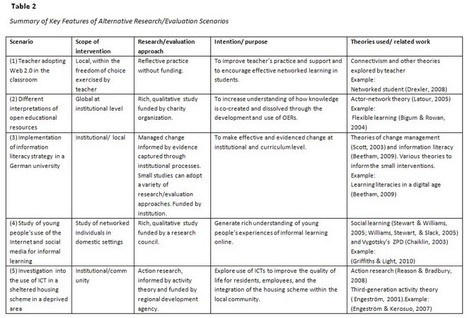
IRRODL: Connectivism: Its place in theory-informed research and innovation in technology-enabled learning. Via Dr. Susan Bainbridge
Scoop.it!

Curation vs. Aggregation? Curation is such a necessity these days. The overwhelming wave of information we are exposed to is drowning us in facts and opinion. Not only do we need to be curating the information that we are consuming but we need to be insisting that our students have the skills and necessary tools in which to curate their own world. I have listed a number of capable curation apps that can help to do just that. I tend to use more than one of these and in fact there are days that I would use three or four. Have a look at the ones that might feel right for you. I have a soft spot for Flipboard but only because it was the tool that first opened my eyes to the potential of the iPad in a classroom - I used it as a twitter fed "further reading" text for a senior art class. Enjoy!
<- a few new ones for me. I wonder if this could be part of a Service pack for teachers when they are issued with an iPad, or their iPad apps are updated. (JS) Via catspyjamasnz
Scoop.it!
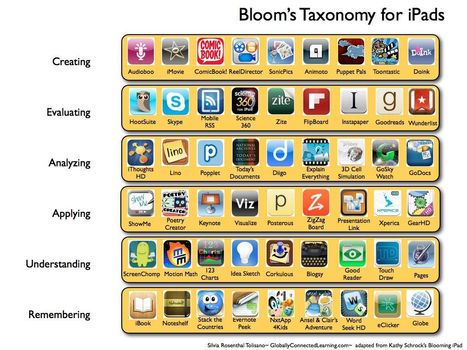
Check this interesting graphic that actually places example iPad applications into Bloom’s levels of performance in the cognitive domain.
Via Cornélia Castro
Scoop.it!

By Melissa Venable As an online instructor you may already be involved in some social networking efforts though sites such as LinkedIn. There is value in building your own personal learning network as you advance ...
Via juandoming
Scoop.it!

Imagine a scenario where predictive analytics from a networked learning system can point to unnoticed trends in student study patterns. A subject with a high failure rate, like College algebra, can be taught over a networked ...
Scoop.it!
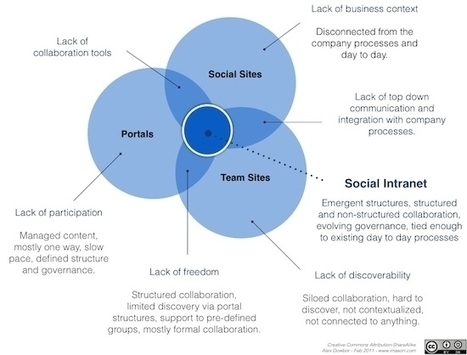
Social intranet is a hot topic. With the rise of social software, the next step to the enterprise social nirvana is the intranet. Through this article about social intranets I stumbled upon a number of interesting thoughts about internal networked learning. I especialy like the first diagram about "Social Intranet, The Intersection Diagram".
Scoop.it!

Interesting blogpost by Tony Bates in which he looks back on e-learning in 2011.
Via Rose Leighton
Scoop.it!

Using mLearning and MOOCs to understand chaos, emergence, and complexity in education...
Scoop.it!

One 'well-known' type of networked lifelong learning is a MOOC, a massive open online course, such as the ones hosted by Stephen Downes, George Siemens and Dave Cormier. In this blogpost you can find Stephen's response to the OPAL questionnaire.
Scoop.it!

... In conclusion, PLE, PLN, Do it yourself and online education via various means like MOOC have their own merits and limitations, and it would be important to question the assumptions behind each model of education and learning, in order to match the needs and expectations of BOTH educators and learners.
Learning in a landscape of practice or networks of practice is both challenging and rewarding, though, each promise comes also with basic questions: Is this sort of learning valued by the learners? Is it an effective way of learning? How? and Why? Research and continuous exploration through experimentation and application would likely provide the answer to the question of: What is knowledge? What is learning? And how does it occur at this digital age. Via Mohsen Saadatmand, Paulo Simões, Steve Wheeler
|





