If you need to de-stress, you could add some cardio, try meditation — or move to Hawaii.

 Your new post is loading...
 Your new post is loading...
Your new post is loading...
 Scoop.it!
If you need to de-stress, you could add some cardio, try meditation — or move to Hawaii. 
No comment yet.
Sign up to comment
Scoop.it!

21habit.com is a simple tool that helps you make or break habits. Pick a habit you want to make or break. Check-in every day for 21 days. Enjoy your success.
Beth Kanter's insight:
Help break that bad habit
Scoop.it!

From
hbr

A clear head produces the best insights. But it's a challenge to take time off in the midst of a busy day to rest your brain. Here are three easy ways to build breaks into your day:Meditate on...
Scoop.it!
TAGtivate is a startup that simplifies content browsing on the world wide web. Browse and share the content you want by taking advantage of the power of hash... Via Robin Good

Beth Kanter's comment,
January 30, 2013 9:54 PM
Okay, was all excited thinking I could sign up and play with the tool, but looks they haven't launched yet...

Robin Good's comment,
January 31, 2013 2:19 AM
Hi Beth, you are right. I understand. Go get excited though with Scoopweb, I think you will truly enjoy that one.
Scoop.it!
Research shows that obstacles boost your brainpower.
Beth Kanter's insight:
An intelligent constraint informs creative action by outlining the "sandbox" within which people can play and guides that action not just by pointing out what to pursue but perhaps more importantly what to ignore. The pressing question for managers here is this: Are constraints preventing or propelling your innovation efforts? There is only one right answer.
Scoop.it!
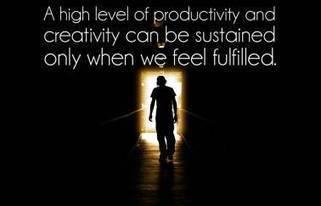
Contradictory to what you might think, productivity and creativity may ruin your life if you sacrifice the things that fill you with strength.
Scoop.it!
"The process of combining more primitive pieces of information to create something more meaningful is a crucial aspect both of learning and of consciousness and is one of the defining features of human experience. Once we have reached adulthood, we have decades of intensive learning behind us, where the discovery of thousands of useful combinations of features, as well as combinations of combinations and so on, has collectively generated an amazingly rich, hierarchical model of the world. Inside us is also written a multitude of mini strategies about how to direct our attention in order to maximize further learning. We can allow our attention to roam anywhere around us and glean interesting new clues about any facet of our local environment, to compare and potentially add to our extensive internal model." Via Howard Rheingold

luiy's comment,
January 30, 2013 11:49 AM
What makes the difference, Bor argues, is a concept called chunking, which allows us to hack the limits of our working memory — a kind of cognitive compression mechanism wherein we parse information into chunks that are more memorable and easier to process than the seemingly random bits of which they’re composed.

wayne_b's curator insight,
February 6, 2013 10:58 AM
It is the process of combining various pieces of information to create something new and more meaningful - that is our learning process. As we combine information from one person or site, and add the thoughts of someone else, that we generate new ideas or expressions of those combined thoughts.
Scoop.it!
Beth Kanter's insight:
I disagree with this. I use both methods for note taking, but taking handwritten notes help me because I get another chance to reflect on what was discussed.
Scoop.it!

If you want to become more organized in the New Year, a long list of tasks isn't going to help. Instead try these three targeted lists.Get the latest...
Beth Kanter's insight:
Love the "Not to do" list. Good idea
Scoop.it!

Ever wonder why you feel the need to make a to-do list and then just lose or ignore it? Psychologists have an answer that can help you be more productive.
Beth Kanter's insight:
Some interesting informationa bout why we make to-do lists. Does not provide a solution or tip to making to do lists and ignoring them.
Scoop.it!
Beth Kanter's insight:
Brian Solis shares his thoughts about multi-tasking multi-screen audiences and summarizes this report from Google “The New Multiscreen World” that reveals the extent of cross platform consumer behavior. Summary: Consumers are incredibly connected and their attention can only be described as fragmented as best.. As they multi-task and multi-screen, new touchpoints emerge for engagement. Google refers to these new touch points as “found time.” These micro-moments emerge as consumers see or think of something something and reach for the screen that’s closest to them to search. Google found that consumers use these micro-moments across multiple screens to search, shop, communicate and keep entertained….spontaneously. This offers advertisers net additional opportunities to engage consumers throughout the day in ways that are contextually relevant to each screen.
|
Scoop.it!

Toilet paper still can’t be digitized, but these days two-ply may be the only printed matter still welcome in the bathroom. A place for your iPad when you’re on the pot.
Beth Kanter's insight:
This isn't as bad as checking your mobile phone in the bathroom, but another piece of evidence that the Internet is continuing to have a dramatic impact on our daily lives. More research on bathroom and technology: Plus, a 2011 survey by Staples Advantage, a division of the office-supply giant, found that 35% of tablet owners brought their tablets into the bathroom. That’s more than those who brought them into restaurants (30%), though not as much as those who brought them into the bedroom (78%). Either way, Staples exec Ed Ludwigson said the surveys showed that tablets “offer fantastic convenience.” Of course, if iPad fans don’t want to pay for a $100 bathroom stand, they have alternatives. On Apple and furniture-related message boards, iPad users boast of their homemade solutions for bathroom reading. Said one member of the MacRumors.com community: “I hot glued some small pieces of wood together to make a stand that holds the iPad at the perfect angle.”
Scoop.it!
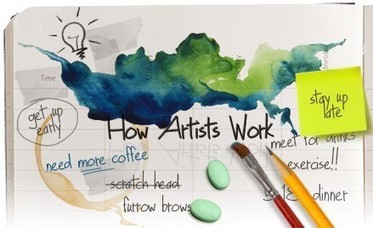
About six years ago, I started collecting any information I could find about the daily routines of writers, artists, and other creative people—first for a blog that I ran for a couple of years, and then for a book that, I'm pleased...
Beth Kanter's insight:
Given how much time I've spent reading and thinking about artists' schedules and working habits, you might expect that I would have some insight into what makes for an ideal daily routine. Is there some combination of sleep, work, exercise, coffee, and focused head-scratching or brow-furrowing that is most likely to lead to creative breakthroughs? Or, at the very least, are there some basic guidelines that will stave off blocks and guarantee a minimum level of intellectual output? Short answer: no, not really. The one lesson of the book is that there is no one way—the rituals and habits that helped Artist A create a masterpiece would never work for Artist B; and, actually, they might not even work for Artist A for very long.
Scoop.it!
Beth Kanter's insight:
Some basic getting stuff done advice.
Scoop.it!
Multi-tasking can be done effectively if it involves simple tasks that operate on completely different channels in our brain. For example, listening to the news while folding laundry. Via Howard Rheingold

Howard Rheingold's curator insight,
March 27, 2013 10:38 PM
"Task-layering" appears to be a kind of multi-tasking that works -- as opposed to the kind that degrades performance on each of the tasks we try to accomplish simultaneously. 
Peter Skillen's curator insight,
April 2, 2013 7:52 AM
What I find interesting is the work Benjamin Bergen describes in Louder Than Words. http://www.louderthanwordsbook.com/ People often ask can we multitask as if there is a 'yes' or 'no' answer. Clearly, situations matter. Bergen points to research that suggests if we visualize or imagine certain activities - like hitting a baseball - the same regions of the brain are activated and engaged as if we were actually hitting that baseball. So even though we might expect the visual region to light up because we are 'seeing' something in our mind's eye, it is actually a motor region that is engaged. This, therefore, impacts our multitasking abilities for another 'motor' task. --> I love the rich texture of these ideas.
Scoop.it!
![Send Personalized Emails using Mail Merge in Gmail [Video Tutorial] | Practical Networked Leadership Skills | Scoop.it](https://img.scoop.it/GQdOEsOYqGpMpTOseHIWcTl72eJkfbmt4t8yenImKBVvK0kTmF0xjctABnaLJIm9)
Learn how to send personalized email messages in bulk using mail merge in Gmail. You can even send rich HTML emails with attachments as well.
Scoop.it!
Howard Rheingold's curator insight,
February 5, 2013 11:04 PM
Gmail extensions can be infotention tools -- the mental part of how you use the tool in relation to your attentional habits is always an essential part of the equation.
Beth Kanter's comment,
February 6, 2013 8:37 PM
Boomerang has saved my life .... I use it to schedule emails and it is extremely useful.

Acid42's comment,
February 12, 2013 3:59 AM
Good article. I'll try TaskForce myself and see how it goes.
Scoop.it!

Your time is limited. This is a basic fact we all know, but why are there some people in the world who manage to get their things done quickly and efficiently?
Scoop.it!

On lots of platforms? You're probably creating mediocre content.
Scoop.it!
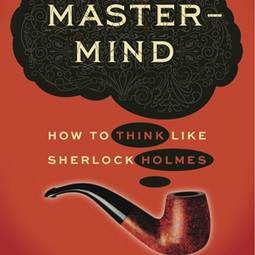
“The habit of mind which leads to a search for relationships between facts,” wrote James Webb Young in his famous 1939 5-step technique for creative problem-solving, “becomes of the highest importance in the production of ideas.”But just how does one acquire those vital cognitive customs? That’s precisely what science writer Maria Konnikova explores inMastermind: How to Think Like Sherlock Holmes (UK; public library) — an effort to reverse-engineer Holmes’s methodology into actionable insights that help develop “habits of thought that will allow you to engage mindfully with yourself and your world as a matter of course.” Via Howard Rheingold

Wendi Pillars's curator insight,
January 27, 2013 9:43 AM
Read this for thought-provoking insights...but check out the rest of the sight, too! 
Tom Hood's curator insight,
March 28, 2013 7:26 AM
Looks like another book to add to my ever-growing reading list. I often use the "crime map" metaphor when trying to linke patterns, people, and trends for significance. Also fits with our philosophy of "linking and leveraging".
Scoop.it!

Think big and follow these tips to make the most of your next brainstorming session.
Beth Kanter's insight:
Some useful tips for brainstorming sessions.
Scoop.it!
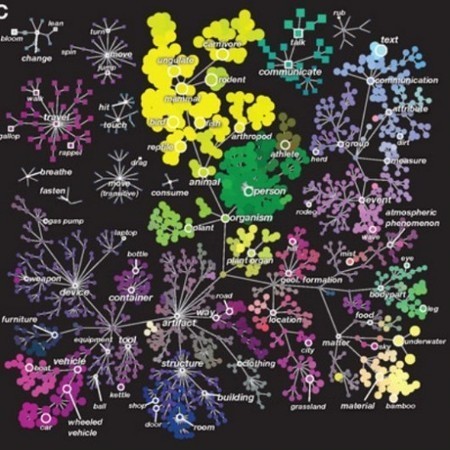
How does our brain organize the visual information that our eyes capture? Researchers at the University of California, Berkeley, used computational models of brain imaging data to answer this question and arrived at what they call “continuous semantic space” – a notion which serves as the basis for the first interactive maps showing how the brain categorizes what we see.The data on which the maps are based was collected while the subjects watched movie clips. Brain activity was recorded via functional Magnetic Resonance Imaging (fMRI), a type of MRI that measures brain activity by detecting related changes in blood flow. In order to find the correlations in the data collected, the researchers used a type of analysis known as regularized linear regression... Via Lauren Moss
Beth Kanter's insight:
Good points to make about why going visual is important

Pedro Barbosa's curator insight,
December 28, 2012 7:53 AM
Excellent articple about neuroscience - visual mapping. Understanding our minds is important on all types of management tasks;)
Pedro Barbosa | www.pbarbosa.com | www.harvardtrends.com
Scoop.it!

The first role of trained infotention is to recognize whether or not multitasking, single-minded focus, or alert but diffused attention is the most appropriate mind-tool for the task at hand. However, for those many situations in which multitasking is either necessary or preferable or both, the most important question is whether -- and to what degree -- multitasking more effectively is a learnable skill. -- Howard
"Results showed that participants did much better at multitasking after training. Interestingly the benefits transferred to the untrained dual task. Brain training can thus be used to get better at multitasking!" Via Howard Rheingold

Jenna Becerra's curator insight,
February 20, 2013 1:52 AM
Before one can think about multitasking, it is important to take into account that it is more than just practice. One has to be metacognitive in his or her approach to learning and paying attention to what is important. Know individual tendencies, but also know that a mind can be trained. Multitasking is not always the right approach, but it is often inevitable. Training one's mind to multitask effectively will only result in efficiency. 
Anne Macdonell's curator insight,
May 14, 2013 8:28 AM
Can't the brain be trained in every task? Why not multitasking as well? |