


Thank you to all of you who attended my webinar last week about Global Transaction IDs (GTIDs), which were introduced in MySQL 5.6 to make the reconfiguration of replication straightforward.

 Your new post is loading...
 Scoop.it!
Thank you to all of you who attended my webinar last week about Global Transaction IDs (GTIDs), which were introduced in MySQL 5.6 to make the reconfiguration of replication straightforward.

No comment yet.
Sign up to comment
Scoop.it!

Docker is an open-source engine that automates the deployment of applications as portable and self-contained containers that will run virtually anywhere. Dockerized applications reduce configuration efforts and obstacles for administrators. Applications (e.g. databases) can be provided in a configured, self-contained and frictionless way.
Scoop.it!

There are a lot of tools that generate test data. Many of them have complex XML scripts or GUI interfaces that let you identify characteristics about the data.
Scoop.it!
Here on the Percona Support team we often ask customers to retrieve disk stats to monitor disk IO and to measure block devices iops and latency. There are a number of tools available to monitor IO on Linux.
Scoop.it!

Tutoriel sur une introduction à DbSetup, une alternative à DbUnit
Mickael Ruau's insight:
Lors du développement de tests d'intégration, j'ai récemment eu besoin de charger une base de données à l'aide de jeux de données. Pour écrire mon premier test, j'ai simplement commencé par écrire un fichier SQL. En un appel de méthode (JdbcTestUtils::executeSqlScript) ou une ligne de déclaration XML (<jdbc:script location=”” />), Spring m'aidait à charger mes données.
Scoop.it!

Ce dossier permet aux experts du droit (juristes, avocats…) non spécialistes en matière de protection des données de se familiariser avec ce domaine du Droit. Son objectif principal : améliorer les connaissances sur lesrègles en matière de protection des données dans les États membres de l’Union européenne et du Conseil de l’Europe. Le dossier fournit une synthèse des cadres légaux applicables de l’Union Européenne, du Conseil de l’Europe et de la Cour européenne des Droits de l’Homme.
Mickael Ruau's insight:
Sommaire du manuel de droit européen de protection des données Avant-propos
Scoop.it!
Collecte d'adresses e-mails : les 10 règles à suivre
Mickael Ruau's insight:
Ce qu'il vous faut retenir Le recueil du consentement de l'internaute doit être actif. Il est impératif de préciser clairement sa finalité. Toutes les informations concernant la collecte de données personnelles doivent être visibles, accessibles et claires. La finalité du traitement, même s'il ne s'agit pas de prospection, doit être indiquée à l'internaute, ainsi que l'identité de l'entreprise. Privilégiez les formulaires courts (nom, âge, sexe, adresse, civilité). Le recueil du consentement doit figurer en haut du questionnaire. N'hésitez pas à utiliser les jeux pour collecter des adresses, sauf si votre cible est plutôt CSP + et professionnelle. Attention au parrainage. On ne peut envoyer un e-mail à un filleul pour obtenir son consentement. Lors de la collecte offline d'adresses e-mails, demander l'accord préalable et explicite de la personne pour pouvoir la recontacter. Pour les adresses collectées offline, installez un logiciel qui validera la syntaxe et les noms de domaine des mails récupérés. N'hésitez pas à rediriger vos clients offline vers un jeux online pour collecter leur e-mail. Pour une plus grande cohérence entre les canaux, rédigez une charte de déontologie multicanal sur la collecte d'e-mails.
Scoop.it!
Gearman is awesome. If you do not know what it is, its a queue and load balancing system for an arbitrary number of workers which enables distributed computing across many nodes. Some of the same guys who worked on mySQL source worked on Gearman.
Scoop.it!

A quick overview on Pentaho. Briefly covering the various aspects that makes up Pentaho, so that if you are just starting to use Pentaho, this would hopefully give you a good overview.
Scoop.it!
Gearman is awesome. If you do not know what it is, its a queue and load balancing system for an arbitrary number of workers which enables distributed computing across many nodes. Some of the same guys who worked on mySQL source worked on Gearman.
Scoop.it!
XML Metadata InterchangeXML Metadata Interchange (XMI) est un standard pour l'échange d' informations de métadonnées UML basé sur XML. XMI est un standard créé par l' OMG. XMI est un procédé de sérialisation d'objets MOF (un autre standard de l'OMG), permettant de décrire des objets sous forme XML.
Scoop.it!
 ISO 8601 - Wikipedia, the free encyclopediaISO 8601 Data elements and interchange formats - Information interchange - Representation of dates and times is an international standard covering the exchange of date and time-related data. It was issued by the International Organization for Standardization (ISO) and was first published in 1988.
Scoop.it!
A unit testing framework for regression testing database stored procedures. Written in Java/JUnit/XML.
|
Scoop.it!
MySQL Date GotchasDatabase JournalWelcome to the second installment in a series on MySQL Gotchas. Part one addressed the MySQL Numeric Overflow Gotcha. Today's article will explore the perils of working with dates in MySQL.
Scoop.it!

I like the promise of using Docker containers for deploying our Rails apps and build our hosting infrastructure. However it's more complex then installing a server with Chef and Capistrano. #capistrano #chef #docker
Scoop.it!

In order to fix MySQL corruption of tables or when it throws random errors, then you can use in-built mysqlcheck command to fix corrupt tables of MySQl Database.
Scoop.it!
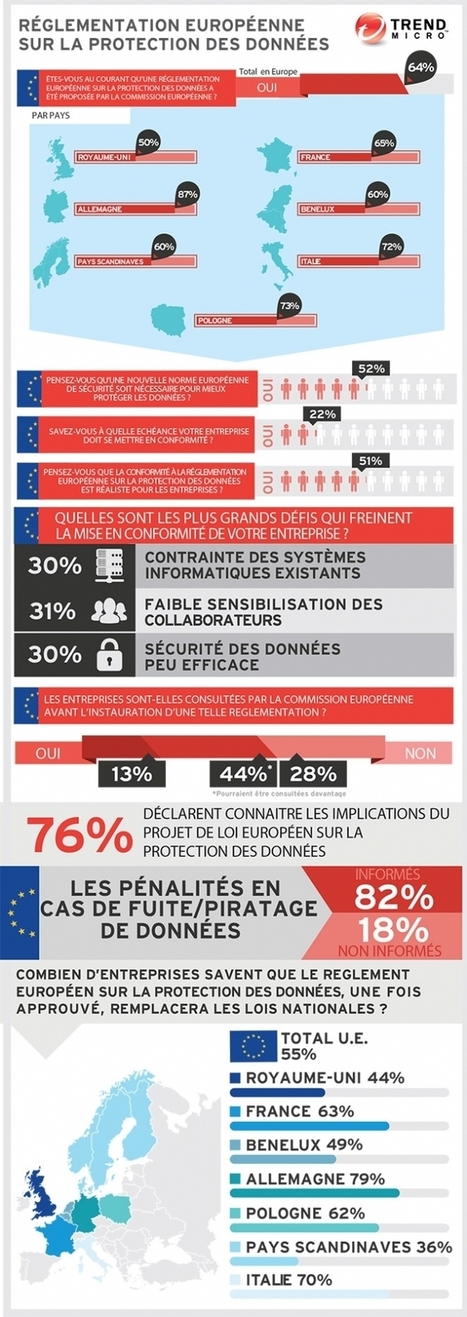
Seulement 55 % des entreprises sondées savent que le règlement européen sur la protection des données, une fois approuvé, remplacera les lois nationales : c'est ce que révèle Trend Micro, qui propose, sous forme d'infographie, un tour d'horizon sur qui sait quoi des réglementations à venir.
Via Stéphane NEREAU, Pascal Paul
Scoop.it!
Don't clean up, prepare!
A classical way of doing database tests is to start from an empty database, populate the database before each test, run the test, then remove the data after the test. This approach is not satisfactory:
We recommend using multiple very small data sets, specific for each test class. If you insert less data, the tests will be faster. We thus recommend the following strategy:
If another test is run after, it will start by clearing the database, and everything will be fine. That means that each test must start by clearing all the tables, and not just the tables it uses. You want your tests to be independent, and able to run in whatever order.
Mickael Ruau's insight:
Cyclic dependencies and SQL support
Sometimes, you need a data set that contains cyclic dependencies. For example you might have a foreign key to the vendor table in the product table, and you might have a foreign key to the featured product in the vendor table. This kind of cyclic dependency is problematic, because you can't delete all the vendors before deleting the products, and vice-versa. Similarly, you can't insert a product before its vendor, but you can't insert the vendor before the product either. In that case, you thus have two solutions:
The solution, in both cases, is to use a SQL operation. For example: Operation insertVendorsAndProducts = sequenceOf( insertInto("VENDOR") .columns("ID", "CODE", "NAME") .values(1L, "AMA", "AMAZON") .build(), insertInto("PRODUCT") .columns("ID", "NAME", "VENDOR_ID") .values(1L, "Kindle", "1L") .build(), sql("update VENDOR set FEATURED_PRODUCT_ID = 1 where ID = 1"));
Scoop.it!
Liquibase is an open source version control tool for databases.
Mickael Ruau's insight:
You would never develop code without version control, why do you develop your database without it? Liquibase is an open source library for tracking, managing and applying database changes that can be used for any database with a JDBC driver. It is built on a simple premise: all database changes are stored in a human readable yet trackable form and checked into source control.
Scoop.it!
When the developers build their own change tracking system using triggers and replication
Scoop.it!

Why Apatar? Unlike most proprietary data integration offerings, Apatar brings a set of advantages to the end- users, developers and partners: Contribute to Apatar Project: Source Code : SVN Bug Tracker : http://apatarforge.org/bug Forums
Scoop.it!

We are a modern company using modern technology like XML interfaces, but many of our customers want for example electronic invoices from us in an EDIFACT format like D96A.
Mickael Ruau's insight:
Parsing EDIFACT is actually not that complicated. Just split at the sytax chars: first at ' to get the segments, than at + to get data elements of that segments and at : to get the individual components. You need to take care of escaped seperator chars, of course. The chars used here are only the default, they can be changed at the beginning of the message by the optional UNA-segment. Actually thewikipedia article on EDIFACT gives a pretty good (but brief) introduction to that. And the format is documented with detail on the UN's UNECE site (yes, that's a lot and hard to read). The tricky part is to get the information out of that and into your application (and verifying it's valid, leave alone creating good error messages). If you really plan to write a comlete parser out of nothing for all that in any language, then: No, there is no easy way to do this. Nor is there for any other flexible data representation. That is a difficult task and always will be. But here's an idea: if you are into XML that much (or any other "modern technology" as you like to call it...). It would be a relatively easy task to write some program that converts EDIFACT messages into some unified XML-EDIFACT-Format (which is a pretty horrible thing and would most likely freak me out).
Scoop.it!
Tutoriel sur la modélisation d'un schéma d'une base de données NoSQL orientée document
Scoop.it!
Liste de normes ISOFin 2011, l' Organisation internationale de normalisation (ISO) compte environ 19 500 normes actives, dont : ISO 1 : Tolérance géométrique des produits - Température de référence ISO 5 : Photographie - mesure de densité ISO 9 : Translittération des caractères cyrilliques en caractères latins (1995) ISO 31 : Grandeurs
Scoop.it!

dbdsgnr is an html5 web app which allows you to design your database schema without writing sql.
Mickael Ruau's insight:
When you are done you can generate an sql script for the following database engines:
|





