Your new post is loading...

|
Scooped by
Mickael Ruau
March 27, 2020 11:57 AM
|
Slides from Peter Zaitsev's talk at the Big Data / Data Science Meetup in Montpellier, France, venue sponsor Elium Tech
|
|
Scooped by
Mickael Ruau
March 19, 2020 5:32 AM
|
ioStream is a message queue service. This "Stream-as-a-Service" tool supports asynchronous communication between services. Based on Apache Pulsar(TM) and compatible with market standard messaging protocols (Kafka*, MQTT*), ioStream by OVH helps you manage events reliably in real time.
|
|
Scooped by
Mickael Ruau
March 17, 2020 4:13 AM
|
Kaggle est une plateforme web organisant des compétitions en science des données. Sur cette plateforme, les entreprises proposent des problèmes en science des données et offrent un prix aux datalogistes obtenant les meilleures performances. L'entreprise a été fondée en 2010 par Anthony Goldbloom . L'animateur de la compétition prépare les données ainsi qu'une description du problème.
|
|
Scooped by
Mickael Ruau
March 12, 2020 9:49 AM
|
8D est l'abréviation de huit disciplines (huit actions à réaliser). Le 8D est une démarche qualité qui permet d'éradiquer un problème au sein d'une entreprise ou organisation. Le 8D permet de : Systématiser la résolution de problèmes. Travailler en équipes transversales. Faire de l'amélioration continue. Pérenniser les résolutions de problèmes ponctuels.
|
|
Scooped by
Mickael Ruau
February 28, 2020 3:56 AM
|
Excel 2013 Keyboard Shortcuts Keyboard Shortcuts from Webucator. CTRL combination shortcut keys, function keys, and some other common shortcut keys for Microsoft Excel 2013
|
|
Scooped by
Mickael Ruau
February 22, 2020 8:04 AM
|
There are plenty of Big Data tools in the market. We have handpicked the best tools that big data professionals are using in 2018.
|
|
Scooped by
Mickael Ruau
February 21, 2020 5:55 AM
|
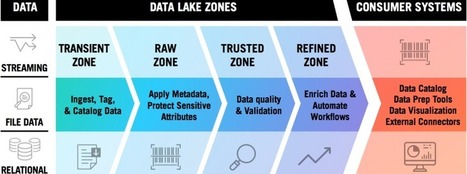
L’ingestion de données consiste à extraire, transformer et charger de grands volumes de données à partir de diverses sources, telles que des bases de données, des API, des serveurs FTP / SFTP, des fichiers, etc., dans un lac de données (Data Lake en anglais). “Data Lake” est un terme apparu au cours de cette décennie pour décrire un élément important du pipeline d’analyse de données dans le monde du Big Data. L’idée est de disposer d’une zone de stockage unique pour toutes les données brutes que n’importe qui dans une organisation pourrait avoir besoin d’analyser. Habituellement, les gens utilisent Hadoop pour travailler sur les données du lac, mais le concept est plus large que Hadoop.
|
|
Scooped by
Mickael Ruau
February 20, 2020 5:55 AM
|
This article looks at Big Data ingestion as well as the keys for speed, such as cataloging, automation, indexing, scalability, Hadoop, and other platforms.
|
|
Scooped by
Mickael Ruau
February 19, 2020 8:02 AM
|
You need these best practices to define the data lake and its methods.
|
|
Scooped by
Mickael Ruau
February 18, 2020 8:03 AM
|
Discover the second post in our series Big Data made easy in which we explain how we worked with StreamSets to load real time data from Citi Bike NYC.
|
|
Scooped by
Mickael Ruau
February 18, 2020 3:35 AM
|
Forgotten T-SQL Cheat Sheet Cheat Sheet from renegrin. Inspired by MidnightDBA here's a reference sheet includes the Logical Processing Order of SELECT, shorthand for recursive CTEs and MERGE, the famous list-of-details XML trick, and more.
|
|
Scooped by
Mickael Ruau
February 17, 2020 8:00 AM
|
A data lake is often optimized for the rapid ingestion of raw, detailed source data for exploration, analytics, and operations.
|
|
Scooped by
Mickael Ruau
February 15, 2020 8:56 AM
|
Now that Trello and Power BI are talking to each other, we need to give them something to talk about. To do this follow these instructions. In Power BI, click: The next three steps are the most important we shall cover: Scroll down to the field cards. Right click on List to bring up this menu:
|
|
|
Scooped by
Mickael Ruau
March 23, 2020 4:17 AM
|
Download Open Datasets on 1000s of Projects + Share Projects on One Platform. Explore Popular Topics Like Government, Sports, Medicine, Fintech, Food, More. Flexible Data Ingestion.
|
|
Scooped by
Mickael Ruau
March 19, 2020 5:31 AM
|
Il était une fois Kafka sur Pulsar All Conferences
|
|
Scooped by
Mickael Ruau
March 13, 2020 2:49 AM
|
There's a little-known pattern in software architecture that deserves more attention. Data-Oriented Architecture was first described by Rajive Joshi in a 2007 whitepaper at RTI, and again in 2017 by Christian Vorhemus and Erich Schikuta at the University of Vienna in this iiWAS paper. DOA is an inversion of the traditional dichotomy between a monolithic binary and data store (monolithic architecture) on the one hand, and small, distributed, independent binaries each with their own data stores (microservices, and service-oriented architecture) on the other. In data-oriented architecture, a monolithic data store is the sole source of state in the system, which is being acted on by loosely-coupled, stateless microservices.
|
|
Scooped by
Mickael Ruau
March 12, 2020 9:07 AM
|
where we explain machine learning concepts and how to get started using it, for real.
|
|
Scooped by
Mickael Ruau
February 25, 2020 7:35 AM
|
Apache HBase is a distributed, scalable, NoSQL big data store that runs on a Hadoop cluster. HBase can host very large tables – billions of rows, millions of columns – and can provide real-time, random read/write access to Hadoop data. HBase is a wide-column data store modeled after Google Bigtable, the database interface to the proprietary Google File System. HBase provides Bigtable-like capabilities on top of Hadoop-compatible file systems, such as MapR XD. HBase scales linearly across very large datasets and easily combines data sources with different structures and schemas.
|
|
Scooped by
Mickael Ruau
February 21, 2020 9:11 AM
|
Data professionals continue to experiment with new ways to approach analytics that improve outcomes for enterprises. Some propose dramatic changes while others are evolutionary. Here’s our list of…
|
|
Scooped by
Mickael Ruau
February 20, 2020 5:58 AM
|
Many of the Big Data and IoT use cases are based on combining data from multiple data sources and to make them available on a Big Data platform for analysis. The data sources are often very heterogeneous, from simple files, databases to high-volume event streams from sensors (IoT devices). It’s important to retrieve this data in a secure and reliable manner and integrate it with the Big Data platform so that it is available for analysis in real-time (stream processing) as well as in batch (typical big data processing).
|
|
Scooped by
Mickael Ruau
February 20, 2020 3:33 AM
|
Contents Include: Introduction, Scalable Data Architecture, Is NoSQL For You?, MongoDB, GigaSpaces XAP, Google App Engine Datastore an
|
|
Scooped by
Mickael Ruau
February 19, 2020 5:54 AM
|
Data ingest tools for BIG data ecosystems are classified into the following blocks: - Apache Nifi: An ETL tool that takes care of loading data from different sources, passes it through a process flow for treatment, and dumps it into another source.
- Apache Sqoop: Bidirectional data transfer between Hadoop and an SQL databases (structured data)
- Apache Flume: System of ingesting semi-structured or unstructured data in streaming on HDFS or Hbase.
On the other hand there are messaging systems with own ingest functions, such as:
|
|
Scooped by
Mickael Ruau
February 18, 2020 5:51 AM
|
Blog about Different layers of Big Data Architecture with Ingestion, Processing, Storage, ETL Pipeline on AWS ,Google Cloud and Azure
|
|
Scooped by
Mickael Ruau
February 18, 2020 3:32 AM
|
Conceptual Database Design Cheat Sheet from Natalie Moore. transit to design and create a solution
|
|
Scooped by
Mickael Ruau
February 16, 2020 8:14 AM
|
Au même titre que l'architecture en tiers est un support de base pour les solutions conventionnelles, le concept de Data Lake permet la réalisation d'une application Big Data dans les règles de l'art. Imaginez, vous qui nous lisez, que vous souhaitiez intégrer dans un tout cohérent votre cluster Hadoop, une base (HBase, disons), des outils pour importer des bases, des traitements conséquents, voire du Machine Learning, et bien sûr, de quoi accéder à vos résultats. Comment faire ? C'est précisément le but de l'article.
|


 Scoop.it!