The translocation mechanism of RxLR effectors from plant pathogenic oomycetes into the cytoplasm of their host is currently the object of intense research activity and debate. Here we report the biochemical and thermodynamic characterisation of the Phytophthora infestans effector AVR3a in vitro. We show that the amino acids surrounding the RxLR leader mediate homodimerisation of the protein. Dimerisation was considerably attenuated by a localised mutation within the RxLR motif that was previously described to prevent translocation of the protein into host. Importantly, we confirm that the reported phospholipid binding properties of AVR3a are mediated by its C-terminal effector domain, and not its RxLR leader. However, we show that the observed phospholipid interaction is attributable to a weak association with small amounts of denatured protein, and is therefore most likely physiologically irrelevant.
Adam Kondorosi has been for about three decades one of the world-wide leading scientists in the field of plant-microbe interactions, and more particularly in the Rhizobium-legume symbiosis. Adam has been the founding director of our institute, the Institut des Sciences du Végétal in Gif-sur-Yvette which he has developed ex nihilo into an internationally renowned research institution in plant biology. Adam died on 21st January 2011 and we - his former colleagues and friends - believe that a scientific symposium is the best tribute we can give to him.
In this symposium, we bring together some of his long-standing colleagues as well as new actors in the field to create a scientific event that is at the forefront of the Rhizobium-legume field and that certainly would have pleased Adam.
We look forward to meet you in Gif-sur-Yvette.
The Organizing committee: Hélène Barbier-Brygoo Martin Crespi Yves Dessaux Bruno Gronenborn Peter Mergaert Pascal Ratet
When a gene from bell and hot peppers is inserted into tomatoes, it not only imparts resistance to bacterial spot—a devastating tomato disease—it also bumps up yields.
Plant activators are compounds, such as analogs of the defense hormone salicylic acid (SA), that protect plants from pathogens by activating the plant immune system. Although some plant activators have been widely used in agriculture, the molecular mechanisms of immune induction are largely unknown. Using a newly established high-throughput screening procedure that screens for compounds that specifically potentiate pathogen-activated cell death in Arabidopsis thaliana cultured suspension cells, we identified five compounds that prime the immune response. These compounds enhanced disease resistance against pathogenic Pseudomonas bacteria in Arabidopsis plants. Pretreatments increased the accumulation of endogenous SA, but reduced its metabolite, SA-O-β-D-glucoside. Inducing compounds inhibited two SA glucosyltransferases (SAGTs) in vitro. Double knockout plants that lack both SAGTs consistently exhibited enhanced disease resistance. Our results demonstrate that manipulation of the active free SA pool via SA-inactivating enzymes can be a useful strategy for fortifying plant disease resistance and may identify useful crop protectants.
India and Pakistan - Albugo candida has a worldwide distribution but is of significant economic importance only in certain countries on certain crops. India has a huge acreage of susceptible B. juncea and some other oilseed crucifers and is the world's hottest spot for the disease caused by A. candida. The disease is rampant on various crucifers all over India, especially on the oilseed types in the central and northern plains. Saharan and Lakra (1988) and Lakra and Saharan (1989) reported from Haryana, India, that the highest leaf and staghead phase infections in B. juncea cv. Prakash resulted in yield losses of 27.4 and 62.7%, respectively, while the combined infection by these two phases resulted in a yield loss of 89.8%. The various parameters contributing to yield, such as the number of branches/plant, number of siliques/branch, silique length, number of seeds/silique, 1000 grain weight, and total yield/plant were all affected by each category of infection (Saharan and Lakra, 1988; Lakra and Saharan, 1989; Saharan and Verma, 1992).
Europe - The disease caused by A. candida appears to be uncommon on spring oilseed rape in Scotland in the UK (Coll et al., 1998). However, high levels of infection by A. candida have been recorded on Brussels sprouts in the UK (Appleton, 1979). Lunaria annua hosts A. candida in Europe in regions such as England (Cromack, 1998), the Netherlands (Mastebroek and Marvin, 2000), and in Crete, Greece (Vakalounakis, 1991). It causes a serious disease of L. annua in Crete and may reduce seed yields in The Netherlands. A. candida also causes an economically important disease of A. rusticana in countries such as Poland (Macias, 1996), Austria (Szith and Furlan, 1979), and Germany (Kalchschmid and Krause, 1976), and of E. sativa in Italy (Minuto et al., 1997). A. candida has also been recently reported on C. sativa from Germany (Föller et al., 1998).
North America - In Canada in 1979, A. candida was cited as being the most important pathogen of B. rapa (Verma and Petrie, 1979). In Saskatchewan, Canada, seed yield losses due to the staghead phase during 1970, 1971 and 1972 were estimated to be 0.747 (3%), 1.836 (6%), and 1.08 (9%) million bu, respectively (Petri, 1973). These losses were worth 1.68, 4.13 and 2.43 million dollars, respectively. The estimated yield losses in rapeseed in northern and central Alberta, Canada were 1-2% in 1971 (Berkenkamp, 1972; Saharan and Verma, 1992). In Manitoba, Canada, losses in rapeseed attributed to A. candida in 1971 amounted to 30-60% (Bernier, 1972). During the 1970s the disease on rapeseed rose sharply in severity in the Canadian prairies and yield losses of up to 60% were reported in Saskatchewan, Canada (Saharan and Verma, 1992). However, the disease became unimportant later due to widespread use of resistant cultivars (Petri, 1985a). In 1982, A. candida occurred in 71.4% of B. rapa fields but its incidence of 24.6% was relatively low (Petri, 1985b). Since then, there has been a resurgence of this disease due to the evolution of new races of the pathogen (Petri, 1994). A. candida has also been recently reported on C. sativa from Alberta, Canada (Paul et al., 2000).
Genetic transformation with resistance (R) genes is expected to enhance resistance durability against pathogens, especially for potato, a vegetatively propagated crop with tetrasomic inheritance and a long-term breeding program. In this study, 128 potato transformants were analysed for the presence of vector T-DNA genes, borders and backbone sequences. They were harvested after transformation using a construct containing neomycin phosphotransferase II (nptII) and three R genes against potato late blight (Phytophthora infestans). Our analysis revealed that 45 % of the R gene-containing transformants possessed a low T-DNA copy number, without the integration of vector backbone and borders. The integration of vector backbone sequences was characterized using eight genes, and backbone gene tetA was selected for the early prediction of plants with backbone sequence integration. Three transformants, two plants harbouring one T-DNA copy and one plant harbouring three T-DNA copies, were crossed with susceptible cv. Katahdin. Based on our results, we conclude that all four T-DNA genes were inherited as one cluster and segregated in a Mendelian fashion. The three T-DNA inserts from the transformant harbouring three T-DNA copies were statistically proven to be un-linked and inherited into the offspring plants independently. All of the R genes were functionally expressed in the offspring plants as in their parental transformants. This functional gene stacking has important implications towards achieving more durable resistance against potato late blight.
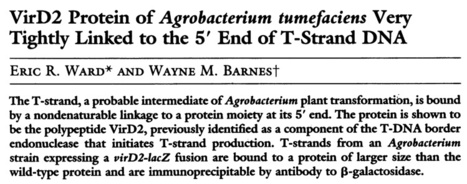
The leading candidate for the first example of a host-translocated effector from a cellular plant pathogen is VirD2: Ward, E.R. and Barnes, W.M. (1988). VirD2 protein of Agrobacterium tumefaciens very tightly linked to the 5' end of T-strand DNA. Science 242: 927-930.
• Stagonospora nodorum: From Pathology to Genomics and Host Resistance Richard P. Oliver, Timothy L. Friesen, Justin D. Faris, and Peter S. Solomon
• Pathogenomics of the Ralstonia solanacearum Species Complex Stéphane Genin and Timothy P. Denny
• The Genomics of Obligate (and Nonobligate) Biotrophs Pietro D. Spanu
• Genome-Enabled Perspectives on the Composition, Evolution, and Expression of Virulence Determinants in Bacterial Plant Pathogens Magdalen Lindeberg
• Plant Defense Compounds: Systems Approaches to Metabolic Analysis Daniel J. Kliebenstein
• Role of Nematode Peptides and Other Small Molecules in Plant Parasitism Melissa G. Mitchum, Xiaohong Wang, Jianying Wang, and Eric L. Davis
• Somatic Hybridization in the Uredinales Robert F. Park and Colin R. Wellings
• Plant Immunity to Necrotrophs Tesfaye Mengiste
• Mechanisms and Evolution of Virulence in Oomycetes Rays H.Y. Jiang and Brett M. Tyler
• Variation and Selection of Quantitative Traits in Plant Pathogens Christian Lannou
• Gall Midges (Hessian Flies) as Plant Pathogens Jeff J. Stuart, Ming-Shun Chen, Richard Shukle, and Marion O. Harris
• Phytophthora Beyond Agriculture Everett M. Hansen, Paul W. Reeser, and Wendy Sutton
• Diversity and Natural Functions of Antibiotics Produced by Beneficial and Plant Pathogenic Bacteria Jos M. Raaijmakers and Mark Mazzola
• The Role of Secretion Systems and Small Molecules in Soft-Rot Enterobacteriaceae Pathogenicity Amy Charkowski, et al.
• Receptor Kinase Signaling Pathways in Plant-Microbe Interactions Meritxell Antolín-Llovera, Martina K. Ried, Andreas Binder, and Martin Parniske
• Fire Blight: Applied Genomic Insights of the Pathogen and Host Mickael Malnoy, Stefan Martens, John L. Norelli, Marie-Anne Barny, George W. Sundin, Theo H.M. Smits, and Brion Duffy
Loss-of-function alleles of the mildew resistance locus O (MLO) gene provide broad spectrum powdery mildew disease resistance. Here, we identified a pepper (Capsicum annuum) MLO gene (CaMLO2) that is transcriptionally induced by Xanthomonas campestris pv. vesicatoria (Xcv) infection. Topology and subcellular localization analyses reveal that CaMLO2 is a plasma membrane-anchored- and amphiphilic Ca2+-dependent calmodulin-binding protein. CaMLO2 expression is upregulated by Xcv and salicylic acid (SA), as well as abiotic stresses. Silencing of CaMLO2 in pepper plants confers enhanced resistance against virulent Xcv, but not against avirulent Xcv. This resistance is accompanied by compromised susceptibility cell death response and reduced bacterial growth, as well as accelerated reactive oxygen species (ROS) burst. Virulent Xcv infection drastically induces the SA-dependent defense marker gene CaPR1 in CaMLO2-silenced leaves. CaMLO2 overexpression in Arabidopsis enhances susceptibility to Pseudomonas syringae pv. tomato and Hyaloperonospora arabidopsidis. CaMLO2-OX leaves exhibit the susceptibility cell death response and high bacterial growth during virulent Pst DC3000 infection. These are accompanied by enhanced electrolyte leakage but compromised induction of some defense response genes and ROS burst. Together, our results suggest that CaMLO2 is involved in the susceptibility cell death response and bacterial and oomycete proliferation in pepper and Arabidopsis.
Roots of M. truncatula were inoculated with zoospores of A. euteiches, harvested after 2 weeks and analysed by raster electron microscopy. Finger-shaped protuberances of the haustorium (Ha) are indicated with arrows. /via Franken et al. Phytochemistry: Gene expression analysis of arbuscule development and functioning (2007)
Magnaporthe oryzae, which causes the devastating rice-blast disease, invades its host plants via a specialized infection structure called the appressorium. Previously, we showed that the ATP-Binding Cassette 3 transporter is necessary for appressorial function (host penetration) in M. oryzae. However, thus far, the molecular basis underlying impaired appressorial function in the abc3Δ remains elusive. We hypothesized that the abc3Δ appressoria accumulate excessive amounts of specific efflux substrate(s) of the Abc3 transporter in M. oryzae. We devised an innovative yeast-based strategy and identified Abc3 Transporter efflux Substrate (ATS) to be a digoxin-like endogenous steroidal glycoside that accumulates to inhibitory levels in M. oryzae abc3Δ appressoria. Exogenous ATS altered cell wall biogenesis and viability in wild-type Schizosaccharomyces pombe, but not in S. pombe expressing M. oryzae Abc3. We show that ATS associates with the Translation Elongation factor Tef2 in M. oryzae, and propose that ATS regulates ion homeostasis during pathogenesis. Excessive ATS accumulation, either intracellularly due to impaired efflux in the abc3Δ or when added exogenously to the wild type, renders M. oryzae nonpathogenic. Furthermore, we demonstrate that the host penetration defects in the abc3Δ are due to aberrant F-actin dynamics as a result of altered Tef2 function and/or ion homeostasis defects caused by excess accumulation of ATS therein. Rather surprisingly, excessive exogenous ATS or digoxin elicited the hypersensitive response in rice, even in the absence of the blast fungus. Lastly, reduced disease symptoms in the inoculated host plants in the presence of excessive digoxin suggest a potential use for such related steroidal glycosides in controlling rice-blast disease.
The Bs2 resistance gene of pepper specifically recognizes and confers resistance to strains of Xanthomonas campestris pv. vesicatoria that contain the corresponding bacterial avirulence gene, avrBs2. The involvement of avrBs2 in pathogen fitness and its prevalence in many X. campestris pathovars suggests that the Bs2 gene may be durable in the field and provide resistance when introduced into other plant species. Employing a positional cloning strategy, the Bs2 locus was isolated and the gene was identified by coexpression with avrBs2 in an Agrobacterium-mediated transient assay. A single candidate gene, predicted to encode motifs characteristic of the nucleotide binding site–leucine-rich repeat class of resistance genes, was identified. This gene specifically controlled the hypersensitive response when transiently expressed in susceptible pepper and tomato lines and in a nonhost species, Nicotiana benthamiana, and was designated as Bs2. Functional expression of Bs2 in stable transgenic tomatoes supports its use as a source of resistance in other Solanaceous plant species.
As the annual potato harvest begins, Wisconsin farmers continue to check their fields for late blight, the ferocious plant disease that caused the 1848 Irish potato famine and fueled massive emigration from Ireland.
The cooler, damper conditions that started in August are conducive to late blight in potatoes, says assistant professor Amanda Gevens, who has joint appointments with University of Wisconsin-Extension and the UW-Madison Department of Plant Pathology. She cautions that the latest highly pathogenic strain, called US-23, can destroy a field within a week.
PUNA, Hawaii -- His shoes crunching through volcanic grit on the Big Island's eastern shore, Dennis Gonsalves walks into a grove of juvenile papaya trees. The renowned plant pathologist eyes the bulbous green fruit stack up the trees' trunks. In a few months, harvest will arrive, each tree shedding two or three papayas a week.
Working in the shadow of a volcano, farmers in Puna, the heart of Hawaii's papaya industry, harvest a bounty of healthy fruit each year. It's a far cry from 15 years ago, when a devastating virus swept through the groves. The trees withered. Their leaves grew to resemble craggy bird claws. The fruit was pockmarked with ring-shaped spots, hallmarks of infection. The island's papaya tradition seemed at an end.
Today, the trees' leaves are thick as a giant's fingers as they dance in the trade winds. The yellow-fleshed papaya will be sold to Los Angeles or San Francisco or fed to Honolulu's throngs. Stopping at one thriving specimen, Gonsalves cannot conceal his pride.
"This one here," he said, "you come six months from now, it'll be loaded with papaya." A bit of paternal glow can be allowed. After all, Gonsalves invented the tree.
In the quest to create a sustainable future, some paths are more direct...more profound...and more tuned-in to discovering the roots of the serious problems that need to be solved. And with the next generation seeing world population swell from 7 to 9 billion people, how will we sustainably increase our food, fiber and fuels using less land and fewer resources? One word: plants. And healthy plants are key. But plants get sick, too. And when disease strikes, disaster can quickly follow. That's why it's more important than ever that today's brightest and best choose their course wisely...and explore new paths that get to the root of some of the most critical problems. For those with insight...for those ready to make an impact, plant pathology is a path that can take you further than you'd ever imagined, or exactly where you'd like to be.
Learn about Plant Pathology through this exciting educational video. This video targets undergraduates in biology and related majors with limited agricultural background, and is available for use in classroom settings, on organization websites, on display at career fairs. You can also share it with your colleagues, the opportunities are endless.
To find out more about how to spread the word visit the American Phytopathological Society's website. www.apsnet.org
APS also has significant outreach resources. If this video piques your interest, check out our other tools for teach and growing plant pathology. http://www.apsnet.org/members/outreach
Compatible/incompatible interactions between the tomato wilt fungus Fusarium oxysporum f. sp. lycopersici (FOL) and tomato Solanum lycopersicum are controlled by three avirulence genes (AVR1–3) in FOL and the corresponding resistance genes (I–I3) in tomato. The three known races (1, 2 and 3) of FOL carry AVR genes in different combinations. The current model to explain the proposed order of mutations in AVR genes is: i) FOL race 2 emerged from race 1 by losing the AVR1 and thus avoiding host resistance mediated by I (the resistance gene corresponding to AVR1), and ii) race 3 emerged when race 2 sustained a point mutation in AVR2, allowing it to evade I2-mediated resistance of the host. Here, an alternative mechanism of mutation of AVR genes was determined by analyses of a race 3 isolate, KoChi-1, that we recovered from a Japanese tomato field in 2008. Although KoChi-1 is race 3, it has an AVR1 gene that is truncated by the transposon Hormin, which belongs to the hAT family. This provides evidence that mobile genetic elements may be one of the driving forces underlying race evolution. KoChi-1 transformants carrying a wild type AVR1 gene from race 1 lost pathogenicity to cultivars carrying I, showing that the truncated KoChi-1 avr1 is not functional. These results imply that KoChi-1 is a new race 3 biotype and propose an additional path for emergence of FOL races: Race 2 emerged from race 1 by transposon-insertion into AVR1, not by deletion of the AVR1 locus; then a point mutation in race 2 AVR2 resulted in emergence of race 3.
To get content containing either thought or leadership enter:
To get content containing both thought and leadership enter:
To get content containing the expression thought leadership enter:
You can enter several keywords and you can refine them whenever you want. Our suggestion engine uses more signals but entering a few keywords here will rapidly give you great content to curate.


 Your new post is loading...