G-protein-coupled receptors (GPCRs) are key cellular components that mediate extracellular signals into intracellular responses. Genome mining revealed that Phytophthora spp. have over 60 GPCR genes among which a prominent class of 12 encoding novel proteins with an N-terminal GPCR domain fused to a C-terminal phosphatidylinositol phosphate kinase (PIPK) domain. This study focuses on two GPCR-PIPKs (GKs) in Phytophthora sojae. PsGK4 and PsGK5 are differentially expressed during the life cycle with the highest expression in cysts and during cyst germination, and at late infection stages. In P. sojae transformants that constitutively express RFP-tagged PsGK4 andPsGK5, the fusion proteins in hyphae reside in small, rapidly moving vesicular-like structures. Functional analysis using gene silencing showed that PsGK4-silenced transformants displayed higher levels of encystment and a reduced cyst germination rate when compared with the recipient strain. Moreover, GK4 deficiency (or reduction) resulted in severe defects in zoospore chemotaxis towards isoflavones and soybean roots. In contrast, PsGK5-silenced transformants exhibited no obvious defects in asexual development but oospore production was severely impaired. Both, PsGK4- and PsGK5-silenced transformants showed reduced pathogenicity. These results point to involvement of GKs in zoospore behaviour, chemotaxis and oospore development, and suggest that PsGK4 and PsGK5 each head independent signalling pathways.
The "Warrior" race of yellow rust, first identified in 2011, is now virulent on adult plants of Claire and related varieties, according to the results of the UK Cereal Pathogen Virulence Survey.
Speaking at the presentation of the survey results, Rosemary Bayles of crop consultants NIAB TAG said that the Warrior race is proving to be more complicated than originally thought. "It was first reported in the UK in 2011, but was also found in France, Germany, Denmark and Sweden in the same year. That's really quite unusual," she said. It has also increased in all of these countries in 2012, with the race accounting for 75% of the isolates tested during 2012 in England, she added. "There's something strange about it and the pathogen appears to be identical across all of these countries. The speculation is that it may have originated outside Europe." A race of yellow rust named after one of the most popular varieties grown in Denmark, Ambition, is the same as the Warrior race, she revealed.
A key virulence strategy of bacterial pathogens is the delivery of multiple pathogen effector proteins into host cells during infection. The HopQ1 effector from Pseudomonas syringae pv. tomato (Pto) strain DC3000 is conserved across multiple bacterial plant pathogens. Here, we investigated the virulence function and host targets of HopQ1 in tomato. Transgenic tomato lines expressing Dexamethasone-inducible HopQ1 exhibited enhanced disease susceptibility to virulent Pto DC3000, the Pto ∆hrcC mutant, and decreased expression of a PAMP-triggered marker gene after bacterial inoculation. HopQ1 interacting proteins were co-immunoprecipitated and identified by mass spectrometry. HopQ1 can associate with multiple tomato 14-3-3 proteins, including TFT1 and TFT5. HopQ1 is phosphorylated in tomato, and four phosphorylated peptides were identified by mass spectrometry. HopQ1 possess a conserved mode I 14-3-3 binding motif whose Serine 51 residue is phosphorylated in tomato and regulates its association with TFT1 and TFT5. Confocal microscopy and fractionation reveal that HopQ1 exhibits nuclear-cytoplasmic localization, while HopQ1 dephosphorylation mimics exhibit more pronounced nuclear localization. HopQ1 delivered from Pto DC3000 was found to promote bacterial virulence in the tomato genotype Rio Grande 76R. However, the HopQ1 (S51A) mutant delivered from Pto DC3000 was unable to promote pathogen virulence. Taken together, our data demonstrates that HopQ1 enhances bacterial virulence and associates with tomato 14-3-3 proteins in a phosphorylation dependent manner which influences HopQ1's sub-cellular localization and virulence promoting activities in planta.
Genome sequences of plant fungal pathogens have enabled the identification of effectors that cooperatively modulate the cellular environment for successful fungal growth and suppress host defense. Identification and characterization of novel effector proteins are crucial to understand pathogen virulence and host plant defense mechanisms. Previous reports indicate that the Pseudomonas syringae pv. tomato DC3000 type III secretion system (T3SS) can be used to study how non-bacterial effectors manipulate dicot plant cell function using the Effector Detector Vector (pEDV) system. Here we report a pEDV-based effector delivery system in which the T3SS of Burkholderia glumae, an emerging rice pathogen, is used to translocate the AVR-Pik and AVR-Pii effectors of fungal pathogen Magnaporthe oryzae to rice cytoplasm. The translocated AVR-Pik and AVR-Pii showed avirulence activity when tested in rice cultivars containing the cognate R genes. AVR-Pik reduced and delayed the hypersensitive response triggered by B. glumae in the non-host plant Nicotiana benthamiana indicative of an immunosuppressive virulence activity. AVR proteins fused with fluorescent protein and nuclear localization signal were delivered by B. glumae T3SS and observed in the nuclei of infected cells in rice, wheat, barley and N. benthamiana. Our bacterial T3SS-enabled eukaryotic effector delivery and subcellular localization assays provide a useful method to identify and study effector functions in monocot plants.
Nico, this paper comes in time to feature in the general discussion of my dissertation, in a section where I explore if a temporal effector translocation hirarchy would exist in R. solanacearum. I wanted to cite a couple papers characterizing effector translocation in planta and this one is a perfect fit. It is amazing how the principle behind the use of NLS, so common nowadays for the characterization of oomycete effectors, could be successfully applied to bacteria pathogens. I hope this method could be useful in the future to the validation (re-validation) of pathogen effector proteins. Thank you for sharing.
The AvrPphB effector of Pseudomonas syringae is a papain-like protease that is injected into the host plant cell and cleaves specific kinases to disrupt immune signaling. Here, we used the unique substrate specificity of AvrPphB to generate a specific activity-based probe. This probe displays various AvrPphB isoforms in bacterial extracts, upon secretion and inside the host plant. We show that AvrPphB is secreted as a proprotease and that secretion requires the prodomain, but probably does not involve a pH-dependent unfolding mechanism. The prodomain removal is required for the ability of AvrPphB to trigger a hypersensitive cell death in resistant host plants, presumably since processing exposes a hidden acylation site required for subcellular targeting in the host cell. We detected two active isoforms of AvrPphB in planta, of which the major one localizes exclusively to membranes.
Plant roots generate electrical currents and associated electrical fields as a consequence of electrogenic ion transport at the root surface. Here we demonstrate that the attraction of swimming zoospores of oomycete plant pathogens to plant roots is mediated in part by electrotaxis in natural root-generated electric fields. The zones of accumulation of anode- or cathode-seeking zoospores adjacent to intact and wounded root surfaces correlated with their in vitro electrotactic behavior. Manipulation of the root electrical field was reflected in changes in the pattern of zoospore accumulation and imposed focal electrical fields were capable of overriding endogenous signals at the root surface. The overall pattern of zoospore accumulation around roots was not affected by the presence of amino acids at concentrations expected within the rhizosphere, although higher concentrations induced encystment and reduced root targeting. The data suggest that electrical signals can augment or override chemical ones in mediating short-range tactic responses of oomycete zoospores at root surfaces.
For dispersal and host infection plant pathogens largely depend on asexual spores. Pathogenesis and sporulation are complex processes that are governed by cellular signalling networks including G-protein and phospholipid signalling. Oomycetes possess a family of novel proteins called GPCR-PIPKs (GKs) that are composed of a seven-transmembrane spanning (7-TM) domain fused to a phosphatidylinositol phosphate kinase (PIPK) domain. Based on this domain structure GKs are anticipated to link G-protein and phospholipid signal pathways; however, their functions are currently unknown. Expression analyses of the 12 GK genes in Phytophthora infestans and their orthologues in Phytophthora sojae, revealed differential expression during asexual development. PiGK1 and PiGK4 were fused to monomeric red fluorescent protein (mRFP) and ectopically expressed in P. infestans. In growing hyphae different subcellular distribution patterns were observed indicating that these two GKs act independently during development. We focused on the functional analyses of PiGK4. Its localization suggested involvement in cell differentiation and elongation and its 7-TM domain showed a canonical GPCR membrane topology. Silencing of GK4 and overexpression of full-length and truncated constructs in P. infestans revealed that PiGK4 is not only involved in spore germination and hyphal elongation but also in sporangia cleavage and infection.
The Oomycete Molecular Genetics Network invites you to attend the 14th meeting at the Asilomar Conference Center in Pacific Grove, CA March 10-12, 2013. As before, the meeting is planned in conjunction with and held immediately prior to the 27th Fungal Genetics Conference at the Asilomar Conference Center. The meeting convenes Sunday morning, March 10 and concludes Tuesday, March 12.
This year’s keynote speakers will be Jeff Dangl and Sarah Grant, both in the Department of Biology at the University of North Carolina-Chapel Hill.Professor Dangl uses genetic and genomic tools to understand how plants interact with pathogenic bacteria and oomycetes. Most recently, his group led an effort to systematically identify Arabidopsis proteins targeted by effectors fromPseudomonas syringae and Hyaloperonospora arabidopsis. For more information on his research projects, visit the Dangl Lab website. Professor Grant’s research focuses on pathogenicity factors, particularly Type III effectors, of P. syringae.
HopQ1, a type III effector secreted by Pseudomonas syringae pv. phaseolicola, is widely conserved among diverse genera of plant bacteria. It promotes the development of halo blight in common bean. However, when this same effector is injected into Nicotiana benthamiana cells, it is recognized by the immune system and prevents infection. Although the ability to synthesize HopQ1 determines host specificity, the role it plays inside plant cells remains unexplored. Following transient expression in planta, HopQ1 was shown to co-purify with host 14-3-3 proteins. The physical interaction between HopQ1 and 14-3-3a was confirmed in planta using FRET-FLIM techniques. Moreover, mass spectrometric (LC-MS-MS/MS) analyses detected specific phosphorylation of the canonical 14-3-3 binding site (RSXpSXP, pS denotes phosphoserine) located in the N-terminal region of HopQ1. Amino acid substitution within this motif abrogated the association and led to altered subcellular localization of HopQ1. In addition, the mutated HopQ1 protein showed reduced stability in planta. These data suggest that the association between host 14-3-3 proteins and HopQ1 is important for modulating the properties of this bacterial effector.
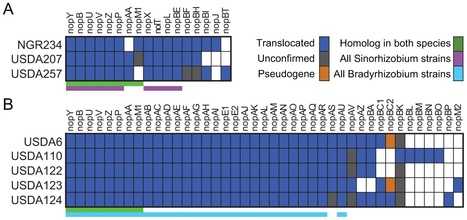
Two diametric paradigms have been proposed to model the molecular co-evolution of microbial mutualists and their eukaryotic hosts. In one, mutualist and host exhibit an antagonistic arms race and each partner evolves rapidly to maximize their own fitness from the interaction at potential expense of the other. In the opposing model, conflicts between mutualist and host are largely resolved and the interaction is characterized by evolutionary stasis. We tested these opposing frameworks in two lineages of mutualistic rhizobia,Sinorhizobium fredii and Bradyrhizobium japonicum. To examine genes demonstrably important for host-interactions we coupled the mining of genome sequences to a comprehensive functional screen for type III effector genes, which are necessary for many Gram-negative pathogens to infect their hosts. We demonstrate that the rhizobial type III effector genes exhibit a surprisingly high degree of conservation in content and sequence that is in contrast to those of a well characterized plant pathogenic species. This type III effector gene conservation is particularly striking in the context of the relatively high genome-wide diversity of rhizobia. The evolution of rhizobial type III effectors is inconsistent with the molecular arms race paradigm. Instead, our results reveal that these loci are relatively static in rhizobial lineages and suggest that fitness conflicts between rhizobia mutualists and their host plants have been largely resolved.
Life demands tradeoffs, and plants are no exception. Virginia wildrye, common on U.S. prairies and rangelands, often plays host to a fungus that helps this grass grow. But the plant pays a price. Researchers have discovered that infected plants produce less pollen than their noninfected counterparts. Instead, the fungus causes the rye grass to make extra seeds, which transmit the fungus to the next generation and new locations. This is the first time a fungus has proven capable of manipulating plant reproduction. The finding highlights the complexity of the relationship between hosts and their guests.
The fungal family Clavicipitaceae includes plant symbionts and parasites that produce several psychoactive and bioprotective alkaloids. The family includes grass symbionts in the epichloae clade (Epichloë and Neotyphodium species), which are extraordinarily diverse both in their host interactions and in their alkaloid profiles. Epichloae produce alkaloids of four distinct classes, all of which deter insects, and some—including the infamous ergot alkaloids—have potent effects on mammals. The exceptional chemotypic diversity of the epichloae may relate to their broad range of host interactions, whereby some are pathogenic and contagious, others are mutualistic and vertically transmitted (seed-borne), and still others vary in pathogenic or mutualistic behavior. We profiled the alkaloids and sequenced the genomes of 10 epichloae, three ergot fungi (Claviceps species), a morning-glory symbiont (Periglandula ipomoeae), and a bamboo pathogen (Aciculosporium take), and compared the gene clusters for four classes of alkaloids. Results indicated a strong tendency for alkaloid loci to have conserved cores that specify the skeleton structures and peripheral genes that determine chemical variations that are known to affect their pharmacological specificities. Generally, gene locations in cluster peripheries positioned them near to transposon-derived, AT-rich repeat blocks, which were probably involved in gene losses, duplications, and neofunctionalizations. The alkaloid loci in the epichloae had unusual structures riddled with large, complex, and dynamic repeat blocks. This feature was not reflective of overall differences in repeat contents in the genomes, nor was it characteristic of most other specialized metabolism loci. The organization and dynamics of alkaloid loci and abundant repeat blocks in the epichloae suggested that these fungi are under selection for alkaloid diversification. We suggest that such selection is related to the variable life histories of the epichloae, their protective roles as symbionts, and their associations with the highly speciose and ecologically diverse cool-season grasses.
Plant LysM proteins control the perception of microbial-derived N-acetylglucosamine compounds for the establishment of symbiosis or activation of plant immunity. This raises questions about how plants, and notably legumes, can differentiate friends and foes using similar molecular actors and whether any receptors can intervene in both symbiosis and resistance.
To study this question, nfp and lyk3 LysM-receptor like kinase mutants of Medicago truncatula that are affected in the early steps of nodulation, were analysed following inoculation with Aphanomyces euteiches, a root oomycete. The role of NFP in this interaction was further analysed by overexpression of NFP and by transcriptome analyses.
nfp, but not lyk3, mutants were significantly more susceptible than wildtype plants to A. euteiches, whereas NFP overexpression increased resistance. Transcriptome analyses on A. euteiches inoculation showed that mutation in the NFP gene led to significant changes in the expression of c. 500 genes, notably involved in cell dynamic processes previously associated with resistance to pathogen penetration. nfp mutants also showed an increased susceptibility to the fungus Colletotrichum trifolii.
These results demonstrate that NFP intervenes in M. truncatula immunity, suggesting an unsuspected role for NFP in the perception of pathogenic signals.
Background - Protein effectors of pathogenicity are instrumental in modulating host immunity and disease resistance. The powdery mildew pathogen of grasses Blumeria graminis causes one of the most important diseases of cereal crops. B. graminis is an obligate biotrophic pathogen and as such has an absolute requirement to suppress or avoid host immunity if it is to survive and cause disease.
Results - Here we characterise a superfamily predicted to be the full complement of Candidates for Secreted Effector Proteins (CSEPs) in the fungal barley powdery mildew parasite B. graminis f.sp. hordei. The 491 genes encoding these proteins constitute over 7% of this pathogen’s annotated genes and most were grouped into 72 families of up to 59 members. They were predominantly expressed in the intracellular feeding structures called haustoria, and proteins specifically associated with the haustoria were identified by large-scale mass spectrometry-based proteomics. There are two major types of effector families: one comprises shorter proteins (100–150 amino acids), with a high relative expression level in the haustoria and evidence of extensive diversifying selection between paralogs; the second type consists of longer proteins (300–400 amino acids), with lower levels of differential expression and evidence of purifying selection between paralogs. An analysis of the predicted protein structures underscores their overall similarity to known fungal effectors, but also highlights unexpected structural affinities to ribonucleases throughout the entire effector super-family. Candidate effector genes belonging to the same family are loosely clustered in the genome and are associated with repetitive DNA derived from retro-transposons.
Conclusions - We employed the full complement of genomic, transcriptomic and proteomic analyses as well as structural prediction methods to identify and characterize the members of the CSEPs superfamily in B. graminis f.sp. hordei. Based on relative intron position and the distribution of CSEPs with a ribonuclease-like domain in the phylogenetic tree we hypothesize that the associated genes originated from an ancestral gene, encoding a secreted ribonuclease, duplicated successively by repetitive DNA-driven processes and diversified during the evolution of the grass and cereal powdery mildew lineage.
Heavy rainfall in 2012 has caused a record number of cases of box blight, which affects a popular plant used in box hedging.
The disease was first discovered at a Hampshire nursery in 1994 and in 1998 the RHS began collating data on diseased cuttings sent in by members. Box blight has now spread Europe-wide and to New Zealand and the USA. In 2000, the disease was recorded on Box Hill in Surrey, the only extensive locality in the UK where Buxus sempervirens is native. The pathogens that cause the disease are Cylindrocladium buxicola andVolutella buxi.
The RHS says on its website: “There are no fungicides available to amateurs with specific recommendations for use against box blight. However, the fungicides difenoconazole (Westland Plant Rescue Control), myclobutanil (Bayer Garden Systhane Fungus Fighter and other products), tebuconazole (Bayer Garden Multirose Concentrate 2) and triticonazole (Scotts Fungus Clear Ultra) are labelled for control of other diseases on ornamentals and could therefore be used legally on box (at owner’s risk) to try and control box blight.”
The translocation of effector proteins into the host plant cells is essential for pathogens to suppress plant immune responses. The oomycete pathogen Phytophthora infestans secretes AVR3a, a crucial virulence effector protein with an N-terminal RXLR motif that is required for this translocation. It has been reported that the RXLR motif of P. sojae Avr1b, which is a close homolog of AVR3a, is required for binding to phosphatidylinositol monophosphates (PIPs). However, in our previous report, AVR3a as well as Avr1b bind to PIPs not via RXLR but via lysine residues forming a positively-charged area in the effector domain. In this report, we examined whether other RXLR effectors whose structures have been determined bind to PIPs. Both P. capsici AVR3a11 and Hyaloperonospora arabidopsidisATR1 have an RXLR motif in their N-terminal regions but did not bind to any PIPs. These results suggest that the RXLR motif is not sufficient for PIP binding.
OK, as you know, I was being facetious about the naming. But the lipid binging results are surprising and interesting. Would be nice to see an amino acid alignment of the proteins and/or the WY motifs.
To get content containing either thought or leadership enter:
To get content containing both thought and leadership enter:
To get content containing the expression thought leadership enter:
You can enter several keywords and you can refine them whenever you want. Our suggestion engine uses more signals but entering a few keywords here will rapidly give you great content to curate.


 Your new post is loading...