We now know what caused the Irish potato famine. Scientists have pinpointed the pathogen by using plant samples collected in the mid-19th century. Weekends on All Things Considered host Jacki Lyden talks about it with the study's co-author, Sophien Kamoun of the Sainsbury Lab in the United Kingdom.
Viruses have generally been studied either as disease-causing infectious agents that have a negative impact on the host (most eukaryote-infecting viruses), or as tools for molecular biology (especially bacteria-infecting viruses, or phage). Virus ecology looks at the more complex issues of virus-host-environment interactions. For plant viruses this includes studies of plant virus biodiversity, including viruses sampled directly from plants and from a variety of other environments; how plant viruses impact species invasion; interactions between plants, viruses and insects; the large number of persistent viruses in plants that may have epigenetic effects; and viruses that provide a clear benefit to their plant hosts (mutualists). Plants in a non-agricultural setting interact with many other living entities such as animals, insects, and other plants, as well as their physical environment. Wild plants are almost always colonized by a number of microbes, including fungi, bacteria and viruses. Viruses may impact any of these interactions.
Sexual recombination drives genetic diversity in eukaryotic genomes and fosters adaptation to novel environmental challenges. Although strictly asexual microorganisms are often considered as evolutionary dead ends, they comprise many devastating plant pathogens. Presently, it remains unknown how such asexual pathogens generate the genetic variation that is required for quick adaptation and evolution in the arms race with their hosts. Here we show that extensive chromosomal rearrangements in the strictly asexual plant pathogenic fungus Verticillium dahliae establish highly dynamic lineage-specific (LS) genomic regions that act as a source for genetic variation to mediate aggressiveness. We show that such LS regions are greatly enriched for in planta-expressed effector genes, encoding secreted proteins that enable host colonization. The LS regions occur at the flanks of chromosomal breakpoints and are enriched for retrotransposons and other repetitive sequence elements. Our results demonstrate that asexual pathogens may evolve by prompting chromosomal rearrangements, enabling rapid development of novel effector genes. Likely, chromosomal reshuffling can act as a general mechanism for adaptation in asexually propagating organisms.
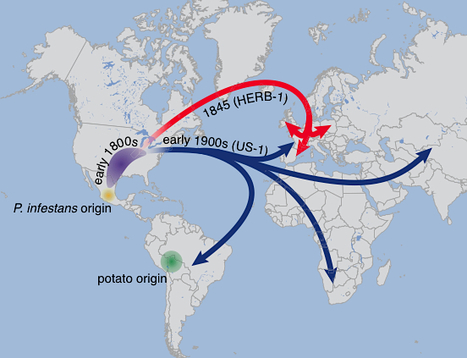
Phytophthora infestans, the cause of potato late blight, is infamous for having triggered the Irish Great Famine in the 1840s. Until the late 1970s, P. infestans diversity outside of its Mexican center of origin was low, and one scenario held that a single strain, US-1, had dominated the global population for 150 years; this was later challenged based on DNA analysis of historical herbarium specimens. We have compared the genomes of 11 herbarium and 15 modern strains. We conclude that the nineteenth century epidemic was caused by a unique genotype, HERB-1, that persisted for over 50 years. HERB-1 is distinct from all examined modern strains, but it is a close relative of US-1, which replaced it outside of Mexico in the twentieth century. We propose that HERB-1 and US-1 emerged from a metapopulation that was established in the early 1800s outside of the species' center of diversity.
CHINCHINÁ, Colombia -- At a sprawling central Colombia coffee laboratory and research facility — full of coffee plants trapped in jars and shimmering test-tubes — workers poked their heads out of cubicles to share the latest news from Central America and Mexico.
“Did you read that story about Nicaragua?” one asked a visiting delegation. “They’re really suffering.”
Just a few years ago, the Colombian coffee industry was on its knees as a virulent fungus known as coffee-leaf rust – or roya in Spanish — infected 40 percent of the crop.
Millions of dollars and a massive re-planting effort later, this Andean nation is showing signs of recovery just as its neighbors to the North are being slammed by the blight.
Analysts believe roya could hit 30 to 50 percent of the Central American and Mexican coffee crop over the next few years, and some aid agencies fear it could lead to hunger or even famine in a region where farmers live from harvest to harvest.
If Colombia’s fight with roya is any indication, Central America could have a long, expensive and rough road ahead.
It has been reported that filament forming surface proteins like hydrophobins are important virulence determinants in fungi and are secreted during pathogenesis. In obligate biotrophic pathogens like rust fungi, such proteins have not yet been identified. Rust transferred protein 1 (RTP1p), a rust protein that is transferred into the host cytoplasm, accumulates around the haustorial complex. To investigate RTP1p structure and function, we used immuno cytological, biochemical and computational approaches. We revealed that RTP1p accumulates in protuberances of the extrahaustorial matrix, a compartment that is surrounding the haustorium and separated from the plant cytoplasm by a modified host plasma membrane. Our analyses reveal RTP1p being capable of forming filamentous structures in vitro and in vivo. We present evidence that filament formation is due to ß-aggregation similar to what is known from amyloid like proteins. Our findings reveal RTP1p being a member of a new class of structural effectors. We hypothesize that RTP1p is transferred into the host to stabilise the host cell and protect the haustorium from degradation in later stages of the interaction. We report first evidence for an amyloid like protein being transferred into the host cell giving high potential for new resistance mechanisms against rust fungi.
Many plant pathogens subvert host immunity by injecting compositionally diverse but functionally similar repertoires of cytoplasmic effector proteins. The bacterial pathogenPseudomonas syringae is a model for exploring the functional structure of such repertoires. The pangenome of P. syringae encodes 57 families of effectors injected by the type III secretion system. Distribution of effector genes among phylogenetically diverse strains reveals a small set of core effectors targeting antimicrobial vesicle trafficking and a much larger set of variable effectors targeting kinase-based recognition processes. Complete disassembly of the 28-effector repertoire of a model strain and reassembly of a minimal functional repertoire reveals the importance of simultaneously attacking both processes. These observations, coupled with growing knowledge of effector targets in plants, support a model for coevolving molecular dialogs between effector repertoires and plant immune systems that emphasizes mutually-driven expansion of the components governing recognition.
AVON PARK, Fla. — Florida’s citrus industry is grappling with the most serious threat in its history: a bacterial disease with no cure that has infected all 32 of the state’s citrus-growing counties. Although the disease, citrus greening, was first spotted in Florida in 2005, this year’s losses from it are by far the most extensive. While the bacteria, which causes fruit to turn bitter and drop from the trees when still unripe, affects all citrus fruits, it has been most devastating to oranges, the largest crop. So many have been affected that the United States Department of Agriculture has downgraded its crop estimates five months in a row, an extraordinary move, analysts said. With the harvest not yet over, orange production has already decreased 10 percent from the initial estimate, a major swing, they said. “The long and short of it is that the industry that made Florida, that is synonymous with Florida, that is a staple on every American breakfast table, is totally threatened,” said Senator Bill Nelson, a Florida Democrat who helped obtain $11 million in federal money for research to fight the disease. “If we don’t find a cure, it will eliminate the citrus industry.”
The relentless migration of the disease from southern to northern Florida — and beyond — has deepened concerns this year among orange juice processors, investors, growers and lawmakers. Florida is the second-largest producer of orange juice in the world, behind Brazil, and the state’s $9 billion citrus industry is a major economic force, contributing 76,000 jobs.
Plant pathogens secrete effector proteins to promote host colonization. During infection of tomato xylem vessels, Fusarium oxysporum f. sp.lycopersici (Fol) secretes the Avr2 effector protein. Besides being a virulence factor, Avr2 is recognized intracellularly by the tomato I-2 resistance protein, resulting in the induction of host defenses. Here, we show that AVR2 is highly expressed in root- and xylem-colonizing hyphae three days post inoculation of roots. Co-expression of I-2 with AVR2deletion constructs using agroinfiltration in Nicotiana benthamianaleaves revealed that, except for the N-terminal 17 amino acids, the entireAVR2 protein is required to trigger I-2-mediated cell death. The truncated Avr2 variants are still able to form homo-dimers, showing that the central region of Avr2 is required for dimerization. Simultaneous production of I-2 and Avr2 chimeras carrying various subcellular localization signals in N. benthamiana leaves revealed that a nuclear localization of Avr2 is required to trigger I-2-dependent cell death. Nuclear exclusion of Avr2 prevented its activation of I-2, suggesting that Avr2 is recognized by I-2 in the nucleus.
Population genetic and phylogenetic studies have shown that Phaeosphaeria nodorum is a member of a species complex that probably shares its center of origin with wheat (Triticum aestivum and Triticum durum). We examined the evolutionary histories of three known necrotrophic effectors (NEs) produced by P. nodorum and compared them with neutral loci.
We screened over 1000 individuals for the presence/absence of each effector and assigned each individual to a multi-effector genotype. Diversity at each NE locus was assessed by sequencing c. 200 individuals for each locus.
We found significant differences in effector frequency among populations. We propose that these differences reflect the presence/absence of the corresponding susceptibility gene in wheat cultivars. The population harboring the highest sequence diversity was different for each effector locus and never coincided with populations harboring the highest diversity at neutral loci. Coalescent and phylogenetic analyses showed a discontinuous presence of all three NEs among nine closely related Phaeosphaeria species. Only two of the nine species were found to harbor NEs.
We present evidence that the three described NEs of P. nodorum were transmitted to its sister species, Phaeosphaeria avenaria tritici 1, via interspecific hybridization.
Parasitic organisms account for a large portion of living species. They have arisen on multiple independent occasions in many phyla, and thus encompass a huge biological diversity. This review uses several lines of evidence to argue that this vast diversity can be reduced to a few evolutionary end points that transcend phylogenetic boundaries. These represent peaks in the adaptive landscape reached independently by different lineages undergoing convergent evolution. Among eukaryotic parasites living in or on animals, six basic parasitic strategies are identified based on the number of hosts used per parasite generation, the fitness loss incurred by the host, and the transmission routes used by the parasites. They are parasitoids, parasitic castrators, directly transmitted parasites, trophically transmitted parasites, vector-transmitted parasites and micropredators. These show evidence of convergence in morphology, physiology, reproduction, life cycles and transmission patterns. Parasite–host body size ratios, and the relationship between virulence and intensity of infection, are also associated with the different parasitic strategies, but not consistently so. At the population level, patterns of parasite distribution among hosts are not uniform across all parasitic strategies, but are distinctly different for parasitoids and castrators than for other parasites. To demonstrate that the above six strategies defined for animal parasites are universal, comparisons are made with parasites of plants, in particular, plant–parasitic nematodes and parasitic angiosperms; these are shown to follow the same evolutionary trajectories seen among animal parasites, despite huge physiological and ecological differences between animals and plants. Beyond demonstrating the inevitable convergence of disparate lineages across biological hyperspace towards a limited set of adaptive strategies, this synthesis also provides a unifying framework for the study of parasitism.
In the plant Arabidopsis thaliana, multiple quantitative trait loci (QTLs), including RFO2, account for the strong resistance of accession Columbia-0 (Col-0) and relative susceptibility of Taynuilt-0 (Ty-0) to the vascular wilt fungus Fusarium oxysporum forma specialis matthioli. We find that RFO2 corresponds to diversity in receptor-like protein (RLP) genes. In Col-0, there is a tandem pair of RLP genes: RFO2/At1g17250 confers resistance while RLP2 does not. In Ty-0, the highly diverged RFO2 locus has one RLP gene conferring weaker resistance. While the endogenous RFO2 makes a modest contribution to resistance, transgenic RFO2 provides strong pathogen-specific resistance. The extracellular leucine-rich repeats (eLRRs) in RFO2 and RLP2 are interchangeable for resistance and remarkably similar to eLRRs in the receptor-like kinase PSY1R, which perceives tyrosine-sulfated peptide PSY1. Reduced infection inpsy1r and mutants of related phytosulfokine (PSK) receptor genes PSKR1 and PSKR2 shows that tyrosine-sulfated peptide signaling promotes susceptibility. The related eLRRs in RFO2 and PSY1R are not interchangeable; and expression of the RLP nPcR, in which eLRRs in RFO2 are replaced with eLRRs in PSY1R, results in constitutive resistance. Counterintuitively, PSY1 signaling suppresses nPcR because psy1r nPcR is lethal. The fact that PSK signaling does not similarly affect nPcR argues that PSY1 signaling directly downregulates the expression of nPcR. Our results support a speculative but intriguing model to explain RFO2's role in resistance. We propose that F. oxysporum produces an effector that inhibits the normal negative feedback regulation of PSY1R, which stabilizes PSY1 signaling and induces susceptibility. However, RFO2, acting as a decoy receptor for PSY1R, is also stabilized by the effector and instead induces host immunity. Overall, the quantitative resistance of RFO2 is reminiscent of the better-studied monogenic resistance traits.
I am still sticking with my prediction that Chalara fraxinea is an endophytic fungus on exotic ash trees, but it forms an inappropriate, toxic relationship with Fraxinus excelsior.
NAIROBI (Thomson Reuters Foundation) – The future of cassava, one of the most climate-resilient crops in Africa, may be under threat because rising temperatures have led to a dramatic increase in the number of whiteflies, tiny insects that spread the deadly cassava brown steak virus.
Previously seen as a major problem, but one confined to eastern and central Africa, the virus is spreading, alarming scientists who say new outbreaks suggest the disease is heading west towards the world’s largest cassava producer – Nigeria.
So far, according to James Legg, a plant virologist at the International Institute for Tropical Agriculture (IITA), new countries such as Angola, Gabon and Central African Republic have been hit by the virus. Legg has done extensive research on the disease and its causes in East Africa.
Scientists have already successfully tackled an equally lethal virus – cassava mosaic disease - transmitted by the same whitefly,Bemisia tabaci. This was done by developing a variety that is resistant to the virus.
But by a cruel twist of nature, both the improved and the unaltered varieties have succumbed to a ‘new’ pandemic of cassava brown streak virus, and scientists have yet to develop a resistant variety.
The biggest worry now is that as the whitefly population hugely increases, the insects could spread across the entire African continent.
Members of the genus Phytophthora cause serious damage to a huge array of plants. From the nineteenth century Irish potato famine to current widespread threats to forests and ecosystems in North and South America, Europe and Australia, the genus lives up to its reputation as the plant destroyer. This book provides an overview of Phytophthora species impacting crops, forests, nurseries, greenhouses and natural areas worldwide. Chapters cover major hosts, identification, epidemiology, management, current research, future perspectives and the impacts of globalization onPhytophthora. Phytophthora: A Global Perspective is an essential resource for researchers and extension workers in plant pathology and crop protection.
FLAGELLIN-SENSING 2 (FLS2) is a leucine-rich repeat/transmembrane domain/protein kinase (LRR-RLK) that is the plant receptor for bacterial flagellin or the flagellin-derived flg22 peptide. Previous work has shown that after flg22 binding, FLS2 releases BIK1 kinase and homologs and associates with BAK1 kinase, and that FLS2 kinase activity is critical for FLS2 function. However, the detailed mechanisms for activation of FLS2 signaling remain unclear. The present study initially identified multiple FLS2 in vitro phosphorylation sites and found that Serine-938 is important for FLS2 function in vivo. FLS2-mediated immune responses are abolished in transgenic plants expressing FLS2S938A, while the acidic phosphomimic mutants FLS2S938D and FLS2S938E conferred responses similar to wild-type FLS2. FLS2-BAK1 association and FLS2-BIK1 disassociation after flg22 exposure still occur with FLS2S938A, demonstrating that flg22-induced BIK1 release and BAK1 binding are not sufficient for FLS2 activity, and that Ser-938 controls other aspects of FLS2 activity. Purified BIK1 still phosphorylated purified FLS2S938A and FLS2S938D mutant kinase domains in vitro. Phosphorylation of BIK1 and homologs after flg22 exposure was disrupted in transgenicArabidopsis thaliana plants expressing FLS2S938A or FLS2D997A (a kinase catalytic site mutant), but was normally induced in FLS2S938D plants. BIK1 association with FLS2 required a kinase-active FLS2, but FLS2-BAK1 association did not. Hence FLS2-BIK1 dissociation and FLS2-BAK1 association are not sufficient for FLS2-mediated defense activation, but the proposed FLS2 phosphorylation site Ser-938 and FLS2 kinase activity are needed both for overall defense activation and for appropriate flg22-stimulated phosphorylation of BIK1 and homologs.
Guo-Liang Wang, a professor in CFAES's Department of Plant Pathology, has successfully cloned genes for disease resistance in rice, which is a staple food for more than half the world's population.
To accomplish successful infection, pathogens deploy complex strategies to interfere with host defense systems and subterfuge host physiology to favor pathogen survival and multiplication. Modulation of plant auxin physiology and signaling is emerging as a common virulence strategy for phytobacteria to cause diseases. However, the underlying mechanisms remain largely elusive. We have previously shown that the Pseudomonas syringae type III effector AvrRpt2 alters Arabidopsis auxin physiology. Here we report that AvrRpt2 promotes auxin response by stimulating the turnover of Aux/IAA proteins, the key negative regulators in auxin signaling. AvrRpt2 acts additively with auxin to stimulate Aux/IAA turnover, suggesting distinct, yet proteasome-dependent mechanisms operated by AvrRpt2 and auxin to control Aux/IAA stability. The cysteine protease activity is required for AvrRpt2-stimulated auxin signaling and Aux/IAA degradation. Importantly, the transgenic plants expressing the dominant axr2-1 mutation recalcitrant to AvrRpt2-mediated degradation ameliorated virulence functions of AvrRpt2, but did not alter the avirulent function mediated by the corresponding RPS2 resistance protein. Thus, promoting auxin response via modulating the stability of key transcription repressors Aux/IAA is a mechanism used by bacterial type III effector AvrRpt2 to promote pathogenicity.
which are responsible for a wide range of diseases including malaria and toxoplasmosis. The primary barrier to understanding the early stages of evolution of these parasites has been the difficulty in finding parasites with closely related free-living lineages with which to make comparisons. Parasites found throughout the florideophyte red algal lineage, however, provide a unique and powerful model to investigate the genetic origins of a parasitic lifestyle. This is because they share a recent common ancestor with an extant free-living red algal species and parasitism has independently arisen over 100 times within this group. Here, we synthesize the relevant hypotheses with respect to how these parasites have proliferated. We also place red algal research in the context of recent developments in understanding the genome evolution of other eukaryotic photosynthesizers turned parasites.
To get content containing either thought or leadership enter:
To get content containing both thought and leadership enter:
To get content containing the expression thought leadership enter:
You can enter several keywords and you can refine them whenever you want. Our suggestion engine uses more signals but entering a few keywords here will rapidly give you great content to curate.


 Your new post is loading...















npr
Scientists can even help history out.