Your new post is loading...

|
Scooped by
Kamoun Lab @ TSL
April 22, 2013 1:31 PM
|
Rice blast, caused by the fungal pathogen Magnaporthe oryzae, is one of the most destructive diseases of rice worldwide. The rice–M. oryzaepathosystem has become a model in the study of plant–fungal interactions because of its scientific advancement and economic importance. Recent studies have identified a number of new pathogen-associated molecular patterns (PAMPs) and effectors from the blast fungus that trigger rice immune responses upon perception. Interaction analyses between avirulence effectors and their cognate resistance proteins have provided new insights into the molecular basis of plant–fungal interactions. In this review, we summarize the recent research on the characterization of those genes in both M. oryzae and rice that are important for the PAMP- and effector-triggered immunity recognition and signaling processes. We also discuss future directions for research that will further our understanding of this pathosystem.
* What Is the Translocation Mechanism of the Blast Fungus Effectors? * Is there Crosstalk Between PTI and ETI in the Rice–Rice Blast Fungus Interaction? * What Is the Function of Effector Targets in PTI and ETI? * Are M. oryzae Effectors Involved in Host Gene Transcriptional Reprogramming-Like Transcription Activator-Like (TAL) Effectors of Xanthomonas? * What Are the Immediate Downstream Events after R Gene Activation?
|
|
Scooped by
Kamoun Lab @ TSL
April 18, 2013 1:17 PM
|
Microbial plant pathogens have evolved a variety of strategies to enter plant hosts and cause disease. In particular, biotrophic pathogens, which parasitize living plant tissue, establish sophisticated interactions in which they modulate the plant's metabolism to their own good. The prime decision, whether or not a pathogen can accommodate itself in its host tissue, is made during the initial phase of infection. At this stage, the plant immune system recognizes conserved molecular patterns of the invading microbe, which initiate a set of basal immune responses. Induced plant defense proteins, toxic compounds and antimicrobial proteins encounter a broad arsenal of pathogen-derived virulence factors that aim to disarm host immunity. Crucial regulatory processes and protein–protein interactions take place in the apoplast, that is, intercellular spaces, plant cell walls and defined host–pathogen interfaces which are formed between the plant cytoplasm and the specialized infection structures of many biotrophic pathogens. This article aims to provide an insight into the most important principles and components of apoplastic plant immunity and its modulation by filamentous microbial pathogens.
|
|
Scooped by
Kamoun Lab @ TSL
April 14, 2013 5:34 AM
|
PRG-Wiki is an open and daily update space about plant resistance gene, in which all information about this family is stored, curated and discussed. The purpose of our work is creating a worldwide community working on plant resistance genes with a constant update on all aspects of this research field and to encourage scientists to be actors of the discussion and of the data exchange. PRG-Wiki actually stores more than 112 reference resistance gene and 104335 putative disease resistance gene. Through the wiki pages any contributor can suggest changes to the PRG database and directly update it with new data, new information and with corrections of wrong information.
|
|
Scooped by
Kamoun Lab @ TSL
April 11, 2013 12:52 PM
|
|
|
Scooped by
Kamoun Lab @ TSL
April 11, 2013 11:35 AM
|
Call For Papers - Article Submission Deadline: September 30, 2013 Focus Issue Editors: John Carr, John McDowell, and Matteo Lorito
This special issue of Molecular Plant Microbe Interactions (MPMI) will bring extra attention to scientists who are making advancements in this critically important area. The focus issue editors
will recruit mini-reviews on translational research written by key scientists.
“We expect this issue to be highly cited, and the single topic format gives researchers a place to present their work alongside the related work of their peers to show the collective progress being made in translational research. If you are doing work in this area, you will want to take advantage of this opportunity to be part of something special.”
–Dr. Jane Glazebrook, MPMI Editor-in-Chief
|
|
Scooped by
Kamoun Lab @ TSL
April 10, 2013 12:58 PM
|
|
|
Scooped by
Kamoun Lab @ TSL
April 10, 2013 12:53 AM
|
|
|
Scooped by
Kamoun Lab @ TSL
April 9, 2013 10:43 AM
|
|
|
Scooped by
Kamoun Lab @ TSL
April 8, 2013 10:21 AM
|
|
|
Scooped by
Kamoun Lab @ TSL
April 7, 2013 7:14 AM
|
|
|
Scooped by
Kamoun Lab @ TSL
April 5, 2013 7:52 AM
|
|
|
Scooped by
Kamoun Lab @ TSL
April 4, 2013 5:47 AM
|
Twitter exchanges following the publication of the Wawra et al. MPMI paper disputing pathogen-independent root and cell uptake of RXLR proteins described by Dou et al. 2008 and Kale et al. 2010.
|
|
Scooped by
Kamoun Lab @ TSL
April 3, 2013 5:37 PM
|
Plant-pathogenic oomycetes have a large set of secreted effectors that can be translocated into their host cells during infection. One group of these effectors are the RxLR effectors for which it has been shown, in a few cases, that the RxLR motif is important for their translocation. It has been suggested that the RxLR-leader sequences alone are enough to translocate the respective effectors into eukaryotic cells through binding to surface-exposed phosphoinositol-3-phosphate. These conclusions were primary based on translocation experiments conducted with recombinant fusion proteins whereby the RxLR leader of RxLR effectors (i.e., Avr1b from Phytophthora sojae) were fused to the green fluorescent protein reporter-protein. However, we failed to observe specific cellular uptake for a comparable fusion protein where the RxLR leader of the P. infestans AVR3a was fused to monomeric red fluorescent protein. Therefore, we reexamined the ability of the reported P. sojae AVR1b RxLR leader to enter eukaryotic cells. Different relevant experiments were performed in three independent laboratories, using fluorescent reporter fusion constructs of AVR3a and Avr1b proteins in a side-by-side comparative study on plant tissue and human and animal cells. We report that we were unable to obtain conclusive evidence for specific RxLR-mediated translocation.
|
|
|
Scooped by
Kamoun Lab @ TSL
April 19, 2013 4:44 AM
|
Increasing numbers of infectious crop diseases that are caused by fungi and oomycetes urge the need to develop alternative strategies for resistance breeding. As an alternative for the use of resistance (R) genes, the application of mutant susceptibility (S) genes has been proposed as a potentially more durable type of resistance. Identification of S genes is hampered by their recessive nature. Here we explore the use of pathogen-derived effectors as molecular probes to identify S genes. Effectors manipulate specific host processes thereby contributing to disease. Effector targets might therefore represent S genes. Indeed, the Pseudomonas syringae effector HopZ2 was found to target MLO2, an Arabidopsis thaliana homologue of the barley S gene Mlo. Unfortunately, most effector targets identified so far are not applicable as S genes due to detrimental effects they have on other traits. However, some effector targets such as Mlo are successfully used, and with the increase in numbers of effector targets being identified, the numbers of S genes that can be used in resistance breeding will rise as well.
|
|
Scooped by
Kamoun Lab @ TSL
April 16, 2013 2:57 AM
|
Welcome to the website of the Trujillo laboratory at the Leibniz Institute of Plant Biochemistry. We are a plant research group interested in ubiquitination and its roles in plant immunity. The molecular machinery that mediates ubiquitination offers great possibilities for the improvement of crop plants. It is of particular importance to widen our understanding of the ubiquitination process and to identify the proteins targetted by this machinery. We combine several approaches including reverse genetics, cell-biology and biochemical methods to analyze the components of the ubiquitination process and to identify and characterize target proteins. Our work is mainly performed using the model plant Arabidopsis thaliana and to study the immune response in plants we employ several plant pathogens, e.g. the bacterial pathogen Pseudomonas syringe or the oomycete Hyaloperonospora arabidopsidis.
|
|
Scooped by
Kamoun Lab @ TSL
April 12, 2013 7:07 PM
|
Stem rust caused by Puccinia graminis f. sp. tritici is a potentially devastating fungal disease that can kill wheat plants and small grain cereals but more typically reduces foliage, root growth, and grain yields [e.g., (1, 2)]. After years of success in keeping the disease at bay, new virulent races (collectively referred to as “Ug99”) have emerged, with the potential to infect much of the world's wheat (3). Despite, or because of, the success of past research, these programs saw an eventual rundown in support (4). We estimate global wheat losses over the past 50 years absent investments in research to limit impacts of stem rust and discuss how this can inform decisions about “right-sizing” research investments. Potential annual stem-rust losses have been previously estimated by extrapolating reported losses from limited time periods and locations to broader spatial and temporal scales: $1.4 billion for developing countries (5); up to $3 billion for North Africa, the Middle East, and South Asia (6); and from $7.6 to $53.7 billion globally [derived from (7), see (8) and supplementary material (SM)]. However, global estimates derived from such “point-based” methods are misconceived and overstated, failing to account for the intrinsic variability of disease-induced crop losses over space and time.
|
|
Scooped by
Kamoun Lab @ TSL
April 11, 2013 11:48 AM
|
|
|
Scooped by
Kamoun Lab @ TSL
April 11, 2013 10:58 AM
|
An interesting Twitter exchange triggered by a discussion at the Keystone Symposium on Plant Immunity, Big Sky, April 2013, on the limitations of genetic analysis in understanding complex processes such as plant immunity.
|
|
Scooped by
Kamoun Lab @ TSL
April 10, 2013 11:09 AM
|
"Integrated model of plant-microbe interactions" Download the animated slides via @figshare http://shar.es/dNwr6
|
|
Scooped by
Kamoun Lab @ TSL
April 9, 2013 8:47 PM
|
Plant Cell "In Brief": The Direct Approach: Resistance Genes Team up to Recognize Different Fungal Effectors in Rice (2013)
|
|
Scooped by
Kamoun Lab @ TSL
April 8, 2013 12:38 PM
|
|
|
Scooped by
Kamoun Lab @ TSL
April 7, 2013 7:56 AM
|
Phytophthora sojae is an oomycete and a pathogen of soybean that causes root rot. During infection P. sojae delivers effector proteins into host cells to foster disease. However, effector-triggered immunity (ETI) results when pathogen factors are recognized by host resistance (R) proteins. Now we have identified the P.sojae Avr1d gene, encoding a predicted effector protein with the amino acid motif Arg-X-Leu-Arg (RXLR). Genetic mapping of 16 different P.sojae isolates and of a segregating F2 population of 40 individuals shows that the predicted RXLR effector gene Avh6 precisely co-segregates with the Avr1d phenotype. Transient expression assays confirm that Avr1d triggers cell death specifically in Rps1d soybean plants. The Avr1d gene is present in P. sojae strains that are avirulent on Rps1d, whereas the gene is deleted from the genome of virulent strains. Two sequence variants of the Avr1d gene encoding different protein products occur in P. sojae strains, but both are recognized by Rps1d and cause ETI. Liposome binding assays show that Avr1d has affinity for phosphatidylinositol 4-phosphate (PtdIns(4)P), and that binding can be disrupted by mutation of lysine residues in the carboxy-terminal effector domain of the protein. The identification of Avr1d aids pathogen diagnostics and soybean cultivar development.
|
|
Scooped by
Kamoun Lab @ TSL
April 6, 2013 9:08 AM
|
|
|
Scooped by
Kamoun Lab @ TSL
April 4, 2013 1:32 PM
|
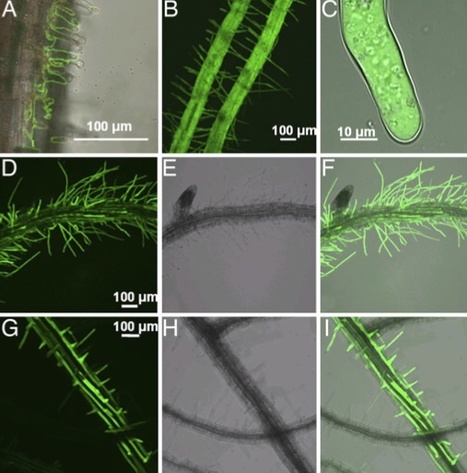
Nitrogen is quantitatively the most important nutrient that plants acquire from the soil. It is well established that plant roots take up nitrogen compounds of low molecular mass, including ammonium, nitrate, and amino acids. However, in the soil of natural ecosystems, nitrogen occurs predominantly as proteins. This complex organic form of nitrogen is considered to be not directly available to plants. We examined the long-held view that plants depend on specialized symbioses with fungi (mycorrhizas) to access soil protein and studied the woody heathland plant Hakea actites and the herbaceous model plant Arabidopsis thaliana, which do not form mycorrhizas. We show that both species can use protein as a nitrogen source for growth without assistance from other organisms. We identified two mechanisms by which roots access protein. Roots exude proteolytic enzymes that digest protein at the root surface and possibly in the apoplast of the root cortex. Intact protein also was taken up into root cells most likely via endocytosis. These findings change our view of the spectrum of nitrogen sources that plants can access and challenge the current paradigm that plants rely on microbes and soil fauna for the breakdown of organic matter.
|
|
Scooped by
Kamoun Lab @ TSL
April 4, 2013 4:03 AM
|
Resistance (R) proteins recognize pathogen avirulence (Avr) proteins by direct or indirect binding and are multidomain proteins generally carrying a nucleotide binding (NB) and a leucine-rich repeat (LRR) domain. Two NB-LRR protein-coding genes from rice (Oryza sativa), RGA4 and RGA5, were found to be required for the recognition of the Magnaporthe oryzae effector AVR1-CO39. RGA4 and RGA5 also mediate recognition of the unrelated M. oryzae effector AVR-Pia, indicating that the corresponding R proteins possess dual recognition specificity. For RGA5, two alternative transcripts, RGA5-A and RGA5-B, were identified. Genetic analysis showed that only RGA5-A confers resistance, while RGA5-B is inactive. Yeast two-hybrid, coimmunoprecipitation, and fluorescence resonance energy transfer–fluorescence lifetime imaging experiments revealed direct binding of AVR-Pia and AVR1-CO39 to RGA5-A, providing evidence for the recognition of multiple Avr proteins by direct binding to a single R protein. Direct binding seems to be required for resistance as an inactive AVR-Pia allele did not bind RGA5-A. A small Avr interaction domain with homology to the Avr recognition domain in the rice R protein Pik-1 was identified in the C terminus of RGA5-A. This reveals a mode of Avr protein recognition through direct binding to a novel, non-LRR interaction domain.
|