Your new post is loading...

|
Rescooped by
Kamoun Lab @ TSL
from TAL effector science
August 5, 2015 12:42 PM
|
(via T. Lahaye, thx) Zhang et al, 2015 Transcription activation-like (TAL) effectors are bacterial type III secretion proteins that function as transcription factors in plants during Xanthomonas/plant interactions, conditioning either host susceptibility and/or host resistance. Three types of TAL effector associated resistance (R) genes have been characterized - recessive, dominant non-transcriptional and dominant TAL effector-dependent transcriptional based resistance. Here, we discuss the last type of R genes, whose functions are dependent on direct TAL effector binding to discrete effector binding elements in the promoters. Only five of the so-called executor R genes have been cloned, and commonalities are not clear. We have placed the protein products in two groups for conceptual purposes. Group 1 consists solely of the protein from pepper, BS3, which is predicted to have catalytic function on the basis of homology to a large conserved protein family. Group 2 consists of BS4C-R, XA27, XA10, and XA23, all of which are relatively short proteins from pepper or rice with multiple potential transmembrane domains. Group 2 members have low sequence similarity to proteins of unknown function in closely related species. Firm predictions await further experimentation on these interesting new members to the R gene repertoire, which have potential broad application in new strategies for disease resistance.
Via dromius
|
|
Scooped by
Kamoun Lab @ TSL
August 4, 2015 5:44 AM
|
Plant Immunity And Microbial Effectors - Dedicated to the research done on the molecular dialogue between plants and pathogens (but also to any interesting report)
Natural Products for Plant Protection
|
|
Scooped by
Kamoun Lab @ TSL
August 4, 2015 5:38 AM
|
PhD in Plant Biology and Phytopathology. I am interested in microbiology, pathogen effectors and plant immunity.
Effectors and Plant Immunity - Strategies of plant defense and microbe attacks
Published articles - Scientific works to which I have contributed
|
|
Scooped by
Kamoun Lab @ TSL
August 3, 2015 6:39 AM
|
• A broad spectrum of fungal and oomycete mechanisms facilitate disease development. - • Biotrophic interfaces contain complex sets of components to evade host plant defences.
- • Pathogen effector secretion is a key feature for reprograming host metabolism.
- • Highly specialized effectors suppress pathogen recognition by host plants.
- • Pathogen cell wall remodeling supports the host invasion process.
Plant pathogenic fungi and oomycetes employ sophisticated mechanisms for evading host recognition. After host penetration, many fungi and oomycetes establish a biotrophic interaction. It is assumed that different strategies employed by these pathogens to avoid triggering host defence responses, including establishment of biotrophic interfacial layers between the pathogen and host, masking of invading hyphae and active suppression of host defence mechanisms, are essential for a biotrophic parasitic lifestyle. During the infection process, filamentous plant pathogens secrete various effectors, which are hypothesized to be involved in facilitating effective host infection. Live-cell imaging of fungi and oomycetes secreting fluorescently labeled effector proteins as well as functional characterization of the components of biotrophic interfaces have led to the recent progress in understanding how eukaryotic filamentous pathogens evade plant recognition.
|
|
Scooped by
Kamoun Lab @ TSL
August 1, 2015 1:00 PM
|
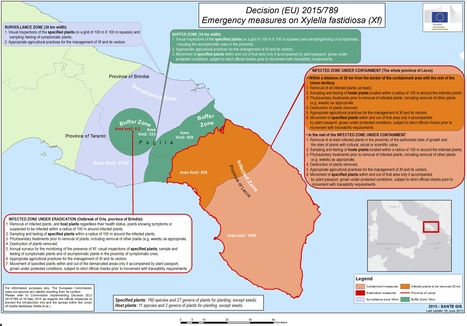
The European Commission recently published a question-and-answer factsheet on the bacterium Xylella fastidiosa on its Food Safety website.
The Xylella fastidiosa bacterium has been responsible for the destruction of olive groves in Italy’s Apulia region resulting in the adoption of urgent European Union (EU) measures to try to combat and contain the outbreak and prevent its spread to other member states of the EU.
The introduction to the factsheet points out that Xylella fastidiosa is one of the world’s deadliest plant bacteria which can have an enormous economic impact, and confirms that the outbreak affecting olive groves in Apulia is the only confirmed outbreak in the EU.
It explains that there are four different subspecies of Xylella fastidiosa and that the strain identified in Apulia is a new genetic variant which has so far only attacked olive and plum trees. The bacterium is spread by spittlebugs, cicadas and sharpshooters which feed on the infected plant tissue.
A study by the EU’s Food Safety Authority had warned that the risk of the deadly bacterium spreading to regions in other EU countries was very high. In the face of uncertainty and misinformation about the bacterium and in an effort to educate the general public, the European Commission has released the factsheet which answers six questions:
What measures have been taken by the Commission to prevent further spread into the Union territory?
How will the Commission prevent the further introduction of Xylella fastidiosa from non-EU countries?
Is there any financial support available for farmers affected by Xylella fastidiosa
Could there be other causes for the decline of olive trees since some scientific papers argue that it is caused by a combination of fungi which weaken the plants before being attacked by Xylella fastidiosa, and specific treatments seem to exist?
How can Xylella fastidiosa be controlled?
What can I do as citizen to prevent further spread of Xylella fastidiosa in the EU?
|
|
Scooped by
Kamoun Lab @ TSL
August 1, 2015 11:09 AM
|
Even though the microevolution of plant hosts and pathogens has been intensely studied, knowledge regarding macro-evolutionary patterns is limited. Having the highest species diversity and host-specificity among Oomycetes, downy mildews are a useful a model for investigating long-term host-pathogen coevolution. We show that phylogenies of Bremia and Asteraceae are significantly congruent. The accepted hypothesis is that pathogens have diverged contemporarily with their hosts. But maximum clade age estimation and sequence divergence comparison reveal that congruence is not due to long-term coevolution but rather due to host-shift driven speciation (pseudo-cospeciation). This pattern results from parasite radiation in related hosts, long after radiation and speciation of the hosts. As large host shifts free pathogens from hosts with effector triggered immunity subsequent radiation and diversification in related hosts with similar innate immunity may follow, resulting in a pattern mimicking true co-divergence, which is probably limited to the terminal nodes in many pathogen groups.
|
|
Scooped by
Kamoun Lab @ TSL
July 28, 2015 1:32 PM
|
#PlantSciCuratorsPostdoctoral scientist interested in the mode of action of effectors and particularly focusing on the Xanthomonas-Pepper interaction.
Plant-microbe interaction
Publications @ the Börnke Lab
|
|
Scooped by
Kamoun Lab @ TSL
July 28, 2015 1:29 PM
|
Plant immunity and legume symbiosis Plant roots and rhizosphere
Plant pathogens and pests
Plant hormones
GMOs & Sustainable agriculture
|
|
Scooped by
Kamoun Lab @ TSL
July 28, 2015 1:13 PM
|
Mary Williams is on Scoop.it since January 19, 2012
Plant Biology Teaching Resources (Higher Education) - Hooks and hot topics for university teachers and students
|
|
Scooped by
Kamoun Lab @ TSL
July 27, 2015 11:53 AM
|
Vesicle trafficking including exocytosis pathway is intimately associated with host immunity against pathogens. However, we have still insufficiently known about how they contribute to immunity, and how pathogen factors affect them. In this study, we explored host interactors of Magnaporthe oryzae effector AVR-Pii. Gel filtration chromatography and co-immunoprecipitation assays identified a 150 kDa complex of proteins in the soluble fraction comprising AVR-Pii and OsExo70-F2 and OsExo70–F3, the two rice Exo70 proteins presumably involved in exocytosis. Simultaneous knockdown of OsExo70-F2/F3 totally abrogated Pii immune receptor-dependent resistance, but had no effect on Pia-and Pik-dependent resistance. Knockdown levels of OsExo70-F3 but not OsExo70-F2 correlated with reduction of Pii function suggesting that OsExo70-F3 is specifically involved in Pii-dependent resistance. In our current experimental conditions, overexpression of AVR-Pii or knockdown of OsExo70-F2 and -F3 genes in rice did not affect the virulence of compatible isolates of M. oryzae. AVR-Pii interaction with OsExo70-F3 seems to play a crucial role in effector triggered immunity by Pii, suggesting the role of OsExo70 as decoy or helper in Pii/AVR-Pii interactions.
|
|
Scooped by
Kamoun Lab @ TSL
July 27, 2015 8:48 AM
|
With the tremendous progress of the past decades, molecular plant science is becoming more unified than ever. We now have the exciting opportunity to further connect subdisciplines and understand plants as whole organisms, as will be required to efficiently utilize them in natural and agricultural systems to meet human needs. The subfields of photosynthesis, plant developmental biology and plant stress are used as examples to discuss how plant science can become better integrated. The challenges, strategies and rich opportunities for the integration of the plant sciences are discussed. In recent years, more and more overlap between various subdisciplines has been inadvertently discovered including tradeoffs that may occur in plants engineered for biotechnological applications. Already important, bioinformatics and computational modelling will become even more central to structuring and understanding the ever growing amounts of data. The process of integrating and overlapping fields in plant biology research is advancing, but plant science will benefit from dedicating more effort and urgency to reach across its boundaries.
|
|
Scooped by
Kamoun Lab @ TSL
July 8, 2015 12:43 AM
|
Plants and animals rely on immune receptors, known as nucleotide-binding domain and leucine-rich repeat containing proteins (NB-LRR or NLR), to defend against invading pathogens and activate immune responses. How NLR receptors respond to pathogens is inadequately understood. We previously reported single-residue mutations that expand the response of the potato immune receptor R3a to AVR3aEM, a stealthy effector from the late blight oomycete pathogen Phytophthora infestans. I2, another NLR that mediates resistance to the wilt causing fungus Fusarium oxysporum f. sp. lycopersici, is the tomato ortholog of R3a. We transferred previously identified R3a mutations to I2 to assess the degree to which the resulting I2 mutants have an altered response. We discovered that wild-type I2 protein responds weakly to AVR3a. One mutant in the N-terminal coiled-coil domain, I2I141N, appeared sensitized and displayed markedly increased response to AVR3a. Remarkably, I2I141N conferred partial resistance to P. infestans. Further, I2I141N has an expanded response spectrum to F. oxysporum f. sp. lycopersici effectors compared to the wild-type I2 protein. Our results suggest that synthetic immune receptors can be engineered to confer resistance to phylogenetically divergent pathogens and indicate that knowledge gathered for one NLR could be exploited to improve NLRs from other plant species.
|
|
Scooped by
Kamoun Lab @ TSL
July 6, 2015 12:49 PM
|
Plants are the source of most of our food, whether directly or as feed for the animals we eat. Our dinner table is a trophic level we share with the microbes that also feed on the primary photosynthetic producers. Microbes that enter into close interactions with plants need to evade or suppress detection and host immunity to access nutrients. They do this by deploying molecular tools – effectors – which target host processes. The mode of action of effector proteins in these events is varied and complex. Recent data from diverse systems indicate that RNA-interacting proteins and RNA itself are delivered by eukaryotic microbes, such as fungi and oomycetes, to host plants and contribute to the establishment of successful interactions. This is evidence that pathogenic microbes can interfere with the host software. We are beginning to see that pathogenic microbes are capable of hacking into the plants' immunity programs.
|
|
|
Scooped by
Kamoun Lab @ TSL
August 5, 2015 6:32 AM
|
La Préfecture de Haute-Corse informe les voyageurs de l'interdiction d'introduction des végétaux dans le cadre de la lutte contre la Xylella Fastidiosa.
The prefecture of Haute-Corse inform passengers of the prohibition of introduction of plants as part of the fight against Xylella fastidiosa.
|
|
Scooped by
Kamoun Lab @ TSL
August 4, 2015 5:40 AM
|
Sebastian Schornack. Co-discoverer of the TAL effector DNA binding code. Current research focus: plant processes leading to development of symbiosome structures between roots and microorganisms (schornacklab.net)
TAL effector science - infos on novel DNA-binding proteins of bacteria and their biotech use
Plant Cell Biology and Microscopy - Methods and Tools for Plant Cell Biology
|
|
Scooped by
Kamoun Lab @ TSL
August 3, 2015 12:12 PM
|
An unprecedented number of new pathogenic fungi and variants of extant strains are emerging to cause disease in animals and plants, putting the resilience of wild and managed ecosystems in jeopardy. This meeting will unite researchers sharing a common aim – to exploit advances in biology to understand the drivers causing the emergence of fungi and to forge a research agenda to mitigate their impact.
|
|
Scooped by
Kamoun Lab @ TSL
August 1, 2015 1:04 PM
|
A bacterial infection ravaging olive trees in the far south of Italy has spread to Corsica, where emergency measures are being implemented.
Xylella fastidiosa, spread by insects, was found at Propriano in southern Corsica. The bacterium can also attack citrus trees and vineyards.
France has destroyed plants around the infected bush found in Propriano.
Xylella is one of the biggest disease threats to plants worldwide, the European Commission says.
There is no effective treatment for infected plants and new Commission regulations say the only solution is to destroy them and establish Xylella-free buffer zones around them.
Corsica - a Mediterranean island near Italy - has a small olive oil industry, with about 500 employees and more than 2,000ha (4,940 acres) of trees.
But the bacterium is a threat to about 300 plant species. It was first detected on the island last week.
On Wednesday France's Agriculture Minister Stephane Le Foll visited Propriano and pledged "a total commitment" to isolating the outbreak.
French authorities suspect that the bacterium arrived via a ferry from the nearby Italian island of Sardinia.
French health inspectors are checking ferry passengers arriving at the small Corsican port of Bonifacio, in an effort to prevent any further Xylella contamination.
|
|
Scooped by
Kamoun Lab @ TSL
August 1, 2015 11:17 AM
|
- Arbuscule branching is impaired in Medicago truncatula exo70i mutants
- Incorporation of STR and STR2 into the periarbuscular membrane is limited in exo70i
- EXO70I accumulates adjacent to the tips of the arbuscule branches.
- EXO70I partially co-localizes with Vapyrin and interacts with Vapyrin.
In eukaryotic cells, polarized secretion mediated by exocytotic fusion of membrane vesicles with the plasma membrane is essential for spatially restricted expansion of the plasma membrane and for the delivery of molecules to specific locations at the membrane and/or cell surface. The EXOCYST complex is central to this process, and in yeast, regulation of the EXO70 subunit influences exocytosis and cargo specificity [ 1, 2 ]. In contrast to yeast and mammalian cells, plants have upwards of 23 EXO70 genes with largely unknown roles [ 3–6 ]. During arbuscular mycorrhizal (AM) symbiosis, deposition of the plant periarbuscular membrane (PAM) around the fungal arbuscule creates an intracellular membrane interface between the symbionts. The PAM has two major membrane sub-domains, and symbiosis-specific transporter proteins are localized in the branch domain [ 7–11 ]. Currently, the mechanisms and cellular machinery involved in biogenesis of the PAM are largely unknown. Here, we identify an EXO70I protein present exclusively in plants forming AM symbiosis. Medicago truncatula exo70imutants are unable to support normal arbuscule development, and incorporation of two PAM-resident ABC transporters, STR and STR2, is limited. During arbuscule branching, EXO70I is located in spatially restricted zones adjacent to the PAM around the arbuscule hyphal tips where it interacts with Vapyrin [ 12–14 ], a plant-specific protein required for arbuscule development. We conclude that EXO70I provides a specific exocytotic capacity necessary for development of the main functional sub-domain of the PAM. Furthermore, in contrast to other eukaryotes, plant EXO70s have evolved distinct specificities and interaction partners to fulfill their specialized secretory requirements.
|
|
Scooped by
Kamoun Lab @ TSL
July 31, 2015 6:51 AM
|
Obligate parasitic plants in the Orobanchaceae germinate after sensing plant hormones, strigolactones, exuded from host roots. In Arabidopsis thaliana, the α/β-hydrolase D14 acts as a strigolactone receptor that controls shoot branching, whereas its ancestral paralog, KAI2, mediates karrikin-specific germination responses. We observed that KAI2, but not D14, is present at higher copy numbers in parasitic species than in nonparasitic relatives. KAI2 paralogs in parasites are distributed into three phylogenetic clades. The fastest-evolving clade, KAI2d, contains the majority of KAI2 paralogs. Homology models predict that the ligand-binding pockets of KAI2d resemble D14. KAI2d transgenes confer strigolactone-specific germination responses to Arabidopsis thaliana. Thus, the KAI2 paralogs D14 and KAI2d underwent convergent evolution of strigolactone recognition, respectively enabling developmental responses to strigolactones in angiosperms and host detection in parasites.
|
|
Scooped by
Kamoun Lab @ TSL
July 28, 2015 1:30 PM
|
I seek to understand the molecular mechanisms controlling the establishment of symbioses between plants and microbes, nitrogen fixation and the stimulation of plant growth by microbes in order to improve the use of these associations in agriculture.
Plant-Microbe Symbioses
Plant - Salmonella or E. coli Interactions
|
|
Scooped by
Kamoun Lab @ TSL
July 28, 2015 1:27 PM
|
INRA researcher in soil microbiology, mycorrhizal symbiosis, plant and fungal genomics, soil metagenomics, and tree physiology.
MycorWeb Plant-Microbe Interactions
|
|
Scooped by
Kamoun Lab @ TSL
July 28, 2015 4:56 AM
|
Surveillance of the extracellular environment by immune receptors is of central importance to eukaryotic survival. The rice receptor kinase XA21, which confers robust resistance to most strains of the Gram-negative bacterium Xanthomonas oryzae pv. oryzae (Xoo), is representative of a large class of cell surface immune receptors in plants and animals. We report the identification of a previously undescribed Xoo protein, called RaxX, which is required for activation of XA21-mediated immunity. Xoo strains that lack RaxX, or carry mutations in the single RaxX tyrosine residue (Y41), are able to evade XA21-mediated immunity. Y41 of RaxX is sulfated by the prokaryotic tyrosine sulfotransferase RaxST. Sulfated, but not nonsulfated, RaxX triggers hallmarks of the plant immune response in an XA21-dependent manner. A sulfated, 21–amino acid synthetic RaxX peptide (RaxX21-sY) is sufficient for this activity. Xoo field isolates that overcome XA21-mediated immunity encode an alternate raxX allele, suggesting that coevolutionary interactions between host and pathogen contribute to RaxX diversification. RaxX is highly conserved in many plant pathogenic Xanthomonas species. The new insights gained from the discovery and characterization of the sulfated protein, RaxX, can be applied to the development of resistant crop varieties and therapeutic reagents that have the potential to block microbial infection of both plants and animals.
|
|
Scooped by
Kamoun Lab @ TSL
July 27, 2015 10:56 AM
|
Newspaper lining the bottom of a stink bug (Podisus maculiventris, pictured, with eggs at bottom) cage may seem an unlikely impetus for scientific discovery, but it was the black and white squares of the crossword puzzle that that led Paul Abram, an entomologist working towards his Ph.D. at Université de Montréal in Canada, to suspect that stink bugs might be employing a surprising strategy when laying their eggs. Plenty of animals, like birds and other insects, lay eggs that differ in color based on what their parents eat or other factors, but scientists have never observed mothers intentionally changing the color of their eggs. Abram noticed that the eggs on the dark squares tended to be darker and vice versa. Although camouflage might be a tempting explanation for the phenomenon, subsequent experiments, in which the stink bugs were given only white fabric to lay their eggs on, revealed that the pigments served a different function. According to research published today in Current Biology, female stink bugs can change the color of their eggs depending how much light is reflecting off a surface by selectively adding a dark pigment. Because of the pigment’s ability to absorb UV light, the researchers believe that its function is to protect the delicate DNA and cellular machinery inside the developing bug. Abram likens it to sunscreen. In the wild stink bugs lay their eggs on leaves, and additional experiments showed that the bugs placed darker eggs on the top (in direct sunlight), whereas eggs on the shaded underside of the leaf contained 2.1 times less pigment on average. The identity of the pigment is still unknown, but early experiments suggest that it may be related to melanin—the most abundant dark pigment on the planet.
|
|
Scooped by
Kamoun Lab @ TSL
July 27, 2015 6:20 AM
|
Many plant-pathogenic xanthomonads rely on Transcription Activator-Like (TAL) effectors to colonize their host. This particular family of type III effectors functions as specific plant transcription factors via a programmable DNA-binding domain. Upon binding to the promoters of plant disease susceptibility genes in a sequence-specific manner, the expression of these host genes is induced. However, plants have evolved specific strategies to counter the action of TAL effectors and confer resistance. One mechanism is to avoid the binding of TAL effectors by mutations of their DNA binding sites, resulting in resistance by loss-of-susceptibility. This article reviews our current knowledge of the susceptibility hubs targeted by Xanthomonas TAL effectors, possible evolutionary scenarios for plants to combat the pathogen with loss-of-function alleles, and how this knowledge can be used overall to develop new pathogen-informed breeding strategies and improve crop resistance.
|
|
Scooped by
Kamoun Lab @ TSL
July 7, 2015 5:41 AM
|
A plant may be rooted in place, but it is never lonely. There are bacteria in, on and near it, munching away on their host, on each other, on compounds in the soil. Amoebae dine on bacteria, nematodes feast on roots, insects devour fruit — with consequences for the chemistry of the soil, the taste of a leaf or the productivity of a crop.
From 30 June to 2 July, more than 200 researchers gathered in Washington DC for the first meeting of the Phytobiomes Initiative, an ambitious proposal to catalogue and characterize a plant’s most intimate associates and their impact on agriculture. By the end of the year, attendees hope to carve out a project that will apply this knowledge in ways that will appeal to funders in industry and government.
“We want to get more money,” says plant pathologist Linda Kinkel at the University of Minnesota in St Paul. “But beyond that, let’s just all try to talk the same language and come up with some shared goals.”
Leach coined the term phytobiome in 2013,at a retreat about food security. She defines the phytobiome broadly, to encompass microbes, insects, nematodes and plants as well as the abiotic factors that influence all these.
Since then, she has visited companies, funding agencies and universities to call for a unifying phytobiomes initiative. She has teamed up with Kellye Eversole, a consultant based in Bethesda, Maryland, and the co-owner of a small family farm in Oklahoma, who has experience working on large agricultural genomics projects, including the US National Plant Genome Initiative. That initiative was launched in 1998 and continues to crank out databases and other tools for analysing plant genomes.
Leach hopes that the Phytobiomes Initiative will leave a similar legacy, but she is mindful that federal funding has tightened considerably since 1998. Still, she notes that the project can build on several emerging trends in agriculture. Industry has shown renewed interest in boosting plant growth by manipulating associated microbes (Nature 504, 199; 2013). Companies and farmers are also investing in ‘precision agriculture’, which uses high-tech monitors to track conditions in a field or even around individual plants, allowing farmers to water and fertilize in exactly the right places.
High-tech future
Eversole foresees a day when tractors will carry dipstick-like gauges that provide a snapshot of the microbial community in the soil. Data from the Phytobiomes Initiative would then help farmers to manipulate that community to their advantage, she says.
But first, the initiative needs to standardize protocols and metrics, the meeting’s attendees determined. Kinkel says that efforts are likely to focus initially on cataloguing microbes and insects and their interactions with different crops and habitats. “We’re where plant biologists were 150 years ago,” she says. “We’re still trying to inventory things.”
Work has already begun along these lines: for example, a group at the International Rice Research Institute in Los Baños in the Philippines is fishing for microbial DNA in data discarded from an effort to sequence the rice genome. The goal is to determine which microbes prefer which strains of the crop.
Kinkel, meanwhile, has begun experimenting with manipulating carbon levels in the soil to alter the microbial population, with the aim of improving plant productivity. “If we can understand better who lives on and within plants, we have the potential to manage them to have healthier, more resilient plants,” she says.
Projects such as these would move faster under an organized, cohesive framework, says Sarah Lebeis, a microbiologist at the University of Tennessee in Knoxville who is studying how plants manipulate microbial communities by secreting antibiotics into the soil. “Right now we’re working as individuals,” she says. “Having an initiative will give us focus and hopefully we’ll progress further, faster, better.”
|