


Netatmo’s June UV bracelet is one of the earliest examples of wearable tech made by women for women. Most of the focus is on its design, as its functionality is limited to measuring UV rays and warning women about sun exposure.

 Your new post is loading...
 Scoop.it! Netatmo’s June UV bracelet is one of the earliest examples of wearable tech made by women for women. Most of the focus is on its design, as its functionality is limited to measuring UV rays and warning women about sun exposure.
Richard Platt's insight:
Tracking sun exposure … and nothing else

No comment yet.
Sign up to comment
Scoop.it!

After embarrassingly stumbling about while ARM and Qualcomm won the smartphone war, Intel has no intention of missing out on the next big trend. It's betting we'll be mad about wearables in the near future, and is taking a scattergun approach to ensure it's inside the winning device.
Richard Platt's insight:
"There are two problems with Intel’s plan. Manufacturers are still trying to work out what to do with wearables, and the public still isn’t sure it actually wants them at all. Analysts are convinced wearables are going to be huge over the coming years, but regular people still need some persuasion."
Scoop.it!

You're looking at a rabbit's heart beating outside the animal that once hosted it. It's alive, pumping blood on its own thanks to a revolutionary electronic membrane that may save your life by keeping your heart beating at a perfect rate. Via Pekka Puhakka
Richard Platt's insight:
They custom made it to precisely fit the shape of the rabbit's heart: First, while the rabbit was still alive, they scanned it and created a 3D model using computer aided tomography. They manufactured the model in a 3D printer, which they used as a mold to create the membrane. After that they took the heart out, applied the membrane, and kept it beating at a perfect pace. - According to University of Illinois' materials researcher John Rorgers, co-leader of the team who has developed this device, it's like an artificial pericardium, the natural membrane that covers the heart:
Scoop.it!

Research last year by Credit Suisse called wearable tech “the next big thing” and predicted the industry was set to grow from around $3 billion to $5 billion today to $50 billion within five years. Wearable technology is an up and coming trend. You may have heard of popular of wearable [...]
Richard Platt's insight:
Accenture chimes in with their take on wearables
Scoop.it!

Wearable tech is getting a high-design makeover.
Richard Platt's insight:
“Silicon Valley has this misconception that if the technical feature is well-built enough, consumers will lap it up, no matter what it looks like. This is not the case,” adds Kate Unsworth, founder and CEO of Kovert Designs, a London-based startup that’s launching sleek, smart jewelry in time for the holidays. “Ever seen a smartwatch on the Champs-Élysées?” - Unsworth is alluding to the aesthetic shortcomings of early wearable gadgets: Bulky, squared off, masculine and plastic-y, they were not likely to find valuable wrist real estate (or face real estate, in the case of Google Glass) among image-conscious consumers.
Scoop.it!

With wearables gaining some traction, smartphones and tablets are by no means the only mobile devices around nowadays. Now, though, Cicret is looking to take things a step farther and turn your ar...
Richard Platt's insight:
It should be interesting to see if the Cicret Bracelet can improve on the technology, to make something we'd actually want to use.
Scoop.it!
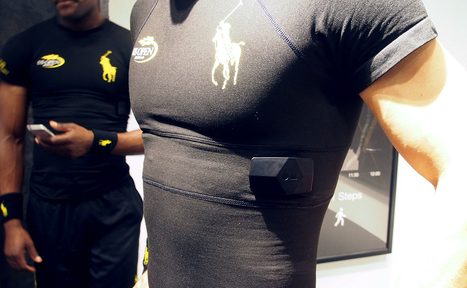
The next months could well see wearables enter the mainstream consciousness like never before. And yet, wearable technology is not without its critics.
Richard Platt's insight:
Balanced article making good points, - Going forward, developers must ensure that they are designing wearable technology that looks and feels more like consumers’ existing devices, while also adding genuinely practical new features that simply can’t be found anywhere else.

Jean-Christophe Gilquin's curator insight,
December 8, 2014 11:18 AM
Proposer de la customisation et du design pour les wearables et offrir des fonctionnalités spécifiques que d'autres device ne proposent pas déja pour inciter les consommateurs à utiliser les wearables et objets connectéés.
Scoop.it!

Leatt Coolit Evaporative Cooling Vest posted in Products-Riding Apparel-Under Garments: COOLIT EVAPORATIVE COOLING VESTS & TEES Supercharge your body’s natural cooling system. At Leatt® we take pride in our safety products, and as riders and racers ourselves, we also know there is a need for some performance enhancing products. The Coolit vests and Coolit tees are our first combination performance enhancing/safety products. Riders need to stay cool while riding. As your core temperatur...
Richard Platt's insight:
The Leatt Coolit Vest employs the simple heat transfer principles of conduction and convection to accomplish cooling the rider. Hyperkewl fabric in the vest stores the water and uses a proprietary chemical formulation to control evaporation, resulting in 10-15°F vest temperatures cooler than ambient air according to Techniche International (the inventor). Leatt advertises a 15-20°F cooler feeling with the Hyperkewl fabric incorporated into the vest. The vest is worn directly against the skin allowing body heat to be transferred into the vest via conduction. The water in the vest evaporates over time via convection, providing a cooling sensation for the rider. Leatt claims the vest is capable of cooling for one to six hours depending on weather conditions.
Scoop.it!

A California hospital has begun requiring certain patients use a wearable remote patient monitoring device in order to comply with internal patient safety protocols Via Philippe Marchal, Lionel Reichardt / le Pharmageek
Richard Platt's insight:
The wearable notifies nurses and doctors when the patient needs to be turned to avoid pressure ulcers
Scoop.it!

WHILE we await the arrival of Google Glass in Australia, other companies are getting in first with their own smart glasses — and, in fact, are starting to leave Google behind. Via Anne Bartlett-Bragg
Richard Platt's insight:
Intersecting with other technologies is how Glass-like technologies are being adapted

Anne Bartlett-Bragg's curator insight,
December 2, 2014 6:04 PM
While the detractors of Google Glass are reporting their demise - there's some really interesting research being done using other wearable devices!!
Scoop.it!

Qardio is a technology company making heart health monitoring easier and better for everyone. Our medical devices are based on proprietary technologies and are beautifully designed, with incredible attention to detail, to fit effortlessly into everyday life, making healthcare easier and more personal Via Sweat&Fuel

Sweat&Fuel's curator insight,
November 20, 2014 7:26 PM
The most pleasant looking blood pressure monitor I've seen. My flatmate used to keep his readings on a google doc taken from a bulky Boots monitor - this is so much neater! I'd prefer it to be USB chargeable though?
Scoop.it!

Wearable devices like fitness trackers or Wi-Fi-enabled spectacles are competing with traditional jewels for space on the body.
Richard Platt's insight:
Now wearables are getting a bit more stylish, a few examples to look at, a new term to consider , "smart jewels"
Scoop.it!

The tech giant spent three years collaborating with the renowned scientist on his new communication platform.
Richard Platt's insight:
Intel -- looking to give the renowned British scientist a new voice -- worked with Hawking for three years to give him a new communication platform -- called ACAT, or Assistive Context Aware Toolkit -- that is twice as fast as his old system. The Intel platform will become available for free to researchers and developers next month, with the hope that it could become the foundation for a modern communication system to help people with motor neuron diseases and quadriplegia. Intel's new toolkit can be customized for different users, and be enabled by touch, eye blinks, eyebrow movements or other inputs for communication. "The development of this system has the potential to improve the lives of disabled people around the world," Hawking said in a statement, " and is leading the way in terms of human interaction and the ability to overcome communication boundaries that once stood in the way."
|
Scoop.it!

Tech wearables don’t have to be ugly. That’s something Amanda Parkes wants to help people realiz...
Richard Platt's insight:
“If you look out there, it’s basically Misfit wearables, the Apple Watch, the Fitbit — these are companies that are basically making gadgets that are attached to your body. That’s not innovation, really.”
Scoop.it!

Fitness finally comes to the Internet.
Richard Platt's insight:
Peloton's at-home bike "it’s easily the best indoor workout I’ve ever done. All you need is a Wi-Fi connection and a power outlet. The class stream has been almost flawless over more than a dozen 45-minute workouts. The only digital glitch was one occasion when a class stream buffered for 30 seconds." - the bike is solid enough to stand and mash the pedals as you would on the road. The best technologies just get out of the way, and during Peloton workouts, it’s easy to forget that you’re using a sophisticated—and expensive—device.($2000) The tablet displays your pedal cadence, speed, and output, in both watts and calories burned. A live leader board, meanwhile, tracks your classmates’ output, providing extra motivation. Most mornings, I’ve burned 800-plus calories before even leaving the house. - “In 1995, the consumer Internet started,” Foley says. “That’s 20 years of technology innovation that has not been felt by the fitness-equipment category.” - The miniaturization of chips and sensors is making it possible to track and–here’s the key—analyze our body movement.
Scoop.it!

Smart clothing doesn't have to mean dresses covered in LEDs. It can be much more useful than that. The futuristic smart fabric XelfleX is a superb example of a wearable that doesn't involve strapping gadgets to your body. Via Pekka Puhakka
Richard Platt's insight:
XelfleX suit could be a great fit for motion capture for film, gaming and VR.
Scoop.it!
Richard Platt's insight:
In 2014, Valencell saw a staggering demand for its PerformTek biometric technology, with a 300% increase in licensing partners Additionally, the company has expanded into the gaming and first responder/military markets, where highly-accurate biometric data is also in high demand. - "The wearable industry is approaching a turning point. With more and more new products being introduced in a variety of form factors, consumers are left with many choices and limited information about what works best," said Michael Dering, CEO of Valencell. "Over time, we predict the products that provide the most accurate, comprehensive data will be the wearables that consumers will choose."
Scoop.it!

Intel may be late to the IoT game but it's working hard to catch up, emphasizing its data centers and analytics offerings as much as its chips.
Richard Platt's insight:
Not surprisingly, then, the IoT markets Intel chose to highlight put less of a priority on low power and more on processing data, an area where Intel excels. Intel used the event to launch a new IoT gateway, a device that will take in data from embedded sensors and devices and feed data to Intel’s data center chips and services

Be-Bound®'s curator insight,
December 12, 2014 5:00 AM
Maybe late in the game, but catching up fast and putting the emphasis on processor, what they know best. Intel will be in the near future a player to count on as far as IoT is concerned.
Scoop.it!

Allwinner unveiled a $6 "H3" SoC targeting $35 to $50 OTT STBs, featuring four Cortex-A7 cores, a Mali-400 GPU, 4K HDMI output, and 5MP camera support.
Richard Platt's insight:
The quad-core H3 is designed for affordable 4K OTT (over-the-top) set-top boxes (STBs), especially in its home turf of China, and sells for only $6 in volume. The targeted devices are so-called “OTT” STBs, which differ from traditional STBs in that they offer Internet access, and differ from streaming media players in that they add broadcast and cable TV services and feature content protection.
Scoop.it!

ShotTracker has three pieces, a net sensor, a wearable that slides into a wristband or compression sleeve, and an app that records all the action on court Via Carine
Richard Platt's insight:
For the next wanna be Michael Jordan / Larry Bird
Scoop.it!
The complete system to monitor sports head impact, born from the industry leader in sensor technology to measure concussive forces. For more information, vis...
Richard Platt's insight:
Potential concussion awareness technology, small and provides incidence tracking for sports. A truly useful wearable technology that can save lives.
Scoop.it!

[infographic] 30 examples on how Google Glasses can be used in the 21st Century classroom. Click here for a larger version. By www.OpenColleges.edu.au
Richard Platt's insight:
Teachers thinking on how to use wearables like Glass - interesting
Scoop.it!

A legal case in Canada is breaking new ground by using data collected from a Fitbit to assess the relative fitness of a person making an injury claim. The law firm representing the claimant is hoping to… Via Anne Bartlett-Bragg
Richard Platt's insight:
There is likely more to be said about wearables and healthcare and legal access to the information
Anne Bartlett-Bragg's curator insight,
November 23, 2014 7:15 PM
Now this is something that needs to be addressed fairly quickly!! We're already becoming more savvy about our data usage on social networks - but even more personal will be our health related data from our wearable devices!! 
Sue Walsh's curator insight,
November 24, 2014 6:04 PM
As more and more of us wear devices that record our activity, and the more invasive the data becomes (heart rate, BP, activity, sleep patterns, location) ... the bigger this issue becomes. Interesting!
Scoop.it!

BitBite is the first wearable device that helps you lose weight and improve your eating habits. Via Sweat&Fuel
Richard Platt's insight:
An indiegogo project, we'll have to see how this actually works over the long term with users
Sweat&Fuel's curator insight,
November 30, 2014 4:37 AM
The idea is very cool, not sure how I feel about the execution.
Scoop.it!

MILAN (Reuters) - Italy's Luxottica is joining forces with U.S. chipmaker Intel Corp to develop glasses that combine its top fashion brands with technology that could allow wearers to access information
Richard Platt's insight:
Luxottica's brands include Ray Ban, Oakley and Persol, while it has licenses to use brands including Chanel and Tiffany. Earlier this year, Intel teamed up with watch retailer Fossil Group and fashion brand Opening Ceremony to develop wearable devices such as fashion bracelets with communications features and wireless charging.
|






