



Wearable technology has moved far beyond eyeglasses, hearing aids, wristwatches and pacemakers. Now that significant computing power can be packed…

 Your new post is loading...
 Scoop.it! Wearable technology has moved far beyond eyeglasses, hearing aids, wristwatches and pacemakers. Now that significant computing power can be packed… 
No comment yet.
Sign up to comment
Scoop.it!

With heavyweight tech brands like Apple, Microsoft and Nike getting into the scene, wearable healthcare technology is bound to gain visibility and achieve usability a lot faster. Via Sam Stern, Lionel Reichardt / le Pharmageek
Richard Platt's insight:
Scoop.it!
Richard Platt's insight:
An Important read, e.g.: Wearable Tech: “is to support immediate, real-world actions by providing relevant, contextual information precisely at the point of decision-making.” - something we call, Modification and Redefinition by the User and the Decision Maker at the point of decision making / learning.
Scoop.it!

It's two days after HTC launched its first wearable, the Grip smartband, in partnership with Under Armour, and a week before the health obsessed and heart rate tracking Apple Watch has its latest event. And Ayse Ildeniz isn't happy. Speaking to Wareable at MWC 2015, Intel's VP of New Devices wished she had seen a…
Richard Platt's insight:
Excellent interview with Intel VP of New Devices Group Ayse Ildeniz - "It's all fitness, fitness, fitness, do everything, do everything, do everything. There is not enough specialisation and expertise around other usage models - that's what we were hoping would take off here. - "Ultimately we need to drive small enough, cheap enough modular based systems that any designer can take and embed into their new trend, design of the year or the season for that matter. Today building a wearable or a technology part is very expensive and it relies on entirely economics of volume which is done on millions of standardisation." - Can't say it enough, Use Case, Use Case, Use Case before the Go/No-Go decision on the development decision.
Scoop.it!

Fossil will be introducing its own technology platform later this year. It's been working with Google and Intel since last year to develop wearable technology. The Richardson-based watch and accessories…
Richard Platt's insight:
The Texas based watch and accessories maker told analysts Thursday that its platform will be used to make what it’s calling connected accessories, but there are no USB ports in these new designs.
Scoop.it!

When Google revealed earlier this year that it was pulling Google Glass from tech store shelves, it was a surprise for many, considering the hype the wearable
Richard Platt's insight:
In an interview, Sony Mobile Communications President Hiroki Totoki told reporters, “It’s easier for us to determine how users will use our devices in the B2B market. The biggest benefit of wearable technologies is that they free up both hands. So we will be looking at what kind of workers want information on a real-time basis, in what kind of circumstances and what information they need.”
Scoop.it!

The real push on the first generation Apple Watch is health.
Richard Platt's insight:
While in Germany, CEO Tim Cook said the watch would be waterproof and said it would be a replacement for car keys and other physical items people tend to carry around with them, like a wallet. Cook also claims that while some people don't see a reason for owning a wearable, the Apple Watch will provide more than enough to change a customer's lifestyle and make them an active wearable user. The real push on the first generation Apple Watch is health, something Cook is very interested in progressing with the wearable. The smartwatch will feature dozens of sensors to collect all types of health and fitness information. - Will Apple's smartwatch actually be a useful wearable for the mass market?
Scoop.it!
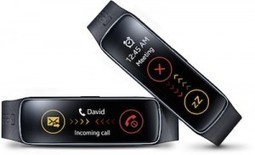
With the Apple Watch launch, and its potential to upend the wearables market, a few months away, Canalys reports that the current market leader for “smart wearable bands” — any wristworn device that can run third-party applications — is Samsung. Meanwhile, the “basic wearable band” market, which Canalys defines as wearables that can’t run apps, is still led by Fitbit. The up-and-comer in the non-smartwatch wearable market is Xiaomi, whose focus on the Chinese market and low price point have catapulted it into the spotlight. It has shipped more than a million Mi Bands, 103,000 of those on the first day. “Though the Mi Band is a lower-margin product than competing devices, Xiaomi entered the wearables market with a unique strategy, and its shipment volumes show how quickly a company can become a major force in a segment based solely on the size of the Chinese market,” analyst Jason Low said in a statement. Canalys didn’t share the total shipment numbers for basic bands, but said 4.6 million smart bands shipped in 2014, only 720,000 of which were Android Wear. Of those, Motorola led the market with its Moto 360. Samsung led the smart band segment overall, owing to the wide range of devices the company has available. “‘Samsung has launched six devices in just 14 months, on different platforms and still leads the smart band market,” VP and principal analyst Chris Jones said in a statement. “But it has struggled to keep consumers engaged and must work hard to attract developers while it focuses on [operating system] Tizen for its wearables.” Canalys predicts Apple’s entry into the market will blow up the category, and says the device’s battery life will be the main advantage over Android Wear to begin with. “Apple made the right decisions with its WatchKit software development kit to maximize battery life for the platform, and the Apple Watch will offer leading energy efficiency,” analyst Daniel Matte said in a statement. “Android Wear will need to improve significantly in the future, and we believe it will do so.”

Cheryl Palmer's curator insight,
February 19, 2015 7:06 PM
WEARABLES - Market report summary on the current (Feb 2015) state of the wearables market with link to data source. Useful to get insight into where major players are focusing their development dollars.
Scoop.it!

The Swiss have finally entered the smartwatch fray. But is this the kind of device people actually want?
Richard Platt's insight:
Coming only a few weeks after Swatch announced it will release a smartwatch to compete with the Apple Watch, a new Swiss company called Manufacture Modules Technologies (MMT) has introduced a line of smartwatches made in Switzerland. MMT is a joint venture between Silicon Valley wearable-technology company Fullpower Technologies and Union Horlogère Holding, which owns Swiss watchmakers Frederique Constant and Alpina.
Scoop.it!

The LG Watch Urbane LTE runs on the LG Wearable Platform, which traces its roots back to the beloved old mobile operating system. Via Kenneth Carnesi,JD
Richard Platt's insight:
The use of WebOS, which LG acquired from Hewlett-Packard in 2013, on both devices suggests the company has more ambitious plans for its proprietary operating system. WebOS, like Samsung's Tizen mobile operating system, could be a way for LG to pare back on its dependence on Google and its Android operating system and power multiple products with its own platform.
Scoop.it!

News: a new smartwatch from Pebble that promises seven days of battery life has reached its $500,000 Kickstarter goal in less than 20 minutes. (more…) Via Brian Yanish - MarketingHits.com
Richard Platt's insight:
A promised 7 day battery life. A follow-up to the original Pebble watch, Pebble Time incorporates a colour e-paper display more akin to an e-book reader than the LCD or OLED screens typically found on smartphones. The company says this will allow the watch to deliver up to seven days of battery life – outpacing its nearest competitors by days.
Scoop.it!

There is new data on a skin patch that may be able to protect nearly three million Americans who suffer from peanut allergies. Doctors say, so far, the results show promise. Don Dahler reports.
Richard Platt's insight:
A wearable technology, just not one with electronic monitoring aspect, although with just a little imagination one could see how this type of technology could benefit by having it integrated with that particular function
Scoop.it!

Wearables Shipments to Jump to 75 Million in 2015, Up 158% on 2014 – Apple Watch to account for over a quarter of wearables shipments in 2015 – By 2018 almost 350 million wearable devices will be in use worldwide. Sales of wearables will grow from 29 million in 2014 to 172 million in 2018, … Via IoT Business News
Richard Platt's insight:
Last year confirmed that North America will remain the biggest market for wearables in the near term. This region accounted for more than half of global sales in 2014 and that momentum continues in 2015. CCS Insight’s consumer surveys indicate extremely high levels of awareness of wearable devices, but the challenge is translating this into sales
|
Scoop.it!

The technology industry is as subject to trends as the fashion, football or financial worlds. Remember when it was sexier to have a small, compact mobile phone? Now - we've got the Google Nexus 6.
Richard Platt's insight:
"The truth is that your average punter is reluctant to splash £200 on a blocky rectangular watch when they've already plonked down £500 or more for a phone that does everything they need it to do. I won't stop being excited by wearable technology - who doesn't want to see innovation coming along But, until smartwatches operate for longer than 48 hours without being charged, and work without a phone, they'll never become a must-have product."
Scoop.it!

Apple is poised to unveil its much-anticipated Apple Watch. It's the first time Apple is venturing into a new product category since it revolutionized the tablet market with the iPad almost five years ago. Jill Schlesinger reports.
Richard Platt's insight:
CBS News video report: On the eve of bringing out the Apple Watch. Battery life was pointed out to be a challenge, but that the Watch was a higher priced than competitive offerings and that if only 10% of IPhone/iPad users bought one, that would be 15 million users, which would be 55% of the current wearable market. - So we'll have to wait and see if it takes off as much as Apple has tried to make it work.
Scoop.it!

EVERYTHING you need to know about the latest smartwatches, trackers and virtual reality headsets.
Richard Platt's insight:
Use Cases are a little better, truth is that these wearables look spiffier, but I don't see the breakthrough application that makes these killer / got to have, because it helps me do something I couldn't do otherwise in a significant better way. - Just saying designers do not seem to be paying attention on how to redefine what people are doing, which is the point of making something smart.
Scoop.it!

Barcelona is widely known for its love of tapas, football and Gaudi, but it has also become a hotbed of technological innovation.
Richard Platt's insight:
This year, smartwatches and virtual reality headsets also took centre stage. Both are at a crucial stage. We're witnessing the launch of products that will either define their categories, or fail to make their mark entirely. For these reasons, the Barcelona congress has never been more essential.
Scoop.it!

The NFL's technological boom has made players such as Andrew Hawkins wary about evaluation techniques.
Richard Platt's insight:
More than 1/2 of the NFL's teams employ some form of player tracking during training camp and regular-season practices, ostensibly to monitor exertion and prevent injuries. And in 2014, the NFL for the first time tracked players during games in the same way. It doesn't yet release the data to teams, but it seems unlikely to remain locked in the digital vault forever.
Scoop.it!

From
www

These 9 medical wearables are about to significantly impact the future of breast cancer, smoking and more. Via Sam Stern, Lionel Reichardt / le Pharmageek
Richard Platt's insight:
Specific Use Case driven innovations for health care, excellent list of examples. Lesson from all of this: find and address a specific need, and there is a demographic that will need that capability, thus a market to sell to.
Scoop.it!

University of Tokyo researchers have developed a "fever alarm armband," a flexible, self-powered wearable device that sounds an alarm in case of high body temperature. This armband will be presented at the 2015 IEEE International Solid State Circuits Conference, San Francisco, on 22-26 February, 2015. The flexible organic components developed for this device are well-suited to wearable devices that continuously monitor vital signs including temperature and heart rate for applications in healthcare settings. Via Dr. Stefan Gruenwald
Scoop.it!

Tomorrow's wearables might not turn on your microwave or help you get out of a bad date. But they could save lives. Via Rémy TESTON, DIRECT MEDICA by Webhelp, Lionel Reichardt / le Pharmageek
Richard Platt's insight:
A study by the McKinsey Global Research Institute suggests that a wearable approach to preventive care may be more cost-effective than existing solutions. Through continuous monitoring rather than periodic testing, physicians could reduce treatment costs by as much as 10% to 20%, saving billions of dollars in the care of congestive heart failure alone, the study said.
Scoop.it!

Wearable Technology And The Way We Run is constantly being changed with innovative new products that are designed to help us run better.
Richard Platt's insight:
The innovative technologies listed show what to expect to see in the second iteration of sports technology. Big data and performance analytics are no longer reserved for the high-tech sports labs. Everyone, from the casual athlete to the elite competitor, now has the ability to take their game to the next level with these solutions.
Scoop.it!
Richard Platt's insight:
As first noted by MAKE: Magazine’s Boris Kourtoukov, “there’s a plethora of options” when it comes to these microcontrollers. What’s more, they all possess one common trait: they’re powered by Atmel. These so-called body boards are now giving Makers the ability to easily (and affordably) produce their own projects in ways that otherwise would have been unimaginable. - Great set of prototype boards for the wearable domain.
Scoop.it!
In the final months of 2014, wearable technology sparked significant media and consumer attention – not least thanks to the announcement of the Apple Watch. Via TechinBiz
Richard Platt's insight:
Smartwatches shift existing technology to a new location – from the pocket to the wrist. More exciting are second-skin devices such as embeddables, ingestibles and hearables. These will include flexible technologies that blend into our skin; devices that are controlled by eye-motion sensors; and earbuds that measure and respond to our heart rate. All are part of the ongoing journey to create technology that is so deeply interwoven with our lives that it becomes almost invisible. The benefits of this transition will be better usability and genuinely groundbreaking technology that goes beyond incremental developments.
Scoop.it!

Richard Platt's insight:
The report says Apple executives had a tough time figuring out “why a consumer would need or want such a device” once those health features were nixed. - It’s unclear if Apple will add the features it originally wanted for the Apple Watch, like blood pressure and blood oxygen level tracking, into a later iteration of its watch: According to the WSJ, the Apple Watch project was internally labeled as a “black hole” because it drew a ton of resources over a development span of +4 years.
|







Dot the "i's" and cross the 't's" of legal before you go to market with your wearable device.