Wearable Tech and the Internet of Things (Iot)
22.8K views | +0 today
Wearable Tech and the Internet of Things (Iot)
Your new post is loading...
Scooped by Richard Platt
April 14, 2015 1:30 AM
Scoop.it!

Wearable Tech Will Shift From Novelty To Norm In The Next 5 Years

Wearable Tech Will Shift From Novelty To Norm In The Next 5 Years | Wearable Tech and the Internet of Things (Iot) | Scoop.it
Though this prediction is still a few years out from the year 2020, 83 percent of experts say wearable tech will have a "widespread and beneficial effect" on the public by the year 2025, according ...
Richard Platt's insight:

Though predictions on ramifications varied, most agreed, “there will be a global, immersive, invisible, ambient networked computing environment built through the continued proliferation of smart sensors, cameras, software, databases, and massive data centres.”  -  “Enterprises need to start putting together a road map for thinking about how wearables can improve their businesses over the next few years,” according to Forrester’s report. “In other words, they need to embark now on the early stages of the enterprise wearables journey.”

No comment yet.
Scooped by Richard Platt
April 14, 2015 1:23 AM
Scoop.it!

Google Eyes On The Wearable Tech Market; Develops An Android Wear App For Use On iPhones

Google is coming up with an Android Wear app for use on iPhones. If Google’s solution can pair the Android supported smart watches with iPhones, the search engine giant will get an opportunity to tap the huge market captured by Apple iPhones.
Richard Platt's insight:

If Apple allows the inclusion of the Android Wear App in its Apple App Store, it will offer a lot of variety to iPhone consumers who can pair their iPhones with any smart watch supported by Android. Google had launched the Android Wear in March 2014 to offer wearable technology products.

No comment yet.
Scooped by Richard Platt
April 14, 2015 1:20 AM
Scoop.it!

Smart Fabric Technology Creates Electricity For Wearable Devices

Researchers in South Korea create "smart fabric" which can generate electricity to power your devices.
Richard Platt's insight:

Wearable technology is a booming market so it comes as no surprise researchers in South Korea have developed a "smart fabric" that can create electricity to power wearable devices. The fabric is a wearable triboelectric nanogenerator and has the capacity to power a wide array of gadgets.   -  "People try to remove static electricity in daily life and attempts to use it as an energy source were quite limited,” said Professor Kim Sang-Woo, leader researcher and professor at School of Advanced Materials Science and Engineering at Sungkyunkwan University, to Reuters. “That's why we started this research, to use static electricity as an energy source."  -  According to the researchers, the friction between layers of silver-coated textile and organic polymer film is what generates the electricity. When the textile rubs against the film, the resulting friction generates enough electricity to power lights, screens and other devices.

No comment yet.
Scooped by Richard Platt
April 14, 2015 12:56 AM
Scoop.it!

RI Hospital uses Google Glass to diagnose skin conditions

RI Hospital uses Google Glass to diagnose skin conditions | Wearable Tech and the Internet of Things (Iot) | Scoop.it
Patients say they prefer video consults to telephone consults.
Richard Platt's insight:

13 months ago, was profiled by a local TV station where the emergency medicine residents, were using Google Glass Technology on dermatology patients. - Doctor Paul Porter's team found that patients preferred video consults to the more widely practiced telephone consult.  -  “For patients, a fast and accurate diagnosis means a faster path to satisfactory treatment,” Porter, M.D., the principal investigator and a physician in the emergency department of Rhode Island, Hasbro Children's and The Miriam hospitals, said in a press release. “A device like this democratizes telemedicine because a hospital can start a program for a few thousand dollars and gain access to an experience that was only previously available at a much higher price point.”

No comment yet.
Scooped by Richard Platt
April 12, 2015 11:45 PM
Scoop.it!

10 Best Wearable Tracking Devices To Keep Kids Safe

10 Best Wearable Tracking Devices To Keep Kids Safe | Wearable Tech and the Internet of Things (Iot) | Scoop.it
All parents want to keep their children safe. But the debates between
the different parenting styles used to keep our kids safe are heated, and safety is defined a bit differently for every way of parenting. Free-range parents would never leash their child. Helicopter parents would
never let their child take the subway alone. But when it comes to
crowded events, theme parks, or giving our children the independence to
venture out in the world alone, will the latest trend in child safety be
c
No comment yet.
Scooped by Richard Platt
April 12, 2015 11:40 PM
Scoop.it!

Internet of Useless Things site mocks our reliance on technologies

Internet of Useless Things site mocks our reliance on technologies | Wearable Tech and the Internet of Things (Iot) | Scoop.it
Technology is continually changing, but is it always for the better? The Internet of Useless Things site seems to think this is not the case.
Richard Platt's insight:

In a successful effort to point out how superfluous our obsession with technology has become, some smart and awfully funny folks decided to create a site called the The Internet of Useless Things.  At this stage I'm almost willing to suggest that smartwatches should be mocked up on this site.

No comment yet.
Scooped by Richard Platt
April 11, 2015 5:53 PM
Scoop.it!

Most Britons would wear a smartwatch at work - if it improved their job

Most Britons would wear a smartwatch at work - if it improved their job | Wearable Tech and the Internet of Things (Iot) | Scoop.it
Poll shows a majority would use technology to give their employers personal data if it improved their working conditions
Richard Platt's insight:

The level of support ranges from 40% for people over 55, up to 70% for those aged 18 to 34.  -  Support is much higher among Britons who already use a fitness tracker or a smartwatch, a group where 87% of people would be happy to give such data to their employer.  -  However, 41% of those polled said they would not trust their employer not to use their data against them in some way.
“Many workers still have an understandable ‘big brother’ reaction to sharing any of their personal data with their employers, but our research shows that most people can be persuaded if they can see clear personal or workplace benefits,” said Anthony Bruce, people analytics leader at PwC, which commissioned the survey. “People are also more open to the idea if the data are anonymised and shared at an aggregate level, rather than being personalised.”  -   Among those who were happy with the idea of feeding personal data to their employer, 71% said they would feel comfortable revealing how long they spend travelling back and forth to the office and 45pc would share their blood pressure with their boss.

No comment yet.
Scooped by Richard Platt
April 9, 2015 1:36 AM
Scoop.it!

The wearables from NASA that made it back to Earth

The wearables from NASA that made it back to Earth | Wearable Tech and the Internet of Things (Iot) | Scoop.it
What has spaceflight ever done for us? A hell of a lot, actually – and aside from trying to get humans to Mars, NASA's technology has trickled down to a host of wearable gadgets. NASA makes a huge investment in technology and each year it releases a report called Spinoff. This details all of the…
Richard Platt's insight:

Awesome set of examples of how wearable technology originally developed by NASA and how we're seeing it in use today  --   very interesting.

No comment yet.
Rescooped by Richard Platt from Wearable Devices
April 8, 2015 11:00 PM
Scoop.it!

A Look at Smart Clothing for 2015

A Look at Smart Clothing for 2015 | Wearable Tech and the Internet of Things (Iot) | Scoop.it

eProducts for shirts, babies, and others. 2015 will be one of those banner years when it comes to the emerging smartwatch and smartclothes market. The market across the world for smart technology products is looking to increase big time over last year’s numbers.


Via Anne Bartlett-Bragg
Richard Platt's insight:

The emphasis on these wearables here are on sports and physical fitness training, and the last couple of directions being on baby/child monitoring.  Nonetheless it's a beginning on better understanding the use cases that people are seeking to uncover and build products and services around.

Anne Bartlett-Bragg's curator insight, April 8, 2015 3:35 AM

These smart clothing initiatives are getting really exciting... watch this space - more to come!

Scooped by Richard Platt
April 7, 2015 11:43 PM
Scoop.it!

Wearable Military Tech Spots Targets and Threats

Wearable Military Tech Spots Targets and Threats | Wearable Tech and the Internet of Things (Iot) | Scoop.it
New devices enable soldiers to pinpoint threats and respond intuitively. Continue reading →
Richard Platt's insight:

The Aviation Warrior system that allows pilots to stay informed of new intelligence about their surroundings. - The device pulls maps, sensor imagery, video and messaging data from multiple military networks and is integrated with a survival radio and GPS. There’s also a thin display that can be worn on the wrist, leg or vest, allowing the system to work away from a helicopter or plane.  -  With the Aviation Warrior system, pilots in the cockpit can also use a helmet to see visual data displayed through a monocle in front of the eye. Using head-tracking and Google Glass-like technologies, mission data — such as targets or known enemies — are labeled in the field of view

No comment yet.
Scooped by Richard Platt
April 7, 2015 12:56 PM
Scoop.it!

We Can Design the Future of Wearables for Social Good

We Can Design the Future of Wearables for Social Good | Wearable Tech and the Internet of Things (Iot) | Scoop.it
By 2018, more than 100 million wearable technology devices will be sold, but few will be used in 'developing countries.' The past decade has seen the proliferation and miniaturization of technology interventions--from laptops to cell phones and table...
Richard Platt's insight:

Wearables for international development interventions require a heightened focus on designing for local context, user feedback loops, and addressing privacy concerns. While planners want to know certain data that goes up the change of custody, wearables should empower users by collecting and providing data that users also find valuable. For example, a wearable providing data on nutrition deficiencies to health officials would not be useful to the user unless they are also educated in nutrition. To justify wearing something on their bodies, data should benefit people in the moment, argued one discussant. "The more intimate technology becomes, the greater responsibility you have for how you use it," he said.

Moolahonly's curator insight, April 7, 2015 4:33 PM

We would like to partner with Wearable Tech firms,http://bit.ly/1ENNPtR ;

Scooped by Richard Platt
April 6, 2015 6:23 PM
Scoop.it!

Pauline van Dongen creates phone chargeable Solar Shirt

Pauline van Dongen creates phone chargeable Solar Shirt | Wearable Tech and the Internet of Things (Iot) | Scoop.it
After her last year's breakthrough innovation, Wearable Solar, Dutch fashion designer Pauline van Dongen has come up with a revamped version titled
Richard Platt's insight:

The Solar Shirt generates power from 120 thin-film solar cells integrated into its fabric. In bright sunlight, it produces around 1 W of electricity – enough to charge a typical phone in a few hours. Indoors, the shirt generates enough power to keep a battery charged.

HUBMODE's curator insight, April 14, 2015 3:31 AM

Les vetements capteurs d'energie

Scooped by Richard Platt
April 6, 2015 4:04 PM
Scoop.it!

Evalise launches line of fashion-forward Wearables for Women (WfW)

Evalise launches line of fashion-forward Wearables for Women (WfW) | Wearable Tech and the Internet of Things (Iot) | Scoop.it
Wearables are arguably the most talked-about tech of 2015. Apple is dominating the recent conversation with its Apple Watch announcements, but there are countless other companies making fitness trackers, body cameras,… Read More
Richard Platt's insight:

Evalise, a new Seattle startup launching this week with a line of “wearables for the working woman.”


Explain what you do so our parents can understand it: Evalise, a new Seattle startup launching this week with a line of “wearables for the working woman.” “We create ‘smart’ bag inserts that allow any standard-sized tote to organize itself, power your devices on the go, have hands-free communication capabilities, and automate ordering for your most beloved items.”


Inspiration hit us when “We started conceptualizing. The conceptualization phase was the most fun, where everything and anything was initially possible. From there, we zeroed in on exactly which features to implement first and how.”

No comment yet.
Scooped by Richard Platt
April 14, 2015 1:27 AM
Scoop.it!

Concept Glasses From AVG Can Trick Any Facial Recognition Software

Concept Glasses From AVG Can Trick Any Facial Recognition Software | Wearable Tech and the Internet of Things (Iot) | Scoop.it
Security firm AVG has developed a pair of "invisibility glasses" that protect wearers from security cameras and other facial recognition technology. Infrared light emitted from small LEDs on the gl...
Richard Platt's insight:

“Rather than designing a product for market release, tech experts are investigating how technology can adapt to combat the daily erosion of our privacy in the digital age. There are a number of reasons why invisibility glasses could be a valuable privacy tool in the future. The increasing use of smartphone cameras in public places means it’s more likely unsolicited images taken of us end up online.” AVG said in statement.

No comment yet.
Scooped by Richard Platt
April 14, 2015 1:22 AM
Scoop.it!

3 Tips for Securing Wearable Technology In the Work Place

3 Tips for Securing Wearable Technology In the Work Place | Wearable Tech and the Internet of Things (Iot) | Scoop.it
Wearables will open new possibilities for effeciency and cyber vulnerability. It's not too early to get policies in place.
Richard Platt's insight:

To secure any mobile technology, enterprises need to adopt a containerized approach where corporate data is separated from personal data and secured. According to Gartner, smartwatches will make up 40 percent of consumer wristworn devices by 2016. While just a year ago only two of the top 10 smartphone vendors were in the wearable space, today nine out of the 10 top smartphone vendors have entered the market.  -  Wearable technology is on the rise, and just as we saw with BYOD, employees will continue to bring wearable devices to work to increase efficiency. Many enterprises are just now planning and implementing their overall mobile strategies and policies to ensure the security of corporate data, and wearables must be a part of that discussion.

No comment yet.
Scooped by Richard Platt
April 14, 2015 1:19 AM
Scoop.it!

Smartwatches Do Little for Journalists But More Useful Wearables Are on the Way

Smartwatches Do Little for Journalists But More Useful Wearables Are on the Way | Wearable Tech and the Internet of Things (Iot) | Scoop.it
Don't look to this first wave of wearables for much that changes how journalists do their jobs gathering news. Coming next, however, are things such as a wrist-launched personal drone and jersey-mounted sports cameras that could open up whole new edi...
Richard Platt's insight:

Take for instance how sports reporting might be enhanced through point-of-view, live-stream video cameras that are small and rugged enough to sew into players' shirts for football, rugby and other sports contests. Such a camera, along with a stripe of biometric sensors that wirelessly transmit real-time heart rate and other performance data to sports fans, is the idea behind First V1sion. The Barcelona-based startup was a finalist last November in Intel's competition. 

No comment yet.
Scooped by Richard Platt
April 13, 2015 7:23 PM
Scoop.it!

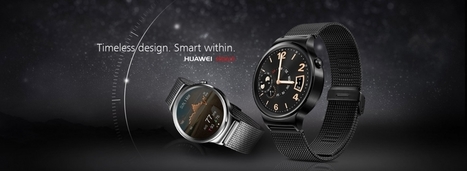
Huawei Smartwatch Brings A Beautiful Classical Look To Android Wear

Huawei Smartwatch Brings A Beautiful Classical Look To Android Wear | Wearable Tech and the Internet of Things (Iot) | Scoop.it
Huawei debuted its first smartwatch Sunday, upgrading its mobile device ambitions with an Android Wear-powered model designed to look as much as possible like a classical round-face timepiece. "Peo...
Richard Platt's insight:

“People prefer the traditional classical watch, but today, smartwatches are not traditional,” said Richard Yu, chief executive of Huawei’s consumer product group.  The Huawei Smartwatch’s 42mm circular face, stainless-steel housing, and array of 40 face looks is designed to bring more of the analogue watch feel to the digital smartwatch world. Arriving in mid-2015, perhaps in June, but he price was not revealed.

No comment yet.
Scooped by Richard Platt
April 12, 2015 11:45 PM
Scoop.it!

Of drones, wearables, and connected onesies

Of drones, wearables, and connected onesies | Wearable Tech and the Internet of Things (Iot) | Scoop.it
With a small drone in his pocket, and a big bounce in his step, Daniel Kraft, MD, took an audience of about 600 CIOs Sunday back to the future, reminding them that the future is now.
Richard Platt's insight:

The experienced Ted Talk speaker, Kraft delivered a rapid-fire slide show that included sound effects. The talk – fast, serious and punched with humor – left the audience thoughtful and also laughing at the prospect of a future that includes a tweet pee app and connected onesies. As Kraft noted, the future is now.

Kraft is a Stanford and Harvard trained physician-scientist, inventor, entrepreneur, and innovator, with more than 20 years of experience in clinical practice, biomedical research and healthcare innovation. He has also chaired the Medicine Track for Singularity University since the university' founding.  There are big opportunities for healthcare to switch from a sick system," he said, reminding the audience that "smart phones have only been around for seven years.  "All these things are moving at an exponential pace,"   Among some of the healthcare-changing technology he sees for today and in the future:

• Instead of merely swimming in data, healthcare providers are finding ways to make it actionable. Instead of data overwhelming providers – and consumers, it can start to be magical.

• Innovators, providers and consumers are going from wearables to "insidables."

• You can do a digital checkup from virtually anywhere.

• Meditation has been found beneficial for wellbeing, and there is a device that can boost its power.

• Surgeons can print stents at the point of care.

"The future is already here." Kraft concluded. "We're going well beyond the EMR now."


No comment yet.
Scooped by Richard Platt
April 12, 2015 12:03 AM
Scoop.it!

Disney's MyMagic+: The future of wearable technology?

Disney's MyMagic+: The future of wearable technology? | Wearable Tech and the Internet of Things (Iot) | Scoop.it
Disney's MagicBands opens up a whole new experience as this wearable makes every aspect, transaction easier.
Richard Platt's insight:

When you book your trip, you also select these MagicBands, wearable RFID/ NFC wristbands that are supposed to make your trip more enjoyable. They act as your park tickets, room key, reservation keeper, FastPass and other magical access. They arrive a few weeks/months later, all depending on how far in advance your trip is booked. You receive them in the mail and I feel like this is where the experience really begins. You have these wristbands, customized with your name etched/printed on the sides. If you want to take it up a notch there are accessories you can buy to add on to the band’s grommets. There are also special wristbands you can pay for, the pair I had came free with our stay at the resort. For example, the Haunted Mansion ones that has a special chime when you swipe your band across the reader in front of the attraction. So you see the system is highly adaptable and customizable.

No comment yet.
Scooped by Richard Platt
April 9, 2015 6:47 PM
Scoop.it!

Google is working on making Android Wear compatible with iOS

Google is working on making Android Wear compatible with iOS | Wearable Tech and the Internet of Things (Iot) | Scoop.it
If it's true, iPhone users won't be stuck with the Apple Watch—they'll be able to pick from the wide selection of Android Wear devices, too.
Richard Platt's insight:

Third-party developers have already figured out how to make this work in a hack-y, kludge-y way, and apparently that’s how the iOS-related code was initially discovered. One developer claims that Google’s been working on since Android Wear 4.4.  -  Jeff Chang, Android Wear product manager, had also hinted at the possibility that Google could be working on iOS compatibility. “We always want as many as possible to enjoy our experience,” Chang told the Huffington Post back in October. “In terms of enabling more people to use Android Wear, we’re very interested in making that happen.”  -  There are a few hurdles before any of this can become a reality. For one, Chang reminds us in the Huffington Post interview that “…it’s not 100 percent under [Google’s] control.” Why would Apple, with its famously, well-manicured walled garden allow Android into the fold? Especially since it’s been struggling to kick Google’s apps and services, either by devoloping its own apps (Apple Maps) or choosing Google competitors (making Bing the search default for Spotlight searches).  -  Android Wear watches would work with the iPhone via a companion app that would push notifications and Google Now cards to the wearable.

No comment yet.
Scooped by Richard Platt
April 9, 2015 12:22 AM
Scoop.it!

New Samsung Patent For Smartwatch Could Be Worrisome For Rivals

New Samsung Patent For Smartwatch Could Be Worrisome For Rivals | Wearable Tech and the Internet of Things (Iot) | Scoop.it
New patent filings revealed that SAMSUNG ELECT LTD(F) (OTCMKTS:SSNLF) is busy advancing its own version of a stylish smartwatch.
Richard Platt's insight:

Samsung seems to be entering the business end of a launch that promises to provide stiff competition to the highly anticipated Apple Watch and the fashionable Moto 360. When Apple publicized news of filing an early patent for its upcoming smartwatch in 2013, reports spread like wildfire and generated much fanfare for the product - which is finally about to roll out for pre-orders in a couple of days in three different variations. Samsung responded with its own patent in September of the same year, and incorporated a fresh rotatable display for its future wearable gadget.

No comment yet.
Scooped by Richard Platt
April 8, 2015 2:14 PM
Scoop.it!

Apple Watch-reviewers chime in: Slow apps, and low battery life limit appeal of the wearable

Apple Watch-reviewers chime in: Slow apps, and low battery life limit appeal of the wearable | Wearable Tech and the Internet of Things (Iot) | Scoop.it
* Gadget is for pioneers for now - WSJ* Battery barely lasts a day and recharge time is slow -CNET* SocGen sees sales of 8 mln units in 2015 (Adds details on app performance, SocGen sales forecast,shares)By
Richard Platt's insight:

* Gadget is for pioneers for now - WSJ

* Battery barely lasts a day and recharge time is slow - CNET


 Apple Inc's "beautiful" and "stylish" smartwatch could make life easier for people on the move, reviewers say, but the gadget gets poor marks for battery life and slow-loading apps. - The watch, the first new product to be launched by Apple under Chief Executive Tim Cook, will hit stores on April 24.  "For now, the Apple Watch is for pioneers," the Wall Street Journal's Geoffrey Fowler wrote. "I won't pay the $1,000 it would cost for the model I tested, only to see a significant improvement roll in before too long."

No comment yet.
Scooped by Richard Platt
April 7, 2015 12:59 PM
Scoop.it!

Why the Time Isn’t Ripe for Smartwatches

Why the Time Isn’t Ripe for Smartwatches | Wearable Tech and the Internet of Things (Iot) | Scoop.it
Anyone who isn’t a self-described early adopter might want to avoid the entire category of wearables, including the Apple Watch, at least for a few more years. The devices are expected to evolve at a breathtaking pace.
Richard Platt's insight:

“Right now there is tremendous innovation in [display technology for smartwatches],” says David Singleton, director of engineering for Android Wear, Google Inc.’s software for smartwatches. “Next year’s technology will be a step change from last year’s. And, if you asked me which will dominate in five years, I couldn’t tell you which will,” It isn’t just display technologies, of which there are at least a half dozen on various smartwatch models. The capabilities of processors on smartwatches also vary tremendously from one model to another, as do the types of sensors and radios they include.  -  All of these components have been repurposed from smartphones. In fact, modern smartwatches are all essentially answers to this question: “Which parts of a smartphone does it make sense to put on a person’s wrist?”  -  Because miniaturization of those components is proceeding apace, each model of smartwatch is a different argument about a smartwatch’s mission.

No comment yet.
Scooped by Richard Platt
April 7, 2015 12:55 PM
Scoop.it!

One Place where Wearables and Big Data intersect - Wearable data shapes Virgin Active's tech future

One Place where Wearables and Big Data intersect - Wearable data shapes Virgin Active's tech future | Wearable Tech and the Internet of Things (Iot) | Scoop.it
Fitness fanatics are bored with basic wearables and expect more data-driven gym services
Richard Platt's insight:

Where wearables and Big Data analytics intersect  "Caddy explained that this is no easy task, and Virgin Active has work to do to make the best use of its members' data to create and deliver valued services.  He explained that simply harvesting data from devices such as GPS locators, step and heart rate monitors results in 31 million data points per year.   Expanded across Virgin Active's 1.4 million members, the amount of data that needs to be handled and analysed becomes enormous. Caddy said he and his IT team have not yet found a way to deal with this huge task.  - "This is analytics on a big scale and no one has solved that problem. I've been round and talked to a lot of companies and no one has solved it yet."

No comment yet.
Scooped by Richard Platt
April 6, 2015 4:15 PM
Scoop.it!

A Smart Bag That Could Be More Useful Than a Smartwatch

A Smart Bag That Could Be More Useful Than a Smartwatch | Wearable Tech and the Internet of Things (Iot) | Scoop.it
The HiSmart satchel shows how today's bags might benefit from some smarts of their own.
Richard Platt's insight:

HiSmart, a new bag from Chinese design company Lepow, is built around that idea of streamlining interactions. It’s no Birkin, but the satchel shows how today’s bags might benefit from some smarts of their own. - Qifang Dai and Ray Lei created the HiSmart bag to make life easier for commuters. It can transform from backpack to messenger bag, but either way, the marquee feature is its strap, which hosts the HiRemote. The silver disc features two Bluetooth chips that communicate with an app on your phone, even if it’s buried deeply within your bag. The remote has a simple interface: ‘plus’ and ‘minus’ buttons control music volume and let you skip tracks. A triangle button answers or ignores calls. A circular button handles the extras, like dropping a pin (to remember where you parked, say), recording notes with a built-in mic, and taking pictures.

No comment yet.