


Moodle and Web 2.0
176.9K views |
+1 today
Filter by date
Tags
 Your new post is loading...
 Scoop.it! 
Exploring Curation as a core competency in digital and media literacy education ... In his seminal white paper on participatory culture, media education scholar Henry Jenkins explored the capacity of new media technologies to facilitate critical inquiry, active exploration and vibrant dialog online. Wrote Jenkins et al. (2009): "Participatory culture is emerging as the culture absorbs and responds to the explosion of new media technologies that make it possible for average consumers to archive, annotate, appropriate, and recirculate media content in powerful new ways. A focus on expanding access to new technologies carries us only so far if we do not also foster the skills and cultural knowledge necessary to deploy those tools toward our own ends" (p8). Jenkins highlights the type of online activities that participatory spaces enable-archive, annotate, appropriate and recirculate-which occur in real time and in the context of abundant information flow. The habits that participatory technologies facilitate also offer a range of opportunities to facilitate more savvy information navigation, curation and appropriation. Jenkins (2006) identified a core set of key skills that "build on the foundation of traditional literacy, research skills, technical skills, and critical analysis skills taught in the classroom." (p4). The identified skills- play, performance, simulation, appropriation, multitasking, distributed cognition, collective intelligence, judgment, transmedia navigation, networking, and negotiation - have at their core the ability to engage multimodal inquiry, multimedia platforms, and information abundance through curation. Via Heiko Idensen 
Michele Ivanisevic's curator insight,
May 2, 2013 2:00 PM
Curation is a useful tool to teach students how to filter the vast amounts of information they are exposed to each day. It provides curriculum links to media literacy and advances skills necessary to navigate an ever-changing world dictated by various technological elements.
Scoop.it!
Juergen Wagner's insight:
Great Tool!
Scoop.it!

A must reference for every teacher/educator/lecturer/parent/student intended to enhance learning using web technologies Via Ana Cristina Pratas 
Ana Cristina Pratas's curator insight,
April 29, 2013 2:06 AM
Especially of interest for teacher trainees. 
Christine Bushong's curator insight,
May 1, 2013 3:32 PM
Web 2.0 tech tools for educators, published 2013.
Scoop.it!

Mind mapping is a great way to brainstorm, make a plan, or turn ideas into the steps needed to make it real. Thankfully, there are great tools out there to help you build mind maps, organize them, and save them for later. Via Baiba Svenca, Marta Florkiewicz-Borkowska 
Willem Kuypers's curator insight,
January 5, 2015 6:04 PM
Les comparaisons sont toujours interessantes, mais à lire selon ses besoins.
Scoop.it!

plerudulier's comment April 27, 2013 4:03 AM
wouldn't it be better to have your list on a google spreadsheet instead of a doc? columns of cells for titles, links, comments, etc. #JustSaying
Scoop.it!

From
esetec

#Curso presencial: Gestión de cursos en moodle #ects #tenerife http://t.co/jBxNZTtP6D
Scoop.it!

If you are not comfortable using real photos to represent yourself in any online profiles and avatars, why not create a cartoon characters of yourself? Via Juana Rodríguez
Scoop.it!

BKF's curator insight,
April 30, 2013 9:50 PM
When you're ready to find some new tools...here you go!
Scoop.it!


Sam Taylor's curator insight,
May 1, 2013 9:01 AM
I'm pretty sure we were looking at doing an open online course on using moodle to teach... |
Scoop.it!

Serge Courrier's curator insight,
May 3, 2013 10:13 AM
Pas beaucoup de commentaires... mais comme toujours un joli travail de sélection de la part de Robin Good et quelques solutions que je ne connaissais pas ! 
Gerda van Doorn's comment,
May 5, 2013 4:01 AM
Another possibility is Symbaloo, great for categorising.
Scoop.it!

Víctor V. Valera Jiménez's curator insight,
May 4, 2013 11:49 PM
Interesante PDF que nos presenta una serie de herramientas para la publicación online como Slideshare, Wobook, Docstop, Yudufree... 
Christoph Meier's curator insight,
May 5, 2013 6:00 AM
Prof. Mohamed Amin Embi von der Universiti Kebangsaan Malaysia hat in diesem Dokument aus 2012 insgesamt 10 Web2.0 Publishing Werkzeuge im Hinblick auf Möglichkeiten ihrer Verwendung in Lehr-Lernprozessen angeschaut. Betrachtet werden Scribt, Issuu, Youpublisher, Calameo, Myebook, Flipsnack, Yudufree, Docstoc, Wobook und Slideshare. Nach einer kurzen Charakterisierung (anscheinend basierend auf den Selbstdarstellungen der jeweiligen Services) werden anhand von Screenshots die Benutzeroberfläche und grundlegende Funktionalitäten aufgezeigt. Details etwa dazu, wie mit den verschiedenen Werkzeugen welche Arten von Medien (Audio, Video, etc.) in die entstehenden E-Books eingebunden werden können finden sich leider nicht. Ebensowenig eine vergleichende Charakterisierung / Bewertung der Werkzeuge.
Scoop.it!
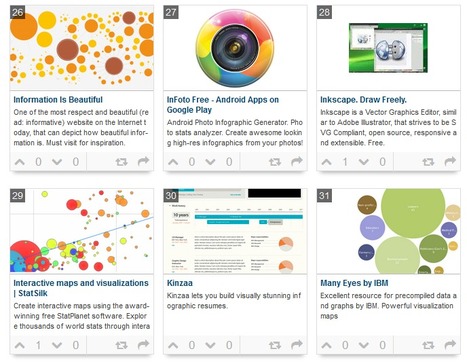
Infographics are interesting–a mash of (hopefully) easily-consumed visuals (so, symbols, shapes, and images) and added relevant character-based data (so, numbers, words, and brief sentences). The learning application for them is clear, with many academic standards–including the Common Core standards–requiring teachers to use a variety of media forms, charts, and other data for both information reading as well as general fluency... Via Baiba Svenca, Marie-Hélène Fasquel-Erhart 
maite collados's curator insight,
January 14, 2014 11:24 AM
Las infografías son una herramienta muy útil por su factor visual: en poco espacio y de forma visulamente agradable y atrayente, engloba datos y relaciona conceptos. 
ManufacturingStories's curator insight,
July 30, 2014 7:50 AM
For more resources on Social Media & Content Curation visit http://bit.ly/1640Tbl
Scoop.it!

Making an effective eLearning courses is not an easy job. Done poorly, your course can end up being a waste of time.
Scoop.it!

Landesinsitut für Pädagogik und Medien Saarland
Scoop.it!

This is my response to the stimulating and interesting post Instructivism, Constructivism or Connectivism by Ryan Tracey. Ryan writes: From a practical perspective then, is the popular “evolution”... Via Ana Cristina Pratas 
Ken Morrison's curator insight,
April 27, 2013 2:53 AM
I'm sharing this link because I have been very interested in both connectivism & constructivism learning theories for a few years. 
Tricia Makowiak's curator insight,
July 2, 2018 7:19 AM
This short article describes the differences between instructivism (teacher-center learning), constructivism, and a new term connectivism using the old scenario of the 4 blindfolded people describing an elephant to each other.
The author points out that any or all of the above “isms” could be used depending on the desired learning outcome, student audience, and desired role of the instructor. A journey through all three methods can facilitate reaching a deeper level of understanding through discussing and sharing multiple perspectives drawn from experiences of the individual students to create multi-dimensional ideas and views of the topic. I believe this depth of understanding may not be achievable using only the perspective of a single person (the instructor), especially in adult education which may encompass students who are also professionals in their fields.
Scoop.it!

Simple, collaborative screen sharing. You each get your own mouse, and you're both always in control. |












Find out how you can enhance teaching using selected Web 2.0 interactive tools.
Web 2.0 Interactive Tools for the Classroom