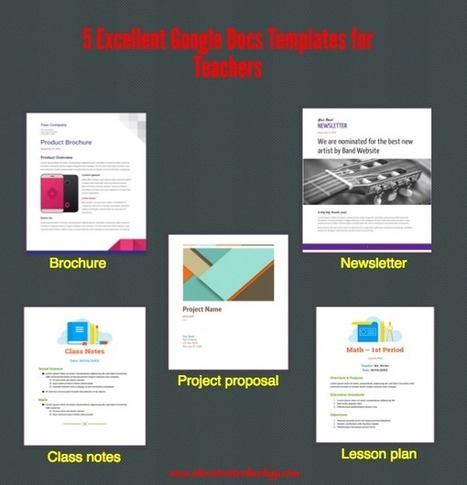
As you probably know, the old Google Docs gallery will be unavailable early 2017 and to access pre-made templates users will have to exclusively use the new Docs Gallery. When you open Docs gallery you will see a notification prompting you to use the new gallery. This is available for Docs, Slides and Sheets. However, today we have spent sometime sifting through the collection of templates available in the new Google Docs and picked out the titles below. These are especially useful for teachers planning to: create newsletters for their class, design project proposals, write book reports, create lesson plans, and make brochures to share with students. To access and use any of these templates, go to Docs Gallery and click on 'More' on top right hand side search for name of the template:
"According to Code.org, 90 percent of parents in the U.S. want their children to learn computer science—it will be crucial for many jobs in the near future—but only 40 percent of schools teach it. Critics claim that it is mainly the more affluent schools that offer computer science courses, thus denying those who attend poorer schools the chance to learn necessary skills. A focus on STEM is not enough: Code.org also reports that while 70 percent of new STEM jobs are in computing, only 7 percent of STEM graduates are in computer science. It is imperative that savvy schools begin to focus some STEM resources on computer science and programming.
In my opinion, parents of every student in every school at every level should demand that all students be taught how to code. They need this skill not because they’ll all go into it as a career—that isn’t realistic—but because it impacts every career in the 21st-century world. Any country recognizing that will benefit in the long term.
With the following resources, you can teach programming to every student and every age."
The oft-shared John Dewey quote “Education is not preparation for life; education is life itself.” is one that resonates with progressive educators around the world. Our education system however, seems to have missed all of those tweets and Pinterest pins. In a recent podcast (listen below) with Getting Smart’s Emily Liebtag, I mentioned moving students from consumers to creators to contributors. Justin Tarte had said this in my TeachThought Podcast with him earlier this year and I appreciated that language. It certainly is a great step to shift our teaching and learning from having students just consuming information to the top of Bloom’s taxonomy where they are creating. That next step, however, where their creations are at least potentially adding value to their community and perhaps the world at large is powerful. While it’s true that our students are indeed the future, there are real reasons why we need to remember that they are also a big part of our today and our teaching and learning should reflect that.
“ One of the most important parts of assessment is deciding how to organise student work. A great way for students to be more involved in the assessment process is to let them curate and present their achievements throughout your course. That’s why digital tools and platforms provide a such fantastic options for measuring progress: they... Read More”
Via paul rayner, Bhushan Thapliyal
On Thursday Padlet unveiled a new feature that lets you comment on the notes that your students write on Padlet walls. Commenting on your students' notes could be a great way to ask them clarifying questions or to just let them know that you are reading what they share. In the video embedded below I demonstrate how to use Padlet's commenting feature.
It is possible to gamify any Moodle 2 course using out-of-the-box Moodle features. Watch this video to learn how to gamify your Moodle courses in under 2
"The Microsoft HoloLens uses augmented reality. The HTC Vive, Oculus Rift, and Sony PlayStation VR use virtual reality. What's the different between these high-tech headsets? ..."
Providing technical support for a large fleet of devices that travel between school and home is no simple task. Jeff Mao, who helped lead the nation's first statewide 1-to-1 learning program, discusses the importance of updating support models and other ways to stay dynamic and prepared.
We present iTILT’s currently available resources in teacher education and continuing professional development (Koenraad et al., 2013) and report on the interim results of the new project, including examples of technology-mediated language tasks.
Presentation at the College of Economic and Management Sciences (CEMS), University of South Africa (Unisa) Leadership Summit 21 -22 November 2016, Manhattan …
Moodle Badges are the fastest way to add engagement to your course. In less than an hour, you can take ANY course and boost learner motivation + completion.
To get content containing either thought or leadership enter:
To get content containing both thought and leadership enter:
To get content containing the expression thought leadership enter:
You can enter several keywords and you can refine them whenever you want. Our suggestion engine uses more signals but entering a few keywords here will rapidly give you great content to curate.


 Your new post is loading...