Your new post is loading...

|
Scooped by
heather dawson
May 18, 5:39 AM
|
Schools have been briefed with vital information to safeguard pupils online in response to an emerging AI threat from blackmailers. The essential guidance lays down the risks of sharing images and videos of pupils on websites and social media platforms, giving key advice for managing children’s image security in education settings.
|
|
Scooped by
heather dawson
May 11, 7:19 AM
|
The Media Reform Coalition and partners have published an Alternative Green Paper, bringing together civil society proposals for a more democratically governed, publicly accountable BBC -one that treats its funders, the public, as real participants in shaping its future.
|
|
Scooped by
heather dawson
May 9, 2:45 PM
|
Older adults are more likely to show stronger confidence in traditional news outlets while teens and young adults distribute trust more evenly across traditional outlets and alternative sources of information like independent creators.
|
|
Scooped by
heather dawson
May 8, 4:03 AM
|
The Observatory on Social Media (OSoMe, pronounced awe•some) unites data scientists and journalists in studying the role of media and technology in society, and building tools to analyze and counter disinformation and manipulation on social media. hosted by Indiana University, studying the role of media and technology in society, and building tools to analyze and counter manipulation on social media.it includes social social media raw datasets as well as papers and reports
|
|
Scooped by
heather dawson
May 6, 5:13 AM
|
This guide provides evidence-based practical tips and checklists on how to manage screen time for children and adolescents in Singapore to help them build a normalised, lifelong relationship with technology. The guide discusses how screen use has both positive and negative effects. It finds screen use has a less significant role in wellbeing than other factors.
|
|
Scooped by
heather dawson
April 30, 5:04 AM
|
AMSR has some very rich material documenting research conducted for the BBC. Peter Menneer, who was Head of BBC Research, 1978-1992, and Graham Mytton, who was Head of Audience Research for the BBC World Service1982-1998, have donated unique reports and papers, both from their own collections and the BBC Archives. The relevant section heading in the BBC World Service section in the archive can be found here: https://amsr.contentdm.oclc.org/digital/collection/BBC-WS
|
|
Scooped by
heather dawson
April 30, 3:05 AM
|
Artificial intelligence is reshaping journalism, from how stories are discovered and produced to how newsrooms operate and engage with audiences. The development of the MethodKit for Journalism & AI was supported by Germany’s Federal Ministry for Economic Cooperation and Development.
|
|
Scooped by
heather dawson
April 27, 9:41 AM
|
Children in Northern Ireland (CiNI) has published a report about its online safety project which aimed to amplify the voices and experiences of children and young people. Delivered in partnership with the NSPCC, the project involved working with a youth advisory group of 10 young people aged 14- to 17-years-old through workshops, a stakeholder engagement and youth voice amplification event, and youth-led creative opportunities such as producing podcasts and social media content. By the end of the project, the young people reported increased confidence and communication skills, and their work and insights played a part in influencing policy discussions, safeguarding campaigns and education tools. Key recommendations from young people include: starting online safety education earlier and involving young people in shaping solutions and resources intended for them
|
|
Scooped by
heather dawson
April 20, 5:52 AM
|
New Study Finds South African Newsrooms Rapidly Adopting AI – But Gaps in Training, Policy and Local Tools Remain This study provides one of the first comprehensive assessments of how South African newsrooms are adopting and using AI. The research finds that AI tools are already widely used for tasks such as research, summarisation, transcription, and drafting content, yet adoption remains informal and uneven across organisations. Most journalists reported receiving little to no formal training on AI, raising concerns about ethical use, accuracy, and the risk of declining public trust. The study highlights the urgent need for structured training, clear editorial guidelines, and the development of tools tailored to African languages and contexts.
|
|
Scooped by
heather dawson
April 20, 5:47 AM
|
Younger audiences find and consume news in ways that are meaningfully different, and their information-seeking behavior is a signal to the changes that publishers should anticipate from audiences in general. That’s a key finding in the just-released Next Gen News 2 report, which surveyed 5,000 adults across five countries and included 84 in-depth interviews with […]
|
|
Scooped by
heather dawson
April 20, 5:02 AM
|
Programme 2026 International Journalism Festival #ijf26 many recordings now available online
|
|
Scooped by
heather dawson
April 14, 11:41 AM
|
|
|
Scooped by
heather dawson
April 10, 2:32 AM
|
A new 7amleh report examines how EU funding and exports of high-risk AI systems contribute to surveillance, repression, and human rights violations in Palestine and the wider region.
|
|
|
Scooped by
heather dawson
May 13, 5:22 AM
|
|
|
Scooped by
heather dawson
May 11, 5:39 AM
|
This report explores parents' and children's views on the Online Safety Act, including what's working so far (and what isn't).
|
|
Scooped by
heather dawson
May 8, 5:48 AM
|
APC member Pollicy just published a collaborative report with the African Internet Rights Alliance that analyses the digital landscapes of Uganda, Kenya and South Africa to find that without "gender-by-design" frameworks, the systems governing our IDs, payments and data reproduce historical inequalities.
|
|
Scooped by
heather dawson
May 8, 4:03 AM
|
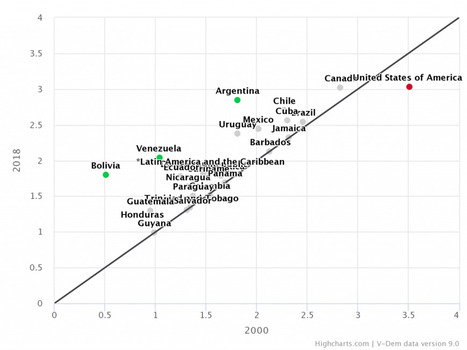
Digital Society Project (DSP) data has been updated for 2026 by VDem . it provides a comprehensive dataset on the relationship between digital technologies and democratic governance. The latest release (Dataset v8) covers the 2000–2025 period across 179 countries has indicators on online censorship, disinformation, and government control Free download
|
|
Scooped by
heather dawson
May 5, 6:06 AM
|
house of commons library briefing
|
|
Scooped by
heather dawson
April 30, 3:07 AM
|
The European Broadcasting Union developed a generative AI tool that allows journalists and the public to interact directly with a trusted database of millions of articles.
|
|
Scooped by
heather dawson
April 29, 2:38 AM
|
Social media inarguably poses threats to democracy: disinformation and misinformation, polarisation, echo chambers, bots and rage-inducing algorithms. Exce
|
|
Scooped by
heather dawson
April 22, 6:07 AM
|
Postdigital Intimacies presents a unique and timely collection of research into the complex interplay and entanglement between digital and analogue relationships. Set within the normalisation of digital technology, cultures, AI and algorithms, the book explores social, political and cultural implications of intimacy in a blurry public–private. Chapters are informed by intersectional feminist, queer, anti-racist and […]
|
|
Scooped by
heather dawson
April 20, 5:49 AM
|
|
|
Scooped by
heather dawson
April 20, 5:03 AM
|
The Global Misogyny News Coverage Tracker unearths endemic violence against women yet low coverage of these stories. Across 1.14bn articles, misogyny-related coverage hit a 1.3% low in 2025. Survivor-, solutions- and system- based angles are needed.
|
|
Scooped by
heather dawson
April 14, 11:45 AM
|
In a global landscape where regulatory frameworks for digital platforms are evolving at uneven speeds, a new study takes a pragmatic look: what can regulators do today when laws do not yet exist, are insufficient, or have gaps in their implementation?
This paper examines current experiences across Europe—both within and beyond the European Union—to identify practical approaches already in use.
The focus is on non-statutory measures: tools that can be implemented within existing mandates, while still allowing for future legal expansion.
|
|
Scooped by
heather dawson
April 10, 2:33 AM
|
This research explores the impacts of TFGBV on the experiences of Black Brazilian women, as well as documenting how we/they have been resisting, creating connections with each other and finding joy in spite of the hostility of online environments.
|