 Your new post is loading...

|
Scooped by
CIHEAM News
February 14, 2020 8:55 AM
|
Food systems are increasingly globalized and interdependent, and diets around the world are changing. Characterization of national food supplies and how they have changed can inform food policies that ensure national food security, support access to healthy diets and enhance environmental sustainability. Here we analysed data for 171 countries on the availability of 18 food groups from the United Nations Food and Agriculture Organization to identify and track multidimensional food supply patterns from 1961 to 2013. Four predominant food-group combinations were identified that explained almost 90% of the cross-country variance in food supply: animal source and sugar, vegetable, starchy root and fruit, and seafood and oilcrops. South Korea, China and Taiwan experienced the largest changes in food supply over the past five decades, with animal source foods and sugar, vegetables and seafood and oilcrops all becoming more abundant components of the food supply. In contrast, in many Western countries the supply of animal source foods and sugar declined. Meanwhile, there was remarkably little change in the food supply in countries in the sub-Saharan Africa region. These changes led to a partial global convergence in the national supply of animal source foods and sugar, and a divergence in those of vegetables and ...
|
|
Scooped by
CIHEAM News
February 11, 2020 8:21 AM
|
World Grain, 04/02/2020 — Poor weather conditions, rail strikes and strong global competition in the wheat market affected Canada’s 2019-20 wheat season, according to a report from the Foreign Agricultural Service of the U.S. Department of Agriculture (USDA). Canadian wheat growers dealt with a wet planting season, dry growing season and a wet and snowy harvest season decreasing the estimate for production. According to the USDA, Canada’s area seeded to all wheat was reduced by 40,000 hectares, area harvested reduced by 162,000 hectares, and production revised . . .
|
|
Scooped by
CIHEAM News
February 7, 2020 6:45 AM
|
6 février 2020, Rome - En janvier, les prix mondiaux des produits alimentaires ont enregistré une hausse pour le quatrième mois consécutif. L'indice FAO des prix des produits alimentaires a affiché une moyenne de 182,7 points au cours de ce mois, soit 0,7 pour cent de plus qu'en décembre et 11,3 pour cent de plus qu'au même moment l'année dernière. Les huiles végétales et le blé ont été les denrées qui ont pesé le plus dans l'indice qui suit les changements mensuels des cours mondiaux des denrées alimentaires les plus couramment commercialisées. L'indice FAO des prix des huiles végétales a augmenté de 7,0 pour cent en un mois, atteignant son niveau le plus élevé depuis trois ans étant donné que les prix des huiles de palme, de soja, ...
|
|
Scooped by
CIHEAM News
February 7, 2020 6:40 AM
|
Reporterre, 07/02/2020 - Alors que les surfaces consacrées à l’agriculture biologique ont augmenté de manière exponentielle depuis 2000, la Tunisie n’a toujours pas pris de virage résolument écologique. L’agriculture bio reste destinée à l’export, exclut la petite paysannerie et exerce une forte pression sur les ressources naturelles. Sidi Bouzid (Tunisie), reportage.
Cela fait deux ans que Leïla Horchani est propriétaire d’une ferme minuscule. Des poules, quelques coqs, sept vaches, deux juments, un troupeau de 150 chèvres et (...)
|
|
Scooped by
CIHEAM News
February 7, 2020 6:31 AM
|
ADIAC, 06/02/2020 - La troisième édition du forum des Panafricaines se tiendra du 6 au 7 mars à Casablanca au Maroc avec pour thème : "les changements climatiques et leur impact sur le continent africain". Les Panafricaines ont décidé de placer cette problematique dans les priorités de leur traitement médiatique, d'autant plus que leur continent ne produit que 4 % des émissions mondiales de gaz à effets de serre d’une part, et d’autre part, au cœur de leurs actions de sensibilisation, que ce soit auprès des décideurs ou des opinions publiques africaines. « A l’heure où, l’Union africaine appelle à mobiliser un front africain uni contre les effets néfastes du changement climatique, à travers le développement de stratégies d’adaptation et de résilience, et où l’ONU souligne que 2020 constituera un tournant pour l’action climat, les Panafricaines s’attèleront pendant leur forum, à travers ces ateliers, à aiguiser les angles à partir desquels, elles construiront leur agenda 2020 », souligne un communiqué de presse.
|
|
Scooped by
CIHEAM News
February 6, 2020 12:54 PM
|
Dans le contexte actuel de la réforme de la PAC, cette note traite de l'évolution des relations entre l'Union européenne et les États membres, à travers l'exemple particulier du principe de subsidiarité Dans le contexte actuel de la réforme de la PAC, cette note traite de l'évolution des relations entre l'Union européenne et les États membres, à travers l'exemple particulier du principe de subsidiarité
|
|
Scooped by
CIHEAM News
February 5, 2020 8:34 AM
|
S&P Global Platts, 23/01/2020 - The ongoing rally in Russian wheat prices is set to continue amid strong demand, weather-driven expectations of lower crops in key exporting countries, and Russian farmers holding back supply as the ruble appreciates. Russian wheat prices have been rallying since September, tracking the international market. S&P Global Platts assessed Russian 12.5% protein wheat FOB deep sea at $233.25/mt on Wednesday, an 11-month high. Support came from higher origination costs, driven primarily by an 8% appreciation in the ruble against the dollar since September and farmers holding onto grain. Rising origination costs resulted in liquidity drying up on the Russian FOB market.
|
|
Scooped by
CIHEAM News
February 5, 2020 8:27 AM
|
Business Standard, 27/01/2020 - Data compiled by National Collateral Management Services (NCML, a non-government body) shows a 6.3 per cent rise to 109 million tonnes. Wheat output in India is likely to hit a record high this year, pushed by a favourable climate and increase in government support prices, which encouraged more sowing. Data compiled by National Collateral Management Services (NCML, a non-government body) shows a 6.3 per cent rise to 109 million tonnes (mt). The Union ministry of agriculture’s first advance estimate was 100.5 mt, as compared to 102 mt in last year’s fourth advance estimate...
|
|
Scooped by
CIHEAM News
February 5, 2020 8:04 AM
|
* Soybeans drop on China virus fears * Wheat, corn also fall * China not buying in U.S. despite trade deal CNBC, 28/01/2020 - Chicago soybean fell again on Tuesday to around their lowest since mid-December on fears the coronavirus outbreak in China will disrupt demand. Wheat and corn also fell. Lack of evidence China is increasing purchases of U.S. farm products after the Phase One trade deal between the two countries also depressed prices. Chicago Board of Trade most-active soybeans were down 0.8% to $8.90 a bushel at 1203 GMT, having hit $8.88-1/4 a bushel on Monday, the lowest since Dec. 12. Wheat fell 0.6% to $5.68-1/2 a bushel, corn fell 0.4% to $3.78-3/4 a bushel. European equity markets rebounded early on Tuesday after Monday’s falls, which saw investors worried about the economic fallout from the coronavirus outbreak in China. Germany has confirmed its first case of the virus, raising concerns about the spreading of the flu-like illness after the death toll in China climbed to 106. The disease has also appeared in France. Soybeans, corn and wheat are all down today largely because of the risk-avoidance mood in the market because of ...
|
|
Scooped by
CIHEAM News
February 4, 2020 10:28 AM
|
https://colloque.inrae.fr/agriculture-europeenne-2050 Cette étude s’interroge sur l’évolution de la place de l’Europe dans les échanges mondiaux de produits agricoles à l’horizon 2050, compte tenu des effets à venir du changement climatique sur la productivité agricole, et des impacts environnementaux des usages des terres. Elle s’inscrit dans la continuité de travaux prospectifs sur l’évolution de la sécurité alimentaire mondiale tels que ceux conduits par INRAE, la FAO (Organisation des Nations unies pour l'alimentation et l'agriculture), ou encore l’IFPRI (International Food Policy Research Institute). Elle a été conduite INRAE (Délégation à l'Expertise scientifique collective, à la Prospective et aux Etudes) à la demande de l’association Pluriagri*. Des hypothèses d’évolution, à l’horizon 2050, des différentes composantes du système agricole et alimentaire ont été élaborées pour 21 régions du monde, dont 8 en Europe. Le travail s’est particulièrement attaché à caractériser les incertitudes relatives à l’évolution des rendements végétaux à l’horizon 2050 sous l’effet conjoint du changement climatique et des évolutions techniques agricoles (sélection variétale, pratiques agricoles, etc.).
|
|
Scooped by
CIHEAM News
February 4, 2020 9:59 AM
|
EU Grains dashboard 20 January 2020. Large areas with temperature accumulation surplus and rain deficit: Northern and Eastern Europe, parts of Southern Europe, Central Morocco. Lebanon and south-eastern Turkey and Mediterranean Spain jar with rain surplus.
|
|
Scooped by
CIHEAM News
February 4, 2020 8:57 AM
|
World Grain, 22/01/2020 — Ongoing strikes that have disrupted France’s rail and port activities could have a severe impact on the cereal sector, Reuters reported citing French grain industry players. The month-long public transport strike has made it difficult for grain producers to get their crop to ports and factories. Intercereales, the French grain organization, said in a letter on Jan. 20 that the situation is now dramatic for grain exports. “The grain industry cannot go without train freight, which is particularly adapted to massive grain transport, nor without ports to export nearly 50% of its production,” Intercereales said in a letter seen by Reuters. “The strikes ... are paralyzing the marketing campaign that was expected to be better than in previous years.” Some livestock feed producers have experienced outages because they can’t bring in enough crops, according to farm sector representatives. Intercereales said 450,000 tonnes of grain worth some 100 million euros ($111 million) were blocked in French ports, Reuters said. The lobby group warned that international clients were now turning to alternative origins, including northern Europe, Baltic countries and the Black Sea. . .
|
|
Scooped by
CIHEAM News
February 4, 2020 8:42 AM
|
World Grain, 27/01/2020 — The annual Alltech Global Feed Survey, released on Jan. 27, estimates that international feed tonnage decreased by 1.07% to 1.126 billion tonnes of feed produced in 2019, due largely to African swine fever (ASF) and the decline of pig feed in the Asia-Pacific region. It was the first decline in global production since Alltech began the annual survey nine years ago. The top nine feed-producing countries, according to the survey, are the United States, China, Brazil, Russia, India, Mexico, Spain, Japan and Germany. Together, these countries produce 58% of the world’s feed production and contain 57% of the world’s feed mills, and they can be viewed as an indicator of overall trends in agriculture. China had been the top feed-producing country, but its pork industry was rocked by ASF, which resulted in the culling of half of its pig herd. The global data, collected from 145 countries and nearly 30,000 feed mills, indicates feed production by species as: broilers 28%; pigs 24%; layers 14%; dairy 12%; beef 10%; other species 6%; aquaculture 4%; and pets 2%. Predominant growth came from the layer, broiler, aqua and pet feed sectors. The following are regional results from the survey. . .
|
|
|
Scooped by
CIHEAM News
February 14, 2020 4:19 AM
|
Agritel, 11/02/2020 - For many years now, Russia has been a price maker of world wheat prices. That is why the market's attention is focused on the development of country’s grain sector. Russia’s target by 2035 is to increase its grains exports to 64 Mt. In the first quarter of 2020, the Ministry should provide a detailed action plan of the agriculture development. The authorities take the matter seriously, since the agro sphere has become strategically important for Russia. This sector has taken a similar importance as the weapon or energy sectors. In August 2019, the Russian government published a document on the long-term development of the agricultural sector until 2035. The strategy provides 3 scenarios for the global agricultural market future: optimistic, basic and pessimistic. Thus, all the calculations for the development of the Russian grain complex are also divided into three different types. It should be mentioned that the basic scenario is shaped as moderately optimistic. Indeed, it integrates the positive trend of growing agricultural consumption in the world over the past 10 years. This trend means that consumption will be ahead of production in developing countries. In addition, the authors of the document hope that the conditions of world trade will not deteriorate. In any scenario, the authorities predict the increase in grain production, as well as the constant growth in domestic consumption which is not called into question. In an optimistic situation, by 2035, grain exports will become 1.5 times bigger compared to ...
|
|
Scooped by
CIHEAM News
February 7, 2020 6:47 AM
|
Terre-net Média, 06/02/2020 - La Chine a annoncé ce jeudi réduire de moitié des droits de douane supplémentaires qu'elle avait mis en place l’année dernière sur des produits américains. Par cette décision, l'Empire du Milieu cherche à montrer son engagement à mettre en œuvre le récent accord avec les États-Unis, mais aussi à...
|
|
Scooped by
CIHEAM News
February 7, 2020 6:43 AM
|
AgriMaroc, 06/02/2020 - Selon les données de l'ONSSA, ce sont plus de 5100 unités de l'industrie agroalimentaire qui travaillent sans autorisation. Dans son rapport qui fait suite aux recommandations de la Cour des comptes, l’Office fait savoir que ces unités ont été classées selon une évaluation des risques que présentent leurs produits. Dès lors, ils ont ajouté que ces unités ont reçu l’alerte pour régulariser leur situation avant le mois de juin 2020. En attendant, l’ONSSA compte créer un code comprenant le numéro de l’autorisation sanitaire, et qui doit figurer sur l’étiquetage des produits des industriels homologués...
|
|
Scooped by
CIHEAM News
February 7, 2020 6:38 AM
|
AgriMaroc, 07/02/2020 - Les agriculteurs et le gouvernement sont d'accord. Les secteurs agricole et agroalimentaire espagnols traversent une crise et la résolution ne sera pas facile. En effet, la disparition des exploitations agricoles se joignant à la concurrence des produits du Maroc et la baisse des prix sont à l’origine de ces problèmes. Le 28 janvier, les mobilisations ont commencé , avec la devise #AgricultoresAlLímite. Elles ont fait descendre dans la rue plus de 35.000 travailleurs du secteur agricole dans différentes parties de la péninsule. Et elles promettent de continuer la grève au moins jusqu’à fin février jusqu’à ce qu’il y ait des prix justes pour la campagne, entre autres. Ce mercredi, les protestations sont venues précisément aux portes de ce ministère. «Les agriculteurs souffrent de deux choses. “D’une part, les coûts de production ont augmenté (machines, phytosanitaires); d’autre part, il devient de plus en plus difficile de commercialiser et les prix de vente sont plus bas “, explique José Luis Miguel, directeur technique de COAG.
|
|
Scooped by
CIHEAM News
February 7, 2020 6:26 AM
|
Agriculture Stratégies, 06/02/2020 - La société de conseil McKinsey propose en ce début d'année 2020 un rapport consacré aux effets socio-économiques du changement climatique. Etabli à partir des simulations climatologiques d’un centre de recherche externe, les auteurs ont cherché à évaluer les impacts du changement climatique sur l’économie mondiale. Ils se sont en particulier penchés sur notre système alimentaire en considérant les impacts potentiels du dérèglement climatique sur les cinq principaux bassins de production représentants 60% de la production mondiale de grains. Ils ont ainsi montré que les chances d’un choc important sur l’offre agricole/alimentaire (10% de baisse de production) au cours d’une décennie serait de 69% à partir de 2030 contre 46% aujourd’hui. Ce choc entraînerait une chute des ratios de stocks/consommation de 35% (équivalent à 127 jours de consommation) à 20% (équivalent à ...
|
|
Scooped by
CIHEAM News
February 5, 2020 8:45 AM
|
Grain Central, 22/01/2020 - The story of how Turkey could consolidate its position as both the world’s biggest flour and pasta exporter, with the EU a close second, depends, in part, on import/export policies for bread wheat and durum. As drought continues to exclude Australia from the global durum trade, Turkey is consolidating its position as both the world’s biggest flour and pasta exporter, with the European Union a close second. Though Turkey and EU grow some of their own durum, their export-oriented industries rely on imported supplies. Turkey’s flour mills grist durum imported from countries including Canada, Kazakhstan and Russia and export the pasta, mostly to sub-Saharan African buyers. EU imports durum mainly from Canada, United States, Kazakhstan and Russia and exports pasta in relatively large quantities to the US and Japan...
|
|
Scooped by
CIHEAM News
February 5, 2020 8:30 AM
|
Money Control, 24/01/2020 - During the meeting, Dias said removal of bottlenecks will provide a major impetus to boosting trade and business ties. Brazil on January 23 expressed willingness to import items such as wheat, rice, millets, and sorghum, from India, said an official release after a meeting of ministers of the two countries. Agriculture and Farmers' Welfare Minister Narendra Singh Tomar held a meeting with Brazilian Minister for Agriculture, Livestock and Food Supply Tereza Cristina Correa da Costa Dias to discuss various bilateral trade opportunities, interests and issues. Both ministers affirmed that agriculture is a priority for both Brazil and India and resolved to strengthen cooperation in the agriculture and allied sectors, said the release. It added that Dias said both the countries share a common challenge with a huge part of the population being engaged in agriculture and most of them being small and marginal farmers with low income and lack of market access and very little access to new technology and innovations.
|
|
Scooped by
CIHEAM News
February 5, 2020 8:11 AM
|
MARS bulletin - crop monitoring in Europe, January 2020 - Overall, the 1 December to 20 January period was warmer than usual throughout Europe. The most marked anomalies occurred in large parts of France and northern-central and eastern Europe, for which this period (1 December to 20 January) was one of the warmest in our records. In southern regions, December was very mild but January temperatures so far have been close to average.
It is still too early to fully assess the impacts of the unusually mild winter conditions on crop yield potentials.
One positive effect of the mild first half of winter is that late-sown winter cereal crops had more time to establish. Moreover, there have so far been no significant occurrences of frost damage to winter crops in the EU. However, there are also negative effects. Primarily, frost tolerance (usually referred to as winter hardening) is weakly developed. Compared to an average year, the hardening of winter crops remains particularly poor in southern Sweden, Germany, Poland, the Baltic countries, Belarus, the north-western part of European Russia and western Ukraine. This means that in these regions, crops are particularly vulnerable to frost damage in the event of a cold air intrusion, although such an event is not expected within the current weather forecast period (until 31 January). Another drawback is that pest and disease pressure can be expected to be higher than usual following a mild winter...
|
|
Scooped by
CIHEAM News
February 4, 2020 10:32 AM
|
Le dernier numéro de l'European Journal of Agronomy présente une modélisation de l'aptitude des territoires agricoles européens à la production de cultures riches en protéines : légumineuses adaptées aux climats tempérés (fèves, lentilles, différents lupins, pois et pois-chiches) et chauds (soja, niébé), mais aussi amarante, quinoa et sarrasin. Cette aptitude a été modélisée, à une échelle spatiale fine, en fonction du climat et du pH des sols. Cette modélisation de l'adéquation d'un territoire aux besoins des plantes a été calibrée sur le climat de la période 1970-2000 et menée sur les prévisions climatiques à l'horizon 2050 (scénario RCP 4.5 du GIEC), à l'aide du modèle EcoCrop. Le travail sur les données climatiques des dernières décennies permet de vérifier la cohérence du modèle, les cultures riches en protéines n'étant, de fait, cultivées que dans les zones d'adéquation optimale. Les conditions pédoclimatiques constituent bien un facteur limitant du développement des cultures, mais l'analyse fait aussi ressortir un important potentiel de production non utilisé jusqu'à présent, du fait de la concurrence dans l'usage des sols avec les autres espèces cultivées. La comparaison, sur les territoires, des scores d'aptitudes calculés pour chacune des cultures permet de faire ressortir celle qui serait la plus adaptée aux conditions locales...
|
|
Scooped by
CIHEAM News
February 4, 2020 10:23 AM
|
Article abstract, Nature, NatureFood, 27/01/2020 - Trade agreements are a major determinant of the operation of food systems. Here, we examine how different aspects of trade can constrain or enable governments’ ability to implement food system-level actions aimed at enhancing nutrition and mitigating climate change. Concerning technical aspects, we focus on the potential impact of trade agreements on three major strategies for transforming food systems—namely the removal of market barriers for agricultural commodities, the protection of regulatory policy space and the revision of subsidies. Concerning non-technical aspects, we review the evidence on the political economy of trade to show that coherence between trade-policy goals and public-interest goals, such as nutrition and climate change, involves actors’ interests, ideas, and formal and informal institutional processes at various levels. With international agreements to liberalize trade and investment being binding, and recommendations to address malnutrition and climate change being non-binding, there is potential for trade to hinder efforts against malnutrition and climate change...
|
|
Scooped by
CIHEAM News
February 4, 2020 9:14 AM
|
Centre d'étude et de prospectives, 20/01/2020 - En décembre 2019, la Direction générale des douanes et droits indirects (DGDDI) a publié un document étudiant l'évolution du solde commercial agricole et agroalimentaire de la France, et les causes de sa dégradation entre 2010 et 2018. L'analyse est réalisée à partir des données douanières et d'Eurostat. Cet article apporte de nouveaux éléments de compréhension sur l'évolution des importations, en distinguant celles en volume et celles en valeur. Les auteurs analysent d'abord l'évolution globale du solde agricole et agroalimentaire sur la période étudiée. Ils montrent qu'il demeure excédentaire en 2018 mais s'est réduit de 1,1 milliard d'€ depuis 2010. Cette dégradation s'explique, selon l'étude, par la hausse des importations en valeur. Les fruits frais et transformés sont les principaux contributeurs, avec un accroissement de 5,2 % en moyenne annuelle entre 2010 et 2018. Les légumes, la viande et les produits laitiers voient également leur déficit s'accroître du fait d'importations plus dynamiques que les exportations. L'étude montre ensuite que l'accroissement des importations en valeur de fruits et légumes non transformés s'explique...
|
|
Scooped by
CIHEAM News
February 4, 2020 8:52 AM
|
World Grain, 17/01/2020 — Mexico’s corn production in 2019-20 is forecast to decline year on year while wheat output is projected to increase, according to a Jan. 17 Global Agricultural Information Network report from the U.S. Department of Agriculture (USDA). The USDA predicts a 2019/20 corn crop of 25 million tonnes, about a 10% decrease from last year’s harvest of 27.6 million tonnes of the seventh largest corn producer in 2018/19. “The official sources assume a higher yield than initially estimated in the 2019 spring/summer crop cycle,” the USDA said. “However, due to . . .
|


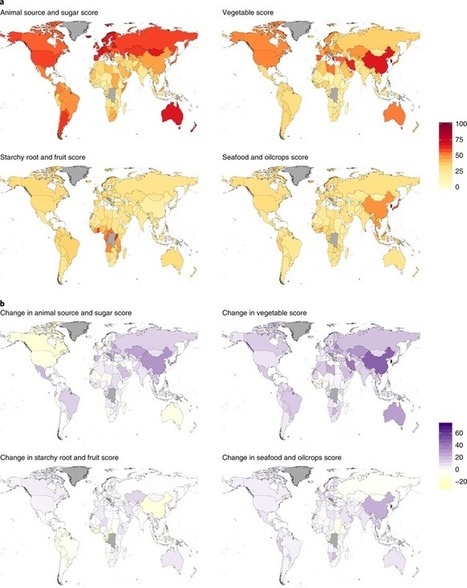







Bentham, J., Singh, G.M., Danaei, G. et al. Multidimensional characterization of global food supply from 1961 to 2013. Nat Food 1, 70–75 (2020). https://doi.org/10.1038/s43016-019-0012-2