Marijuana continues to pop up during this (epically long) federal election campaign, with each party offering a different solution to keep the drug out of the hands of young people.
It’s an important debate that essentially boils down to whether you think the current system – under which Canadian youth have become the top users of marijuana compared with their peers in the rest of the developed world – is working or if you believe, like a growing segment of the medical community, that change is needed.
It’s ironic so many people are enraged over the public health consequences of marijuana policy, yet pay little attention to another harmful substance that poses a far greater threat to Canadians.
Several issues of current debate in health promotion evaluation are examined. These include the definition and measurement of relevant outcomes to health promotion, and the use of evaluation methodologies which assess both the outcome achieved and the process by which it is achieved. Considerable progress is being made in understanding the complexity of health promotion activity, and in the corresponding need for sophisticated measures and evaluation research designs which reflect this complexity. The more powerful forms of health promotion action are those which are long term, and least easily predicted, controlled and measured by conventional means. Against this, important and valued advances in knowledge and credibility have come from more tightly defined and controlled interventions, which have been evaluated through the application of more traditional experimental designs. This tension between ‘scientific rigour’ and the perceived advantages (in longterm effectiveness and maintenance) coming from the less-well-defined content and methods of community controlled programmes continues to pose technical problems in evaluation. It is important to foster and develop evaluation designs which combine the advantages of different research methodologies, quantitative with qualitative, in ways which are relevant to the stage of development of a programme. The use of a diverse range of data and information sources will generally provide more illuminating, relevant and sensitive evidence of effects than a single ‘definitive’ study. Evaluations have to be tailored to suit the activity and circumstances of individual programmes—no single methodology is right for all programmes.
Le cause delle disuguaglianze di salute dipendono non solo da fattori esterni al sistema sanitario, ma anche dall’organizzazione e dal funzionamento del governo clinico.
In particolare, ad avere un impatto – positivo o negativo – su tali iniquità sono gli interventi di prevenzione, diagnosi e cura e la relazione fra paziente, organizzazione e professionisti sanitari
BEN SAREBBE FOLLE CHI QUEL CHE NON VORRIA TROVAR CERCASSE* Presentazione di Gianfranco Domenighetti dell’Università della Svizzera Italiana Un tempo le persone chiedevano di essere curate perché si sentivano ammalate, oggigiorno si incoraggiano le persone soggettivamente sane a sottoporsi a tutta una serie di esami diagnostici preventivi per rassicurarle di non essere «ammalate». Il complesso medico-industriale ha sviluppato tecnologie in grado di identificare le più piccole anomalie, ha modificato le soglie che definiscono la «normalità» e «creato» nuove malattie. La grande maggioranza di queste «anomalie» o pseudo-malattie scoperte in persone soggettivamente sane sono «inconsistenti», cioè non daranno sintomi o problemi nel corso della vita.1 L’informazione diffusa nella società civile dai media, dai supporti informativi prodotti dai servizi sanitari e dai bollettini delle associazioni e società scientifiche ha probabilmente accresciuto significativamente l’ansia e l’angoscia sociale, illustrando una miriade di rischi sanitari in costante agguato.
In 1517, Martin Luther nailed his “Ninety-Five Theses” to the wooden doors of Wittenberg Cathedral, sparking a global reformation of the Christian faith
I was recently asked to present on what are the essential ingredients for a health communication campaign and what type of impact should be expected from them. For the answer, I turned to Leslie Snyder who has studied the effectiveness...
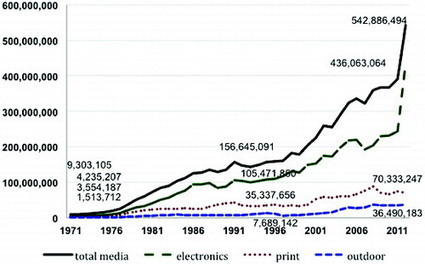
This article provides an analysis of the relationship between annual advertising expenditures and sales, using a time series regression procedure, for beer, wine, and liquor sold in the United States from 1971 to 2012. Information from these four decades provides a comprehensive analysis of the relationships of numerous variables with aggregate alcohol category sales. Even though per capita alcohol consumption has not changed much throughout this period, alcohol advertising media expenditures for all alcohol beverages have increased almost 400% since 1971. This study has provided evidence of consumption changes across categories of alcohol beverages over the past 40-plus years with the preponderance of those changes significantly correlated to fluctuations in demography, taxation and income levels – not advertising. Despite other macro-level studies with consistent findings, the perception that advertising increases consumption exists. The findings here indicate that there is either no relationship or a weak one between advertising and aggregate category sales. Therefore, advertising restrictions or bans with the purpose of reducing consumption may not have the desired effect. Implications on policy decisions regarding advertising controls are addressed.
The biggest change in formative research that social marketers are still learning how to do well is concept testing. As I described it in my book, concept testing is the phase of research “in which options for the target behavior and its associated value or benefits are validated among members of the priority group” (p. 185). It is VERY different from pretesting draft messages (in all their formats) and prototypes of products and services before putting them into final form. If I can do only one type of formative research, I always choose concept testing. Why?
Concept testing pits the ‘expert-driven’ decisions of what behavior people ‘should’ engage in and the theoretical hypotheses of ‘why’ they are (or are not) motivated to do so against the realities of the priority group we seek to serve. Concept testing focuses social marketers on being close to people, audience-driven versus maintaining an expert role in which decisions are made and carried out without considering the POV and voice of people. Decisions about what people are expected to be able to do, versus what their capabilities, resources and circumstances allow them to do are rarely examined by these experts. What motivates people to do what they do, or decide to engage in a new behavior, are presumed to be ‘determinants’ of behavior – not the actual thoughts, emotions and experiences people have when confronted by our messages, products and services. If our assumptions about what’s feasible and desirable for people to do are not challenged with concept testing, our messages, materials, products and services are doomed. Too many ‘pretests’ are in reality ‘disaster checks,’ and while the participants in these tests are often kind to us in their responses, lukewarm receptions do not bode well for effective behavioral, organizational or social change. And receiving negative feedback on our work often comes too late in the planning and budgeting of projects to allow for much else than cosmetic changes. The fundamental flaws in the strategy are beyond repair.
Concepts are the ‘big ideas’ for your campaign or program. They bring your positioning statement to life (and if you aren’t crafting a positioning statement before starting down the implementation path, that’s another challenge you can read more about here). For example, the VERBTM campaign to increase physical activity among preteens had the positioning statement: “We want tweens to see regular physical activity as something that is cool and fun and better than just sitting around and watching TV or playing video games all the time.”
The first key issue that the ‘big idea’ or concept needs to grapple with are what are these ‘regular physical activity’ behaviors – walking, team sports, bicycling, swimming, etc...? Experts will decide which ones to focus on by, as more common than you think, what they see their kids doing, or their kids’ classmates, or what a recent survey has found as the most popular ones. They’ll then go on to create materials and programs that feature these activities – or just a single one – and then pretest them.
The second question a concept needs to address is: How do we make these physical activity behaviors more compelling, relevant and valuable (beneficial) to tweens than the alternatives (TV and video games)?
- See more at: http://socialmarketing.blogs.com/r_craiig_lefebvres_social/#sthash.xcOKApbw.dpuf
Intervista a Francois Lagarde - Social Marketing and Communications Consultant and Adjunct Professor, Department of Health Administration Faculty of Medicine...
Abstract This cross-cultural experiment examined the effectiveness of three health message characteristics to foster or inhibit selective exposure to health information. An online magazine was created with eight articles about various health risks. Four articles were manipulated regarding (1) severity of the described health threat (low versus high), (2) suggested efficacy to avoid or minimize negative consequences (low versus high) and (3) type of evidence presented (statistical information versus exemplar information). Respondents from the U.S. and from Germany (n = 301/298) browsed through the magazine while selective exposure was unobtrusively logged. Findings reveal country-specific exposure patterns. A positive main effect of severity was only found for U.S. respondents. Independent of respondents' country, significantly more time was spent with low-severity/high-efficacy messages and high-severity/low-efficacy messages than with articles featuring the often-recommended high-severity/high-efficacy message combination. Respondents generally read more exemplar messages than those with statistical evidence, especially when high efficacy was suggested. Implications of these exposure patterns for the real-life effectiveness of health messages are discussed and an improved theoretical conceptualization of message effectiveness is proposed.
Attracting the target audience's attention to messages about health risks remains one of the most challenging objectives in health communication (Pease, Brannon, & Pilling, 2006; Rimal & Adkins, 2003). Even though many factors have been established as affecting selective exposure in the contexts of political communication, general news, and entertainment (see overviews byDonsbach, 2009, and Knobloch-Westerwick, 2006, 2008), much less evidence is at hand for the realm of health information. Many health campaigns are hindered by insufficient exposure (Hornik, 2002; Noar, 2008), and very little is known about the potential of health message features to foster or inhibit selective exposure. Building on persuasion theories and research, the current investigation addresses this research gap and focuses on three health message characteristics that have been repeatedly postulated to influence health behavior and are thus frequently used in health message design. As related effects research was often conducted in forced-exposure settings, it is not clear yet to what extent the observed effectiveness patterns also apply to everyday media use: “Although laboratory studies can tell us a great deal about how to develop persuasive appeals that have maximum impact on individuals who are exposed to them, they provide only limited information about the effectiveness of persuasion in a mass media context. In real life, audiences can actively or passively avoid exposure to health messages” (Stroebe, 2000, 64).
Based on a thorough literature review, three frequently incorporated health message characteristics were chosen to be included in this analysis: the severity of a health risk, the efficacy to avoid a threat or to minimize its negative outcome, and finally the type of presented evidence (statistical information versus exemplar information). Drawing on persuasion research, these characteristics and their presumed relationship to health message exposure and avoidance are discussed next. The derived hypotheses are then tested in a cross-cultural experiment.
Boom du business de l’auto-évaluation médicale pour les particuliers, facilitation des diagnostics et soins à distance pour les professionnels… La médecine fait sa révolution numérique.
The ability to write something meaningful in140 characters, including a shortened URL, is the basis of Twitter. Over 500 million tweets go out every day to
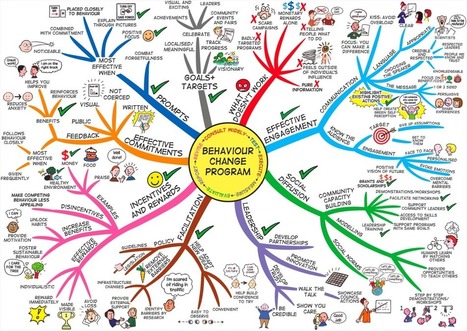
We’ve all been in the situation – we know that one or more of our behaviours are having a negative effect on our lives, but there just isn’t enough of a counter argument to warrant a change. “Why not eat another bacon sandwich, I’m joining a gym next week”… or “just another cigarette, I’ve had a stressful day today”
On 8 October 2013, the European Union moved a step closer to strengthening tobacco control when members of the European Parliament (MEPs) voted for a European Commission proposal for a revised directive on tobacco products, albeit with extensive amendments.
Developing a marketing plan explicitly, and implicitly, captures many of the core assumptions and understandings of social marketing. In its essence, a social marketing plan is a translation document that distills...
To get content containing either thought or leadership enter:
To get content containing both thought and leadership enter:
To get content containing the expression thought leadership enter:
You can enter several keywords and you can refine them whenever you want. Our suggestion engine uses more signals but entering a few keywords here will rapidly give you great content to curate.


 Your new post is loading...













![Weighing up the Ingredients of Behaviour Change [INFOGRAPHIC] | Marketing Sociale - University of Bologna | Scoop.it](https://img.scoop.it/tpfXulqeid4PoZUFfPzS2Tl72eJkfbmt4t8yenImKBVvK0kTmF0xjctABnaLJIm9)