The Startup Classroom brings together Sonoma State University School of Education with Sonoma County Office of Education and the support of Maker Media to offer a new Maker Certificate Program, the first certificate program of its kind. The program offers a series of mini courses designed for people seeking to lead Maker activities in schools, clubs, community centers, libraries and other organizations.
Baby, it’s cold outside! Well, not for us. We live in California, where it’s a currently hovering at a balmy 60 degrees. But, for the rest of the country, winter has come! So grab your toolkits, roll up your repair sleeves, and get ready to fight the frostbite. We’ve gathered some helpful repairs to keep you warm for the rest of winter.
How many devices are trashed for little more than a flat battery - sustainability means keeping what we have for longer or finding new uses for them... Today I fixed my vacuum cleaner - a simple task with a screw driver... no repair shop, and no garbage collector required... it lives to suck another day...
Lego Pompeii was painstakingly recreated from more than 190,000 individual blocks across 470 hours for Sydney University’s Nicholson Museum – it’s the largest model of the ancient city ever constructed…
We’re a 4000 sq.ft. creative space that provides open and membership based access to digital fabrication tools, education workshops, making events and a vibrant
FAAST is middleware to facilitate integration of full-body control with games and VR applications using either OpenNI or the Microsoft Kinect for Windows skeleton tracking software. FAAST includes a custom VRPN server to stream up to four user skeletons over a network, allowing VR applications to read the skeletal joints as trackers using any VRPN client. Additionally, the toolkit can also emulate keyboard input triggered by body posture and specific gestures. This allows the user add custom body-based control mechanisms to existing off-the-shelf games that do not provide official support for depth sensors.
FAAST is free to use and distribute for both commercial and noncommercial purposes. However, you must still abide by the licensing terms of any third party software you install for skeleton tracking (either OpenNI software or Microsoft Kinect for Windows). Please see the websites of these libraries for more information.
AMNH’s newest education program, BridgeUp: STEM is focused on the intersection of computer science and science. This portfolio of programs will include an intensive Brown Scholars program for high school girls; an exploratory program for middle-school youth in under-resourced schools; a post-baccalaureate teaching/research fellowship for women; a professional development component for teachers; and public programming, including an annual hackathon, to promote the use of computer science in the observation, research, and communication of science.
The Scholars' Lab Makerspace is a place for tinkering and experimentation with technologies like desktop fabrication, physical computing, and augmented reality.
One of the selling points for modular smartphones like Project Ara or the Puzzlephone is that they reduce waste. But little has been said about how discarded modules could be put to use. Finland's Circular Devices, the company developing the Puzzlephone, has now revealed its answer to that question: it's called the Puzzlecluster, and it's a scalable supercomputer.
Shanghai-based company WinSun Decoration Design Engineering is showing off its latest feat of innovative construction: 3D printed homes and villas that take only days to produce. (Jan. 20)
One year ago, a simple and very cool construction kit for children came out; called Strawbees, it lets kids develop their inner engineer by making all kinds of structures out of ordinary drinking straws and cardboard. Now, a spinoff project has emerged: a “toy to make toys” called Quirkbot. Quirkbot is a small 8MHz microcontroller…
The next guest in our interview series is Chloé Rutzerveld, young talented and promising Food and Concept designer, from Eindhoven University of Technology. Chloé is interested in combining aspects of food, design, nature, culture and life sciences in a form of critical design. She uses food as a medium to address, communicate and discuss social, cultural or scientific issues.
Throughout 2014, Chloé worked on a 3D food printing project, titled Edible Growth, to show how high-tech or lab-produced food doesn’t have to be unhealthy, unnatural or not tasteful. Her concept is an example of a future food product fully natural, healthy, and sustainable.
The working principle combines aspects of nature, science, technology and design: multiple layers containing seeds, spores and yeast are printed according to a personalized 3D file. Within five days the plants and fungi mature and the yeast ferments the solid inside into a liquid. Depending on the preferred intensity, the consumer decides when to harvest and eat the edible. While the project is still speculative due to technological limits, the concept is very intriguing.
To assess maker projects in your class, begin with a three-part rubric to guide students through process, understanding, and product.
While many teachers are excited about the maker movement and may even be creating projects for their classrooms, assessment can be puzzling even to veteran classroom teachers. How can teachers prove that deep, rich learning is occurring through making? How do we justify a grade to students and parents alike, especially to the student who "just isn’t good at art"? By crafting a three-part rubric that assesses process, understanding, and product, teachers can rest assured that they are covering all the bases.
Started out as just a collection of snaps as I stripped down an engine bought off ebay. (To replace my old engine, which had suffered catastrophic failure). ...
Inspired by the golden ratio, mathematician Edmund Harriss discovered a delightful fractal curve that no one had ever drawn before. But it’s not just a pretty picture, it contains some lovely theory – and brings the golden ratio into a family of perfect proportions.
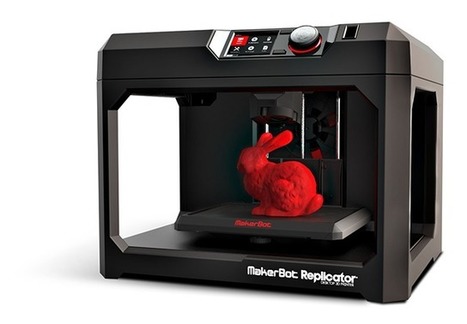
"A growing number of K-12 schools are investing in 3D printers, encouraged, in part, by examples of improved student engagement. Some educators say using the printers also allows students to apply classroom instruction to real-world situations."
A resource for teachers, mentors, parents, STEM professionals and volunteers eager to help children learn about science, technology, engineering and math.
To get content containing either thought or leadership enter:
To get content containing both thought and leadership enter:
To get content containing the expression thought leadership enter:
You can enter several keywords and you can refine them whenever you want. Our suggestion engine uses more signals but entering a few keywords here will rapidly give you great content to curate.


 Your new post is loading...