LEDOracle has watched the steady growth of the LED lighting industries in the eastern regions of the world. Lighting engineers in Pakistan are preparing to begin the first LED street lighting project for the country in the months ...
Sérieux! qu'est-ce qui pourrait mal tourner? Est-ce fortement accroître la pollution lumineuse, congestionner l'espace, perturber les écosystèmes qui dépendent de l'obscurité, bousculer le biorythme des animaux, entraver les liaisons aériennes, brûler des terres agricoles, mettre le feu aux forêts en manque d'eau... et là on pas encore commencé à parler de la souveraineté, de sécurité nationale, de la possible militarisation, etc. C'est vrai, à bien y penser, what could go wrong? 🤷♀️ https://lnkd.in/gMwMRvnS
🌌 The stars don't recognise borders — and neither do we. 🌌
Since 2018, Dark Sky Ireland has been a proud cross-border partnership, uniting communities from Kerry to Tyrone in the fight against light pollution. One island, one sky, one mission. ✨
Here's what "all-island" actually looks like in practice:
🟢Kerry International Dark Sky Reserve — Europe's only Gold Tier reserve, lighting up the Iveragh Peninsula 🟠 Mayo Dark Sky Park — Gold Tier status since 2016 and International Dark Sky Place of the Year 2024 🔵 OM Dark Sky Park, Davagh Forest, Co. Tyrone — Northern Ireland's only official Dark Sky Park, pairing Bronze Age stone circles with cutting-edge telescopes ⚪ Armagh Observatory & Planetarium — over 200 years of Irish astronomy, still going strong 🟣 Carrick-a-Rede, Co. Antrim — free 24-hour stargazing access, no rope-bridge nerves required 😄 🔴 Blackrock Castle Observatory, Cork — a 16th-century castle turned working observatory and science centre, right on the banks of the Lee 🟡 Dunsink Observatory, Dublin — Ireland's oldest observatory, quietly watching the skies since 1785 🟤 Birr Castle Observatory & Great Telescope, Offaly — home to the "Leviathan of Parsonstown," the largest telescope in the world for over 70 years
From a starry night over Ballycroy to one over Beaghmore, from Blackrock's castle walls to Birr's historic dome — it's the same Milky Way arching over every county on this island, north and south. Light pollution doesn't stop at a border, so neither does our work to stop it.
🌟 And behind every one of these reserves, parks and observatories are the dark sky community groups doing the real, unglamorous, brilliant work on the ground — north and south. From FRIENDS OF MAYO DARK SKIES to the CORK SKY FRIENDLY CAMPAIGN, from DONEGAL DARK SKIES to CLOUGHJORDAN ECO VILLAGE and all the NATIONAL TIDY TOWN VOLUNTEERS monitoring skyglow in their own back gardens — this movement is powered by ordinary people giving up their evenings to protect something extraordinary. Whether you're in a village hall in KERRY or a community centre on RATHLIN ISLAND, if you're out there talking to your local council about street lighting, running a stargazing night for kids, or just nagging your neighbour about that floodlight — we see you, and we appreciate you. 🙌
💚 Why this matters: Ireland's night skies are one of our last truly shared natural resources — no passport required to look up. Protecting them means working together: sharing data, sharing lighting guidelines, sharing festivals, and sharing the wonder.
Kerry Dark Sky Tourism Mayo Dark Sky Park Friends of Mayo Dark Skies Cork Environmental Blackrock Castle Observatory Armagh Observatory & Planetarium Dunsink Observatory Birr Castle Demesne Cloughjordan Ecovillage
Incredibly proud of Bray & Co's client DarkSky International who have partnered with Star Trek! This is the first activation with more to come. Watch this space (yes, bad pun intended).
Take a look at the Intellistreets smart city installation at Wayne State University’s Keast Commons in Detroit. This project showcases a fully integrated smart lighting and communications system, including:
Advanced luminaire control for efficient campus lighting Flood light control for enhanced visibility and safety Notification beacons for real-time alerts and visual messaging Integrated audio for public communication and emergency notifications
Designed to improve safety, connectivity, and overall campus experience, this installation highlights how smart city infrastructure is transforming public spaces in Detroit and beyond.
Copenhagan has switched on a red-light district for wildlife & people!
Light pollution has grown in the last 20 years in Ireland and the UK. As well as the impacts on our circadian rhythms, cold white light can dazzle wildlife reducing their ability to forage.
Check out this pioneering project that uses red light to illuminate the streets for pedestrians and vehicular traffic, and balances the needs of nocturnal wildlife.
"We can switch off light sources such as computers, phones, TVs and lamps ourselves. But other sources are beyond our control: streetlights, headlights on cars, illuminated monuments, flashing billboards, and spotlights on construction sites, storefronts, bus stops, parking lots, sports fields and stadiums, to name just a few." [...] "No other environmental condition has remained unchanged over the millennia like the natural light of the sun, moon and stars. All living things have adapted to this rhythm. More than half of all species are nocturnal — if the nights become brighter, it could have devastating consequences."
🌌Since 80% of the world has never experienced truly dark skies…it must not be THAT important, right?
And if you've never experienced it you can’t miss it, right? WRONG.
Just because less of something exists in nature and we "seem" fine, it doesn’t mean we're not affected.
🍂Artificial light at night (ALAN) disrupts plants' growing seasons, causing stress that reduces summer shade and clean air.
🐢Sea turtles hatch at night on the beach. Hatchlings detect the horizon by following the light leading them to the ocean. Artificial lights, however, misdirect them. In Florida, millions of hatchlings die this way every year.
🤒Studies show that people living in areas of high light pollution have elevated rates of breast, prostate, colon, and thyroid cancers.
We envision a future where EVERY Texan participates in conservation. But how do we help our local communities understand why they should care about dark skies?
🌟YOU can share the signs of a healthy dark sky vs a polluted night sky!
Check out these #ConservationPartner tools and resources to help illustrate:
Hill Country Alliance “Friends of the Night Sky Resource Guide” is a compendium for cultivating dark sky advocacy in the Texas Hill Country!
DarkSky Texas has a “What is Light Pollution” guide and an “Outdoor Light Fixture Replacement Options” guide! Find both and MORE under “solutions and resources” on their main website.
AUDUBON FOUNDATION OF TEXAS's #LightsOutTexas campaign encourages businesses and homeowners to turn lights out during bird migration season!
Emitel, which says it delivers digital services and solutions powered by infrastructure, technology and data, has won a contract to build an intelligent street lighting control system for Warsaw.
💡L’éclairage public est-il vraiment conçu pour tous les usagers ❓
🔬Une étude récente sur le comportement visuel dans l’espace public montre que tous les usagers ne regardent pas leur environnement de la même manière.
Alors que certains concentrent naturellement leur regard sur leur trajectoire, d’autres balayent en permanence les abords : buissons, zones d’ombre, recoins, accès latéraux… autant d’endroits où pourrait apparaître un danger.
Cela soulève une question qui dépasse la simple conformité aux normes.
📆 Aujourd’hui, les normes d’éclairage routier définissent notamment des exigences de : ✔️ luminance ou éclairement sur la chaussée, ✔️ uniformité, ✔️ limitation de l’éblouissement, ✔️ et, dans certains cas, d’éclairement vertical dans la direction de déplacement.
Ces critères sont essentiels et ont considérablement amélioré la sécurité.
Mais ils évaluent principalement ce qui se passe sur le chemin de déplacement.
Ils prennent beaucoup moins en compte la perception des espaces périphériques, pourtant déterminante pour le sentiment de #sécurité de nombreux usagers.
Et surtout…
🧑🧑🧒🧒Pour qui concevons-nous réellement nos installations ?
Un jeune adulte, une personne âgée, un homme, une femme ou une personne photosensible ne perçoivent pas l’espace public de la même manière. Leurs besoins en matière d’éclairage sont différents.
Un espace public “conforme” est-il nécessairement un espace public perçu comme sûr par tous ?
À l’heure où les villes parlent d’inclusion, il est peut-être temps d’élargir notre réflexion.
Ne plus seulement se demander :
“Combien de lux avons-nous sur la chaussée ?”
Mais aussi :
“Qui utilisera cet espace… et que verra réellement cette personne ?”
🎯La lumière ne sert pas uniquement à rendre un obstacle visible.
Elle doit aussi permettre de comprendre son environnement, d’anticiper et de se sentir en sécurité.
Peut-être que la prochaine évolution de l’éclairage public ne viendra pas uniquement de luminaires plus performants…
... mais d'une meilleure compréhension des usagers et d'une définition plus fine des besoins multiples et complexes de la vie urbaine.
For decades, we have treated darkness as a design defect. New road? Add lights. New pathway? Add lights. Existing luminaire? Replace it—often with something brighter.
But lighting is one of the few areas of engineering where over-engineering can itself produce a non-compliant outcome.
Too little light can fail the required criteria. Too much can create excessive illuminance, glare, spill and poor uniformity. Good lighting design exists in a “Goldilocks zone”: enough light to achieve the safety and operational outcome, but no more than the environment actually needs.
Belgium’s Hoge Kempen National Park is removing 75 unnecessary streetlights, while Massachusetts has advanced measures encouraging shielded, warmer and lower-output public lighting.
This is not an argument for switching everything off. It is an argument for classification, targeted optics, shielding, dimming and—where justified—the deliberate preservation of darkness.
Good lighting design is not about installing the most light.
It is about providing the right light, in the right place, at the right time—and having the restraint to stop there.
Belgian national park lighting removal | Massachusetts lighting legislation
I talk a lot about light pollution caused by artificial light at night. Now for something totally bonkers, light pollution caused by reflecting the sun back to earth at night 🤯
This idea if it comes to fruition will literally turn night to day and no consideration is being offered to the environmental (or other) impacts that might have.
The sustainable city of the future will not be built through new infrastructure alone. It will also depend on how intelligently we use, upgrade and extend the life of what is already in place.
Lighting is a powerful example. By refurbishing and connecting existing systems, cities can reduce energy use, preserve materials and create public spaces that respond more effectively to people’s needs.
Read Signify’s latest article exploring how cities in Denmark and Switzerland are putting this thinking into practice: https://lnkd.in/eUDBZ4s4
From my latest presentation, Humanizing the Night: Are you afraid of the dark? Since ancient times night and darkness have been symbols of evil. Yet, for night owls and artists, the afterhours represent freedom and creativity.
From Fast Company “Our study found that adults who are naturally more active in the evening, what we called ‘eveningness,’ tended to perform better on cognitive tests than those who are ‘morning people.’ Rather than just being personal preferences, these chronotypes could impact our cognitive function,” "Off-the-clock creatives may also be some of the greatest visionaries. The music and art world, for example, provides plenty of examples of late-night genius: Bob Dylan famously did his best songwriting at night. Carl Jung, Franz Kafka, Prince, and Picasso were also often hard at work after dark. Likewise, Fiona Apple has described herself as being nocturnal, while Taylor Swift wrote her record-breaking album Midnights after dark."
For more on Humanizing the Night, 7 steps to safer and more vibrant cities https://lnkd.in/gkxU37nN
The technology is straightforward. Each unit operates independently, collecting solar energy during the day and storing it in an onboard battery.When the sun...
Discover how solar street lights are revolutionizing public lighting solutions with energy-efficient technology, lower maintenance costs, eco-friendly operat...
Selecting the right outdoor lighting is a crucial investment for property managers, business owners, municipal planners, and anyone responsible for public safety and infrastructure. In today’s energy-conscious world, solar-powered solutions are not only a step forward in sustainability—they’re...
The fact that eliminating dusk to dawn lighting determined to be unnecessary is deemed "radical" when "sensible" is more apt kind of says it all. We must completely overhaul our relationship to the night and how we use lighting based on facts, not on feelings and unquestioned habits.
"New approaches to sustainable lighting policy that go beyond energy efficiency are therefore needed. For example, lighting regulation in France now requires advertising lighting to be turned off at hours when pedestrians are unlikely to be present and interior lights to be turned off when buildings are not occupied. This approach has the potential to reduce light emissions without adversely affecting advertisers. Matching streetlight provision to resident needs with lighting curfews or motion sensors similarly reduces light without affecting objective or perceptive safety. Finally, because private windows are the most common outdoor light source, policy encouraging the use of curtains after sunset could have a larger impact than one might first assume." https://lnkd.in/gsnHSpZz
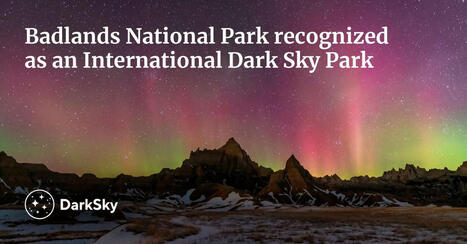
Congratulations to Badlands National Park on becoming an International Dark Sky Park! This recognition celebrates the park's extraordinary night skies and its ongoing commitment to protecting the nocturnal environment.
Years of collaboration to reduce light pollution, improve outdoor lighting, expand night sky programming, and engage local communities have made this achievement possible. The designation also strengthens South Dakota's growing reputation as a destination for stargazing, astronomy, and unforgettable night sky experiences.
Congratulations to Badlands National Park, the National Park Service, the Badlands National Park Conservancy, and all the partners who helped make this milestone a reality. Here's to protecting the night for generations to come! Visit https://bit.ly/4vTFlzP to learn more.
📷 Photo by Teresa Hofer
Travel South Dakota Badlands National Park Conservancy
To get content containing either thought or leadership enter:
To get content containing both thought and leadership enter:
To get content containing the expression thought leadership enter:
You can enter several keywords and you can refine them whenever you want. Our suggestion engine uses more signals but entering a few keywords here will rapidly give you great content to curate.



 Scoop.it!

 Your new post is loading...