Your new post is loading...

|
Scooped by
Kim Flintoff
August 24, 2017 9:14 PM
|
Dr. Margy Jones-Carey - Teaching students to ask questions enables them to become thinkers, processors and to carry these skills into the 21st Century.
I was recently preparing for a presentation to educators in Brazil on 21st-century skills, global competency and problem-based learning. As I was preparing for the presentation, I did some research on the future careers of today’s students. The U.S. Department of Labor report from 2013 states that 65% of today’s students will work in careers that have yet to be developed. That means that we must teach students skills to solve problems we’ve never seen before and won’t see for years.
As educators, we are faced with the challenge to identify skills and dispositions that can be transported into unknown jobs and careers. I came to the final realization that to be prepared to be productive members of the 21st century, students need to be four things:
Self-modifying Self-managed Self-evaluating Self-directed
|
|
Scooped by
Kim Flintoff
August 20, 2017 8:31 PM
|
Teaching has been compared to rocket science, but usually in jest, as in it’s not rocket science.
But any teacher worth their salt–and thus aware of the incredible demands of instructional design, personalizing learning, classroom management, the always-on demand of student and collegial relationships, grading, and so on
|
|
Scooped by
Kim Flintoff
August 15, 2017 7:53 PM
|
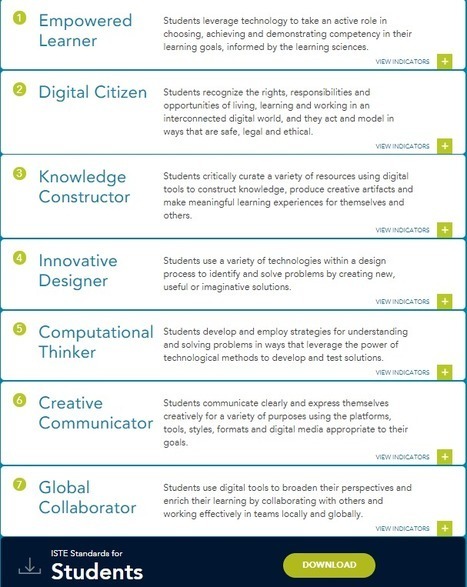
STE STANDARDS FOR STUDENTS
Promote future-ready learning with the ISTE Standards for Students
Today’s students must be prepared to thrive in a constantly evolving technological landscape. The ISTE Standards for Students are designed to empower student voice and ensure that learning is a student-driven process. Connect with other educators in the ISTE Standards Community and learn how to use the standards in the classroom with the ISTE Standards for Students ebook.
Share the music video "7 ways" and start a conversation about the ISTE Standards with your students!
|
|
Scooped by
Kim Flintoff
August 8, 2017 7:28 PM
|
If intelligent machines can do many tasks now performed by people, what uniquely human skills will be valued? If the half-life of skills necessary for employment continues to dwindle, how can individuals, employers and society as a whole ensure that learning models and the education system keep up? As the global workforce gets older, younger and more diverse, how will leaders and organizational culture have to adapt? If alternative work arrangements like short-term gigs and self-employment become more ubiquitous and mainstream, could that have profound effects on not just how we work, but where we work, how we commute and even how cities are designed? If augmented reality gives workers access to vast amounts of data and assistance, will workers need to become more tech fluent for the technology to deliver on its promise?
|
|
Scooped by
Kim Flintoff
August 8, 2017 7:25 PM
|
EXPERTISE HAS AN EVER-SHORTER SHELF LIFE
It used to be that only certain types of jobs—think of computer programmers and IT troubleshooters—needed constant training and upskilling. Now, all of us are expected to continuously learn new skills, new tools, and new systems. Just as COBOL programmers had to learn C++ and Java, administrative assistants have switched from typewriters and dictation machines to PCs and voice memos, assembly-line workers have had to learn to operate robots, and designers have moved from sketchpads and clay models to touchscreens and 3D printing.
In technical fields, there is constant pressure to master new technologies or risk becoming instantly obsolete. One of our clients anonymously surveyed its IT department about what skills people wanted to learn, and more than 80 percent said they were desperate to learn tools such as AngularJS (a new open-source programming environment for mobile apps), even though the company was not yet using the technology.8
|
|
Scooped by
Kim Flintoff
June 21, 2017 7:26 PM
|
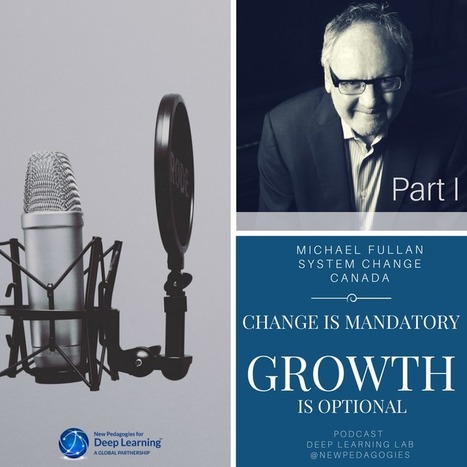
Michael Fullan is a worldwide authority on educational reform.
Michael “walks the talk” by leading our NPDL Partnership – a global endeavor to shift pedagogy and deepen learning in over 1000 schools in 7 countries.
A former Dean of the Ontario Institute for Studies in Education (OISE) of the University of Toronto, Michael advises policymakers and local leaders around the world to provide leadership in education, integrating solid academic knowledge and the undeniable (and often under looked) theoretical richness of everyday teacher practice.
Michael received the Order of Canada in December 2012, and holds honorary doctorates from several universities in North America and abroad, and yet, he is a constant learner, a careful listener, a gifted observer and a defiant voice advocating for the moral purpose of all children learning. His perspective on the why and how to shape a meaningful school system for the learners of today pushes the thinking of thousands of change makers around the world.
In this Podcast, Michael talks us though areas such as Whole system change in Finland, why we should not wait for politicians to start changing schools and the relationship between equity and quality, amongst others!
|
|
Scooped by
Kim Flintoff
June 9, 2017 7:46 PM
|
Amazon reminds us again and again that it isn’t technology that eliminates jobs, it is the short-sighted business decisions that use technology simply to cut costs and fatten corporate profits.
|
|
Scooped by
Kim Flintoff
May 29, 2017 3:10 AM
|
Digital technology has become an everyday part of young people’s lives both at home and in the classroom. Portable tablet devices in particular have become increasingly popular with more and more children having access to or ownership of iPads and other digital devices. Recognising the educational potential of this technology, many schools have prioritised the integration of tablet devices into their classrooms. Indeed, these machines offer a number of potential advantages compared to desktop computers, including portability, intuitive design, and a touchscreen interface. However, the increasing presence of digital technology in homes and schools raises important questions about its role in children’s learning and development.
The pilot project ‘Developing the use of portable devices in early years learning’ investigated the long-term implementation of iPads in five Northern Ireland primary schools located within the Belfast Education and Library Board1 (BELB) area, and associated feeder nursery/pre-schools. This study aimed to evaluate the outcomes of the pilot project. The primary objective of the study was to assess the impact of the use of iPads on children’s learning in the Early Years and Foundation Stage of education. It focused on the impact upon literacy and numeracy, as well as examining the extent to which 2 iPads can support other areas of the curriculum.
|
|
Scooped by
Kim Flintoff
May 24, 2017 12:27 AM
|
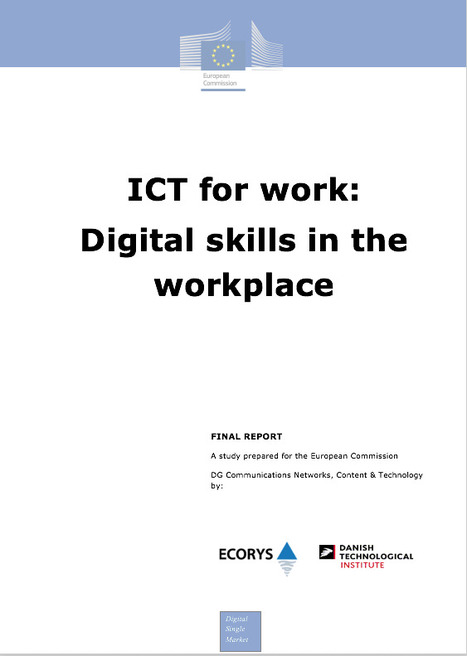
The European Commission has just published the final report of the study "ICT for Work: Digital Skills in the Workplace" on the impact of information and communication technologies (ICT) on the transformation of jobs and skills. The evidence shows that digital technologies are used in all types of jobs, also in economic sectors not traditionally related to digitisation e.g. farming, health care, vocational training and construction.
The digital economy is transforming the way people work and the skills they need at work. This represents a major challenge for employers, workers and public authorities. The study presents data and policy recommendations that could support the transformation of the labour market into opportunities for all.
https://ec.europa.eu/digital-single-market/en/news/ict-work-digital-skills-workplace
|
|
Scooped by
Kim Flintoff
May 8, 2017 12:28 AM
|
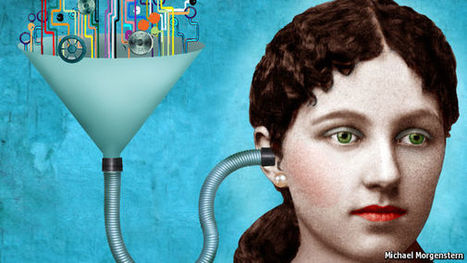
IN JULY 2011 Sebastian Thrun, who among other things is a professor at Stanford, posted a short video on YouTube, announcing that he and a colleague, Peter Norvig, were making their “Introduction to Artificial Intelligence” course available free online. By the time the course began in October, 160,000 people in 190 countries had signed up for it. At the same time Andrew Ng, also a Stanford professor, made one of his courses, on machine learning, available free online, for which 100,000 people enrolled. Both courses ran for ten weeks. Mr Thrun’s was completed by 23,000 people; Mr Ng’s by 13,000.
|
|
Scooped by
Kim Flintoff
May 2, 2017 7:34 PM
|
Massive open online course (MOOC) provider edX yesterday launched a new line of programs that are designed to build or advance critical skills for in-demand careers like software development and data science.
Professional Certificate programs “provide learners with a more immediate path to reskill or upskill quickly in order to advance their career or position themselves for a new job,” according to the announcement. Each offers a series of courses created in collaboration with industry professionals and universities, focusing on job competencies and professional development in fields like computer science, data science and digital marketing.
|
|
Scooped by
Kim Flintoff
April 24, 2017 8:13 PM
|
Rather than encouraging each person to choose a profession, say, architect or engineer, he works backwards from the skills that each student wants to acquire. So instead of saying, “I want to be a doctor”, he’ll aim to get students to talk about a goal, in this case “using empathy in a medical setting”.
Students today should focus on a collection of skills, rather than a particular profession, says Jean-Philippe Michel (Credit: Getty Images)
It might seem a bit esoteric, but the twist in language helps boil down real objectives. And sometimes those don’t jibe with a single profession or even the career choice you might have imagined wanting at the start. Instead, Michel says deciding the skills you want to use leads to a career that’s more targeted—and thus more likely to bring you satisfaction. It also might be less a job and more a set of projects and work situations that lead you from one thing to the next.
“They need to shift from thinking about jobs and careers to think about challenges and problems,” Michel says. Easier said than done for, say, Gen X or even older millennials, but it’s not so out of the realm of thinking for younger people, who are already narrowing down their university studies.
|
|
Scooped by
Kim Flintoff
April 17, 2017 7:38 PM
|
BLOOMINGTON, IN–(Marketwired – April 12, 2017) – Solution Tree, a premier educational publisher and professional development provider, announced that Mindful Assessment: The 6 Essential Fluencies of Innovative Learning by Lee Watanabe Crockett and Andrew Churches was named a 2017 REVERE Awards finalist in the Professional Resources: Instruction and Classroom Practice category.
For more than 50 years, the REVERE Awards have identified the best content for educating learners on any platform—print, digital or blended. The evaluation process is rigorous, with both educators and industry-professional judges evaluating each entry.
|
|
|
Scooped by
Kim Flintoff
August 20, 2017 8:32 PM
|
Sorry, film nerds: Naughty Dog, a video game company, is putting out the most exciting stories on the market.
You may recall that in our 2016 end-of-year trailer rankings, the #1 trailer we selected was not for a movie. It was—gasp!—for a video game. That video game is Naughty Dog's The Last of Us Pt. II, and to this day, it is still one of our most-anticipated upcoming releases.
This begs the question: What happens when video games reach the same level of technical acumen as films, while also delivering equivalent emotionally resonant experiences? Or, rather: What happens when playing a video game actually exceeds the cinematic experience?
|
|
Scooped by
Kim Flintoff
August 17, 2017 12:09 AM
|
Like so many others, I began learning about the extent to which metaphor shapes our view of the world by sitting at the feet (metaphorically speaking) of George Lakoff and Mark Johnson when they published Metaphors We Live By. As the authors write, metaphor is “explaining one kind of thing in terms of another” (p. 5). This only makes sense that we use metaphor given what we think to be true about human learning. An ancient truth that continues to be supported by current and emerging research is that we use what we already know, what is familiar to us, to understand and make sense of that which is new to us. We learn a new math concept by comparing it to something that we already know and building upon that. We do the same thing across content areas and learning contexts. Metaphors are important to our religious expressions and how we think and talk about our thoughts and actions. We are creatures of comparison.
Coming back to education, there is the chance that using technological and industrial metaphors as the dominant means of discourse about the what, why, and how of education will push us toward technological and industrial values. Some aspire to put these technological and industrial systems to work for humans. After all, the Russian origin of the contemporary word for “robot” is the word “slave.” We enslave technologies to serve us. Given the incredibly emotional baggage of the word “slave”, I mention it with caution, but it is important, because it reminds us about the past hopes and dreams of about the role of technology, but this is something that certainly continues today. We think of technology as existing to serve us.
|
|
Scooped by
Kim Flintoff
August 15, 2017 7:48 PM
|
Curtin University has climbed into the world’s top 200 universities in the prestigious Academic Ranking of World Universities (ARWU) published today.
The University is now placed in the 151-200 band, up from the 201-300 band in 2016 and 2015, and from 301-400 in 2014 and 401-500 in 2013, with the University estimated to be 180th in the world and 9th in Australia.
The ARWU listing is widely recognised for its relevance as a research-orientated ranking system, and is based on a range of measures including research output and number of Highly Cited Researchers.
|
|
Scooped by
Kim Flintoff
August 8, 2017 7:26 PM
|
And that will have a huge impact on the future of learning. Because if work is being extracted from jobs, and if jobs and work are being extracted from companies—and because, as you and I have both written, we’re now in a world of flows1—then learning has to become lifelong. We have to provide both the learning tools and the learning resources for lifelong learning when your job becomes work and your company becomes a platform.
So I’m not sure what the work of the future is, but I know that the future of companies is to be hiring people and constantly training people to be prepared for a job that has not been invented yet. If you, as a company, are not providing both the resources and the opportunity for lifelong learning, [you’re sunk], because you simply cannot be a lifelong employee anymore unless you are a lifelong learner. If you’re training people for a job that’s already been invented, or if you’re going to school in preparation for a job that’s already been invented, I would suggest that you’re going to have problems somewhere down the road.
|
|
Scooped by
Kim Flintoff
June 21, 2017 7:27 PM
|
Ed note: 2 Pieces for Context–30 Incredible Ways Technology Will Change Education by 2028 and Curriculum is More Important Than Learning Technology
We recently speculated on the what education might look like in the year 2028 (see the link above), when today’s kindergartners have finished K-12 and beginning their work in the world (or college). The focus of that piece was technology, and how it might impact the way students learn in the coming decades.
This piece is similar, but a bit more focused on the pros and the cons of learning trends, and the ultimate impact they might have on education, and society at large. Note that all of these pieces are necessarily speculative, presented to hopefully promote conversation, illuminate possibility, and help us to stop and think where this all might be headed.
|
|
Scooped by
Kim Flintoff
June 9, 2017 7:49 PM
|
Combination Learning is a new teaching and learning strategy for the 21st century. The definition of Combination Learning is learning through the flexible combination of two or more learning components.
This is a new learning strategy developed by TeachThought that responds to the endless possibilities in modern learning environments. It is purposefully flexible, and adaptable to a variety of content areas, grade levels, and available local technology.
The Big Idea
The big idea of combination learning is shifting the focus from content to the process of learning.
Combination Learning allows teachers and students to work together to “mash” bits and pieces of learning to design entirely unique and personalized learning scenarios. The result is a flexible, self-directed learning environment where the teacher acts as facilitator and mentor, and the student is at the center of–and entirely accountable for–their own progress and performance.
It can be as simple or complex as the circumstances call for. It can be standards-based or open-ended; technology-based or based on in-person human interaction; project-based, game-based, rigorous, supportive, etc. In that way it is more of a shell or template for teachers and students to fill as necessary.
|
|
Scooped by
Kim Flintoff
June 7, 2017 1:18 AM
|
Yet schools have not changed enough to prepare themselves for the disruptive reality where 47 percent of work roles will be made redundant by machines. Pew Research Centre research confirms that much of this change is not imminent, it's here.
The disruptions that have rolled through so many industries have yet to have a full impact on schools but we would be foolish to think they will be cocooned from change.
We need schools that teach capacities that machines will always struggle with like creativity, critical reflection, compassion, collaboration and communication.
There are already some suggestions.
|
|
Scooped by
Kim Flintoff
May 29, 2017 2:51 AM
|
Nearly a third of business leaders and technology analysts express “no confidence” that education and job training in the United States will evolve rapidly enough to match the next decade’s labor market demands, a new report from the Pew Research Center finds.
About 30 percent of the executives, hiring managers, college professors and automation researchers who responded to the Pew survey felt future prospects looked bleak, anticipating that firms would encounter more trouble finding workers with their desired skill sets over the next decade.
“People are wrestling with this basic metaphysical question: What are humans good for?” he said. “It’s important to figure that out because this blended world of machines and humans is already upon us and it’s going to accelerate.”
|
|
Scooped by
Kim Flintoff
May 9, 2017 8:37 PM
|
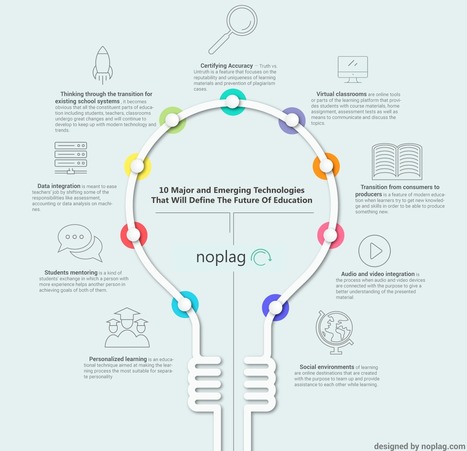
Innovative technologies change the way we used to learn and that happens incredibly quickly. What major technologies will define the future of modern education?
|
|
Scooped by
Kim Flintoff
May 2, 2017 10:40 PM
|
In a report released by the World Economic Forum, 21st century learning comprises of three key skill areas:
Foundational Literacies: numeracy, literacy, ICT, scientific, financial, cultural and civic literacies
Competencies: critical-thinking, creativity, communication, and collaboration
Character Qualities: curiosity, grit, initiative, adaptability, leadership, and social and cultural awareness
|
|
Scooped by
Kim Flintoff
April 30, 2017 8:10 PM
|
THE ENDS OF EDUCATION are changing from:
Improving our children as individual thinkers, so that they can (hopefully) improve their world when they become adults,
TO
Having our children improve their world and improve humanity WHILE THEY ARE STUDENTS, and teaching them to do it better and better—and improve themselves in the process.
THE PARADIGM FOR HOW WE EDUCATE is changing from:
Having all children take a similar sequence of academic courses and classes in a narrow range of subjects
TO
Having each child accomplish, as the foundation, essence, and bulk of his or her formal education, an individualized series of team-based real-world projects that make their world a better place in some way—while acquiring, through those projects, a broad skillset of effective thinking, action, relationships and accomplishment.
The best news is that this new kind of education—one directly oriented towards bettering the young people’s and our world—is an education that almost all kids want. They know that society is quickly changing. They know their success in the 21st century will come NOT because they can succeed and think in academic subjects (although those will still be useful, at times, for some), but because they can work, in teams, to get things done that improve their local, national and global world.
The countries in the world that realize this, and take quick and appropriate action, will be the places where children prosper and flourish in the future. The places that move slowly and reluctantly—or don’t move at all—doom their young people to lives of ill-prepared floundering as those young people search for footing in a new, much more accomplishment-demanding world.
|
|
Scooped by
Kim Flintoff
April 17, 2017 8:42 PM
|
Most of us haven’t quite realized there is something extraordinary happening.
A few months ago, I freed myself from standard-procedure society. I broke the chains of fear that kept me locked up into the system. Since then, I see the world from a different perspective: the one that everything is going through change and that most of us are unaware of that.
Why is the world changing? In this post, I’ll point out the eight reasons that lead me to believe it.
1. No one can stand the employment model any longer.
2. The entrepreneurship model is also changing.
3. The rise of collaboration.
4. We are finally figuring out what the Internet is.
5. The fall of exaggerated consumerism.
6. Healthy and organic eating.
7. The awakening of spirituality.
8 . Un-schooling trends.
|