Learning Analytics, Educational Data Mining, Adaptive Learning
5.9K views | +0 today
Learning Analytics, Educational Data Mining, Adaptive Learning
Making sense of results and student activity
Your new post is loading...

Popular Tags

Scooped by Peter Mellow
September 2, 2014 6:24 PM
Scoop.it!

Media Release: University of Tasmania drives student success with Desire2Learn’s predictive analytics technology

Media Release: University of Tasmania drives student success with Desire2Learn’s predictive analytics technology | Learning Analytics, Educational Data Mining, Adaptive Learning | Scoop.it

The Student Success System develops intervention strategies to provide students with personalised support, leading to higher student retention and achievement


Melbourne, Australia, September 02, 2014 – D2L (Desire2Learn) - the learning technology company that created Brightspace, the world’s first truly integrated learning platform (ILP) – takes student engagement and achievement rates at the University of Tasmania to a new level with the Student Success System (S3), a flagship solution in the D2L analytics portfolio.

No comment yet.
Scooped by Peter Mellow
August 31, 2014 8:03 PM
Scoop.it!

Questions of Data Ownership on Campus (EDUCAUSE Review) | EDUCAUSE.edu

Questions of Data Ownership on Campus (EDUCAUSE Review) | EDUCAUSE.edu | Learning Analytics, Educational Data Mining, Adaptive Learning | Scoop.it

Valid arguments exist for students to control data about themselves, and similarly plausible arguments suggest that the institution can claim ownership. This article explores both perspectives. To avoid win-lose solutions, institutions acting as "information fiduciaries" can reap the benefits of analyzing student data while respecting student rights.

No comment yet.
Scooped by Peter Mellow
August 24, 2014 5:09 AM
Scoop.it!

For Big-Data Scientists, ‘Janitor Work’ Is Key Hurdle to Insights

For Big-Data Scientists, ‘Janitor Work’ Is Key Hurdle to Insights | Learning Analytics, Educational Data Mining, Adaptive Learning | Scoop.it
The analysis of giant data sets promises unique business insights, but much manual effort is still required to prepare the information for parsing.
No comment yet.
Scooped by Kim Flintoff
August 7, 2014 10:53 AM
Scoop.it!

Campus Technology : August 2014, Page 11

Campus Technology : August 2014, Page 11 | Learning Analytics, Educational Data Mining, Adaptive Learning | Scoop.it
No comment yet.
Scooped by Kim Flintoff
July 31, 2014 1:47 AM
Scoop.it!

The Promise of 'Small Data' on Campus -- Campus Technology

The Promise of 'Small Data' on Campus -- Campus Technology | Learning Analytics, Educational Data Mining, Adaptive Learning | Scoop.it
At the CT 2014 conference this week in Boston, one former CIO told attendees that education is not "about gathering terabytes of data and asking it to tell me the patterns." Instead, he argued for the potential of "small data" to create a personalized learning experiences that cut down on student frustration and confusion.
Kim Flintoff's insight:

Image used under CC license from https://www.flickr.com/photos/ww4f/

No comment yet.
Scooped by Kim Flintoff
July 24, 2014 7:29 PM
Scoop.it!

▶ Learning Analytics to inform teaching practice - YouTube

Dr Abelardo Pardo from the School of Electrical and Information Engineering at The University of Sydney, gives an overview of learning analytics and how to u...
No comment yet.
Scooped by Kim Flintoff
July 11, 2014 9:11 PM
Scoop.it!

How to Read Education Data Without Jumping to Conclusions

How to Read Education Data Without Jumping to Conclusions | Learning Analytics, Educational Data Mining, Adaptive Learning | Scoop.it
With research findings widely available on websites and Twitter feeds, it's easier than ever to oversimplify the results—and risk bringing half-formed ideas into America's classrooms. 
No comment yet.
Scooped by Peter Mellow
July 2, 2014 7:10 PM
Scoop.it!

Student Learning and Analytics at Michigan (SLAM) | CRLT

Student Learning and Analytics at Michigan (SLAM) | CRLT | Learning Analytics, Educational Data Mining, Adaptive Learning | Scoop.it

Sponsored by the Provost's Task Force on Learning Analytics, Student Learning and Analytics at Michigan (SLAM) is a speaker series. Presenters will focus on the analysis and use of data about students, courses and academic programs-- for the purposes of improving teaching and learning.

No comment yet.
Scooped by Peter Mellow
June 18, 2014 8:19 PM
Scoop.it!

Ethical Discourse: Guiding the Future of Learning Analytics (EDUCAUSE Review) | EDUCAUSE.edu

Ethical Discourse: Guiding the Future of Learning Analytics (EDUCAUSE Review) | EDUCAUSE.edu | Learning Analytics, Educational Data Mining, Adaptive Learning | Scoop.it

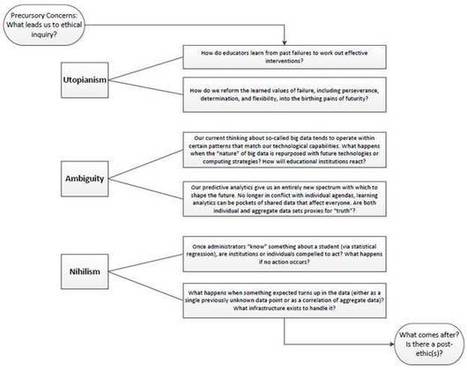
Learning analytics holds increasing potential for student agency and autonomy, highlighting a need for ethical discourse at all levels of higher education institutions. Topics central to this dialogue include student awareness of analytics, the future of algorithms and learning analytics, and the redefinition of failure.

No comment yet.
Scooped by Peter Mellow
June 12, 2014 6:43 PM
Scoop.it!

University data can be a force for good

University data can be a force for good | Learning Analytics, Educational Data Mining, Adaptive Learning | Scoop.it
Data analytics shouldn't be seen as a dark art but a tool to aid student retention and enhance experience, says Ruth Drysdale
No comment yet.
Scooped by Peter Mellow
June 12, 2014 4:13 AM
Scoop.it!

Learning analytics don't just measure students' progress – they can shape it

Learning analytics don't just measure students' progress – they can shape it | Learning Analytics, Educational Data Mining, Adaptive Learning | Scoop.it
From online forum debates to predictive essay writing software, data showing how students learn can help universities adapt their teaching
No comment yet.
Scooped by Peter Mellow
May 20, 2014 6:31 PM
Scoop.it!

Turning Learning Measurement Issues into Successful Analytics

Turning Learning Measurement Issues into Successful Analytics | Learning Analytics, Educational Data Mining, Adaptive Learning | Scoop.it
Did you know that 86% of organizations are focused on reporting, but only 15% of HR functions have strong analytics capabilities? This leads to a disconnect between Learning and Development (L&D) and Corporate within organizations.
No comment yet.
Rescooped by Kim Flintoff from Learning & Technology News
April 17, 2014 9:10 PM
Scoop.it!

Why Data Is the Key to Successful Course Redesign - Edudemic

Why Data Is the Key to Successful Course Redesign - Edudemic | Learning Analytics, Educational Data Mining, Adaptive Learning | Scoop.it

Course redesign can be a major undertaking, but utilizing the data derived from your existing course can inform your decisions on what areas need to be targeted. When you combine the four factors I mentioned and use them to form a holistic, summative picture of your course redesign project; you can be certain that what is currently working in your course remains, and what is not working is revised.


Via Nik Peachey
Nik Peachey's curator insight, April 15, 2014 4:56 AM

Interesting article on using data to help redesign courses.

Enrico De Angelis's curator insight, April 15, 2014 5:27 AM

Some basic tips and references for a systematic redesign of courses.

Scooped by Peter Mellow
August 31, 2014 10:09 PM
Scoop.it!

Why Students Should Own Their Educational Data – Wired Campus - Blogs - The Chronicle of Higher Education

Why Students Should Own Their Educational Data – Wired Campus - Blogs - The Chronicle of Higher Education | Learning Analytics, Educational Data Mining, Adaptive Learning | Scoop.it

Designing a textbook or lecture with the average student in mind may sound logical. But L. Todd Rose, who teaches educational neuroscience at Harvard University’s Graduate School of Education, argues that doing so means that the lesson is designed for nobody.

No comment yet.
Scooped by Peter Mellow
August 29, 2014 8:18 PM
Scoop.it!

Learning Analytics and Ethics: A Framework beyond Utilitarianism (EDUCAUSE Review) | EDUCAUSE.edu

Learning Analytics and Ethics: A Framework beyond Utilitarianism (EDUCAUSE Review) | EDUCAUSE.edu | Learning Analytics, Educational Data Mining, Adaptive Learning | Scoop.it

Utilitarian concerns increasingly drive machine ethics, particularly the few ethical discussions in learning analytics. Determining the most good for the most people is a responsible way forward, but perhaps not the most comprehensive, especially when assessing potential outcomes. Innovations in learning analytics may occur more rapidly and with better outcomes if informed ethical discussions occur at every step of development.

No comment yet.
Scooped by Peter Mellow
August 12, 2014 8:19 PM
Scoop.it!

Can Universities Use Data to Fix What Ails the Lecture?

Can Universities Use Data to Fix What Ails the Lecture? | Learning Analytics, Educational Data Mining, Adaptive Learning | Scoop.it
In a culture of accountability, universities call on technology to collect information about student participation in the classroom.
No comment yet.
Rescooped by Kim Flintoff from Games, gaming and gamification in Education
July 31, 2014 10:47 PM
Scoop.it!

Getting Played: Gamification, Bullshit and the Rise of Algorithmic Surveillance

Getting Played: Gamification, Bullshit and the Rise of Algorithmic Surveillance | Learning Analytics, Educational Data Mining, Adaptive Learning | Scoop.it

Gamification, the idea that game mechanics can be integrated into assumed “non-game” circumstances has gained ascendance
amongst champions of marketing, behavior change and efficiency. Ironically, some of the most heated critique of gamification
has come from the broader community of “traditional” videogame developers. Connecting broadly to projects surrounding “big
data” and algorithmic surveillance, the project of gamification continues to expand and intensify. This paper examines the
complex relationship between game designers and the rise of arguments in support of gamification. I analyze the various actors
and interests mobilizing arguments, deconstructing their underlying assumptions about the relationship between games and social
phenomena. Turning to an analytic framework rooted in the Assemblage of Play (Taylor 2009) and emergent coercive forms of
(played) control (Taylor 2006), the essay critiques assumptions on either side of the debate on the role of games and play. The
strained connections between debates on gamification and broader interest in serious games offers an important moment to
explore algorithmic surveillance.

Kim Flintoff's curator insight, July 31, 2014 10:46 PM

A challenging provocation that demands consideration by anyone working in the area.  Interesting piece challenging those of us working with gamification, learning analytics, MOOCs, etc...

Rescooped by Peter Mellow from Learning with MOOCs
July 29, 2014 5:57 PM
Scoop.it!

What 6.9 million clicks tell us about how to fix online education

What 6.9 million clicks tell us about how to fix online education | Learning Analytics, Educational Data Mining, Adaptive Learning | Scoop.it

In a paper published this spring, the CSAIL team outlined some key findings on what online learners want from videos. These include:


Brevity (viewers generally tune out after six minutes)


Informality, with professors seated at a desk, not standing behind a podium


Lively visuals rather than static PowerPoint slides


Fast talkers (professors seen as the most engaging spoke at 254 words per minute)


More pauses, so viewers can soak in complex diagrams


Web-friendly lessons (existing videos broken into shorter chunks are less effective than ones crafted for online audiences)

Stephen Bright's curator insight, July 29, 2014 6:06 PM

Analysis from MIT about the features of online videos used in MOOCs that online learners prefer. Interesting analysis for MOOCs but these features could be applied to videos used in any implementation of blended learning.


Also shows that the slick, production theatre videos with a highly professional look may not be the ones that students prefer to watch.

Nigel Robertson 's curator insight, July 31, 2014 8:04 AM
What we already knew and any academic should intrinsically understand this if they are in tune with the people they teach,
Scooped by Kim Flintoff
July 14, 2014 5:10 AM
Scoop.it!

Snooping professor or friendly don? The ethics of university learning analytics

Snooping professor or friendly don? The ethics of university learning analytics | Learning Analytics, Educational Data Mining, Adaptive Learning | Scoop.it
Universities have been recording data digitally about their students for decades. No one would seriously question the necessity of collecting facts for administrative purposes, such as a student’s name…
No comment yet.
Scooped by Peter Mellow
July 6, 2014 5:22 PM
Scoop.it!

Big Data Comes To College

Big Data Comes To College | Learning Analytics, Educational Data Mining, Adaptive Learning | Scoop.it
When students at Purdue University are reading their homework assignments, sometimes the assignments are reading them too. A software program called
No comment yet.
Scooped by Peter Mellow
June 30, 2014 9:54 PM
Scoop.it!

12 Essentials of Prescriptive Analytics for Student Success -- Campus Technology

12 Essentials of Prescriptive Analytics for Student Success -- Campus Technology | Learning Analytics, Educational Data Mining, Adaptive Learning | Scoop.it
The University of Wisconsin-Green Bay's CIO is pursuing a track that marries institutional data, predictions and business rules to create prescriptions for student and campus success. Here are his 12 best practices for prescriptive analytics.
No comment yet.
Scooped by Peter Mellow
June 12, 2014 6:44 PM
Scoop.it!

Collecting data on students: is it useful to know which books they've read?

Collecting data on students: is it useful to know which books they've read? | Learning Analytics, Educational Data Mining, Adaptive Learning | Scoop.it
Universities can gain valuable information by tracking students' behaviour online, but they must be careful not to misuse it
No comment yet.
Scooped by Peter Mellow
June 12, 2014 6:42 PM
Scoop.it!

Big data can transform learning – as long as lecturers take control

Big data can transform learning – as long as lecturers take control | Learning Analytics, Educational Data Mining, Adaptive Learning | Scoop.it
The collection of data on a large scale has already revolutionised our experience of online shopping. Imagine what it can do for online learning
No comment yet.
Scooped by Peter Mellow
June 10, 2014 10:23 PM
Scoop.it!

After grappling with data, MOOC Research Initiative participants release results @insidehighered

After grappling with data, MOOC Research Initiative participants release results @insidehighered | Learning Analytics, Educational Data Mining, Adaptive Learning | Scoop.it

Massive open online course providers are collecting troves of data about their students, but what good is it if researchers can't use the information?


The MOOC Research Initiative formally released its results on Monday, six months after researchers met in Arlington, Texas, to brief one another on initial findings. The body of research -- 22 projects examining everything from how social networks form in MOOCs to how the courses can be used for remedial education -- can perhaps best be described as the first chapter of MOOC research, confirming some widely held beliefs about the medium while casting doubt on others.

No comment yet.
Rescooped by Peter Mellow from Networked Learning - MOOCs and more
April 22, 2014 8:43 PM
Scoop.it!

Who Does What in a Massive Open Online Course? | Seaton et al. , Comm. of the ACM

Who Does What in a Massive Open Online Course? | Seaton et al. , Comm. of the ACM | Learning Analytics, Educational Data Mining, Adaptive Learning | Scoop.it

Massive Open Online Courses (MOOCs) collect valuable data on student learning behavior; essentially complete records of al student interactions in a self-contained learning environment, with the benefit of large sample sizes. […] 

• […] 76% of all participants were browsers who collectively accounted for only 8% of time spent in the course, whereas, the 7% certificate-earning participants averaged 100 hours each and collectively accounted for 60% of total time. 

• Students spent the most time per week interacting with lecture videos and homework, followed by discussion forums and online laboratories;


Via Peter B. Sloep
Peter B. Sloep's curator insight, April 21, 2014 3:46 PM

The article analyses the behaviour of some 150,000 registrants for the inaugural edX course — 6.002x: Circuits and Electronics, which was offered in the spring of 2012. The analysis is based on the log files for the course, constituting an exemplary case of the application of learning analytics in action (although the authors don’t use that term at all). It consists of two parts. First, the authors take the data of all registrants into account, later to focus on those relatively few (about 10,000) who managed to earn a course certificate. 


Overall, this is an interesting and useful study. I have two minor qualms with it. First, the analysis focuses on those registrants who passed the exam and earned a certificate. Although the 10,000 students who managed to do this is a sizable number, it pales with the 150,000 who registred in the first place. Second, and as far as I am concerned more importantly, no attempts is made to frame the discussion in the context of a particular learning theory. However, these qualms do not detract from the value of this study, it deserves to be widely read, particularly by people who are engaged in learning analytics (who might miss it as that term is not used). @pbsloep

(see for a more extensive discussion of the article my blog post at http://pbsloep.blogspot.nl/2014/04/who-does-what-in-massive-open-online.html)