


Evidence-centered design suggests that any system of assessment begins with a conception of the capabilities one wants to develop in a learner; from there develops the machinery of the assessment s...
Via Ana Cristina Pratas

 Your new post is loading...
 Scoop.it! Evidence-centered design suggests that any system of assessment begins with a conception of the capabilities one wants to develop in a learner; from there develops the machinery of the assessment s... Via Ana Cristina Pratas 
No comment yet.
Sign up to comment
Scoop.it!
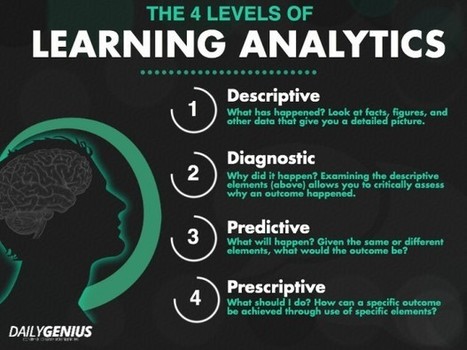
“ Using data to drive learning outcomes isn’t a new concept, really. For as long as teachers have been giving students assessments, the assessments and results have been used by both students and teachers (even if only loosely) to determine how to move forward. What needs to be reviewed more? What was covered/studied well? Learning analytics takes this concept and kicks it up a notch. Well, more like a thousand notches, especially if you’re considering things like adaptive computer based testing that changes as students use it.” Via Patric Lougheed, Ivon Prefontaine, PhD

Tim Hopper's curator insight,
February 11, 2015 10:33 AM
The idea of continuous and real time feedback loops to help students learn sounds exciting if harnessed in the right way by instructors.
Scoop.it!

As colleges and universities accumulate more and more information from campus systems, researchers are looking for ways to turn big data into learning insights.
Scoop.it!

Adaptive learning technologies may pave the way to a "pedagogical renaissance." Although still in the early stages, these technologies have already shown some of their potential, as fewer students are failing or dropping out of classes that use these programs.
Scoop.it!

I believe the move to large-scale adoption of learning analytics, with the attendant rise in institution-level decisions, should motivate us to spend some time thinking about how concepts such as validity and reliability apply in this practical setting. Motivation comes from: large scale adoption has “upped the stakes”, and non-experts are now involved in decision-making. This article is a brief look at some of the issues with where we are now, and some of the potential pit-falls going forwards.
Scoop.it!

The search for data that impacts student success may lead to more questions than answers.
When we first sketched out a topic for this month's feature on the quest for data that impacts student success, we had a slightly different story in mind. We wanted to come up with a handful of data types that any higher ed institution pursuing learning analytics should have on its list — say, five key data points that really impact student outcomes.The search for data that impacts student success may lead to more questions than answers.
Scoop.it!

New analytics tools from uClass aim to give users a better picture of what instructional materials their teachers are using—and whether these resources are effective
Scoop.it!

The real challenge for learner analytics now is to move analytics to action, says Russ Little, PAR's new Chief Innovation Officer.
Scoop.it!
The evaluations persist, a new paper argues, because they are easy to produce and offer the comfort of a number, but they make no sense statistically.
Scoop.it!

Analytics is the use of data, statistical analysis, and explanatory and predictive models to gain insights and to act on complex issues. Analytics has already transformed other sectors. In “10 Predictions for What the CIO Role Will Look Like in 2020,” John Brandon quotes CIO Oliver T. Bussmann: “[CIOs need] to earn a place in the C-suite by looking into the future of where the business is going, and determining the right technology roadmap to enable new business models, to improve margin, or otherwise give their company a leg up on the competition. In many cases this will mean leveraging in-memory computing and analytics to react to and capitalize on trends in real-time.”
Scoop.it!

The efforts to boost the nascent field of learning analytics could bring about a sea change in education, making it possible to personalize — on a massive scale — students’ learning by their individual interests and needs, according to a comprehensive report, involving experts from academia, business, nonprofits, foundations and government . It was written by Roy Pea, the David Jacks Professor of Education and Learning Sciences at the Stanford Graduate School of Education.
Scoop.it!

We've Been Hearing a lot About Big Data Lately, but What Does it Mean for Educators? Wikipedia defines Big Data as, “a blanket term for any collection of d Via Grant Montgomery
Scoop.it!

The Internet of Things has reached the height of its hype, according to Gartner.
|
Scoop.it!

UK universities are monitoring students’ information to help them to improve their academic performance but are giving insufficient thought to the effectiveness of the technology they use and the rights of those they track. This is according to Sharon Slade, senior lecturer in the Faculty of Business, Management and Law at The Open University, which is believed to have become the first institution in the UK to produce a publicly available written policy on the ethical use of student data for learning analytics – the practice of collecting and analysing student data with the intention of optimising their educational experience. Work on a transparent ethical policy at The Open University highlighted concerns about technology and privacy
Scoop.it!

The issue progresses from a simple definition and explanation of what big data is into more complex issues.
Scoop.it!
The initiative will be led by researchers at Carnegie Mellon University, who propose to construct a new data-sharing infrastructure that is distributed across multiple institutions, including third-party and for-profit vendors.
Scoop.it!

A coalition of prominent research universities is receiving federal support to redesign and scale up a massive repository for analyzing learning and behavioral data.
Scoop.it!

The same technologists who protest against the NSA’s metadata collection programs are the ones profiting the most from the widespread surveillance of students.
Scoop.it!
cits.curtin.edu.au/tcit See how Curtin IT Services is playing a part in forging a new and flexible digital experience for our staff, students and researchers...
davidgibson's insight:
Analytics will underpin all aspects of the university in a few years. It's a long road and we are 'on it.'
Scoop.it!

Stanford calls for education data science field; presents national road map to analytics success In a truly comprehensive report, with advice and suggestions from over 800 teachers and administrators, a Stanford-led national Workgroup calls for a new movement in learning analytics—redefining the field and offering a seemingly scalable road map to success. The Workgroup, report, and road map were developed, because as Roy Pea, the David Jacks Professor of Education and Learning Sciences at the Stanford Graduate School of Education and lead investigator of the report, explains: the technology behind analytics has progressed faster than education’s ability to use it.
Scoop.it!

Concern was also expressed about the metrics being used for analytics – how accurate and appropriate are they and could it be dangerous to base interventions by tutors on metrics which portray an incomplete picture of student activity?
A number of the participants had already been thinking in detail about how to tackle these issues. There was a consensus that learning analytics should be carried out primarily to improve learning outcomes and for the students’ benefit. Analytics should be conducted in a way that would not adversely affect learners based on their past attainment, behaviour or perceived lack of chance for success. The group felt that the sector should not engage with the technical and logistical aspects of learning analytics without first making explicit the legal and ethical issues and understanding our obligations towards students.
Scoop.it!
This slide deck outlines the four key layers of any big data system.
Scoop.it!

This special issue of the eLearning Papers is based on the contributions made to the EMOOCS 2014 conference jointly organized by the École Polytechnique Fédérale de Lausanne (EPFL) and P.A.U. Education. The success of this conference with more than 450 participants demonstrates that MOOCs are at the beginning of a wave and a first step towards opening up education.
Scoop.it!

From
www

Capturing and analyzing data has changed how decisions are made and resources are allocated in businesses, journalism, government, and military and intelligence fields. Through better use of data, leaders are able to plan and enact strategies with greater clarity and confidence. Data drives increased organizational efficiency and a competitive advantage. Simply, analytics provide new insight and actionable intelligence. Via Grant Montgomery
|






