Your new post is loading...

|
Scooped by
Mel Riddile
August 11, 2017 6:53 PM
|
From New York to Vermont, and from Illinois to Idaho, a new kind of education standard is taking root. It's called mastery-based learning, and it means no grades. That's right; no A's, B's or C's. Instead, students focus on grade-appropriate skills competency. As in, being able to solve a certain type of math problem, or read at a certain level, or construct a thesis. Once they get it, they move on. Otherwise, they continue to focus on that particular set of skills.
According to The New York Times, in some regions, like New York City, elementary, middle and high schools are adopting this type of skills-based evaluation system voluntarily, while in others, states have mandated that these changes take place. And obviously, some parents and educators are all for abolishing grades, while others have met such a massive overhaul to education with much resistance.
|
|
Scooped by
Mel Riddile
August 11, 2017 6:34 PM
|
A new study finds that U.S. schools hand out 98 different kinds of high school diplomas, and 51 of them fail to prepare students adequately for college or careers. A disproportionate share of those weaker diplomas go to students of color and students from low-income families.
The uneven quality in high school credentials begs for attention in the national conversation about high school completion, even as the country boasts an all-time-high graduation rate of 83.2 percent, the report says.
"High school graduation rates are an important but incomplete indicator of success. In addition to measuring whether students receive a diploma, it also is critical to gauge the value of the diploma itself," says "Paper Thin," the study by the Alliance for Excellent Education. "Allowing students to walk across the stage at graduation with paper-thin diplomas—that do not signify readiness for postsecondary education—is a disservice both to students and to the economic potential of the United States."
|
|
Scooped by
Mel Riddile
August 10, 2017 3:14 PM
|
Our research on leadership development shows that leaders who are in learning mode develop stronger leadership skills than their peers.
Building on Susan Ashford and Scott DeRue’s mindful engagement experiential learning cycle, we found that leaders who exhibit a growth mindset diligently work through each of the following three phases of the experiential learning cycle.
First, leaders set challenging learning goals in the form of “I need to learn how to…” For some leaders, the goal might be to become more persuasive or to be more approachable. With a goal in mind, leaders can identify opportunities to make progress toward it. These could include a new project, an international assignment, a job rotation, or simply striving to approach routine encounters in a fundamentally different way.
|
|
Scooped by
Mel Riddile
August 8, 2017 2:27 PM
|
Set a leadership values-based goal. An authentic and connected presence begins from the inside-out. How you define the role and what you value will “telegraph” out to those you work with. As a new manager, spend time to consider the kind of leader you are and hope to be. Set an aspirational goal to serve as a guiding compass. As one new manager shared recently, “my professional leadership goal is to be a genuine and emotionally intelligent manager who inspires others to excellence.”
|
|
Scooped by
Mel Riddile
August 7, 2017 5:24 PM
|
A 10-year longitudinal study on executive transitions that my organization conducted found that more than 50% of executives who inherit a mess fail within their first 18 months on the job. We also uncovered numerous landmines for leaders in this situation. And, with the best of intentions, my client was about to step on a number of them. When a leader inherits a mess created by others, especially when arriving as an outsider, the situation can feel fragile and knowing where to begin the long journey of change can feel precarious. Based on our research and my experience, there are six things the most effective leaders do to avoid failing in a new role.
|
|
Scooped by
Mel Riddile
August 5, 2017 3:29 PM
|
Eight in 10 teenagers identify school as a primary source of stress, and one in 10 say they’ve received lower grades because of stress. When it comes to math, the problem may be worse—many students experience math anxiety, low self-confidence, or overwhelming amounts of academic pressure, which can disrupt learning, leading to lower grades and test scores. Teachers try out a lot of ideas to reduce math stress, and here’s a surprising one: Have students write about their personal values. That’s the finding from a new study published in PLOS One.
|
|
Scooped by
Mel Riddile
August 4, 2017 12:16 PM
|
Close reading requires a substantial emphasis on readers figuring out a high-quality text. This "figuring out" is accomplished primarily by reading and discussing the text (as opposed to being told about the text by a teacher or being informed about it through some textbook commentary). Because challenging texts do not give up their meanings easily, it is essential that readers re-read such texts (not all texts are worth close reading). A first reading is about figuring out what a text says. It is purely an issue of reading comprehension. Thus, if someone is reading a story, he/should be able to retell the plot; if someone is reading a science chapter, he/she should be able to answer questions about the key ideas and details of the text.
|
|
Scooped by
Mel Riddile
August 2, 2017 6:39 PM
|
Any effective creativity training program should focus on both aspects of the creative process: “convergent” thinking (the generative, brainstorming phase in which tasks are carried out without judgement or hesitation), and “divergent” thinking (that part where you hone and assess the wealth of ideas that you’ve already generated). The convergent stage is the time when ideas are freely generated without rejection, no matter how bad they may seem. And this is all many creative studies minors focus on—that sexy, sky’s-the-limit phase when everyone is tossing ideas around, the wilder the better.
|
|
Scooped by
Mel Riddile
August 2, 2017 2:55 PM
|
As the testing in K-12 has become more emphasized, educators are still working out how to get the right amount of testing that doesn't sacrifice valuable teaching time.
|
|
Scooped by
Mel Riddile
August 1, 2017 6:26 PM
|
The roots of those abilities and those skills seem to come from an endowment that is evolutionarily ancient and that we share with most other species.
In other words, we've evolved to know math — along with almost every other animal. How did you become interested in this?
I've always been fascinated with the idea that you can have this sophisticated knowledge — at least the foundations of it — in place, very early on. And we know now that it's very broadly available across animal species. Species as different from humans as fish: Guppies are sensitive to numbers in the environment. Of course, primates are. Salamanders. Various insects. It's this basic ability that helps animals navigate their environment. I mean, literally, navigate the environment by calculating angles and distances and so forth. It helps them choose the greater amount of food if they're choosing between two quantities. It shows up in foraging contexts all the time.
|
|
Scooped by
Mel Riddile
July 30, 2017 6:03 PM
|
We are so fortunate to have a wealth of information at our finger tips. There are so many online resources we can use to educate ourselves. Sometimes it does become overwhelming with all the options, but we should never feel overwhelmed by information. Depending on what you want to educate yourself on, you should find a ton of online resources on the subject. Traditional learning has taken a back step for individuals who want to take control of their time and what information they find beneficial to their lives.
So many people have decided to give up their 9-5 jobs in the hopes of making money from their passions. A lot of successful people have emerged and you can find teenagers starting and succeeding at business, without much of a formal qualification. If you are someone who want to self-educate yourself, we have the best resources to use as a start.
|
|
Scooped by
Mel Riddile
July 30, 2017 9:43 AM
|
Educators say principals are the key to academic success. They set priorities for teachers and students and help build strong relationships between them and among parents and educators.
But the demands on principals are strenuous. They often face pressure to turn struggling schools around quickly, even if they have just taken over. Many are yanked out of schools within a few years and are unable to fulfill their plans for improvement.
|
|
Scooped by
Mel Riddile
July 29, 2017 1:28 PM
|
Watch how Sarah gives students directions as a way to prepare them for successful collaboration. The tips you gain will help with all sorts of group work you have planned for your students.
|
|
|
Scooped by
Mel Riddile
August 11, 2017 6:37 PM
|
Aspiring teachers in California will now be able to major in education as undergraduates, which an unusual state law there has technically forbidden for more than five decades.
|
|
Scooped by
Mel Riddile
August 10, 2017 3:22 PM
|
The less you care about your own success, the more successful you will be.
That's according to Adam Grant, organizational psychologist, top-rated professor at Wharton business school and author of The New York Times best-selling books "Give and Take," "Originals" and "Option B."
"One of the things that stands out for me when I think about what distinguishes the greatest leaders of our time, is that success is very rarely a goal for them, it's a byproduct of other goals that they have," Grant, who has studied thousands of leaders in his career, tells CNBC Make It.
"They say, 'Look, the most meaningful way to succeed is to help other people succeed, to advance a vision or an idea or a project that is bigger than me, that's going to affect a lot of people,'" explains Grant.
"And then the bigger you aim there, the more you focus on doing something that's going to benefit others, the more likely you are to produce something that's also going to achieve success for you."
|
|
Scooped by
Mel Riddile
August 8, 2017 2:36 PM
|
Males are enrolling in higher education at alarmingly low rates, and some colleges are working hard to reverse the trend. This fall, women will comprise more than 56 percent of students on campuses nationwide, according to the U.S. Department of Education. Some 2.2 million fewer men than women will be enrolled in college this year. And the trend shows no sign of abating. By 2026, the department estimates, 57 percent of college students will be women.
|
|
Scooped by
Mel Riddile
August 7, 2017 5:30 PM
|
Here's why leadership is so tough.
What makes this mentality so difficult is that, in every capacity, it asks that you, as a leader, put yourself last.
It's a removal of the ego. You can't just rage out of impatience, or get upset because other people aren't working the way you want them to work. You can't show your frustration--even if everyone else is. You can't sit back and complain when times get tough, you have to be the positive force that changes the tide.
You, as a leader, have to take a step back from your impulsive, emotional reactions, and instead operate from a place of calm understanding. And that's a skill that isn't taught in school, it's not taught in after-school clubs, or even on sports teams.
It's learned through watching closely others who embody that trait.
And it's learned through diligent self-inquiry, and constantly practicing the art of being flexible in the way you communicate and lead others.
|
|
Scooped by
Mel Riddile
August 5, 2017 5:28 PM
|
Adults in education spend a lot of time debating about how to get high school students ready to succeed in college. But students have a less-than-rosy picture to report about how well that's going.
A new survey of 55,000 high school students across the country finds that only about half say their schools are doing a good job.
The study was conducted by YouthTruth, a San Francisco nonprofit that contracts with schools and districts interested in using the online surveys to kickstart dialogues focused on improvement.
|
|
Scooped by
Mel Riddile
August 4, 2017 6:03 PM
|
Enrollment in teacher-prep programs is falling nationwide, and by more than 50 percent in Michigan colleges and universities. Why the classroom is losing its appeal.
|
|
Scooped by
Mel Riddile
August 4, 2017 12:09 PM
|
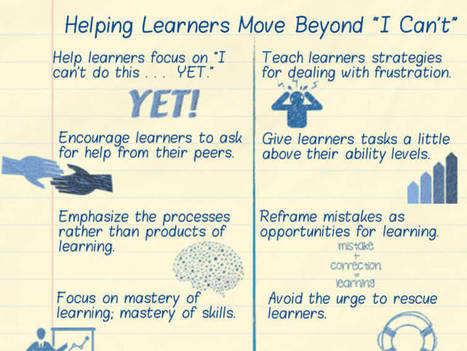
The use of “YET” was drawn from Carol Dweck’s work with growth mindsets. ‘Just the words “yet” or “not yet,” we’re finding give kids greater confidence, give them a path into the future that creates greater persistence. And we can actually change students’ mindsets. In one study, we taught them that every time they push out of their comfort zone to learn something new and difficult, the neurons in their brain can form new, stronger connections,and over time, they can get smarter.’ (Carol Dweck TED Talk: The power of believing that you can improve) By asking learners to add ‘yet’ to the end of their ‘I can’t do this’ comments, possibilities are opened up for success in future attempts and iterations. It changes their fixed or failure mindsets to growth and possibility ones.
|
|
Scooped by
Mel Riddile
August 2, 2017 3:02 PM
|
Some say English instruction must get back to basics, with a focus on grammar. But won’t that stifle a student’s personal voice? Three-quarters of both 12th and 8th graders lack proficiency in writing, according to the most recent National Assessment of Educational Progress. And 40 percent of those who took the ACT writing exam in the high school class of 2016 lacked the reading and writing skills necessary to successfully complete a college-level English composition class, according to the company’s data. Poor writing is nothing new, nor is concern about it. More than half of first-year students at Harvard failed an entrance exam in writing — in 1874. But the Common Core State Standards, now in use in more than two-thirds of the states, were supposed to change all this. By requiring students to learn three types of essay writing — argumentative, informational and narrative — the Core staked a claim for writing as central to the American curriculum. It represented a sea change after the era of No Child Left Behind, the 2002 federal law that largely overlooked writing in favor of reading comprehension assessed by standardized multiple-choice tests.
|
|
Scooped by
Mel Riddile
August 1, 2017 6:29 PM
|
American children and teens spend around 7.5 hours a week more at school than kids did 20 years ago.
That's only one way in which schools and education have changed over the years. Fashions come and go, but historical events and political changes impact education in many ways.
From speed-reading to SMART boards, here's what going to school looked like the decade you were born.
|
|
Scooped by
Mel Riddile
July 31, 2017 6:55 PM
|
5 Growth Mindset Practices
In their groundbreaking book, Professional Learning Communities at Work, Richard DuFour and Robert Eaker say it clearly when pointing out the issue that comes about when change initiatives are considered "a task to complete rather than an ongoing process." If we really want to improve our schools, our work, and the education of our students, we can do so by adopting a new mindset -- for everyone -- that would include:
Being humble enough to accept that there are things about ourselves and our practices that can improve
Becoming part of professional teams that value constructive critique instead of criticism
Treating setbacks as formative struggles within the learning process instead of summative failures
Realizing the restrictive role that timelines can play in reaching high standards, and using foundational philosophies such as Universal Design for Learning (UDL) to map systems so that everyone's growth is supported
Create flexible grouping at all times so that nobody's trapped in any one course level or particular type of work.
|
|
Scooped by
Mel Riddile
July 30, 2017 6:01 PM
|
In order for a school community to thrive, there needs to be a shared, clear vision that helps to focus the mission. This action plan will help assert forward movement and develop a closer and more effective thread in the stakeholders within the district.
But a leader alone can't establish or develop this vision, it must be a group effort that grows and matures over time. We simply can't just write it and let it languish; we must nurture it and adjust it as we move along our path to ensure that we are staying faithful to what works best for our kids, in each of our communities.
And since growth requires constant change, we need to be able to adjust the vision and mission to the time we are currently working in.
|
|
Scooped by
Mel Riddile
July 29, 2017 1:51 PM
|
Best content around Internet Safety Learning selected by the EdTech Update community.
|