KILUVU
142.5K views | +0 today
Follow
KILUVU
Pour partager le Monde Vu et Lu de mes yeux verts
Your new post is loading...
Rescooped by Yves Carmeille "Libre passeur" from Education 2.0 & 3.0
February 23, 2019 7:00 AM
Scoop.it!

5 blended-learning myths to bust in 2019

5 blended-learning myths to bust in 2019 | KILUVU | Scoop.it

This piece is co-authored by Chelsea Waite, research fellow, education, at the Christensen Institute.

In February 2016, the Christensen Institute debuted the Blended Learning Universe (BLU)—an online hub of blended learning resources—in response to more and more schools across the U.S. implementing a blended-learning strategy for students. Researchers at the Institute define blended learning as a formal education program that must have three components: it must be part online, with students having some control over the time, place, path, or pace of their learning; it must occur, in part, in a brick-and-mortar location away from home; and the modalities along a student’s learning path must be connected to provide an integrated learning experience. While there is great diversity of practice, the Institute identifies seven common models leveraged by educators:


Via Elizabeth E Charles, Yashy Tohsaku
No comment yet.
Rescooped by Yves Carmeille "Libre passeur" from All digital
December 27, 2017 2:41 AM
Scoop.it!

Developing a Student-Generated Virtual Museum for Ubiquitous Learning - A Design-Based Research Study | LinkedIn

Developing a Student-Generated Virtual Museum for Ubiquitous Learning - A Design-Based Research Study | LinkedIn | KILUVU | Scoop.it

Via Stephania Savva, Ph.D
Stephania Savva, Ph.D's curator insight, October 6, 2017 4:12 PM
This paper addresses parts of my doctoral study exploring how engagement in a museum-school synergy influenced pupils’ multimodal awareness and meaning making as well as increased their critical thinking and enhanced their literacy repertoires, through relevant cultural practice and participation based on a Museum-based Multiliteracies Practice framework. 

Findings indicate that addressing museum-based multiliteracies can lead the way towards ubiquitous learning. 

 Feel free to share if this sounds of interest.
Kim Flintoff's curator insight, November 2, 2017 8:03 PM
Short abstract

Currently, dramatic changes take place in terms of rapidly emerging modes of communication, technologies, increased cultural diversity, evolving workplaces cultures, new challenges for equitable education and the varying and changing identities of students everywhere. Bearing this in mind, this article draws on a design-based research study to argue of the need for museums to respond to global trends and fulfill their social and educational imperatives by investigating the potential of a particular pedagogical framework that is grounded in culturally inclusive pedagogical practices and characteristics of ubiquitous learning.
Rescooped by Yves Carmeille "Libre passeur" from 21st Century Learning and Teaching
May 22, 2017 4:03 AM
Scoop.it!

Why It's Time To Put Students In The Driver's Seat

Why It's Time To Put Students In The Driver's Seat | KILUVU | Scoop.it
Think about how you or the people you work with approach the creation of a blended learning lesson plan. The first steps of coming up with and flushing out your initial idea. Then, scouring the web to find safe, factually accurate sites that are not blocked by your school filters and checking the fine print …


This method of teaching does require a certain amount of bravery. There is a very real chance that when a student asks you a question (How do I add media? How do I change the font? How do I import pictures? etc. etc.) you will have to say the dreaded “I don’t know”. But the neat thing is, your students are ok with this. You’re all learning as you go. More often than not another child in the class will be using the same site or will have at least used it before. If a classmate knows the answer, they can step into the role of teacher – from which much confidence is gained and leadership skills are learned.


Even the most reserved kid really enjoys teaching their teacher a trick or two. If no one knows the answer, they can collaborate to find the solution; an activity that provides important life skills with many real-world applications. All while leaving the initiative, process development and ownership of the learning itself right where it belongs, in the hands of the learners.


Gust MEES: I started with it in 2002 already and was a pioneer in my country, BUT I got BEST results! Make sure to work TOGETHER as a TEAM with the students, learners, create ALSO some groups where the BEST work together with the weakest. YOU will love it later and YOU will miss it as it gives YOU a direct feedback of WHAT THEY learned and YOU adjust on demand and necessity... WHEN the BEST feel boring, give THEM a special task to motivate THEM ;) ===> Adjust <===.


Concerning the questions from the students, please check my advice here:


http://gustmees.wordpress.com/2014/01/04/practice-better-ways-to-say-i-dont-know-in-the-classroom/


http://gustmees.wordpress.com/2012/05/02/work-sheet-teachers-best-practiceshowto/


Via Gust MEES
Gust MEES's comment, May 28, 2014 3:40 PM
@Ivon Prefontaine, PhD Hi, give me some time (???), please and I will create a blog about how I did it ages ago (2002-2003), thanks. For the moment GO for #DeepTHINKing and try to find out (paper & notes & ideas) how You could realize it with your actual #ProfessionalDevelopment, make some #Brainstorming with THE #LEARNERS in mind ;) A good exercise ;) Let me know, thanks ;)
Gust MEES's comment, May 28, 2014 7:18 PM
@Ivon Prefontaine, PhD I will take it is a priority to create THAT blog, stay tuned, please ;)
Alan Jordan's curator insight, April 3, 2016 4:13 PM

I am not sure what is being suggested is putting students in charge. It is more about a complicated conversation between teachers and students about the subject matter. There is an in-between space where teachers and students meet.

Rescooped by Yves Carmeille "Libre passeur" from Go Big
April 30, 2018 5:19 AM
Scoop.it!

Developing a Student-Generated Virtual Museum for Ubiquitous Learning - A Design-Based Research Study | LinkedIn

Developing a Student-Generated Virtual Museum for Ubiquitous Learning - A Design-Based Research Study | LinkedIn | KILUVU | Scoop.it
Currently, dramatic changes take place in terms of rapidly emerging modes of communication, technologies, increased cultural diversity, evolving workplaces cultures, new challenges for equitable education and the varying and changing identities of students everywhere. Bearing this in mind, this article draws on a design-based research study to argue of the need for museums to respond to global trends and fulfill their social and educational imperatives by investigating the potential of a particular pedagogical framework that is grounded in culturally inclusive pedagogical practices and characteristics of ubiquitous learning.

Via Andreas Christodoulou
Andreas Christodoulou's curator insight, October 6, 2017 4:08 PM
A useful resource on appropriate implementation of educational technology and its practical implications for students. This empirically-based study, indicates that addressing museum-based multiliteracies within a blended learning environment can be meaningful for ubiquitous learning.
THE OFFICIAL ANDREASCY's curator insight, October 6, 2017 4:20 PM

In this article, a design-based research approach is presented, which utilizes multiliteracies pedagogy to support ubiquitous learning during the design of a student-generated virtual museum. The findings from implementing the museum-school synergy, indicate that there is potential for beneficial ubiquitous learning experiences for students when theory-based practice is undertaken.

Rescooped by Yves Carmeille "Libre passeur" from All digital
October 20, 2016 2:34 AM
Scoop.it!

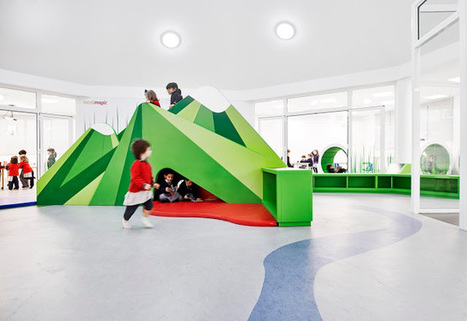
4 Key Elements to Redesigning Learning Spaces for the 21st Century

4 Key Elements to Redesigning Learning Spaces for the 21st Century | KILUVU | Scoop.it
Look into the key elements that are needed to re-design an appropriate learning space for 21 century.

Via THE OFFICIAL ANDREASCY, Stephania Savva, Ph.D
THE OFFICIAL ANDREASCY's curator insight, October 18, 2016 4:42 AM

The purpose is to improve teaching and learning.

Andreas Christodoulou's curator insight, October 18, 2016 4:54 AM
Re-designing learning spaces in schools will positively impact classroom learning: http://tiny.cc/RedesigningLearningSpaces