


Effective narrated slide deck featuring Michelle Pacansky-Brock on using Voicethread for assessment; emphasis is on assessment that builds upon students' capacities and motivation for self-driven learning. -JL

 Your new post is loading...
 Scoop.it! Effective narrated slide deck featuring Michelle Pacansky-Brock on using Voicethread for assessment; emphasis is on assessment that builds upon students' capacities and motivation for self-driven learning. -JL No comment yet.
Sign up to comment
Scoop.it!

Terry Freedman is quite a prolific writer and ed tech evangelist in Great Britain. He publishes a monthly newsletter that contains a great deal of useful and interesting infromation. The November issue came out on the 29th and is devoted primarily to things 3D.
Scoop.it!

Engineers have discovered how to program a smartphone to sense nearby keyboard vibrations and decipher complete sentences with up to 80 percent accuracy.
Scoop.it!

It’s easy to attribute our failures of will to our biology. But it’s wrong.
By GREG WALTON and CAROL DWECK. Dweck is author of the great book, Mindset.
Scoop.it!

Principles of networked learning, constructivism, and connectivism inform the design of a test case through which secondary students construct personal learning environments for the purpose of independent inquiry. Emerging web applications and open educational resources are integrated to support a Networked Student Model that promotes inquiry-based learning and digital literacy, empowers the learner, and offers flexibility as new technologies emerge. The Networked Student Model and a test case are described in detail along with implications and considerations for additional research. The article is meant to facilitate further discussion about K-12 student construction of personal learning environments and offer the practitioner a foundation on which to facilitate a networked learning experience. It seeks to determine how a teacher can scaffold a networked learning approach while providing a foundation on which students take more control of the learning process. Via Paulo Simões, Jim Lerman
Scoop.it!

Inspired by Angela Meiers and Dan Pink, 7th grade teacher Denise Krebs has decided to implement a weekly Genius Hour with her students, in which they pursue their own intellectual interests. This compiliation of her blog posts tells us how its going and directs us to the Twitter hashtag for the project, #geniuhour. This looks really interesting. -JL
Scoop.it!

Julia Steiny speaks with education technology leader Angela Maiers about the promise and future of ed tech -- and how we integrate it into our classrooms.
Scoop.it!

This collections of short, personal reflections on their own education by 15 achievers touched so many chords in me that I became surprised. Great ruminations on passion, interest, and learning.
Scoop.it!

Vicki Davis, co-originator of the Flat Classroom Project, is one of the most informative and prolific ed tech bloggers. Here she provides links to her 8 most popular posts for the year, along with a few others that remain popular from other years. -JL
Scoop.it!

Kikuchat offers a persistent hosted group chat solution for teams.
Key features include:
a) Multiple Rooms
b) Uploads and Embeds
c) Chat from Anywhere
Find out more about it here: http://kikuchat.com/ Via Robin Good
Scoop.it!
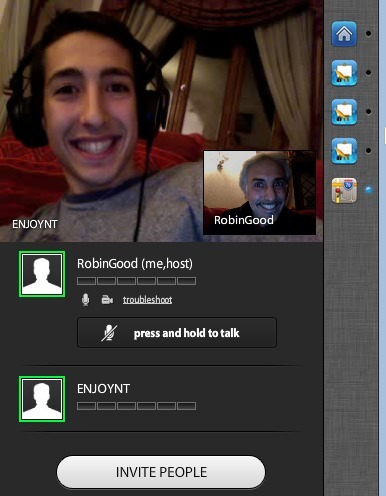
LiveMinutes is a new innovative and easy-to-use free web conferencing tool which allows you to easily share documents, images and video clips while talking live with your connected participants via an integrated Skype facility.
LiveMintues integrates also a whiteboard, the ability integrate and annotate maps, auto-creation of meeting minutes, a text chat area and a full attendees list.
Last but not least the host can choose between multiple simultaneous open microphones or two-at-a-time modality. Via Robin Good
Scoop.it!
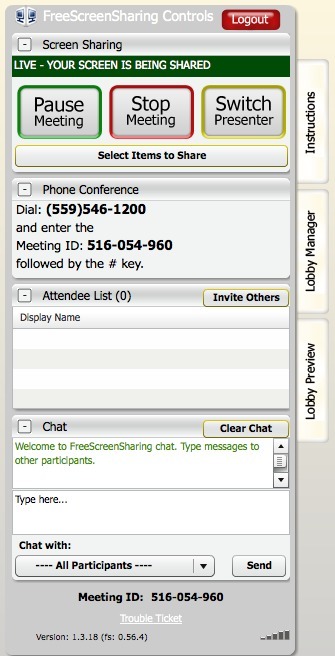
Robin Good: FreeScreenSharing.com is a new webconferencing service that integrates screen-sharing, text chat and audio conferencing in a simple and free to use tool.
The service integrates a US-based toll-free tele-conferencing service and provides multiple options to customize and personalize the customer interface.
The technology makes use of Java and Javascript and can be accessed easily with both PCs and Macs.
As for another past freebie conferencing system, Freebinar (now Anymeeting), I can't avoid to note how much the control dashboard of FSS closely replicates in many instances the original GoToMeeting UI, though there exist some key differences.
Find out more here: http://freescreensharing.com/faq.html
Via Robin Good
Scoop.it!

Rondee 2.0 is a telephone-conferencing with web-based scheduling and response tracking service.
The new free service allows users to have access to a single platform providing the choice of scheduling a conference in advance with RSVP tracking or conferencing on demand.
Additionally, users now have the option of customizing a variety of features such as configurable greeting tones, audio recording, detailed call reporting.
Read more: http://www.sfgate.com/cgi-bin/article.cgi?f=/g/a/2011/11/07/prweb8940727.DTL Via Robin Good |
Scoop.it!

If you are beginning to investigate what a Flipped Classroom is, with the thought of possibly trying some kind of Flip yourself… then this is also the right place. I have researched and tried to find you the very best resources to get educators in all positions thinking about what a Flipped Classroom” really is”? I know that if you take a look at the resources provided you will walk away with a better understanding, and a well thought out implementation.
Scoop.it!

For eight weeks, the MIT Education Arcade and the Smithsonian Institute put on an alternate reality game seeking engage children with the scientific method.
[This article makes a great case study on building community.] Via The Digital Rocking Chair
Scoop.it!

A Virginia company leading a national movement to replace classrooms with computers is facing a backlash from critics who are questioning its funding, quality and oversight.
Scoop.it!

I'm always amazed that more people don't know the little tricks you can use to get more out of a simple Google search. Here are 10 of my favorites. Via Shirley Reushle
Scoop.it!
Google and Microsoft are among technology companies calling on the UK Government to make changes to the education system to provide teaching in computer science
Scoop.it!

Lots of people believe that a single individual can’t make a difference in an organization. Lots of people, it turns out, are wrong.
Scoop.it!

C. M.Rubin interviews the Director of the Oklahoma A+ Schools Program, a model school network for the integration of the arts into the entire school curriculum...
Scoop.it!

It used to be that if you worked hard, you were guaranteed a certain kind of life. There are reasons success is no longer a straight shot.
Scoop.it!

... The most interesting part of Drexler’s essay steps away from the particular technological tools and techniques which PLE’s entail and focuses instead on what this means for teaching and learning. Teachers, she explains, are no longer the primary or even the best source of information available to students, and our work must increasingly attend to supporting students in developing their skills and motivations for becoming themselves networked and sophisticated online learners. Consider as an example the way the student in the video above consults experts around the world on her subjects of inquiry. ... Via Paulo Simões
Scoop.it!

Nota is a unique, cutting-edge collaborative web platform that allows users to create, share and collaborate on presentations and virtually any other form of online material.
Using Nota’s proprietary toolset, users can instantly integrate text, video, maps, clip art, photos from web album or on the local computer, or license-free images from Flickr, and material from an ever-expanding array of sources.
Users can then instantly embed their work in Facebook or blogs, and can share and collaborate with friends. Via Robin Good
Scoop.it!
Robin Good: Hoot.Me is a Facebook application that allows you to video-conference with up to 8 people, screen-share with no extra software installation, and chat with your FB contacts.
Designed for collaborative study sessions it offers a unique approach to make Facebook a just-in-time study-oriented platform.
Other interesting info-bits from the About page: "Smart chat allows typed math equations to be automatically reformatted to look the way they should.
Sessions are stored, so you can get your help from past conversations too.
Don’t want your studies to be public? No problem. With private sessions, you can invite only the people you want by sharing the link.
If you’re a teacher, you can use this for your class to hold virtual office hours or answer homework questions.
You don’t have to be Facebook friends to collaborate on Hoot." Via Robin Good
Scoop.it!

Buzzumi is a new online service which allows you to easily create a webcast in which you can transmit your audio and video signal, while attendees can text chat back at you.
Finally you can personalize the "look" of your webcast by selecting an existing wallpaper image or uploading your own. Via Robin Good |






