YouTube http://www.youtube.com/ has implemented a complete redesign of its site, it is engineered to integrate closeley with G+ and social media. As well as changes to the the look and feel such as a soft grey background, there is a greater emphasis on channels and a recognition of the growing importance of curation.
It will be interesting to see the reaction and how it will be used. Having looked at it briefly it is time to take a closer look.
The oft-discussed dilemma of whether to share your Facebook profile with your mom often overlooks an important factor: Does she want to share hers with you? A recent study suggests that about half of the time, the answer is no — at least not the whole profile.
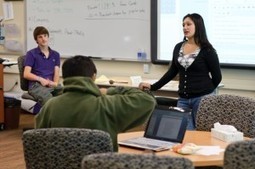
Tracy Pirkle, OHLSD’s director of curriculum and e-learning, created a pilot program last year called eKIDS (eLearning Kids in Demand) that turned a handful of seventh-graders at each of the district’s middle schools into “e-learning consultants.”
Guided by research, educators at Cochrane Collegiate have homed in on ten top teaching methods, and teachers receive weekly PD to help them implement the practices. Watch the video.
Erica McWilliam is the conference speaker who has most inspired my education-related professional learning on several occasions over the the past 3 years.
"In his presentation StudentsLive! Real-world learning at the 2010 Olympic and Paralympic Games, Chris Kennedy shares the story of twenty-five students who brought the notion of personalized learning to life and learned how powerful social media can be for learning."
Education Resource Strategies, a Watertown, Mass.-based company that helps large urban districts strategize how to deploy their resources, has created a novel process to help school leaders think about budget tradeoffs.
Called School Budget Hold 'Em, the goal is to create a "winning hand" of cards that meld budget priorities with educational priorities.
In this new weekly series, Tech & Learning spotlights best practices in teaching with technology with the aim of helping our readers make the most of their classroom hardware and software. Today's video features The Odyssey Stations Lesson Plan from teacher Kim Sharp of Klein ISD in Klein, Texas.The Resource for Education Technology Leaders focusing on K-12 educators.
Skype in the classroom is a free community to help teachers everywhere use Skype to help their students learn.
It’s a place for teachers to connect with each other, find partner classes and share inspiration. This is a global initiative that was created in response to the growing number of teachers using Skype in their classrooms. Read more...
The Life Sciences Education journal started publishing peer-reviewed articles in spring 2002 on life science education at the K–12, undergraduate, and graduate levels. The journal takes a broad view of the life sciences, and they frequently feature pieces on math, chemistry, neurosciences, genetics, and other fields. The articles are written by professionals engaged in teaching biology teaching in a variety of educational environments, and first-time visitors may wish to start by looking over the "Most-Read Articles" area. Here they will find pieces such as "Rubrics: Tools for Making Learning Goals and Evaluation Criteria Explicit for Both Teachers and Learners" and "Clickers in the Large Classroom: Current Research and Best-Practice Tools". Visitors can also search for articles in the archive and also look at the "Most-Cited Articles" section. Finally, users can also sign up to receive updates about new additions to the journal.
A trained teacher, Rachel Lynette no longer spends her days in a classroom. Even so, she's hard at work on lesson plans.
Those work sheets, it turns out, are valuable commodities.
"I earn about two-thirds of my living this way," the Bothell woman said. "My goal is $100 a day, every day -- seven days a week, not five."
In October, Lynette said, she earned $3,350 selling her original lesson plans at the TeachersPayTeachers website. She isn't getting rich, but the site's founder, and at least one top seller, make serious money.
At Cochrane Collegiate Academy, teachers credit their principal with helping them continually improve their practice through effective PD, ongoing support, and mutual trust.
This is a guest post from Jon Bergmann. Jon is a pioneer of the flipped classroom movement. You can join the Flipped Class community at FlippedClass.com, and can follow Jon on Twitter @jonbergmann.
A review of our favorite educational apps released or updated in the past month. (Read all of our Educational Apps series.) Below you’ll find a mixture of iOS, Android, and Web-based apps.
In a Simple K12 blog post titled “17 Signs Your Classroom is Behind the Times” they provide a list of things that characterize a classroom that has fallen behind. Number 16 lists a variety of technology tools that every educator should know about.
As I read the list, I realized that although many teachers are interested in and excited about technology integration, they are too busy to explore all the new technology tools available online.
This blog post is dedicated to all of the overworked teachers who just don’t have the time to seek out this information. I have provided brief explanations, links to and pictures of the tools mentioned by Simple K12 (and a couple of my favorites). I hope this makes it more manageable for teachers to pick and choose which tools they want to use.
One of my favorite books is Daniel Pink's Drive: the Surprising Truth about What Motivates Us. And speaking of motivation, I was movitated to read his book after watching the animation of a talk he gave. I must have watched that video three or four times before getting online and ordering his book, and after devoring his book my mind kept thinking, "How can I use these ideas in my classroom?"
One of the real big things that stuck in my mind was the idea of autonomy -- or having the freedom to choose how we do something. He explains how this can be one of the biggest reasons why people succeed at a given task. The problem was that when I went back through my lesson plans I didn't see any autonomy for my students. Every one of them were step-by-step tech projects. So over the summer I started to revamp some of my lessons to include student autonomy.
Another great and informative post on Clayton Christensen's most recent activities, including a talk at The Future of State Universities conference. Excellent overview of some of Christensen's major points from "Disrupting Class: How Disruptive Innovation Will Change the Way the World Learns."
Projectors and lasers and smartphones, oh my! It might still be 2011 (barely), but that hasn't stopped a whole bunch of technology companies, innovators and researchers from thinking about what the future might look like.
Homepage to Wired magazine's wiki containing more than 300 reliable how-to articles in 12 categories such as Computers, Gadgets, iPad & iPhone, Internet, Software, and Work. -Jl
To get content containing either thought or leadership enter:
To get content containing both thought and leadership enter:
To get content containing the expression thought leadership enter:
You can enter several keywords and you can refine them whenever you want. Our suggestion engine uses more signals but entering a few keywords here will rapidly give you great content to curate.


 Your new post is loading...