 Your new post is loading...

|
Scooped by
Jim Lerman
January 8, 2013 11:52 PM
|
By Kevin Jarrett "We have seen the future and it is MOBILE, COLLABORATIVE and ALWAYS-ON This evolution of the NCS elementary computer lab is the result of many forces converging at once. Thanks to a very successful pilot of Google Chromebooks in our 4th grade this year (funded by our generous community and amazing Parent-Teacher Organization), we are now confident that Chromebooks (the hardware) and Google Apps for Education (the software) are not only viable but essential to our instructional mission. "We will still use Microsoft products, just not exclusively. We live in a blended world, a world where we interact with a variety of technologies every day, more and more of which are web-based. Therefore, we want to provide students with seamless access to the information and resources they need, on whatever device they are using, wherever they happen to be. Groundbreaking technologies available today (like Google Apps and Classlink’s Launchpad product, for example) can make this possible. "Our district is evaluating highly competitive proposals for enterprise wireless connectivity and we are developing appropriate “bring your own technology” policies that make sense for us. Best of all, NCS teachers and staff are at the epicenter of this effort, dedicating themselves to finding creative ways to leverage these technologies in the classroom to help students learn."
|
|
Scooped by
Jim Lerman
January 8, 2013 11:37 PM
|
"The 2012 Survey of Online Learning reveals that the number of students taking at least one online course has now surpassed 6.7 million. Higher education adoption of Massive Open Online Courses remains low, with most institutions still on the sidelines. "The rate of growth in online enrollments remains extremely robust," said study co-author Jeff Seaman, Co-Director of the Babson Survey Research Group. "This is somewhat surprising given that overall higher education enrollments actually declined during this period."
"Institutional opinions on MOOCs are mixed, with positive views of their ability to learn about online pedagogy and to attract new students, but concerns about whether they represent a sustainable method for offering courses," stated his co-author I. Elaine Allen. Key report findings include: Over 6.7 million students were taking at least one online course during the fall 2011 term, an increase of 570,000 students over the previous year.Thirty-two percent of higher education students now take at least one course online. Only 2.6 percent of higher education institutions currently have a MOOC (Massive Open Online Course), another 9.4 percent report MOOCs are in the planning stages. Academic leaders remain unconvinced that MOOCs represent a sustainable method for offering online courses, but do believe that they provide an important means for institutions to learn about online pedagogy.Seventy-seven percent of academic leaders rate the learning outcomes in online education as the same or superior to those in face-to-face.Only 30.2 percent of chief academic officers believe that their faculty accept the value and legitimacy of online education - a rate is lower than recorded in 2004.The proportion of chief academic leaders that say that online learning is critical to their long-term strategy is at a new high of 69.1 percent. A majority of chief academic officers at all types of institutions continue to believe that lower retention rates for online courses are a barrier to the wide-spread adoption of online education.
|
|
Scooped by
Jim Lerman
January 8, 2013 5:36 PM
|
From the website "This video from TEDxBayfield features Stephen Baker, principal of Virtual High School Ontario. The mission of Virtual High School is to provide students with the opportunity to achieve success according to the students’ own interests, abilities, and goals. By providing a quality online education within the student’s greater educational community, Virtual High School can offer the student more choice. "
|
|
Rescooped by
Jim Lerman
from :: The 4th Era ::
January 8, 2013 5:28 PM
|
By Katrina Schwartz "Azul Terronez, who teaches at High Tech Middle, a public charter school in San Diego, Calif says that when an educator teaches a unit of study, then assigns a project, that is not project-based learning because the discovery didn’t arise from the project itself. And kids can see through the idea of a so-called “fun project” for what it often is – busy work. “They don’t see it as learning; they see it as something else to do,” said Terronez. “They don’t see the value.” “If you inspire them to care about it and draw parallels with their world, then they care and remember.” For Terronez, the goal is to always connect classroom learning to its applications in the outside world. He’s found that when the project is based in the real world, addressing problems that people actually face, and not focused on a grade, students are naturally invested. “If you inspire them to care about it and draw parallels with their world then they care and remember,” he said. It takes a lot of diligent planning by the teacher to design projects that give students space to explore themes and real-world resonance to make it meaningful for them. And it takes trust in the students, as well. "When Terronez assigns a writing project, it’s rarely just for a grade. Rather, the goal of the assignment is to be published in an anthology or in some other way relevant to the world around them. "Here are just a few examples of some the innovative things Terroniez has tried."
MathCast is an equation editor, an application that allows you to input mathematical equations. These equations can be used in written documents and webpages. The equations can be rendered graphically to the screen, to picture files, or to MathML - today's leading standard language for describing mathematics.
MathCast is a free and open source application. Feel free to use it to help your studies, to add mathematics to your website, etc.
Via Gust MEES
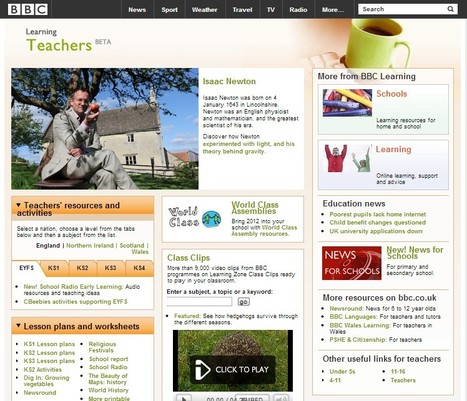
Teaching resources and classroom activities: lesson plans, worksheets, classroom games and video clips for all curriculum school subjects.
Via Gust MEES
A new era in mobile devices is dawning: Acer has announced the $99 Android 7-inch tablet. Is BYOD still relevant?
Via Grant Montgomery
|
|
Rescooped by
Jim Lerman
from Active learning Approaches
January 7, 2013 10:58 PM
|
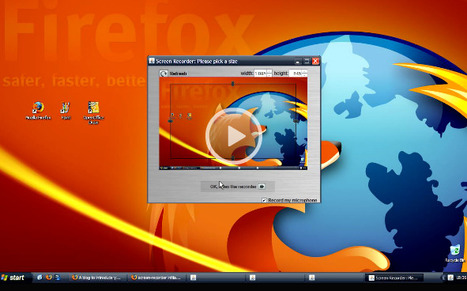
With Skoffer you can build in a screencast-recorder, that runs without installation directly from the browser, into your website.
You can install a ready to use plugin for your website-software or build your own applications based on the simple Skoffer API.
Skoffer is the API version of the ScreenCastle.com screencast recorder.
If you only want to record and host a screencast as fast as possible ScreenCastle.com is for you.
If you are a developer, and want to build in the screencast recorder into your website you are right on this site.
Via Baiba Svenca, Kim Flintoff
|
|
Rescooped by
Jim Lerman
from Active learning Approaches
January 7, 2013 7:43 PM
|
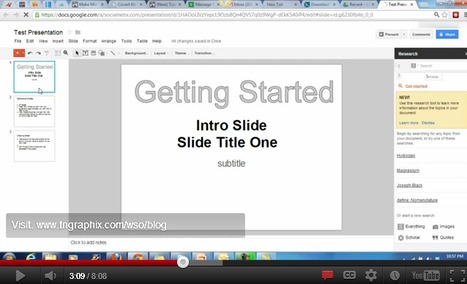
Watch this short 8:00 video to learn how easy it is to create presentation videos using FREE software available online!
Via Baiba Svenca, Kim Flintoff
|
|
Scooped by
Jim Lerman
January 7, 2013 2:05 PM
|
By David Zax "Tanay Tandon, high school sophomore, put out a Flipboard-like app last week called Clipped. What’s it like to be a teen prodigy hacker juggling the demands of high school? "Tanay...apologized for not being able to meet in person for our interview. “I don’t have a ride,” he explained.Tandon is 15. He can be forgiven for not even having found time to get a learner’s permit this year."
|
|
Rescooped by
Jim Lerman
from :: The 4th Era ::
January 7, 2013 1:48 PM
|
Thursday, January 10 at 4pm ET Presenters: Victoria Van Voorhis, Founder & CEO, Second Avenue Software, with Jayne C. Lammers, Assistant Professor, University of Rochester's Warner School of Education. How do girls' preferences in computer games vary from those of boys? Girls value the opportunity to collaborate with others in solving problems in non-violent, non-competitive contexts. These factors should be considered when designing or evaluating games for the classroom. Join Victoria Van Voorhis and Jayne C. Lammers for our community's new webinar to learn how to incorporate games into your curriculum to engage all of your students. Join these two experts who have studied girls and gaming from diverse perspectives for the insight you need to make smart choices about games for learning.
|
|
Rescooped by
Jim Lerman
from iPad Resources
January 6, 2013 8:27 PM
|
TCEA is a member-based organization devoted to the use of technology in education.
Via Linda Nitsche
|
|
|
Scooped by
Jim Lerman
January 8, 2013 11:45 PM
|
By Reg Swanson "Storytelling continues to be a powerful tool in education. Storytelling from a teacher's point of view allows us an insight into the depth of understanding our student have around certain concepts and ideas. It also gives us a privileged view into the world of the kids in our care.
"Storytelling is just as fantastic for students. Storytelling apps allow students a voice, a way of telling complex narratives and a way of illustrating their ability to weave multiple ideas into a single and coherent storyline.
"Here are a couple of apps that students and teachers of all ages will love. People never seen to tire of Stop-motion movies."
|
|
Scooped by
Jim Lerman
January 8, 2013 5:52 PM
|
Posted by Katie Lepi "If your resolution for 2013 was to be better organized, these apps are recommended for you by the fine folks at Apple. They’ve assembled a sort of toolkit for teachers that aim to make you a better, more informed, and connected educator. "Before you start being an even better teacher, you should take some self inventory and figure out when you’ll have time to take on this task. That means it’s time to get organized. These 5 apps will help you do just that."
|
|
Scooped by
Jim Lerman
January 8, 2013 5:34 PM
|
By Jessica Sullivan "The benefits of the project were noticeable almost immediately. After the initial lesson on basic skills to get started with Google Earth, the students were so engaged that before their first planning class period was over I had invited the high school administrators to visit to see what we were working on in room 407. "The next class period, students eagerly explained what they were working on to our Assistant Principal, a former Marine Ecologist and IB Biology teacher, while taking him on the tour they had built thus far. After two class work days, other benefits became apparent. Google Earth tours can be made with a recorded narration of the stops along the way. This was a huge benefit for non-native English speakers who felt less intimidated by being able to practice and re-record their voices as opposed to speaking “live” in front of the class."
Kimai - the free and easy Time-Tracking software application.
Via Gust MEES
Teaching ideas and themes, lesson plans, discussion guides, extension activities, and other teaching resources for teachers of K-12 grades.
Via Gust MEES
|
|
Rescooped by
Jim Lerman
from Digital Citizenship in Schools
January 7, 2013 11:39 PM
|
Yesterday, Diigo released a new version of their browser extension. The updated extension includes some features that are quite handy.
The most significant of the updates is a streamlined screenshot process.
Via Judy O'Connell
|
|
Rescooped by
Jim Lerman
from Digital Delights for Learners
January 7, 2013 11:29 PM
|
From the US National Archives Each activity-creation tool helps students develop historical thinking skills and gets them thinking like historians. Choose one of the tools below to begin. Then find and insert primary sources and customize the activity to fit your unique students.
Via Ana Cristina Pratas
|
|
Rescooped by
Jim Lerman
from Active learning Approaches
January 7, 2013 7:53 PM
|
|
|
Scooped by
Jim Lerman
January 7, 2013 2:21 PM
|
The SALG instrument focuses exclusively on the degree to which a course has enabled student learning. In particular, the SALG asks students to assess and report on their own learning, and on the degree to which specific aspects of the course have contributed to that learning. The instrument has since been revised to include five overarching questions, each of which an instructor can customize to a course through sub-items. These questions are: How much did the following aspects of the course help you in your learning? (Examples might include class and lab activities, assessments, particular learning methods, and resources.) As a result of your work in this class, what gains did you make in your understanding of each of the following? (Instructors insert those concepts that they consider most important.) As a result of your work in this class, what gains did you make in the following skills? (A sample of skills includes the ability to make quantitative estimates, finding trends in data, or writing technical texts.) As a result of your work in this class, what gains did you make in the following? (The sub-items address attitudinal issues such as enthusiasm for the course or subject area.) As a result of your work in this class, what gains did you make in integrating the following? (The sub-items address how the students integrated information.)
|
|
Scooped by
Jim Lerman
January 7, 2013 1:57 PM
|
By Dvae Llorens "Remember when Google Plus “flopped"? Well, it didn’t. "I'm willing to stake my reputation on the following statement: If Google Plus doesn’t have a staggering number of active users by the end of 2013, you can all come over to my office and pie me in the face."
|
|
Scooped by
Jim Lerman
January 7, 2013 1:41 PM
|
If you use PowerPoint lectures in your face-to-face classes, you can use those same lectures as jumping-off points for creating narrated animations for your online students to watch. That’s the good news.
|


















You can rely on Kevin Jarrett to be on the leading edge of K-4, school-based educational technology.