"How will the Common Core shift English-language arts learning in elementary school? Well, the transition to more nonfiction readings has certainly received the most attention, but that's just one subtle way. To help parents understand these shifts, we've compiled some of the best Common Core resources from around the Web. • There are also plenty of useful resources for educators here too, from sample lessons and assessments, to classroom practice video series. With full implementation of the CCSS set for next fall, many nonprofits and publishers are racing to put together useful resources for parents, educators and students. Here are some of the most helpful aligned with Common Core ELA at the elementary level."
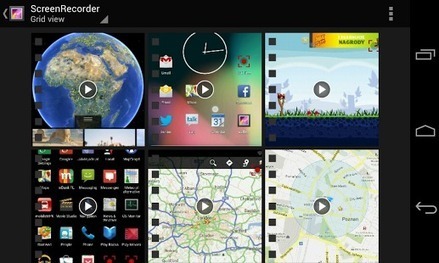
Record great quality screencasts directly from your phone or tablet! SCR Screen Recorder uses hardware accelerated video encoding to achieve best quality screen recording on any device. It's the only video recorder on the market supporting Tegra device including Nexus 7.
In their new book, Leaving to Learn: Designing a Student Experience that Reduces Dropouts and Produces Deep Engagement in Learning, Elliot Washor, cofounder of Big Picture Learning, and collaborator Charlie Mojkowski explore the reasons kids drop out of school and how to to develop productive learning environments for adolescents.
For the past 30 years creativity coach Eric Maisel, Ph.D, has worked with a variety of individuals, everyone from artists to authors to musicians to scientists
"Edmodo recently released a new look for their website. Many times when a website changes there’s a ton of confusion about old features, new features, and where everything is now located. Not with Edmodo!The simple and clear design makes it easy to navigate between all of the tools. So there shouldn’t be too much confusion for existing users, and teachers who want to learn how to use Edmodo for the first time are met with a sleek and simple interface.
"Here are a few videos on how to navigate the new Edmodo site, and how to use the basic features for anyone interested in learning to use Edmodo in the classroom."
Mali is perhaps best known for his slam poem "What Teachers Make." One version of it on YouTube has been viewed 4.7 million times (8-22-13). I just encountered this "new" video of his (2011) on the Teaching Channel. He describes, in just 3 minutes, his ideal middle school. Sounds pretty good to me.
"Yesterday, after posting A Complete Guide to Using Blogger In School I received a couple of questions about why I am hosting it on Box.com instead of Google Drive or Scribd as I have done with some guides in the past.
"There are a couple of reasons why I'm not hosting it on Google Drive. First, the Box.com document viewer looks and functions much better than Google Drive does when it comes to large PDFs. In fact, A Complete Guide to Using Blogger In Schoolis a such a large file that Google Drive won't display a preview of it, it just displays a download link. The other reason that I chose to use Box is that Box will email me a weekly update about the usage of my shared files. I can also log-in whenever I want to see the current usage statistics about my shared files.
"I'm not hosting A Complete Guide to Using Blogger In School on Scribd because I've learned that a lot of schools block Scribd."
"David Lynch meditates, and he meditates hard. Beginning his practice in earnest after it helped him solve a creative problem during the production of his breakout 1977 film Eraserhead, he has continued meditating assiduously ever since, going so far as to found the David Lynch Foundation for Consciousness-Based Education and Peace and publish a pro-meditation book called Catching the Big Fish. It might seem nonsensical to hear an artist of the grotesque like Lynch speak rapturously about voyaging into his own consciousness, let alone in his fractured all-American, askew-Jimmy-Stewart manner, but he does meditate for a practical reason: it gives him ideas. Only by meditating, he says, can he dive down and catch the “big fish” he uses as ingredients in his inimitable film, music, and visual art. You can hear more of his thoughts on meditation, consciousness, and creativity in his nine-minute speech above."
"It seems like every other month, Evernote gets additional upgrades. A few are quietly released, while others are highly anticipated by heavy Evernote users. Since I wrote my last article about Evernote’s new design and file storage upgrades, the popular notebook has gotten important new features, including Reminders, a highlighter and tighter security for subscribers, among others.
"If you’re new to Evernote, download Mark O’Neill’s free PDF, How to Use Evernote: the Missing Manual to get up to speed. And if you’re an iPhone or iPad owner, I’ve already explained why Evernote is a must-have app for the iPhone and iPad.
"This article is based on my use of Evernote for Mac OS X and iOS. The highlighted features may not yet be available for the Windows and Android versions of Evernote."
"Have you ever considered hosting your own livestream? Do you have a pet topic you’d like to run as a livestream show, or do you just want to stay connected with a large group of acquaintances who you connect with over a certain topic? Whatever you want to show the world, it’s time to read “On Air: Set Up Your Own Online Broadcast” by author Niall Norton-Cormier. This free guide tells you all you need to know to get started streaming."
"For as long as I can remember — and certainly long before I had the term for it — I’ve believed that creativity is combinatorial: Alive and awake to the world, we amass a collection of cross-disciplinary building blocks — knowledge, memories, bits of information, sparks of inspiration, and other existing ideas — that we then combine and recombine, mostly unconsciously, into something “new.” From this vast and cross-disciplinary mental pool of resources beckons the infrastructure of what we call our “own” “original” ideas. The notion, of course, is not new — some of history’s greatest minds across art, science, poetry, and cinema have articulated it, directly or indirectly, in one form or another: Arthur Koestler’s famous theory of “bisociation” explained creativity through the combination of elements that don’t ordinarily belong together; graphic designer Paula Scher likens creativity to a slot machine that aligns the seemingly random jumble of stuff in our heads into a suddenly miraculous combination; T. S. Eliot believed that the poet’s mind incubates fragmentary thoughts into beautiful ideas; the great Stephen Jay Gouldmaintained that connecting the seemingly unconnected is the secret of genius;Gutenberg’s invention of the printing press embodied this combinatorial creativity; even what we call “intuition” is based on the unconscious application of this very mental faculty.
"The concept, in fact, was perhaps best explained by Albert Einstein, who termed it “combinatory play.” (Einstein famously came up with some of his best scientific ideas during his violin breaks.) From his Ideas and Opinions (public library) — the same invaluable volume that gave us the beloved physicist’s timeless wisdom on kindness and our shared existence — comes Einstein’s single most succinct articulation of how his mind works, driven by this powerful combinatorial creativity. The 1945 letter was written in response to French mathematician Jacques S. Hadamard’s survey of the mental processes of famous scientists, inspired by polymath Henri Poincaré’s famous meditation on the subject and published as An Essay on the Psychology of Invention in the Mathematical Field, with Einstein’s missive included as a “testimonial”:
"Before I became a high school English as a second language teacher 9 years ago, I spent 19 years as a community organizer, primarily in immigrant neighborhoods and with institutions focused on immigrants. Organizing is a process of helping people—many of whom might be reluctant to change—learn new skills and engage in the world in a way that improves their situation. Organizing means helping people use their assets—their experiences, traditions, and stories—to reimagine themselves and their dreams. It's about helping them tap into their intrinsic motivation and embark on a journey of action, discovery, and learning. I call the process that successful organizers use the organizing cycle. As a teacher, I've adapted this cycle to help English language learners become accomplished readers and learners.
"The organizing cycle includes five actions: Build strong relationships with students; access prior knowledge through stories; help students learn by doing; identify and mentor students' leadership potential; and promote the habit of reflection."
Ferlazzo takes his background as a community organizer and applies it to teaching language skills. He focuses on ELLs, but the strategies are applicable in virtually any setting. This article synthesizes so much excellent pedagogy.
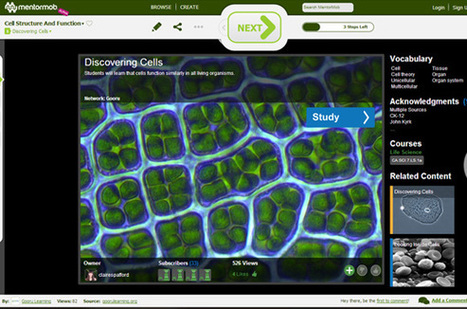
"Truth is often stranger than fiction, and in the case of current events, there are so many science topics on the forefront of policy and society that at times it might seem that it is a script for a sci-fi movie. Everything from global warming, natural disaster, cloning, GMO, fracking debates, invasive species, medical ethics, and geopolitical issues–science is everywhere in news, politics, and world events. A lot of it is exciting if you stop a moment for consideration.
"This week’s Learnist feature is about science–especially weird science, which will attract the young and old alike."
"In today's hypermedia landscape, youth and young adults are increasingly using social media platforms, online aggregators and mobile applications for daily information use. Communication educators, armed with a host of free, easy-to-use online tools, have the ability to create dynamic approaches to teaching and learning about information and communication flow online. In this paper we explore the concept of curation as a student- and creation-driven pedagogical tool to enhance digital and media literacy education. We present a theoretical justification for curation and present six key ways that curation can be used to teach about critical thinking, analysis and expression online. We utilize a case study of the digital curation platform Storify to explore how curation works in the classroom, and present a framework that integrates curation pedagogy into core media literacy education learning outcomes."
Curation can be used as an authentic activity with many disciplines to enable students to critically evaluate resources for a common interest. Would like to hear more about discipline based projects.
"Scoop.it is a great platform for curating web based content and collecting together your own portfolio or reading lists to share with the world. One of my major problems though with Scoop.it, used to be finding the articles and links I had saved and searching for useful articles on other Scoop.it.
"My Scoop.it sites
Learning technology newsTools for learnersCommercial software and apps for learningMy portfolio
"I'm happy to say that Scoop.it have solved this problem and added a 'Filter' feature to help users search the sites. You can watch this tutorial and see how it works."
What is Google Drive? A complete guide how to use it. Cloud (storage), Creation, Collaboration, Communication How to access Google Drive, including from Goog...
"Giving students the right tools and opportunities to process their thinking, ask questions, brainstorm ideas, and present their work are all part of the learning process in an interactive classroom. Here are some tips and related tools to get you started."
The Cornell Notes strategy is one possible model students can use, in addition to combination notes, REAP strategy, and others. When used in combination with technology, students are able to activate key brain areas during learning, while also retaining critical information for future review.
How Noteaking Is Changing
"It’d be easy to fall victim to hyperbole here and suggest that notetaking is the stuff of electricity and holograms, but that’s only partly true. Today, 40% of students prefer a mix of physical and digital notes. In the digital classroom then, the primary shift parallels blended learning: a mix of physical and electronic information that serves as a compromise between “old” and “new” learning.
"In the digital classroom, recording pens, tablets, laptops, audio software, and social media make recording, reviewing, sharing, and storing these notes different than it was even 10 years ago. The infographic below explores how."
Note-taking is a huge thing in education. Learning a whole heap of systems and theory at work has made me consider and compare alternatives the impact the use of technology has had on taking notes. As a very kinsethetic learner, taking notes has always played a huge part in learning for me. So is typing the same as writing? Typing works for me - not only are my notes easier to read at a later date, as I think the words as I type them somehow this connects my fingers to my brain and I seem to absorb and take things on board or transfer the knowledge to my brain [the cognitivits would be happy]. Advancements in technology enable my mind-maps to be included as part of my notes, and I can easily add book-marks etc to make finding a particular point so much easier. Comments my learning mates or the facilitator make are also easier to incorporate into my own notes - even in a different colour text. Have I learnt more, better or faster? The jury is still out on these questions. The implications of this as a teacher is something definitely worth pondering further.
"A Complete Guide to Using Blogger In School covers everything from blogging terminology to blogging activities to the nuts and bolts of using Blogger. You'll learn where to find media to use in blog posts, how to use media in blog posts, and get ideas for media-based blog posts. You'll also learn how to set-up your blog for multiple authors and how to manage comments."
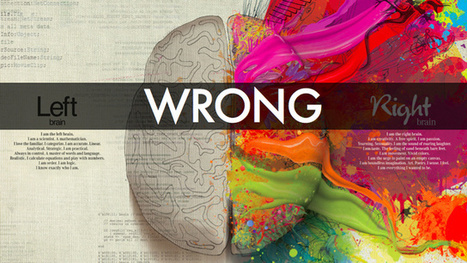
"The latest findings from the real neuroscience of creativity suggest that the right brain/left brain distinction is not the right one when it comes to understanding how creativity is implemented in the brain. Creativity does not involve a single brain region or single side of the brain.
"Instead, the entire creative process– from the initial burst of inspiration to the final polished product– consists of many interacting cognitive processes and emotions. Depending on the stage of the creative process, and what you’re actually attempting to create, different brain regions are recruited to handle the task.
"Importantly, many of these brain regions work as a team to get the job done, and many recruit structures from both the left and right side of the brain. In recent years, evidence has accumulated suggesting that “cognition results from the dynamic interactions of distributed brain areas operating in large-scale networks.”
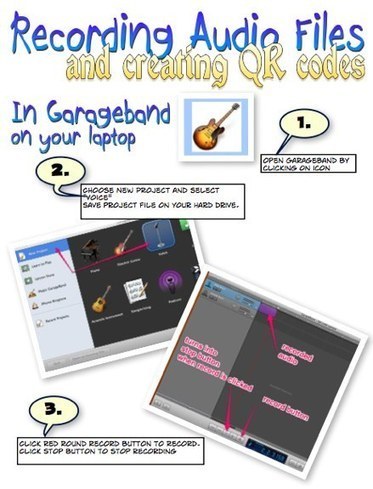
"I shared a very successful collaboration between our Art teacher and Language Arts teacher in a previous post titled Transliteracy: QR Codes and Art as well as at several conferences and workshops I was leading in the past few months. To follow up on several requests by teachers and workshop attendees, I have created a easy step-by-step how to guide /info-flyer, if you would like to record your students and create QR codes to point to these audio files.
"The examples screenshots are from Garageband (on a mac) and AudioMemo on the iPad. You can of course record the audio with any other app, program or device you have and are comfortable with using, editing and creating an mp3 or wave file."
"Are you a teacher or trainer? Someone involved in a hiring process? Do you need to check somehow that other people have the skills or knowledge that you expect them to? Well, you’re going to love what you can do using Google Forms. You can create a self-grading test for whatever your purposes are. That’s powerful!
"Google Forms are amazing tools, allowing you to do some really advanced tricks with forms as the front-end and spreadsheets at the heart. Once you get started you’ll be amazed at just how much you can achieve with this basic premise. Today we’ll look at how to create a self-grading quiz using Google Forms. From there, you’ll no doubt find a lot more ways to use forms and spreadsheets."
"After last week’s discovery of Salvador Dalí’s little-known 1969 Alice in Wonderland illustrations, I followed the rabbit hole to another confluence of creative culture titans. In 1945, Dalí and Walt Disney embarked upon a formidable collaboration — to create a six-minute sequence combining animation with live dancers, in the process inventing a new animation technique inspired by Freud’s work of Freud on the unconscious mind and the hidden images with double meaning. The film, titled Destino, tells the tragic love story of Chronos, the personification of time, who falls in love with a mortal woman as the two float across the surrealist landscapes of Dalí’s paintings. The poetic, wordless animation features a score by Mexican composer Armando Dominguez performed by Dora Luz."
"It is a myth that all it takes to write is to sit down in front of a blank page, to begin at the beginning and write through to the end, with no planning, break, editing, or changes in between. And yet, this is sometimes what we ask our students to do. Good writers plan and revise, rearrange and delete text, re-reading and producing multiple drafts before they produce their finished document. This is what a process writing approach is about."
"My personal favorite is using photos using the Picture Word Inductive Model. As I described briefly in my recent New York Times guest post, and in my book, it’s an “inductive learning process where students first brainstorm twenty words related to a picture, then put those words into categories and add new ones that fit those categories. Next they complete a “cloze” (or fill-in-the-blank) activity with sentences about the picture which are then put into categories of their own. They convert those sentence categories into paragraphs, and, finally, arrange the paragraphs into essays.” You can see sample pictures and read more about it here.
"A related lesson is using Picture Data Sets. For example, students can identifying images that fit a specific criteria (one week my ninth graders compiled images of Jamaican music, Jamaican history, and Jamaican nature attractions and then wrote about each one). These can also include students putting images into different categories and then having other students try to identify which ones they had in mind. Sites on The Best Online Virtual “Corkboards” (or “Bulletin Boards”) list work very well for these kinds of activities."
Ferlazzo is a great curator and this site shows him at his best. Photos are a terrific way to engage learners and this post is a treasure trove of ideas and resources. Don't miss it!
To get content containing either thought or leadership enter:
To get content containing both thought and leadership enter:
To get content containing the expression thought leadership enter:
You can enter several keywords and you can refine them whenever you want. Our suggestion engine uses more signals but entering a few keywords here will rapidly give you great content to curate.


 Your new post is loading...