


This is my first slide deck designed to share. It reflects a summary and applied practice of some basic lessons learned about data visualization and information
Via Baiba Svenca

 Your new post is loading...
 Scoop.it! This is my first slide deck designed to share. It reflects a summary and applied practice of some basic lessons learned about data visualization and information Via Baiba Svenca 
Scoop.it!
"A collection of 18 useful videos produced for the Ed2.0Work EU project that introduce Skype, WizIQ, Voicethread, Voxopop, Blogger, Wordpress, Tumblr, Posterous, AudioBoo, Slideshare, Prezi, Google Drive, Wikispaces, PBWorks, Diigo, Delicious, Reddit and the EU project Web20ERC "
via Lisa Nielsen and Joel Josephson
Scoop.it!
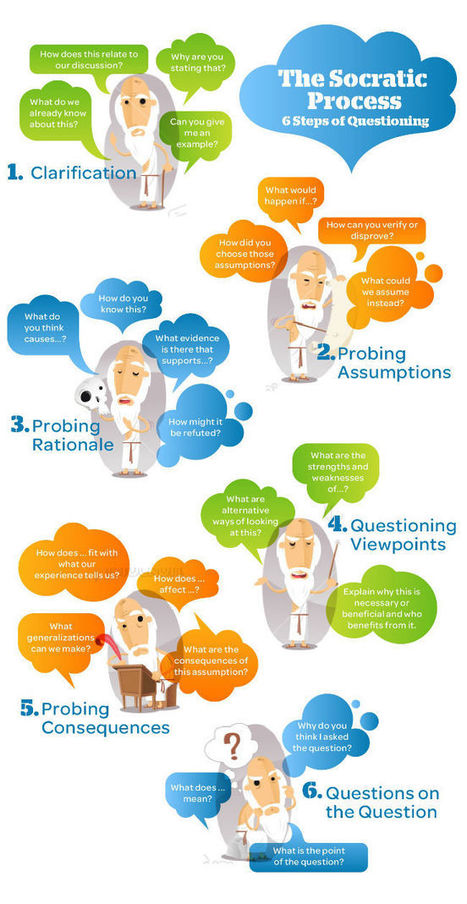
by Med Kharbach
"Learning is all about asking questions and finding answers to them. An inquisitive mind is one that goes beyond the status quo and probes deep below surface meanings. To foster such kind of thinking inside our classroom requires some hard work and a serious investment in time and efforts. We, as teachers and educators, need to prepare the right environment where inquisitive minds can nourish and grow. We need to water this environment with a culture of asking questions."
Jim Lerman's insight:
Useful inforgraphic
Scoop.it!

by Richard Byrne
"Active Textbook is an interesting service that you can use to turn your PDFs into multimedia documents. The basic idea behind the service is that you can upload PDFs and add pictures, links, and videos that are displayed when students read your PDF through the Active Textbook viewer. While reading your PDF through Active Textbook students can highlight, draw, and add comments to the document."
Scoop.it!

At Bates Middle School in Annapolis, Maryland, arts integration has helped raise student achievement. Via Dr. Tom D'Amico (@TDOttawa) , Angie Miller
Scoop.it!

"In discussions about contemplative pedagogy a great deal of attention has been devoted to practical applications of mindfulness in the classroom (what we might call “mindfulness-based pedagogy”). The tendency in this approach is to view mindfulness as a type of technology that can be used to enhance the quality and effectiveness of the teaching and learning experience.
"While there are many wonderful benefits of this approach, it generally abstracts mindfulness from its historical roots as a practice aimed at moral and spiritual development. The purpose of this presentation is to recover the value of traditional meditation practice as a means of cultivating the capacities or virtues characteristic of the mindful teacher." Via Dr. Susan Bainbridge, Lynn Berry

Heidi Hutchison's curator insight,
August 27, 2013 9:18 AM
Looks like a great resource. I liken getting kids to understand their digital footprint to getting them to understand the choices they make now, affects the direction their life will go later. Definitely a tough lesson to learn and teach! we need all the help we can get! :)
Heidi Hutchison's curator insight,
October 10, 2013 12:38 PM
Great to add to what you already may do or it is a great beginning!
Scoop.it!

by Maria Popova
Scoop.it!
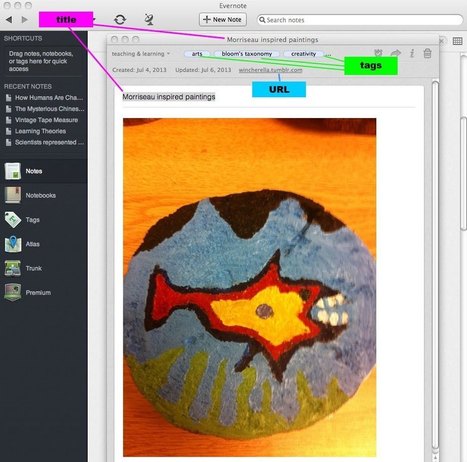
by Bart Miller
"Three weeks ago, I began exploring Evernote. Literally within minutes, I was convinced that it is an essential tool for inquiry-based teaching. I hope that by the end of this post, you will agree and want to join me in taking a huge step toward true metateaching. If student curiosity is a spark, I want to use Evernote to ignite that spark into a raging inferno.
"To be authentic, inquiry must be unpredictable. Inquiry teaching includes a fair amount of modeled and structured inquiry, but the deepest learning occurs when learners follow their own interests and processes to construct understanding.
"I have been using Evernote to create an interconnected web of media that can be instantly searched based on criteria I create for my inquiry classroom. I already feel like a librarian from a futuristic sci-fi movie! Here is my process for curating resources:"
Scoop.it!

"Our window of opportunity to touch our students’ lives closes faster than we realize. Never let an opportunity to change a child’s life pass you by. I hope that we wind summer down we all start looking for those windows and can be that change for some student…socks be darned."
Jim Lerman's insight:
A great story that has little to do with tech and education, but everything to do with what teachers and schools can do. It's definitely worth the 5 minutes it takes to read it.
Scoop.it!
Presented at ipadpalooza 2013, Showcases ipad projects and products for primary classrooms. Examples are from Lisa Carnazzo's 2nd grade classroom
Scoop.it!

by Katrina Stevens
"A thousand tweets point to tools that help students make, not memorize...."
"When asked where they found their best resources for identifying new educational tools to try, of course #edtechchat tweeps cited their PLN and #EdTechChat as prime resources for finding new educational tools, but Edsurge, Educlipper, Edshelf, Edutopia, Edudemic, and Graphite were also listed as go-to resources for learning about new educational technology."
Scoop.it!

Zeega is a new form of interactive media, enabling anyone to express themselves by easily combining media from the cloud. Make the web you want. Zeegas work across all platforms, from iOS to Android to Chrome, Firefox, IE and Safari. A Zeega can play inside Twitter, Facebook, Tumblr and other apps. Via Baiba Svenca

Tom Cockburn's curator insight,
August 25, 2013 4:55 PM
more of a monologue than dialogue at first sight but maybe I've missed something about the interaction...still learning 
Melanie Faizer's curator insight,
March 10, 2014 9:57 PM
Zeega.com is a great example of storytelling through aggregating and curating, and in addition, embedded, automated attribution. It removes much of the burden of copyright. From a storytelling perspective, it has limitless possibilities, but one of the challenges is finding that story worth telling. Some Zeega examples are beautifully executed; too many are (from a journalistic perspective) one-dimensional in their execution and not thought-provoking. We are still new at curating content, and it shows. Curating is another form of narrating: the story still needs a point, a trajectory.
Scoop.it!

"This article has been a while coming… but our paper on an analysis of 21st century learning frameworks and implications for teacher knowledge is finally in print. A previous version of the paper can be found here. Here is the full reference with a link to the article. Citation and abstract appear below.
"Kereluik, K., Mishra, P., Fahnoe, C., & Terry, L. (2013). What knowledge is of most worth: Teacher knowledge for 21st century learning. Journal of Digital Learning in Teacher Education, 29(4), 127-140.
"This article offers a critical review of the literature on 21st century knowledge frameworks, with a particular focus on what this means for teachers and teacher educators. The authors accomplish this by identifying common themes and knowledge domains in 15 reports, books, and articles that describe the kinds of knowledge that researchers state are integral and important for success in the 21st century. The authors argue that seemingly disparate frameworks converge on three types of knowledge, as necessary for the 21st century: foundational, meta, and humanistic. Although 21st century frameworks are thought to advocate new types of knowledge, little has actually changed in the new century with respect to the overall goals of education. Despite this sense of continuity, significant changes related to how technologies change all three types of knowledge need to be conveyed. The article ends with specific conclusions and recommendations for teacher education." Via Susan Einhorn
Jim Lerman's insight:
Mishra is one of the popularizers of the term TPACK , which characterizes a particular approach to teacher education. This new article proposes a rather significant overhaul of that concept.

Susan Einhorn's curator insight,
July 5, 2013 12:49 PM
Interesting effort to come up with a clear definition of 21st century learning and skills. Draws together a number of previous studies and articles. |
Scoop.it!

FREE :: STARTS SEPT. 9 :: LIMITED TO 500 PARTICIPANTS
"Google has funded an associate professor in the Indiana University School of Education to develop a "Big Open Online Course," or BOOC. Daniel Hickey will offer a free course in September focused on educators and titled "Assessment Practices, Principles and Policies" for as many as 500 students, funded by a $50,000 Google grant. "Hickey intends for this BOOC to offer most of the advantages of a Massive Open Online Course, or MOOC, but with more interaction, while taking advantage of Google's new Coursebuilder course management system. "Google wants to know whether interactive online practices that are working well with 20 students can be scaled up," Hickey said.
"Students who complete the BOOC will learn the practical skills needed to improve classroom student assessments while exploring assessment principles and new accountability policies. These topics are becoming more important to educators as states introduce new curriculum standards and achievement tests, while at the same time beginning to evaluate teachers according to short-term gains on those tests. Students who wish to take the course for graduate-level credit will be able to do so by completing additional course requirements, including a term paper based on the weekly assignments".
Scoop.it!

by Jessica Slusser
"At the Serious Play Conference this week we heard numerous educators, administrators, and game designers talk about their history and experience with gaming in the classroom. The three themes around most of the discussions were how to select games, how to get other teachers or administration on board, and lesson/classroom planning. Here’s the top 5 tips for diving headfirst into the gaming world."
Scoop.it!

posted by Katie Lepi
"So are you making the most of the technology you probably already have to keep in touch with your students’ families? We’ve put together a collection of some of our favorite tech-centric ways to do just that. Have we included your favorites? Leave us a note in the comments if we’ve missed one of the must have parent communication tools in your toolbox!"
Scoop.it!

Vittle lets you quickly capture any idea, and share them with anyone to view on their own time. Vittle works like a magic whiteboard that records what you write and say: Annotate and sketch using the ultra-smooth ink of our proprietary Inkflow Engine,Resize and move anything around the page,Zoom in to focus on key points,Visually navigate through even complex topics. Use Vittle to build a video library on any subject. It is also a powerful tool for collaborating across time and space with any number of people. Via Nik Peachey

Vicki Mast's curator insight,
September 13, 2013 11:24 AM
I just downloaded the free version which looks good, but may have to upgrade. The features look well worth the $3.99 price. You can move & resize your drawn objects, zoom in/out, etc. If you're working on creating "flipped classroom" videos, or how-to tutorials this may be what you need. Check out their website and user guide for the details. 
D G Stevenson's curator insight,
December 9, 2013 9:01 AM
Useful for explaining concepts in a visually interesting way.
Scoop.it!

This is the first post in a series on resources to discover and curate digital curriculum. In this post Michael Gorman introduces three tools in depth: Symbaloo, Diigo and Evernote. "This series is really not centered on all the amazing resources available, but rather how to we find quality material and how do we archive it so we can find it later." Although you may be aware of these three tools Gorman many show you techniques to using them that are new. The post explores these tools with both the teacher and student in mind. Based on your AUP these tools have the potential to be used by both groups. If you wonder why you would want your students to become digital curators think about how it would require them to "be informed and practice proper digital citizenship." Via Beth Dichter, Lynn Berry

Deisy Bazan's curator insight,
January 30, 2021 11:59 PM
Great information about curating tools! Very well elaborated!
Scoop.it!

Contemplative pedagogy involves teaching methods designed to cultivate deepened awareness, concentration, and insight. Contemplation fosters additional ways of knowing that complement the rational methods of traditional liberal arts education. As Tobin Hart states, “Inviting the contemplative simply includes the natural human capacity for knowing through silence, looking inward, pondering deeply, beholding, witnessing the contents of our consciousness…. These approaches cultivate an inner technology of knowing….” This cultivation is the aim of contemplative pedagogy, teaching that includes methods “designed to quiet and shift the habitual chatter of the mind to cultivate a capacity for deepened awareness, concentration, and insight.” Such methods include journals, music, art, poetry, dialogue, questions, and guided meditation.
"In the classroom, these forms of inquiry are not employed as religious practices but as pedagogical techniques for learning through refined attention or mindfulness. Research confirms that these contemplative forms of inquiry can offset the constant distractions of our multi-tasking, multi-media culture. Thus, creative teaching methods that integrate the ancient practice of contemplation innovatively meet the particular needs of today’s students.
"The following video, produced here at the CFT, features interviews with faculty members of Vanderbilt’s contemplative pedagogy group describing the roles these forms of inquiry play in their teaching."
Scoop.it!
by Maria Popova
"To trace the development of double function terms in children, Asch and Nerlove presented groups of kids with a collection of different objects — ice water, sugar cubes, powder puffs — and asked them to identify the ones that were cold, sweet, or soft. This, of course, they were easily able to do.
"Asch and Nerlove then asked the children, Can a person be cold? Can a person be sweet? Can a person be soft? While preschoolers understood the literal physical references, they did not understand the metaphorical psychological references. They described cold people as those not dressed warmly; hard people were those with firm muscles. One preschooler described his mother as “sweet” but only because she cooked sweet things, not because she was nice.
"Asch and Nerlove observed that only between the ages of seven and ten did children begin to understand the psychological meanings of these descriptions. Some seven- and eight-year-olds said that hard people are tough, bright people are cheerful, and crooked people do bad things. But only some of the eleven- and twelve-year-olds were able to actually describe the metaphorical link between the physical condition and the psychological state. Some nine- and ten-year-olds, for instance, were able to explain that both the sun and bright people “beamed.” Children’s metaphorical competence, it seems, is limited to basic perceptual metaphors, at least until early adolescence."
Scoop.it!
by Bart Miller
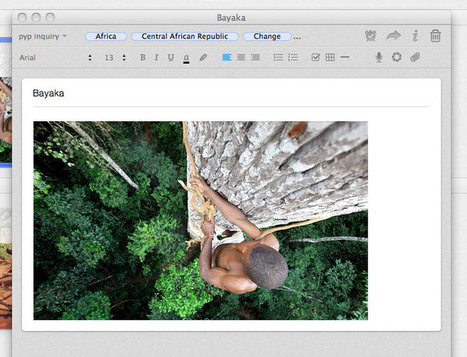
"Does Evernote work for inquiry?
"I’d say so. In the time it took to write this post, I planned a sizable chunk of guided inquiry for my class including authentic articles and video, and that’s from just one note. Further independent inquiry can be instantly supported with additional resources, as well as spontaneous modeled and guided inquiry."
Jim Lerman's insight:
How one teacher has used Evernote to plan a unit of guided inquiry for 6th graders.
Scoop.it!
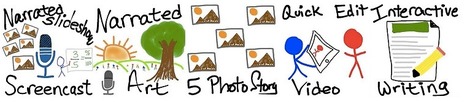
Freyer has presented his 3-day workshop on producing media with an iPad on numerous occasions. Complete directions and videos and resources are offered here for anyone to teach themselves. Learn how to do:
-Screencasting and Narrated SlideShows -Quick Edit Videography -Interactive Writing and eBooks
...all on an iPad.
Jim Lerman's insight:
A great aid for anyone wishing to learn these important functions. Kudos to Freyer for sharing so generously.
Scoop.it!

description by Internet Scout Project DebateGraph states, "to change the world you need to look at it in a different way." Many would agree; this platform gives multiple partners the ability to visualize and share different ideas. It's a neat concept and it's one that has been used by the United Kingdom's Foreign Office and CNN. A helpful "how-to" area can get users started and the application allows visitors to link ideas visually via a very easy-to-use interface. This version of debate graph is compatible with all operating systems
Jim Lerman's insight:
An online, interactive, collaborative mind-mapping tool. Looks quite versatile.
Scoop.it!
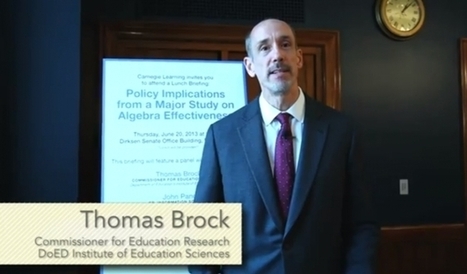
"With the U.S. ranking 25th in international math scores, a panel of scientists and education experts on Capitol Hill recently hailed research so unique that only two percent of all U.S. Department of Education funded studies are similar. The study discovered that a Carnegie Learning curriculum doubled the amount of algebra learning typically experienced by high school math students. Moreover the results are extraordinary because experts believe school districts across the country could realistically replicate the success in their classrooms. Watch highlights of the panel here."

Jim Lerman's comment,
August 26, 2013 12:29 AM
Great to hear from you Bonnie. Hope you are doing well. I'm so glad you find good material on my posts.
Scoop.it!
It's time for the annual mega-list of the best of the best tools for teachers. From A to Z, more than 900 resources were submitted and this is the final list. Do you know each of these tools? Via Timo Ilomäki

Jean-François "JFMA" Moreau's curator insight,
August 24, 2013 5:18 AM
MAKING YOUR MEDICAL STUDENTS AND HUMAN RESSOURCES MORE MOTIVATED! If they don't where they're going to, let's them know at least where they come from! Let you teach your students the universal history of the hospital and the medical school like I'm proposing it from Hippocrates of Cos to now. Our university hospitals originated from Nestorians and Syriaq bimaristans! If you're interested in and you don't know how to do it, let you be free to invite me as a visiting lecturer. I'll do that for the best of your students. You just have to pay my C-airplane ticket and a 3-night-stay in a good hotel. Since Gl. Patton's army delivered my village on 4 August 1944 from Rommel's one, I don't request honoraria. This is a gift to the US people. 
Ness Crouch's curator insight,
August 30, 2013 5:45 PM
A lot of tools I already know but always handy to have a reminder of what is out there. |







The author Sheila B. Robinson has put together her ideas about planning and designing a PowerPoint presentation with the focus on education. This slideshow is like another lesson in mastering PowerPoint presentation skills.