 Your new post is loading...

|
Scooped by
Jim Lerman
September 4, 2013 10:22 AM
|
By Mihaly Csikszentmihalyi,
"Creativity is a central source of meaning in our lives. Most of the things that are interesting, important, and human are the result of creativity. What makes us different from apes—our language, values, artistic expression, scientific understanding, and technology—is the result of individual ingenuity that was recognized, rewarded, and transmitted through learning.
"When we're creative, we feel we are living more fully than during the rest of life. The excitement of the artist at the easel or the scientist in the lab comes close to the ideal fulfillment we all hope to get from life, and so rarely do. Perhaps only sex, sports, music, and religious ecstasy—even when these experiences remain fleeting and leave no trace—provide a profound sense of being part of an entity greater than ourselves. But creativity also leaves an outcome that adds to the richness and complexity of the future.
"I have devoted 30 years of research to how creative people live and work, to make more understandable the mysterious process by which they come up with new ideas and new things. Creative individuals are remarkable for their ability to adapt to almost any situation and to make do with whatever is at hand to reach their goals. If I had to express in one word what makes their personalities different from others, it's complexity. They show tendencies of thought and action that in most people are segregated. They contain contradictory extremes; instead of being an "individual," each of them is a "multitude."
|
|
Scooped by
Jim Lerman
September 4, 2013 12:56 AM
|
Posted by Jeff Dunn
"These free courses are all designed to help you get that little bit of extra knowledge so you can know what to look for in future apps, be able to quickly decide if it’s right for you, and you’ll simply know more than your students. For a couple minutes, at least. All these courses are from a side-project I’ve been working on called Modern Lessons. It’s a free online school for teachers and other education-lovers. Enjoy!"
|
|
Rescooped by
Jim Lerman
from Learning, Teaching & Leading Today
September 4, 2013 12:17 AM
|
To GeoGebra fans out there, the GeoGebra Tablet Apps for iPad, Android, and Windows tablets are now available.
Via Dennis Richards
|
|
Scooped by
Jim Lerman
September 4, 2013 12:00 AM
|
by Debbie Morrison
"It’s that time of year when educators seek fresh ideas and strategies to create meaningful learning experiences for their students. I too have plans for the upcoming school-year; one of my goals is to create a robust selection of useful resources accessible here on Online Learning Insights. This resource bank will be a list of links by topic targeted to professors, instructors and instructional designers looking for ideas, inspiration and/or skill development specific to online or blended learning and instruction. The resources are carefully selected; I’ve included only those that I refer to consistently, are of high-quality and support knowledge and skill development.
"This post [part I] is the beginning of the resource section—it will grow over time. If you have ideas for additional topics, or would like to suggest a resource, please do so by adding a comment to this post."
15 hours of free training in just 5 minutes a day. 180 free computer technology tips that will teach you basic computer skills in just 5 minutes a day
Via Dr. Tom D'Amico (@TDOttawa)
|
|
Rescooped by
Jim Lerman
from Scriveners' Trappings
September 2, 2013 11:54 AM
|
"If you navigate this website's menu bar (at left, in the light blue area), you will quickly discover pages dedicated to our local inservice classes and their instructors, as well as links to hundreds of complete writing lessons developed during local workshops we ran between 2001 and 2011. Our lessons include thousands of student samples submitted by teachers all over the world who--even though they're not from Northern Nevada--use our posted materials to inspire their students to write."
Via Katie Frank, Jim Lerman
|
|
Scooped by
Jim Lerman
September 2, 2013 1:55 AM
|
Complex thinking isn't chaotic, nor is it linear.
by Ewan McIntosh
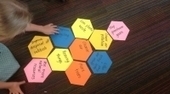
"Hexagonal Thinking is where either student or teacher writes key concepts on hexagonal cards, at the end of a period of learning, where the content behind each 'headline' is relatively clear to a team of learners. The students then place the cards together in the way that makes most sense to them - some ideas will connect to up to five others, others will lie at the end of a long sequential order, others still will appear in small outlying positions, on their own.
"In schools, we've seen it put to use by practitioners such as Chris Harte and David Didau. Harte has used the visual, tactical hexagons to help students see the complex connections between the various verb structures of the French language, and shared the thinking and impact of this in a TeachMeet presentation, "Why hexagons are better than squares".
"After a NoTosh workshop, Brisbane educator Elisabeth Hales used a simple set of cards to help students hone down on the key connections after a rich environmental immersion, as part of a design thinking project. Quickly, students were able to model to one another their different takes on what they had experienced and researched - no two hexagonal syntheses are the same."
|
|
Scooped by
Jim Lerman
September 1, 2013 7:46 PM
|
Looking for ways to integrate just one iPad into your daily routine in class? Here's a visual guide to the one iPad classroom perfect for teachers.
|
|
Rescooped by
Jim Lerman
from Presentation Tools
September 1, 2013 6:52 PM
|
|
|
Scooped by
Jim Lerman
September 1, 2013 6:46 PM
|
|
|
Rescooped by
Jim Lerman
from E-learning
September 1, 2013 6:35 PM
|
Pheed is a free social multimedia platform that enables users to create, inspire and share text, photos, videos, audio tracks, voice-notes and live broadcasts.
Via Julian Coleman
Even digitally versed teachers need to evolve with the language of their increasingly connected students. Here's a social media guide to help.
Via Joyce Valenza
|
|
Rescooped by
Jim Lerman
from Common Core Online
September 1, 2013 2:29 AM
|
|
|
|
Scooped by
Jim Lerman
September 4, 2013 1:13 AM
|
by Justin Dennis
"Whether you’re looking for a cheap 7-inch tablet or a full-featured 10-inch tablet, this guide can help you out. For those unsure about which size tablet to get, you’ll want to check out Matt’s article on how much screen size really matters — do you want a heavier, more expensive tablet with a large screen; or a lighter, less expensive one with a smaller screen? Every student is different. Some may need a stylus for sketching or taking notes while others might need a keyboard. The good news is that there are so many great tablets available right now that your hardest choice isn’t going to be finding one, but deciding on one.
"Many tablets come with 4G options, but today we’ll just be looking at the cheaper WiFi-only models, since 4G coverage can be expensive and most universities have WiFi across their entire campus.
"If you’re a newbie to the tablet world, don’t forget to check out our Tablet Buying Guide: Summer 2013 before you get started. Right now, we’ll be starting off with the most inexpensive tablet and working our way up the price ladder."
|
|
Scooped by
Jim Lerman
September 4, 2013 12:37 AM
|
by Dale Borgeson
"The quality and practicality of digital learning tools is a bit subjective.
"Where one classroom may do very well with the unpackaged and unfiltered content available on YouTube, Scribd, or podcasts, another teacher may want a practice app that picks one grade level of one content area and has students practice.
"Where one teacher may create a classroom full of self-directed learners working through way through project-based learning units, another may want pre-packaged content like that available through MOOCs and iTunesU.
"So the following list by Dale Borgeson then–almost maddeningly long at 464 digital learning tools and counting–will make some of you crazy, and some of you smile. If you count yourself among the latter, help improve the list on your next rainy day. How? You can make listly a more effective crowdsourcing tool by “upvoting” apps you’ve used and like, and downvoting those you’ve used and don’t like. In doing so, you help separate the useful apps from the not-so-much."
|
|
Rescooped by
Jim Lerman
from Active learning Approaches
September 4, 2013 12:09 AM
|
"Welcome to Spark 101, a new teaching resource designed to bridge the gap between classroom learning �and real-world applications. Spark 101 delivers dynamic, real-world STEM (science, technology, engineering, �and math) content to classrooms. Its mission is to engage students, educators, and organizations. To connect �everyday problems faced by industry to classroom teaching and learning. And to inspire students to pursue �STEM-related college majors and careers
"Through short, interactive videos from industry and a variety of educator resources, Spark 101 provides real-world scenarios educators can use to engage students in dynamic classroom discussions and problem solving.
"Following a 2012 pilot, we are working to broadly share Spark 101 with educators and fill our library with powerful content from industry. Explore the site. Try a lesson. And let us know which subjects you need to bring to life in your classroom. Together, we can “spark” our students’ interests and inspire them for post-secondary success! "
Via dianataylor
|
|
Scooped by
Jim Lerman
September 3, 2013 11:55 PM
|
by Debbie Morrison
"This is the second article in a series featuring select instructional resources—I’m in the process of building a bank of resources accessible from this blog geared to educators seeking skill development in facilitating and designing online courses. Over time I’ll be adding to the Resources section with the goal of sharing high-quality, relevant and helpful resources. This post includes resources grouped by topic with a brief description of each, and an icon indicating its type. For the list of previously featured resources and/or for the icon legend please refer to theresources tab of this site."
|
|
Scooped by
Jim Lerman
September 3, 2013 4:26 PM
|
Do you have what it takes to effectively use the top 4 social networks? It's not as hard as you might think. Here are some tips and tricks worth knowing about!
|
|
Rescooped by
Jim Lerman
from Ignite Reading & Writing
September 2, 2013 11:46 AM
|
|
|
Scooped by
Jim Lerman
September 2, 2013 1:00 AM
|
by Maria Popova
"In 1926, thirteen years before James Webb Young’s Technique for Producing Ideas and more than three decades before Arthur Koestler’s seminal “bisociation” theory of how creativity works, English social psychologist and London School of Economics co-founder Graham Wallas, sixty-eight at the time, penned The Art of Thought— an insightful theory outlining the four stages of the creative process, based both on his own empirical observations and on the accounts of famous inventors and polymaths. Though, sadly, the book is long out of print, with surviving copiessold for a fortune and available in a few public libraries, the gist of Wallas’s model has been preserved in a chapter of the 1976 treasure The Creativity Question (public library) — an invaluable selection of meditations on and approaches to creativity by some of history’s greatest minds, compiled by psychiatrist Albert Rothenberg and philosopher Carl R. Hausman, reminiscent of the 1942 gem An Anatomy of Inspiration.
"Wallas outlines four stages of the creative process — preparation, incubation, illumination, and verification — dancing in a delicate osmosis of conscious and unconscious work. These phases, which literary legend Michael Cowley would come to parallel in his 1958 model of the four stages of writing, go as follows:"
|
|
Scooped by
Jim Lerman
September 1, 2013 7:37 PM
|
by Diane Darrow
"We do not need to teach creativity, but rather inspire its daily practice. Somewhere along the way, we simply forgot to honor this innate gift and how to access its power. Our role as educators is to encourage learning experiences that increase the ability to recognize and listen to our inner voice.
"Let us begin by shifting emphasis from finding the right answer to creating school cultures that encourage risk-taking and embrace ambiguity. Psychologist Carl Rogers believed that we repress and even hide creative talent if our working environment is not psychologically safe or grounded on unconditional acceptance and empathy. Building a culture of trust is the first essential ingredient for an innovative community of thinkers to emerge. In order for innovation to breed, we need to feel safe enough to get out of our comfort zone, embrace uncertainty, take chances, and effectively collaborate with others. Together we can build ways to enhance rather than undermine creative thinking. No app, nor piece of technology, can produce this. It grows from the hearts, hands and guidance of a caring community."
|
|
Rescooped by
Jim Lerman
from iPads in Education Daily
September 1, 2013 6:48 PM
|
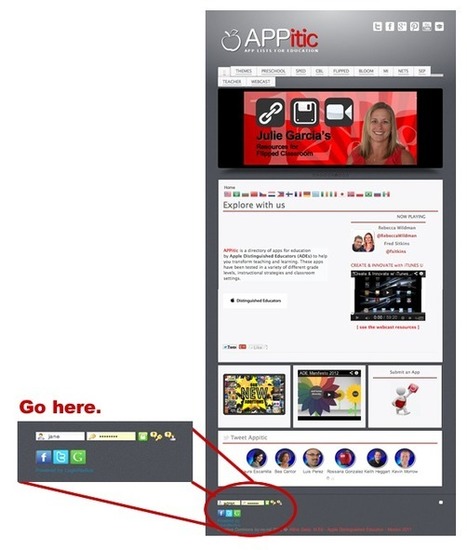
Get recommended app lists, webcasts and resources selected by Apple Distinguished Educators. Our recommended apps have been tested in a variety of different grade levels, instructional strategies and classroom settings.
Via Jon Samuelson
|
|
Rescooped by
Jim Lerman
from Digital Delights for Learners
September 1, 2013 6:43 PM
|
Get recommended app lists, webcasts and resources selected by Apple Distinguished Educators. Our recommended apps have been tested in a variety of different grade levels, instructional strategies and classroom settings.
Via Ana Cristina Pratas
|
|
Scooped by
Jim Lerman
September 1, 2013 2:55 AM
|
by Dale Borgeson "In past years I have used a number of these assets but I have not as clearly organized them as I have this year. For this year’s bunch I have gathered the most important items into one single web page of my classroom website, New Students 2013-2014. I’m hoping that by conveniently placing this information in one place my students and parents are more likely to use the provided references. "The following is a list of free online tools that I have incorporated (or plan to) for this year’s class. These websites were chosen for their ease of use and because they cost nothing!"
|
|
Rescooped by
Jim Lerman
from Education and Tech Tools
September 1, 2013 2:35 AM
|
A few weeks ago I created a Google Custom Search Engine for videos that are not hosted on YouTube. You can find the search engine on this page. This evening I updated that search engine to include four more resources.
Via Becky Roehrs
|


















Creative people combine playfulness and discipline, or responsibility and irresponsibility. There is no question that a playfully light attitude is typical of creative individuals.