Something
Get Started for FREE
Sign up with Facebook Sign up with X
I don't have a Facebook or a X account

 Your new post is loading...
 Your new post is loading...
Your new post is loading...
 Scoop.it!
UKOER International Case study. e activities of two UK higher education sector librarians, using existing open educational resources (OER), created to support information literacy and digital literacy teaching, to promote OER ... Via David Bevington
Scoop.it!

"We all know that education budgets are getting cut more and more, and that meaningful professional development opportunities have unfortunately become a bit of an oxymoron in education. Not only can being a "connected educator" help change that, but it can also provide you with ongoing inspiration and support. I'd even go as far to argue that being connected will be the most impactful thing you can do in your career." Via EDTECH@UTRGV
Scoop.it!

14 Technology Concepts Every Teacher should Know about http://t.co/MtLb8EId7O #ukedchat #edchat #education
So you are coming across too many tech terms that it becomes hard for you to draw clear boundaries between what each of them refer to. Well we do share with you this confusion and that is why we deem it important to put forward a list of the major and most popular educational concepts that are technology-related. The list below is a simple attempt to help you better capture the full picture of what all these tech terms are about by providing clear definitions to each one of them. If you like visuals and want to have a poster instead then check out this one HERE.
Scoop.it!

Massive open online courses are transforming higher education — and providing fodder for scientific research. (RT @FrancescPedroED: Nature Journal Reviews MOOCs and Offers a Balanced Account of Their Implications For Higher Education Worldwide.
Scoop.it!

Recently, there has been a surge in “gamifying” education, or presenting content in a game-like context to motivate learners to engage with the material. Is this a fad, or a natural evolution in educating the next generation of students?
Scoop.it!

The first Australian free online education platform has been launched in Canberra today, by tertiary education minister Chris Bowen.Open Universities Australia, a private distance and online education… (The Aussie Coursera?
Scoop.it!

50 Education Technology Tools Every Teacher Should Know About - Lists of great technology tools for teachers broken down by category - Learning, Lesson planning, etc (RT @Edudemic: 50 Education Technology Tools Every Teacher Should Know About...
Scoop.it!

Ana Cristina Pratas's curator insight,
March 22, 2013 8:02 AM
This report sets out to help decision makers in higher education institutions gain a better understanding of the phenomenon of Massive Online Open Courses (MOOCs) and trends towards greater openness in higher education and to think about the implications for their institutions. The phenomena of MOOCs are described, placing them in the wider context of open education, online learning and the changes that are currently taking place in higher education at a time of globalisation of education and constrained budgets. The report is written from a UK higher education perspective, but is largely informed by the developments in MOOCs from the USA and Canada. A literature review was undertaken focussing on the extensive reporting of MOOCs through blogs, press releases as well as openly available reports. This identified current debates about new course provision, the impact of changes in funding and the implications for greater openness in higher education. The theory of disruptive innovation is used to help form the questions of policy and strategy that higher education institutions need to address.
Scoop.it!

Education technology leaders these days are in high demand. If you are looking for great edtech leaders, it helps to know what qualities to look for before deciding to settle on any one specific candidate. According to a Harvard Business Review article in 2004, a great leader needs more than intelligence, determination, toughness and vision—they also need a high degree of emotional intelligence, that is to say, the must also possess self-awareness, self-regulation, motivation, empathy and social skill.
These days, great edtech leaders need to put many of those Emotional Intelligence (EI) skills to work as they should possess a digital presence as well. Great edtech leaders stay current in their field and have a view towards the future knowing what is coming next in educational technology so to prepare students for the world they are growing up in.
Currently, educators need to prepare students today for jobs that do not even exist yet and doing so requires appropriate tools. Knowing which tools are best to use and how to use them is the responsibility of all educators but educators need to get their guidance from their edtech leaders. A great edtech leader, therefore, needs to be part of a Professional Learning Network (PLN) in order to stay current. Great edtech leaders need social skills in order to do this well. Being part of a PLN requires many of the EIs mentioned above.
Click headline to read more-- Via Chuck Sherwood, Former Senior Associate, TeleDimensions, Inc
Scoop.it!

Presentations and slides from this conference looking at new pedagogies and business models in relation to open access learning in the higher education sector (with a special focus on MOOCs). It was a collaboration between the University of London International Programmes, the Observatory on Borderless Higher Education and the Leadership Foundation. Via jean lievens
Scoop.it!
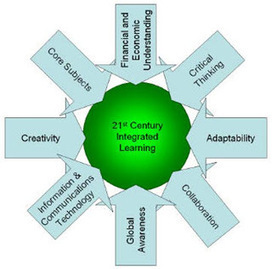
The world is awash with people and groups wishing to reform education. Some want to go “back to basics” while others want to go “forward to the future”.
Amongst the more progressive groups there is a surprising degree of similarity in what they propose. Thus, the RSA “Opening Minds” project in the UK or the US based P21 or the Apple Classroom of Tomorrow Today all have a high degree of overlap - indeed a Venn diagram of their views would be almost a single circle. Via Gust MEES 
Gust MEES's curator insight,
March 20, 2013 5:11 PM
A MUST read!!!
Check also:
- http://www.scoop.it/t/21st-century-learning-and-teaching?tag=Creativity
- http://www.scoop.it/t/21st-century-learning-and-teaching?tag=Collaboration
- http://www.scoop.it/t/21st-century-learning-and-teaching?tag=Critical-Thinking
- http://www.scoop.it/t/21st-century-learning-and-teaching?tag=Adaptability+to+Online+Learning
- http://www.scoop.it/t/21st-century-learning-and-teaching?tag=Problem+Based+Learning
Scoop.it!
RT @GMcKBlogs: MOOCs and Librarianship > Google Group http://t.co/Z7W5wOSIMJ #MOOCs #mooclib |
Scoop.it!

Jane Schmude's curator insight,
April 1, 2013 8:03 PM
This is a good resource for teachers, teacher librarians and teacher educators.
Scoop.it!

The presentations and the session recording from the JISC webinar Rising to the Digital Literacy Challenge, held on 28 February 2013, are online. Via David Bevington
Scoop.it!
GCFLearnFree.org - The freedom to learn what you want, when you want, absolutely free! Check out our Everyday Life, Basic Math, and Computer Training today!
Scoop.it!

What Impact Have MOOCs Had on Open Courseware? | Inside Higher Ed http://t.co/5XDNkO27ZC
Scoop.it!
Google Docs ( Drive ) is an important component of your digital toolbox as a teacher and educator. I have been posting a lot on the importance of this service in education and Google Docs section here in Educational Technology and Mobile Learning has some great resources to help you start leveraging the potential of Docs in your teaching.
Scoop.it!
How do you promote #infolit in your business or school? http://t.co/EHZixDfcjn
Scoop.it!
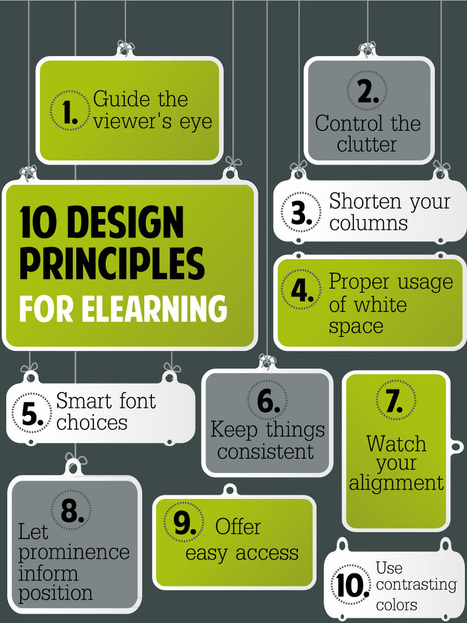
If you are a novice to eLearning, it is wise to know a few key principles about eLearning design. Via EDTECH@UTRGV 
EDTECH@UTRGV's curator insight,
March 21, 2013 5:07 PM
Let's not forget the cardinal rule of design: Know your intended audience.
Scoop.it!

#NewTitles Online learning in higher education: randomized trial compares hybrid learning to traditional cours... http://t.co/YqiAkbpuKi
Scoop.it!

Figuring out the proper way to leverage one of the most popular learning tools on the planet can be tough. We at Edudemic do regular features where we offer tips and advice on how to properly leverage Twitter. If you’re a student, parent, or teacher, Twitter can be a powerful weapon in your arsenal of learning resources. So we figured a few Twitter tips for students and others might be in order.
Twitter can open up new worlds to just about anyone involved in education. Parents can connect with one another and their children’s teachers, students can collaborate or participate in hashtag chats, and teachers can build a robust professional / personal learning network (PLN).
Click headline to read more-- Via Chuck Sherwood, Former Senior Associate, TeleDimensions, Inc
Scoop.it!

You can’t just take your eLearning courses and reformat them to be compatible for mobile devices. Content needs to be fit for the purpose. Via EDTECH@UTRGV
Scoop.it!
From
prezi

Adapting existing programs to enhance a digital learning environment (Useful prezi on #Blooms digital taxonomy - http://t.co/LLyvHBpuWP #elearning)
Elizabeth E Charles's insight:
Good examples of web 2 tools to achieve Blooms taxonomy.
Scoop.it!
Invited speaker at London Met University to talk about the use of social media in higher education. |