Your new post is loading...

|
Scooped by
Gilbert C FAURE
August 21, 2020 4:32 AM
|
Buggert and colleagues provide a phenotypic and functional map of SARS-CoV-2-specific
T cells across the full spectrum of exposure, infection, and COVID-19 severity. They
observe that SARS-CoV-2-specific T cells generate a broad, robust and functionally
replete response in convalescent individuals, that may provide protection from recurrent
episodes of severe COVID-19.
|
|
Scooped by
Gilbert C FAURE
August 17, 2020 3:58 AM
|
Covid-19 T cell response is strong
|
|
Scooped by
Gilbert C FAURE
August 2, 2020 11:38 AM
|
The role of T cells in the resolution or exacerbation of COVID-19, as well as their potential to provide long-term protection from reinfection with SARS-CoV-2, remains debated. Nevertheless, recent studies have highlighted various aspects of T cell responses to SARS-CoV-2 infection that are starting to enable some general concepts to emerge. In this Progress article, Zeyu Chen and E. John Wherry summarize early reports of the T cell responses observed in patients with COVID-19, emphasizing how different immune response characteristics in different patients may reflect a spectrum of disease phenotypes.

|
Suggested by
Société Francaise d'Immunologie
July 28, 2020 3:03 PM
|
Scientists are examining the role of T cells, which are likely crucial for long-term protection against SARS-CoV-2.
|
|
Scooped by
Gilbert C FAURE
July 27, 2020 8:22 AM
|
Recent studies have provided insights into the pathogenesis of coronavirus disease 2019 (COVID-19)1–4. Yet, longitudinal immunological correlates of disease outcome remain unclear. Here, we serially analysed immune responses in 113 COVID-19 patients with moderate (non-ICU) and severe (ICU) disease. Immune profiling revealed an overall increase in innate cell lineages with a concomitant reduction in T cell number. We identify an association between early, elevated cytokines and worse disease outcomes. Following an early increase in cytokines, COVID-19 patients with moderate disease displayed a progressive reduction in type-1 (antiviral) and type-3 (antifungal) responses. In contrast, patients with severe disease maintained these elevated responses throughout the course of disease. Moreover, severe disease was accompanied by an increase in multiple type 2 (anti-helminths) effectors including, IL-5, IL-13, IgE and eosinophils. Unsupervised clustering analysis identified 4 immune signatures, representing (A) growth factors, (B) type-2/3 cytokines, (C) mixed type-1/2/3 cytokines, and (D) chemokines that correlated with three distinct disease trajectories of patients. The immune profile of patients who recovered with moderate disease was enriched in tissue reparative growth factor signature (A), while the profile for those with worsened disease trajectory had elevated levels of all four signatures. Thus, we identified development of a maladapted immune response profile associated with severe COVID-19 outcome and early immune signatures that correlate with divergent disease trajectories.
|
|
Scooped by
Gilbert C FAURE
July 18, 2020 6:28 AM
|
|
|
Scooped by
Gilbert C FAURE
July 17, 2020 6:16 AM
|
Click here to edit the content
|
|
Scooped by
Gilbert C FAURE
July 14, 2020 3:28 PM
|
Extrapulmonary.... Click here to edit the content
|
|
Scooped by
Gilbert C FAURE
July 14, 2020 8:01 AM
|
T cell reactivity against SARS-CoV-2 was observed in unexposed people; however, the source and clinical relevance of the reactivity remains unknown. It is speculated that this reflects T cell memory to circulating ‘common cold’ coronaviruses. It will be important to define specificities of these T cells and assess their association with COVID-19 disease severity and vaccine responses. Recent studies have shown T cell reactivity to SARS-CoV-2 in 20–50% of unexposed individuals; it is speculated that this is due to T cell memory to common cold coronaviruses. Here, Crotty and Sette discuss the potential implications of these findings for disease severity, herd immunity and vaccine development.
|
|
Scooped by
Gilbert C FAURE
July 13, 2020 11:44 AM
|
|
|
Scooped by
Gilbert C FAURE
July 13, 2020 11:41 AM
|
INTERFERON TYPE 1 and COVID-19
|
|
Scooped by
Gilbert C FAURE
July 6, 2020 2:54 AM
|
Click here to edit the content Six months of coronavirus: the mysteries scientists are still racing to solve
|
|
Scooped by
Gilbert C FAURE
July 1, 2020 6:33 AM
|
bioRxiv - the preprint server for biology, operated by Cold Spring Harbor Laboratory, a research and educational institution
|
|
|
Scooped by
Gilbert C FAURE
August 21, 2020 2:25 AM
|
Abstract. Beside the commonly described pulmonary expression of the coronavirus disease 2019 (COVID-19), major vascular events have been reported. The objectiv
|
|
Scooped by
Gilbert C FAURE
August 7, 2020 2:50 AM
|
Severe acute respiratory syndrome coronavirus 2 (SARS-CoV-2) has caused the rapidly unfolding coronavirus disease 2019 (COVID-19) pandemic1,2. Clinical manifestations of COVID-19 vary, ranging from asymptomatic infection to respiratory failure. The mechanisms determining such variable outcomes remain unresolved. Here, we investigated SARS-CoV-2 spike glycoprotein (S)-reactive CD4+ T cells in peripheral blood of patients with COVID-19 and SARS-CoV-2-unexposed healthy donors (HD). We detected SARS-CoV-2 S-reactive CD4+ T cells in 83% of patients with COVID-19 but also in 35% of HD. S-reactive CD4+ T cells in HD reacted primarily to C-terminal S epitopes, which show a higher homology to spike glycoproteins of human endemic coronaviruses, compared to N-terminal epitopes. S-reactive T cell lines generated from SARS-CoV-2-naive HD responded similarly to C-terminal S of human endemic coronaviruses 229E and OC43 and SARS-CoV-2, demonstrating the presence of S-cross-reactive T cells, probably generated during past encounters with endemic coronaviruses. The role of pre-existing SARS-CoV-2 cross-reactive T cells for clinical outcomes remains to be determined in larger cohorts. However, the presence of S-cross-reactive T cells in a sizable fraction of the general population may affect the dynamics of the current pandemic, and has important implications for the design and analysis of upcoming COVID-19 vaccine trials.
|
|
Scooped by
Gilbert C FAURE
August 1, 2020 4:26 AM
|
The pathogenesis of coronavirus disease 2019 (COVID-19) may be envisaged as the dynamic
interaction between four vicious feedback loops chained or happening at once. These are the viral loop, the hyperinflammatory loop, the non-canonical renin-angiotensin system (RAS) axis loop, and the...
|
|
Scooped by
Gilbert C FAURE
July 27, 2020 10:32 AM
|
|
|
Scooped by
Gilbert C FAURE
July 25, 2020 4:40 AM
|
Understanding the clinical presentation of severe acute respiratory syndrome coronavirus 2 (SARS-CoV-2) infection and prognosis in children is a major issue. Children often present mild symptoms, and some severe forms require paediatric intensive care, with in some cases a fatal prognosis. Our aim was to identify the epidemiological characteristics, clinical presentation, and prognosis of children with coronavirus disease 2019 (Covid-19) hospitalized in Paris suburb hospitals. In this prospective, observational, multicentre study, we included children hospitalized in paediatric departments of Paris suburb hospitals from 23 March 2020 to 10 May 2020, during the national lockdown in France with confirmed SARS-CoV-2 infection (positive RNA test on a nasopharyngeal swab) or highly suspected infection (clinical, biological, and/or radiological data features suggestive for SARS-CoV-2 infection). A total of 192 children were included for confirmed (n = 157) or highly suspected (n = 35) SARS-CoV-2 infection. The median age was one year old (interquartile range 0.125–11) with a sex ratio 1.3:1. Fever was recorded in 147 (76.6%) children and considered poorly tolerated in 29 (15.1%). The symptoms ranged from rhinorrhoea (34.4%) and gastrointestinal (35.5%) to respiratory distress (25%). Only 10 (5.2%) children had anosmia and five (2.6%) had chest pain. An underlying condition was identified in almost 30% of the children in our study. Overall, 24 (12.5%) children were admitted to paediatric intensive care units, 12 required mechanical ventilation, and three died. For children in Paris suburbs, most cases of Covid-19 showed mild or moderate clinical expression. However, one-eighth of children were admitted to paediatric intensive care units and three died.

|
Suggested by
LIGHTING
July 18, 2020 6:21 AM
|
SARS-CoV-2 T cell immunity: Specificity, function, durability, and role in protection T cells at last
|
|
Scooped by
Gilbert C FAURE
July 16, 2020 6:02 AM
|
|
|
Scooped by
Gilbert C FAURE
July 14, 2020 3:26 PM
|
bioRxiv - the preprint server for biology, operated by Cold Spring Harbor Laboratory, a research and educational institution
|
|
Rescooped by
Gilbert C FAURE
from Virus World
July 13, 2020 2:11 PM
|
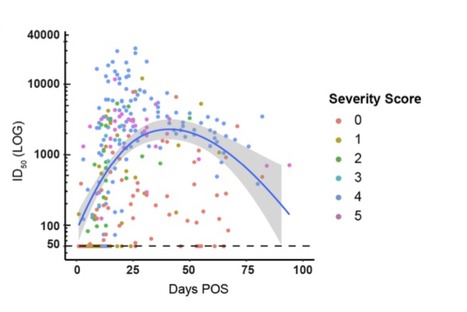
Antibody (Ab) responses to SARS-CoV-2 can be detected in most infected individuals 10-15 days following the onset of COVID-19 symptoms. However, due to the recent emergence of this virus in the human population it is not yet known how long these Ab responses will be maintained or whether they will provide protection from re-infection. Using sequential serum samples collected up to 94 days post onset of symptoms (POS) from 65 RT-qPCR confirmed SARS-CoV-2-infected individuals, we show seroconversion in >95% of cases and neutralizing antibody (nAb) responses when sampled beyond 8 days POS. We demonstrate that the magnitude of the nAb response is dependent upon the disease severity, but this does not affect the kinetics of the nAb response. Declining nAb titres were observed during the follow up period. Whilst some individuals with high peak ID50 (>10,000) maintained titres >1,000 at >60 days POS, some with lower peak ID50 had titres approaching baseline within the follow up period. A similar decline in nAb titres was also observed in a cohort of seropositive healthcare workers from Guy′s and St Thomas′ Hospitals. We suggest that this transient nAb response is a feature shared by both a SARS-CoV-2 infection that causes low disease severity and the circulating seasonal coronaviruses that are associated with common colds. This study has important implications when considering widespread serological testing, Ab protection against re-infection with SARS-CoV-2 and the durability of vaccine protection. Preprint available at medRxiv (July 11, 2020): https://www.medrxiv.org/content/10.1101/2020.07.09.20148429v1
Via Juan Lama
|
|
Scooped by
Gilbert C FAURE
July 13, 2020 11:42 AM
|
|
|
Scooped by
Gilbert C FAURE
July 7, 2020 6:25 AM
|
medRxiv - The Preprint Server for Health Sciences
|
|
Scooped by
Gilbert C FAURE
July 3, 2020 2:36 PM
|
A small subset of uninfected people also had SARS-CoV-2-fighting T cells, a finding that scientists are still trying to figure out.
|


 Scoop.it!