
iGeneration - Humane Use of Technology in an AI world (Pedagogy & Digital Innovation)
1.2M views |
+4 today
Teaching and learning in the Digital Age - meeting the pedagogical challenges of digital learning and innovation for the iGeneration.
Curated by
Dr. Tom D'Amico (@TDOttawa)
 Your new post is loading...
 Your new post is loading...
Your new post is loading...
 Scoop.it!


LundTechIntegration's curator insight,
May 29, 2014 8:43 AM
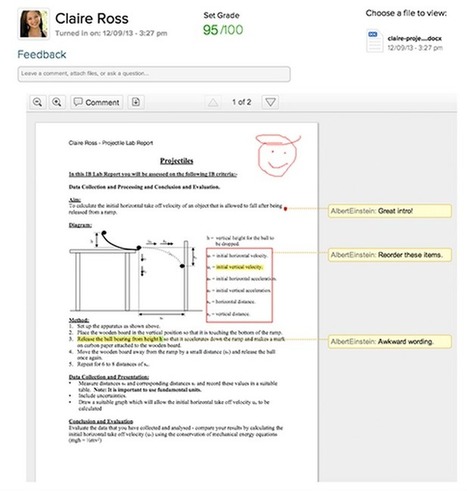
Great tool to help with grading and make it easy for teachers and students to collaborate.
Scoop.it!

Feedback is an inevitable part of teaching. Naturally, you’re in a position where you’re giving a whole lot of feedback, but you’re likely on the receiving end of feedback as well. We’ve all been on the receiving end of feedback in various aspects of our lives, and I’m sure we’ve all experienced some feedback that …
Scoop.it!
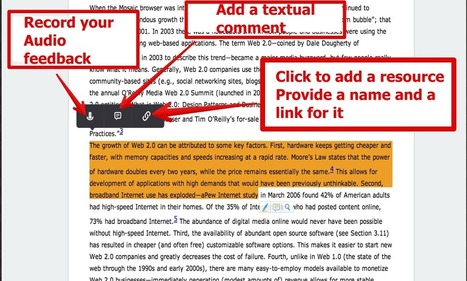
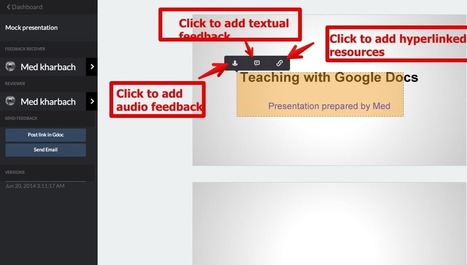
Gr 6 student using Kaizena to provide evidence of persuasive text. Teacher giving feedback using voice and written comment. Created with TechSmith Snagit for...
|
Scoop.it!

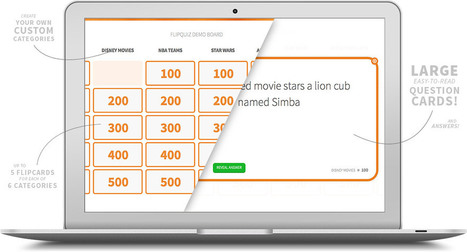
Gamification is one of the buzzwords in education right now, and for a good reason: Gamification is empowering, exciting, and under the right circumstances can be the disruptive innovator many teachers desperately need in order to change the dynamics between knowledge and the learner. There is an explosion of EdTech tools destined to gamify the …
Scoop.it!

During the summer, you'll want to improve your teaching and lessons, but how do you decide where to start? Your students! I use these three ways to get feedback from my students on my lessons, activi
Scoop.it!

Providing timely and effective feedback on student work is a critical component to any classroom. As students increasingly operate and create in a digital environment, emerging tools provide unique new opportunities for teachers to provide feedback on both written work and video projects. Feedback on Written Work With the increased adoption of Google Apps …
Scoop.it!

Mark Fuson's curator insight,
August 14, 2014 5:04 PM
I'm absolutely in love with the idea of Kaizena. You can post your observations and instruction for students to improve their writing, labs, performances, and speeches. But what really intrigues me is they can also post their observations, decisions, and questions to you. An amazing Google Application which needs exploring.
Scoop.it!

Parenting these days is patrolled by the language police. Sometimes it seems like the worst thing you could ever say to a kid is “Good job!” or the dreaded, “Good girl!” Widely popularized psychological research warns about the “inverse power of praise” and the importance of “unconditional parenting.” What are these researchers really getting at? Are the particular words we use to talk to our kids so important? And how do we convey positive feelings without negative consequences?
Scoop.it!
By Barry Saide and Chris Giordano A 5th grade teacher and a 9th grade social studies teacher from two different school districts who have never met were drawn together by several common interests. In our classrooms, our main goal is to foster a love of learning. If we can create a love of learning, students will enjoy the process and take risks. The more open and honest students are as learners, the more open they are to feedback, critique, and self-reflection. So, how do we do it? Backchanneling. Backchanneling is a strategy that provides students with the opportunity to converse about content informally, both during class and outside of the traditional class period. This strategy helps encourage critical thinking and reflection while providing meaningful feedback for educators. Students have the comfort level to share in silence, benefitting our introverts and extroverts equally. Everyone has a voice, even those who read responses and type little. But our experience has been that students feel more empowered to share openly, honestly, and regularly if they can type it. Perhaps this is where 21st century students are. Barry's experiences: 5th grade students need to interact. They like to move. They like to share their thinking. They hate desks. And sitting still for more than 15 minutes—well, adults may have trouble with that. Think your students could sit at their desks for an hour and a half, without changing posture? Mine did, when discussing whether knowing the history of political parties was important. Students read a short piece, then logged into the posted link for the backchannel. Students took one side of the argument (their choice). They cited the text to prove their thinking and support their opinion. They cited outside sources found using our safe search engine link. They challenged and argued with one another and came to some understandings. And in the end, they all enjoyed the learning process. When I posted the question "What did you learn from our discussion?" in our backchannel, common themes were the joy in communicating in real time and in being able to share their thinking. In feeling the work was relevant and engaging during the online discussion, students felt a sense of belonging. And, isn't that what we are educators strive for, with or without technology? Chris's experiences: At the secondary level, students have a communication itch that needs scratching. At any opportunity, secondary students are fulfilling their technology cravings by taking out their phones. Do they ask their friends questions verbally? No. They text each other from across the classroom. As an educator, I want to provide an opportunity for students to communicate using a virtual platform that is appropriate and similar to something they already use outside the classroom context. In our current unit, I created a schedule where each student takes a turn as the backchannel moderator and creates a conversational question relative to the day's lesson. Students go home, informally chat, and interact with each other. Students continue their engagement at home with questions to which they can relate, for example,"Find a product made in another country. What is it? Why do you suppose that was not made domestically and how did the product get here?". The next day, simply ask your students how the backchannel went last night and listen to the explosion of chatter! A perfect anticipatory set. Teachers can similarly benefit from backchanneling. Students can provide meaningful feedback to teachers about how the lesson (1) can be interesting, (2) is developing, and (3) was executed. There are several platforms available for teachers when incorporating a backchannel: 1. TodaysMeet is a backchannel website. The discussion room can be created for any length of time, from one hour to one year. Students do not have to sign up to enjoy this platform. Our favorite feature is its privacy: if someone doesn't know the link, they can't find us, making it a safe, controlled environment. The discussion transcript can be printed or saved for reviewing at a later time. 2. Edmodo has a similar backchannel feature to TodaysMeet. You must first establish an Edmodo class and help your students log in to the website. One benefit is that teachers can also provide media for students to discuss in real time. Edmodo also lends itself to a flipped classroom approach. 3. Twitter can provide an open forum of communication that would serve nicely as a backchannel. Assign a class hashtag for students to use with each tweet so you can track the conversation. Please make sure parents and students are aware of the availability of sensitive content on the Internet. In today's education world, the stakes are very high. Teachers want to know how to reach students, and students want teachers to reach them. Backchanneling provides this opportunity. With such instant feedback at our disposal, teachers can make the necessary changes to their instruction to meet the needs of their individual students.

Michael Ramirez's curator insight,
January 31, 2021 1:08 PM
Edmodo is a great resource that can promote positive and meaningful learning by utlizing backchannel feedback.
Scoop.it!

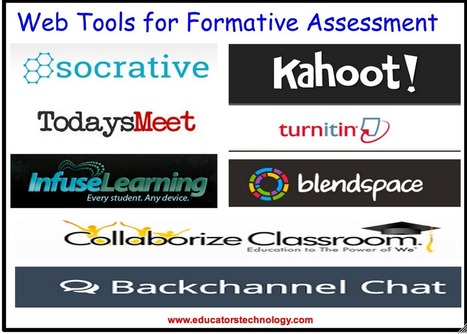
These free online assessment tools are a great way for teachers to keep track of student achievement and inform future planning. They are easy to learn and can be used on any device.
|