There are some big myths about writing with mobile devices. But are they actually true? The EdTechTeacher team weighs in on a controversial topic.
Via Felix Jacomino
Your new post is loading...
From
edudemic
There are some big myths about writing with mobile devices. But are they actually true? The EdTechTeacher team weighs in on a controversial topic. Via Felix Jacomino
From
wideoo
A new tool to make cool videos. You just choose a template, insert objects, animate and share! Go meet Mr. Wideo :)
Une tablette peut-être utilisée comme TBI. Via Sophie Bocquet, Maruchan, Juergen Wagner
Pierre Mongin 's curator insight,
June 25, 2013 2:39 AM
Il y a encore plus simple utiliser des logiciels comme Inksur Ipad (gratuit) et écrire avec son doigt ou avec unstylet comme si l'on était au tableau .L'avantage est que l'on est face à son public
Pierre Mongin 's curator insight,
September 27, 2014 8:07 AM
l'enseignant est alors indépendant de la marque du tableau selon les salles où il se trouve
Daniel Morgenstern's curator insight,
September 27, 2014 8:39 AM
Merci à Hugues, toujours à la pointe.
"APP GROUPS, BOOKMARK FAVORITE WEBSITES TO THE HOME PAGE, CAPS LOCK, CHANGE NOTES FONT, CREATE A TOUGHER PASSWORD and so many more tips! Via John Evans
Websites & mobile apps to set up a flipped classroom / blended learning environment, such as Educreations, Khan Academy, BrainPOP, Edmodo, Camtasia, etc. Via Ramiro Aduviri Velasco, juandoming
From
cursus
« MOS Player for iPad», lecteur de contenu eLearning en mode déconnecté, idéal pour les populations nomades Via Thot - Cursus
“There’s an App for that”… Well actually, sometimes there isn’t. Sometimes the App you want is the one in your head, not in the App Store. This is where German startup “Cleverlize” steps in to help educators create their own custom apps… In minutes… With no programming required at all!...
The Best iOS Apps for Students and Teachers
These 5 apps are among the less well-known applications to support the flipped classroom model. Via John Evans
Lumax Producties's curator insight,
May 21, 2013 2:54 AM
Met deze apps kun je makkelijk eigen interactieve content maken om kennis te delen en over te dragen. Handig voor scholen en voor leren op de werkplek.
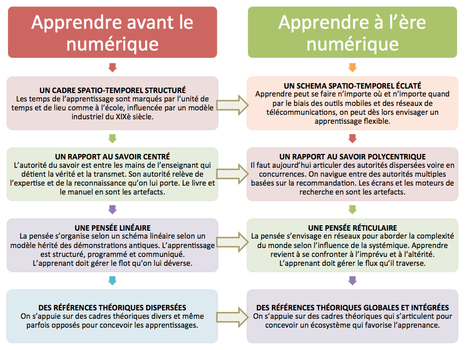
Après avoir défini les contours d'un modèle de pédagogie ouverte et hybride, je propose aujourd'hui d'explorer les grandes ruptures que l'ère numérique provoque en terme d'apprentissages.
Philippe-Didier Gauthier's curator insight,
January 6, 2014 4:37 PM
#apprenance Une réfléxion schématique, un peu réductrice mais qui met en valeur les différences. Pour ce qui est du dernier point, le changement de cadre épistémologique ne me semble pas si évident qu'il est présenté ici. Mais cela donne à réflechir !
kimiko's curator insight,
February 6, 2014 5:10 AM
les grandes ruptures que l'ère numérique provoque en terme d'apprentissages
In 2008, Fran Simmons, an English teacher at NewDorpHigh School in New York—at that time one of the lowest-performing secondary institutions in the nation— devised a simple test for her students in an effort to keep district officials from pulling the plug. First, she asked her freshman class to read Of Mice and Men. Then, using information from the novel, she asked them to answer the following prompt in a single sentence: “Although George …” She was looking for a sentence like: Although George worked very hard, he could not attain the American Dream. What Simmons received was alarming in the truest sense of the word. Some students wrote passable sentences, but many could not manage to finish the line. More than a few wrote the following: “Although George and Lenny were friends.” Via Beth Dichter
Beth Dichter's curator insight,
May 16, 2013 10:49 PM
This in-depth post explores the issue of language impacts our ability to think. After an introduction the post is split into three sections. The first section explores "the psycholingusitic case for writing education." It is noted that the Common Core states that students in grades 6-12 "should demonstrate increasing sophistication in all aspects of language use, from vocabulary and syntax to the development and organization of ideas, and they should address increasingly demanding content and sources.” What follows is a look at language, where we see that the language we learn impacts us in many ways, that some cultures have many words for a word like snow while others do not, that cultures whom have language that have "gendered objects" impacts how people view the objects. The second section explores "Can you teach better math and science be teaching writing?" Information is provided about New Dorp High School (in New York). The school implemented a program that included "writing-to-learn" across the curriculum (except for math) and discovered that major gains in writing were apparent by the second year. The third section "highlights ten features of writing education that can be used to enhance student learning across all subject areas, ultimately resulting in higher academic performance." The first two suggestions are below (all are quoted from the post). 1. Vocabulary Across The Disciplines: Emphasize that the concept of a word may change depending on the context in which it is used.
Ann Kenady's curator insight,
February 5, 2014 11:23 PM
This article gives compelling evidence that the ability to write effectively is closely linked to the ability to think coherently. The author writes, "Students’ inability to write was contributing to their inability to think, severely impeding intellectual growth across many subjects." |
Let's explore a number of excellent search alternatives, all with specific qualities that work well in various situations. Via Felix Jacomino
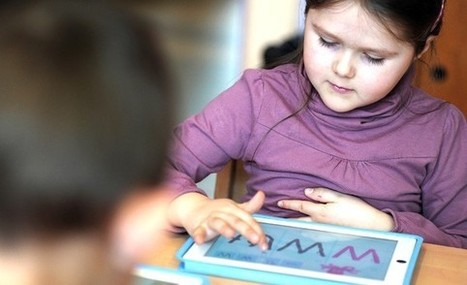
Touch-screen tablets for young students have become all the rage. Some districts are even buying iPads for every kindergartner, a move sparking both celebration and consternation. Via Jon Samuelson
Pearletta Wilson's curator insight,
May 22, 2013 5:00 AM
This article is about younger students than those in further education. However it gives great insight into how ipads could be used with our college students which I will consider as we prepare and plan for the next academic year.
Switching from a traditional classroom to a flipped classroom can be daunting because there are a lack of effective models. So, what should an effective flipped classroom look like? In our experience, effective flipped classrooms share many of these characteristics: Via Nik Peachey
Jane Sowter-Maranion's curator insight,
May 22, 2013 7:28 PM
The development of critical literacy in students is a large part of the new Australian Curriculum. The 'flipped classroom' can really assist teachers in developing higher order thinking skills, ICT literacy, and Information literacy.
Ness Crouch's curator insight,
June 22, 2013 5:22 PM
Very useful article with some great suggestions worth reading.
Becky Roehrs's curator insight,
May 21, 2013 1:52 PM
I've used Join.me and it works great. In the Sakai LMS, you can use the Meetings tool (but it's not a free tool).
From Virtual Classrooms to Moodle MOOCs and Google Docs,you can be sure that this web education tool box is brimming with complete solutions for teaching online. Via TeachingEnglish
rthibert's curator insight,
May 21, 2013 8:00 AM
Following the successful implementation of the Acer-European Schoolnet Educational Netbook Pilot in 2010/2011, Acer and European Schoolnet carried out a new pilot study on the use of tablet devices to enhance teaching and learning practices in 2012. This is an executive summary.
Emaze vision – to change the way people create presentations through a simple, fully automated process that generate powerful and engaging showcases. Via Baiba Svenca
Two Pens's curator insight,
June 10, 2013 1:13 PM
It's an early beta but looks promising for making more interesting presentations. Not at "swoopy" as Prezi (that's good).
Maria Zambonino Gordillo's curator insight,
December 17, 2013 12:00 PM
gracias deseo innovaciones tecnologicas
What are the keys designing a project-based learning classroom? It starts with the teacher. Via Stephanie Sandifer
Si vous supprimez des fichiers accidentellement sur votre disque dur sous Windows, seule la référence des fichiers dans la table d'allocations est effacée. Il est possible de récupérer les fichiers ou les dossiers effacés sur le disque tant que de nouvelles données n'ont pas été écrites à la place. Pour cela, je vous invite à essayer l'application gratuite de récupération de fichiers nomméeUndelete Navigator. ... Via David Vergnon
"Julie Greller's blog A Media Specialist's Guide to the Internet features some great content for teachers. Posts are sorted by subject and grade level, and there's also a link to some free ebooks. ... Via callooh
callooh's curator insight,
April 5, 2013 4:48 PM
Information and online tools to add to your digital storytelling toolbox
Donna Meehan's curator insight,
May 20, 2013 2:49 PM
Great resources to add to you toolbox for digital storytelling.
This presentation was given by Ray Birks and Aaron Hansen at WAETAG 2012. The focus was how to engage and enrich students and teachers in technology. Mobile apps, websites and software are included as is a key that lets you know if it is free or a cost, and grade level (K-5, 6-8, 9-12). Most likely you will fine (or perhaps be reminded of) a couple of new tools that you might like to use. Via Beth Dichter, Juergen Wagner |
Your new post is loading...
This article comes by way of @felixjacomino on ScoopIt. I really like this article, because it's main point is that people are trying to adapt old ways of writing to new technology. I believe the author, at some point, even points out that in education, it doesn't matter what software package a child learns as long as they learn technology and the basics of how to use word processing. I started out on WordPerfect years ago, and then had to adapt to Word 1.0 (what version are we up to now?). Same with CMS systems that I've learned in the past. People are always so stuck on knowing specific products in tech comm instead of realizing that if you know one software package, you can probably adapt fairly quickly to a new one if you are just shown the differences. That was definitely the case with my current position.
But back to iPads and writing--I took copious notes on my iPad during the STC Summit, and wrote several long blog posts on my iPad as well. Yes, it was easier to type with a wireless keyboard, but that's only because I type very fast and legibility is important to me. It's a sensory thing for me. I found that for basic writing tasks, I can use the iPad with ease, and that's the point of this article. No more excuses! Mobile is definitely an option.
--techcommgeekmom
I have found it quite difficult doing long term typing on my iPad. Very interesting.