


Four Houston residents pleaded guilty Friday for harboring illegal immigrants in a sex trafficking ring, according to the U.S. attorney.
Those arrested on Oct.


 Your new post is loading...
 Scoop.it! Four Houston residents pleaded guilty Friday for harboring illegal immigrants in a sex trafficking ring, according to the U.S. attorney. 
No comment yet.
Sign up to comment
Scoop.it!

Europol informed that a broad police operation took place in the state of Carinthia on December 11: Austrian law enforcement authorities, with the support of Europol and Romanian authorities, ran an operation on 11 December to identify victims of ...
terry clarke's insight:
There simply isn't being enough done (in terms of financial resources and manpowe) to address this growing, tragic problem.
Scoop.it!

“ Six key rules for student engagement include making it meaningful, fostering efficacy, autonomy support, collaborative learning, establishing positive teacher-student relationships, and mastery orientations.”
Via Becky Roehrs, Suvi Salo, Ivon Prefontaine, PhD

Becky Roehrs's curator insight,
December 9, 2014 7:43 AM
All of the rules are explained and examples of how to implement each rule are provided. Based on a ton of research, too.
Scoop.it!

“ There is a large focus in education to try out the hottest teaching trends, best education technology, and basically do whatever others are doing. Your colleague down the hall is doing project-based learning? Why not you! Your parents say you should flip your classroom? Terrific! But sometimes you need to go back to one of …”
Via Amy Burns
terry clarke's insight:
I'm glad social media & modern technology did not exist when I was undergoing questioning with the Socratic method when I was in law school!
Scoop.it!

Over the past few months internet companies have asked the FCC to look into new restrictions and fees tacked on by carriers such as Verizon and AT&T to SMS services. They say that these changes will hurt legitimate SMS messaging between customers.
Scoop.it!

“ Check out these homework myths one teacher debunked and the strategies he used to successfully engage his students in homework.”
Via Elke Höfler, Ivon Prefontaine, PhD
Scoop.it!

“Child identity theft is considered to be one of the fastest-growing crimes. Kids’ identities are stolen over 50 times more than those of adults! We’re often so focused protecting our kids from so many threats in the real world; we forget that in cyberspace bad guys are stealing children’s identities to open credit cards, apply for loans, rent homes and even receive health care. Bad guys make money by selling and reselling the same child’s identity over and over. And they get away with it because parents don’t think about monitoring their son or daughter’s identity.Why is this important? Children could potentially lose out on future jobs, internships and loans that require a clean background check or credit report—all because they were victims of identity theft as kids. That’s a future I’m trying to help my daughters avoid. Growing up in the real world is difficult enough that I don’t want their digital lives to hold them back.”Learn more:- https://gustmees.wordpress.com/2014/11/18/why-cybersecurity-starts-at-home-and-is-concerning-all-of-us/- https://gustmees.wordpress.com/2014/11/12/how-to-teach-kids-up-from-the-early-age-about-cyber-security-and-digital-citizenship/- https://gustmees.wordpress.com/2014/11/25/digital-citizenship-social-media-and-privacy/
Via Gust MEES

Steven Stich's curator insight,
December 9, 2014 8:40 PM
Did you know that children's identity is stolen over 50 times more than adults? I had no idea until reading this article. People who steal children's identity use their information to open credit cards, apply for loans, and this can affect kids ability to gain jobs in the future as a result. One day these children will be the future of America so it is vital that actions are taken by parents to ensure that their children are being safe online, and that no one is taking advantage of them. 
Ness Crouch's curator insight,
March 13, 2016 3:22 AM
Child identity theft is considered to be one of the fastest-growing crimes. Kids’ identities are stolen over 50 times more than those of adults! We’re often so focused protecting our kids from so many threats in the real world; we forget that in cyberspace bad guys are stealing children’s identities to open credit cards, apply for loans, rent homes and even receive health care. Bad guys make money by selling and reselling the same child’s identity over and over. And they get away with it because parents don’t think about monitoring their son or daughter’s identity. Learn more: - https://gustmees.wordpress.com/2014/11/25/digital-citizenship-social-media-and-privacy/
Scoop.it!

"When it comes to human rights, the United States must practice at home what it preaches abroad."
terry clarke's insight:
It is very disappointing to see what the rest of the world thinks of our human rights practices when we condemn so many nations for their alleged poor human rights records.
Scoop.it!

The terms 'critical' and 'reflection' are sorely misunderstood in education. Being critical is often misinterpreted as being negative. 'Reflection' is also frequently distorted to mean "reflect on what you are doing wrong". Too often the students that we teach give negative feedback when asked to be critical. So to counter act this, educators initiate strategies such as '2 stars and a wish' and SWNI (strengths, weaknesses, new ideas). These strategies are designed to make reflective practices a more positive experience for students. It teaches them that being critically reflective is not just a negative activity, that it is important to be positive and give feedback to help improve or make something better. Learn more: Via Gust MEES

Claudia Estrada's curator insight,
August 17, 2014 3:10 PM
This is the skill we all need to learn and urgently develop with our students.
Scoop.it!

Many studies show us that our brains prefer storytelling to facts.When we read facts, only the language parts of our brains work to understand the meaning. When we read a story, the language parts of our brains and any other part of the brain that we would use if we were actually experiencing what we’re reading, light up.This means that it’s easier for us to remember stories than facts. Our brains can't make major distinctions between a story we’re reading about and something we are actually doing.... Via Jeff Domansky

ManufacturingStories's curator insight,
October 1, 2014 3:55 PM
For more resources on STEM Education visit http://bit.ly/1640Tbl 
Ricard Garcia's curator insight,
October 3, 2014 2:02 AM
One more proof to show how important storytelling may be!
Scoop.it!

Take a moment to join us in a snapshot of a classroom we recently observed: Students are hard at work designing a travel brochure as a part of their study of Ireland. They need to think about how m... Via Dr. Tom D'Amico (@TDOttawa)
Scoop.it!

2013 was a year of exploration for brands on social media. From testing Vines to launching Instagram ads, many companies were dabbling in social media efforts across the Web just to see how customers would react. Now, in 2014, brands are geting serious. They’re using the wealth of data as well as the human connection that social media can provide to develop deeper relationships with customers.
Visit the link for more on these seven ways brands are using social media to increase customer loyalty this year. Via Lauren Moss

Francesca Mattonelli's curator insight,
May 7, 2014 5:53 AM
Una bella infografica per riassumere i "must" del 2014 
Katie Muirhead's curator insight,
August 19, 2014 11:52 AM
Further highlights statistics of social media consumption and the information behind the choices of online advertisiers
Scoop.it!
From
www

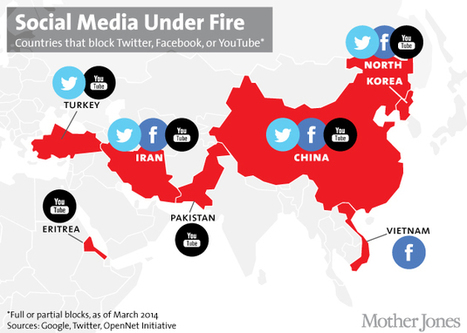
The internet increasingly pervades our lives, delivering information to us no matter where we are. It takes a complex system of cables, servers, towers, and other infrastructure, developed over decades, to allow us to stay in touch with our friends and family so effortlessly. Here are 40 maps that will help you better understand the internet — where it came from, how it works, and how it's used by people around the world. Via Lauren Moss

Coolwired's curator insight,
August 31, 2014 10:04 AM
This informative site sheds light on the pervasive workings of the Internet. 
Mel Leggatt's curator insight,
November 20, 2014 11:36 AM
A really excellent visual resource for understanding how the Internet has and continues to evolve. 
Vincent Lahondère's curator insight,
January 4, 2018 6:06 AM
Cette série de cartes accompagnées de commentaires en anglais est absolument remarquable car elle permet de comprendre comment internet s'est imposé à travers le monde. |
Scoop.it!

Angelina Jolie is not the only woman who got trashed by Sony, according to a new account of alleged harassment and racism.
terry clarke's insight:
Yeah, we're living in a post-racial society. Right.
Scoop.it!

The CIA torture techniques detailed in the Senate Intelligence Committee report – repeated mock drownings causing convulsions and vomiting, inserting pureed food into the rectum of a suicidal prisoner – are truly the stuff of nightmares.
terry clarke's insight:
Certainly, this is no surprise to anyone knowledgeable about Human Rights issues.
Scoop.it!

Beth Dichter's curator insight,
December 8, 2014 10:57 PM
This eLearning Technology Compass provides another way to help you choose technology tools. Working from the inner circle towards the outer circle you will find * Goals * Competencies * Performance Assessments * Ring of Technologies Under this visual you will also find a detailed table that lists: * Desired Competencies * Rationale * Related Activities * Potential Technologies And the site also provides tutorials on many of the tools. This is like a one stop shop that will help you find great tools to help students grow skills in the desired competencies.
Becky Roehrs's curator insight,
December 9, 2014 2:48 PM
This eLearning Technology Compass is based on a matrix that helps instructors meet their learning outcomes by choosing the right tech tool for the job.
Scoop.it!
terry clarke's insight:
My Asian American daughter who loves puns will be disappointed in China's prohibition against using puns.
Scoop.it!

“ Electronic skin just got a major upgrade.”
terry clarke's insight:
Interesting concept. I just wonder how many years from seeing it reach the production phase.
Scoop.it!

Teach your children to become good digital citizens with these resources.The Internet is a wonderful place for learning and entertainment, but like the world around us, it can pose dangers if precautions are not taken. Allowing free access puts your child, your computer and your personal data at risk.Learn more:- https://gustmees.wordpress.com/2014/11/12/how-to-teach-kids-up-from-the-early-age-about-cyber-security-and-digital-citizenship/- https://gustmees.wordpress.com/2014/11/25/digital-citizenship-social-media-and-privacy/- https://gustmees.wordpress.com/2014/10/11/learning-to-become-a-good-digital-citizen-digital-citizenship/
Via Gust MEES

Gust MEES's curator insight,
December 6, 2014 7:12 PM
Teach your children to become good digital citizens with these resources.
The Internet is a wonderful place for learning and entertainment, but like the world around us, it can pose dangers if precautions are not taken. Allowing free access puts your child, your computer and your personal data at risk. Learn more: - https://gustmees.wordpress.com/2014/11/25/digital-citizenship-social-media-and-privacy/
Ness Crouch's curator insight,
March 13, 2016 4:11 AM
Teach your children to become good digital citizens with these resources.
The Internet is a wonderful place for learning and entertainment, but like the world around us, it can pose dangers if precautions are not taken. Allowing free access puts your child, your computer and your personal data at risk. Learn more: - https://gustmees.wordpress.com/2014/11/25/digital-citizenship-social-media-and-privacy/
Scoop.it!

“ A brief collection of infographics on the state of teaching around the world for teachers and would-be teachers.”
Via Paul Murray, Ivon Prefontaine, PhD
Scoop.it!
The terms 'critical' and 'reflection' are sorely misunderstood in education. Being critical is often misinterpreted as being negative. 'Reflection' is also frequently distorted to mean "reflect on what you are doing wrong". Too often the students that we teach give negative feedback when asked to be critical. So to counter act this, educators initiate strategies such as '2 stars and a wish' and SWNI (strengths, weaknesses, new ideas). These strategies are designed to make reflective practices a more positive experience for students. It teaches them that being critically reflective is not just a negative activity, that it is important to be positive and give feedback to help improve or make something better. Learn more: Via Gust MEES
Claudia Estrada's curator insight,
August 17, 2014 3:10 PM
This is the skill we all need to learn and urgently develop with our students.
Scoop.it!

Story and images by Manish Singh / WinBeta Earlier this year, Earlier this year, Microsoft announced "Skype Translator", a ground breaking feature which would allow two people speaking in different languages to have audio conversations. At the company's Worldwide Partner Conference event, Microsoft CEO Satya Nadella announced a development to that project -- Skype Translator now facilitates video conferencing as well.
terry clarke's insight:
. Although universal communication among people speaking different languages is certainly a worthy goal, I am reluctant to embrace the technology that allegedly allows instantaneous translation during audio/video conferences among speakers of different languages--for many reasons.

Joyce Valenza's curator insight,
July 30, 2014 7:16 AM
This is going to be such a game changer for connecting learners globally! 
Rosemary Tyrrell, Ed.D.'s curator insight,
July 30, 2014 11:16 AM
Looks like we are one step closer to Gene Roddenberry's view of the future. Does this remind anyone of a universal translator???
Scoop.it!

Vanderbilt University "Metacognition is, put simply, thinking about one’s thinking. More precisely, it refers to the processes used to plan, monitor, and assess one’s understanding and performance. Metacognition includes a critical awareness of a) one’s thinking and learning and b) oneself as a thinker and learner. Metacognitive practices increase students’ abilities to transfer or adapt their learning to new contexts and tasks." Via Mel Riddile

Mel Riddile's curator insight,
July 25, 2014 9:13 AM
Four assignments for explicit instruction:

Nicola Parkin's curator insight,
July 28, 2014 7:35 PM
Nice! 4 strategies for helping learner learn to learn.
Scoop.it!
Vanderbilt University "Metacognition is, put simply, thinking about one’s thinking. More precisely, it refers to the processes used to plan, monitor, and assess one’s understanding and performance. Metacognition includes a critical awareness of a) one’s thinking and learning and b) oneself as a thinker and learner. Metacognitive practices increase students’ abilities to transfer or adapt their learning to new contexts and tasks." Via Mel Riddile
Mel Riddile's curator insight,
July 25, 2014 9:13 AM
Four assignments for explicit instruction:
Nicola Parkin's curator insight,
July 28, 2014 7:35 PM
Nice! 4 strategies for helping learner learn to learn.
Scoop.it!

As millions of new Internet users log on every month, the numbers relating to the flow of information becomes ever more staggering. An infographic from analytics software provider Domo, attempts to quantify just how much data is generated in one minute online. Compare it to Domo’s similar infographic from two years ago to see just how much more we’ve crammed into a minute... Via Lauren Moss

Mike Allen's curator insight,
April 25, 2015 5:54 AM
different psychology attracts different users - obvious - but finding out details will energise your response rate. One ad won't do for all 
Thomas Sowell's curator insight,
October 12, 2016 8:31 PM
It is amazing what information is out there on the internet.
|






