Your new post is loading...

|
Rescooped by
Antonios Bouris
from Amazing Science
December 12, 2019 8:37 PM
|
There are a few fundamental facts about the Universe — its origin, its history, and what it is today — that are awfully hard to wrap your head around. There are a few fundamental facts about the Universe — its origin, its history, and what it is today — that are awfully hard to wrap your head around. One of them is the Big Bang, or the idea that the Universe began a certain time ago: 13.8 billion years ago to be precise. That’s the first moment we can describe the Universe as we know it to be today: full of matter and radiation, and the ingredients that would eventually grow into stars, galaxies, planets and human beings. So how far away can we see? You might think, in a Universe limited by the speed of light, that would be 13.8 billion light years: the age of the Universe multiplied by the speed of light. But 13.8 billion light years is far too small to be the right answer. In actuality, we can see for 46 billion light years in all directions, for a total diameter of 92 billion light years.
Via Dr. Stefan Gruenwald
|
|
Rescooped by
Antonios Bouris
from Amazing Science
December 12, 2019 8:35 PM
|
The first map showing the global geology of Saturn’s largest moon, Titan, has been completed and fully reveals a dynamic world of dunes, lakes, plains, craters and other terrains. Titan is the only planetary body in our solar system other than Earth known to have stable liquid on its surface. But instead of water raining down from clouds and filling lakes and seas as on Earth, on Titan what rains down is methane and ethane – hydrocarbons that we think of as gases but that behave as liquids in Titan’s frigid climate. “Titan has an active methane-based hydrologic cycle that has shaped a complex geologic landscape, making its surface one of most geologically diverse in the solar system,” said Rosaly Lopes, a planetary geologist at NASA’s Jet Propulsion Laboratory in Pasadena, California, and lead author of new research used to develop the map.
Via Dr. Stefan Gruenwald
|
|
Rescooped by
Antonios Bouris
from Amazing Science
December 12, 2019 7:17 PM
|
Humans are able to see from birth, so we often take it for granted. Trying to teach a machine to see from scratch, however, is a whole other ballpark. But first, what even is “seeing” in the first place? Vision has three parts: - Being able to physically “see” the object in front of you
- Understanding and recognizing what it is
- Being able to respond to it
In humans, this process corresponds to our eyes being able to see what is in front of us, then our brains recognizing what it is.
Via Dr. Stefan Gruenwald
|
|
Scooped by
Antonios Bouris
December 5, 2019 7:31 PM
|
A historic NASA probe sends back a treasure-trove of information from billions of miles away. The probe, launched in 1977, reached interstellar space. 5 new studies detail the data gathered by its instruments.
|
|
Rescooped by
Antonios Bouris
from Amazing Science
December 5, 2019 7:23 PM
|
The Neptune-like planet discovered is thought to be more than four times the size of the Earth-sized white dwarf. University of Warwick discovered the ring of gas using the Very Large Telescope in Chile. Evidence of a giant planet orbiting a dead white dwarf star has been found for the first time. Until now there was no example of a planet that had survived a star's transition to a white dwarf - leaving little hope for our own planet's future. Astronomers say the evidence for the distant planet comes in the form of a disc of gas created from its evaporating atmosphere. The Neptune-like planet discovered is thought to be more than four times the size of the Earth-sized white dwarf. The giant planet orbits the star about once every 10 days, leaving a trail of gas comprised of hydrogen, oxygen and sulphur in its wake.
Via Dr. Stefan Gruenwald
|
|
Scooped by
Antonios Bouris
November 28, 2019 11:48 PM
|
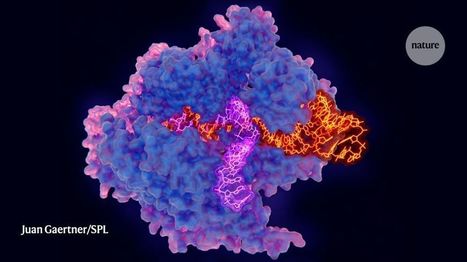
CRISPR-Cas9 gene editing requires cutting DNA, which can lead to errors. Scientists at Columbia University are proposing an alternative that uses a transposon to precisely insert DNA sequences in any site on the genome.
|
|
Rescooped by
Antonios Bouris
from Amazing Science
November 28, 2019 11:37 PM
|
According to the latest theories, planets are formed from fluffy dust aggregates in a protoplanetary disk around a young star. But young stars are not the only objects that possess dust disks. In a novel approach, the researchers focused on heavy disks around supermassive black holes in the nuclei of galaxies. "Our calculations show that tens of thousands of planets with 10 times the mass of the Earth could be formed around 10 light-years from a black hole," says Eiichiro Kokubo, a professor at the National Astronomical Observatory of Japan who studies planet formation. "Around black holes, there might exist planetary systems of astonishing scale."
Via Dr. Stefan Gruenwald
|
|
Rescooped by
Antonios Bouris
from Amazing Science
November 28, 2019 10:52 PM
|
A little robotic explorer will be rolling into Antarctica this month to perform a gymnastic feat — driving upside down under sea ice. BRUIE, or the Buoyant Rover for Under-Ice Exploration, is being developed for underwater exploration in extraterrestrial, icy waters by engineers at NASA’s Jet Propulsion Laboratory in Pasadena, California. It will spend the next month testing its endurance at Australia’s Casey research station in Antarctica, in preparation for a mission that could one day search for life in ocean worlds beyond Earth.
Via Dr. Stefan Gruenwald
|
|
Rescooped by
Antonios Bouris
from Amazing Science
November 20, 2019 7:31 PM
|
Researchers at the National Institute of Standards and Technology (NIST) have made one of the highest-performance cameras ever composed of sensors that count single photons, or particles of light. With more than 1,000 sensors, or pixels, NIST's camera may be useful in future space-based telescopes searching for chemical signs of life on other planets, and in new instruments designed to search for the elusive "dark matter" believed to constitute most of the "stuff" in the universe.
Via Dr. Stefan Gruenwald
|
|
Scooped by
Antonios Bouris
November 20, 2019 7:27 PM
|
The Bill Gates-backed startup Heliogen has generated solar heat topping 1,000 degrees Celsius using mirrors.
|
|
Scooped by
Antonios Bouris
November 18, 2019 11:37 PM
|
NASA has picked SpaceX, Blue Origin and three other companies to join its private moon lander project to deliver big payloads to the moon.
|
|
Scooped by
Antonios Bouris
November 17, 2019 3:03 AM
|
What is common between Vatican archives, Italian movies and McDonalds's "special sauce"? If all the world's open-source code was lost during the apocalypse, it would destroy computing and the internet as we know it. So Microsoft is storing it.
|
|
Rescooped by
Antonios Bouris
from Amazing Science
November 10, 2019 7:34 PM
|
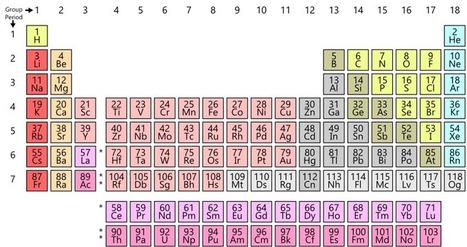
2019 is the International Year of the Periodic Table of Elements. Here, we discuss the history of the periodic table as well as the designated year. Elements 113, 115, 117 and 118 — fill out the seventh row of the periodic table of the elements. All are superheavies. That’s why they sit at the base right of the bench (see above). Naming rights classically go to those who find an element. And that’s what happen here. Element 113 was found by scientists at RIKEN in Wako, Japan. They have requested to call it Nihonium, to be shortened as Nh. This name comes from Nihon. It’s Japanese for “Land of the Rising Sun,” which is what a lot of people call Japan. Element 115 will turn out to be Moscovium, abridged as Mc. It refers to the Moscow area. And that was where the combined organization for Nuclear Research is based (Dubna). It exposed number 115 in a teamwork with researchers at Lawrence Livermore National Laboratory in California and Oak Ridge National Laboratory (ORNL) in Tennessee. That's why Tennessee also gets a periodic table entry. It’s the home location of ORNL, Vanderbilt University & the University of Tennessee. So element 117 will become Tennessine and will be represented by the symbol Ts.
Via Dr. Stefan Gruenwald
|
|
|
Rescooped by
Antonios Bouris
from Amazing Science
December 12, 2019 8:36 PM
|
There are dozens of disciplines and subdisciplines within the broad ambit of climate science, studying everything from ancient geology to the spread of disease. But one discipline in particular is exposed to intense public scrutiny, the subject of long-running political and legal disputes: modeling.
As interesting as the details of climate science may be, what society most needs from it is an answer to a simple question: What the hell is going to happen? What are we in for? That’s the question models seek to answer.
Via Dr. Stefan Gruenwald
|
|
Scooped by
Antonios Bouris
December 12, 2019 7:18 PM
|
The European Space Agency has officially approved funding for ClearSpace-1 — the world's first mission dedicated to cleaning up space junk.
|
|
Scooped by
Antonios Bouris
December 5, 2019 8:35 PM
|
Parallax is a method of measuring the distance to nearby objects in space. It is also a method used to display 3D images.
|
|
Scooped by
Antonios Bouris
December 5, 2019 7:28 PM
|
Researchers have identified a metal that conducts electricity without conducting heat - an incredibly useful property that defies our current understanding of how conductors work.
|
|
Rescooped by
Antonios Bouris
from Amazing Science
December 5, 2019 7:21 PM
|
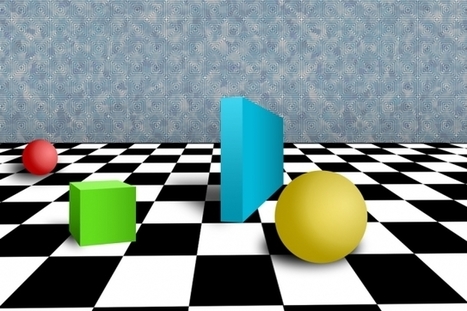
ADEPT, an artificial intelligence model developed by MIT researchers, demonstrates an understanding of some basic “intuitive physics” by registering a surprise signal when objects in a scene violate assumed reality, similarly to how human infants and adults would register surprise. We often think of artificial intelligence as a tool for automating certain tasks. But it turns out that the technology could also help give us a better understanding of ourselves. At least that's what a team of researchers at the Massachusetts Institute of Technology (MIT) think they'll be able to do with their new AI model.
Via Dr. Stefan Gruenwald
|
|
Scooped by
Antonios Bouris
November 28, 2019 11:45 PM
|
The system allows researchers more control over DNA changes, potentially opening up conditions that have challenged gene-editors.
|
|
Scooped by
Antonios Bouris
November 28, 2019 10:53 PM
|
“Experts noted reduced anxiety and improved overall emotional mood in the herd. Examples of dairy farms from different countries show that in a calm atmosphere, the quantity, and sometimes the quality, of milk increases markedly," the statement read.
They also noted that local farms are already playing classical music to cows during the winter months to boost their spirits. That already "has a positive effect on milk flow.”
Researchers will continue the experiment in a long-term study, and the developers are reportedly happy to expand the project to other farms if it proves successful.
|
|
Rescooped by
Antonios Bouris
from Amazing Science
November 20, 2019 7:31 PM
|
Forty years ago, a Voyager spacecraft snapped the first closeup images of Europa, one of Jupiter’s 79 moons. These revealed brownish cracks slicing the moon’s icy surface, which give Europa the look of a veiny eyeball. Missions to the outer solar system in the decades since have amassed enough additional information about Europa to make it a high-priority target of investigation in NASA’s search for life.
Via Dr. Stefan Gruenwald
|
|
Scooped by
Antonios Bouris
November 20, 2019 7:29 PM
|
A private orbital systems company is developing the "Dream Chaser," a sleek reusable spacecraft, which NASA will test to shuttle cargo to the Space Station.
|
|
Rescooped by
Antonios Bouris
from Amazing Science
November 20, 2019 7:26 PM
|
A skeleton from the Cretaceous found in Japan reveals an early bird with a tail nub resembling the avians of today. Birds are ancient creatures. Every hawk, sparrow, pigeon and penguin alive today has ancestral roots dating back to the Jurassic, when the first birds were just another form of raptor-like dinosaur. Dozens of fossils uncovered and described during the last three decades have illuminated much of this deep history, but the rock record can still yield surprises. A fossil recently found in Japan is one such unexpected avian that raises questions about what else may await discovery.
Via Dr. Stefan Gruenwald
|
|
Rescooped by
Antonios Bouris
from Amazing Science
November 18, 2019 11:33 PM
|
Black holes 'have no hair': no attributes that can be used to tell them apart. Extreme black holes (spinning at maximally allowed rate) can have an additional property, permanent hair that is made of a massless scalar field. Nearly extreme black holes (like Gargantua, the black hole featured in the movie "Interstellar") have hair that is a transient phenomenon: nearly extreme black holes that attempt to regrow hair will lose it and become bald again. The black holes of Einstein's theory of relativity can be completely described by just three parameters: their mass, spin angular momentum, and electric charge. Since two black holes that share these parameters cannot be distinguished, regardless of how they were made, black holes are said to "have no hair"—they have no additional attributes that can be used to tell them apart.
Via Dr. Stefan Gruenwald
|
|
Rescooped by
Antonios Bouris
from Amazing Science
November 10, 2019 7:35 PM
|
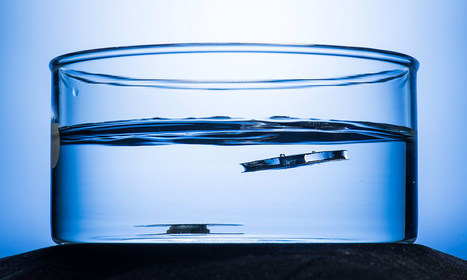
Researchers, inspired by diving bell spiders and rafts of fire ants, have created a metallic structure that is so water repellent, it refuses to sink—no matter how often it is forced into water or how much it is damaged or punctured. Could this lead to an unsinkable ship? A wearable flotation device that will still float after being punctured? Electronic monitoring devices that can survive in long term in the ocean? All of the above, says Chunlei Guo, professor of optics and physics, whose lab describes the structure in ACS Applied Materials and Interfaces .The structure uses a groundbreaking technique the lab developed for using femtosecond bursts of lasers to “etch” the surfaces of metals with intricate micro- and nanoscale patterns that trap air and make the surfaces superhydrophobic, or water repellent.
Via Dr. Stefan Gruenwald
|