Design, Science and Technology
59.4K views | +59 today
Design, Science and Technology
#ideas #design #science #technology #inspiration #media #information
Your new post is loading...
Rescooped by Antonios Bouris from About Photography
August 10, 2012 3:37 AM
Scoop.it!

Expressive animal portrait photography - Make your ideas Art

Expressive animal portrait photography - Make your ideas Art | Design, Science and Technology | Scoop.it
Today we have with us 27 really expressive animal and wild life animal portrait photographs from Fotopedia & Flickr.

Via Spyros Thalassinos
No comment yet.
Rescooped by Antonios Bouris from Social-Business-Marketing
August 10, 2012 3:35 AM
Scoop.it!

Storytelling Vs. Corporate Speak

Storytelling Vs. Corporate Speak | Design, Science and Technology | Scoop.it
The Art Of Storytelling In Business Communications And Public Relations...

You could make an argument that the Infographic is the new black.

Beyond the visual appeal, Infographics push companies to communicate at the industry level.

Specifically, Lou Hoffman contends there’s often a gap between the content developed by the PR function and the type of content needed by journalists, bloggers and other influencers.

This Infographic strives to capture this disconnect.

By Lou Hoffman  http://bit.ly/ORK2U0

Source http://bit.ly/ONbEa5


Via maxOz
maxOz's comment, August 9, 2012 4:48 AM
Alessio xxx
Rescooped by Antonios Bouris from 21st Century Learning and Teaching
August 10, 2012 3:33 AM
Scoop.it!

How to Develop 5 Critical Thinking Types - Forbes

How to Develop 5 Critical Thinking Types - Forbes | Design, Science and Technology | Scoop.it

Great leaders think strategically. They can understand and appreciate the current state as well as see possibilities.


- Critical thinking is the mental process of objectively analyzing a situation by gathering information from all possible sources, and then evaluating both the tangible and intangible aspects, as well as the implications of any course of action.

 
- Implementation thinking is the ability to organize ideas and plans in a way that they will be effectively carried out.


- Conceptual thinking consists of the ability to find connections or patterns between abstract ideas and then piece them together to form a complete picture.


- Innovative thinking involves generating new ideas or new ways of approaching things to create possibilities and opportunities. 


- Intuitive thinking is the ability to take what you may sense or perceive to be true and, without knowledge or evidence, appropriately factor it in to the final decision.


Read more, a MUST:

http://www.forbes.com/sites/work-in-progress/2012/03/27/how-to-develop-5-critical-thinking-types/


Via Jess Chalmers, Gust MEES
Gust MEES's comment, August 9, 2012 6:50 PM
Hi rosemary,

I made a Typo, sorry. I forgot the "a" in "Red more", please add it, thx in advance.

greetings,
Gust
Rescooped by Antonios Bouris from Design Thinking- a new way
July 16, 2012 12:56 PM
Scoop.it!

Professor Guy Claxton speaking on "What's the point of school?" (Short Version)

Professor Guy Claxton gives an insight into ways schooling and teaching needs to be changed in order to prepare children to become powerful lifelong learners...

Via Danielle Carter
No comment yet.
Rescooped by Antonios Bouris from Design Thinking- a new way
July 16, 2012 12:55 PM
Scoop.it!

What Schools Can Learn From Google, IDEO, and Pixar

What Schools Can Learn From Google, IDEO, and Pixar | Design, Science and Technology | Scoop.it
A community about to build or rehab a school often creates checklists of best practices, looks for furniture that matches its mascot, and orders shiny new lockers to line its corridors.

Via Danielle Carter
No comment yet.
Rescooped by Antonios Bouris from Design Thinking- a new way
July 16, 2012 3:05 AM
Scoop.it!

Why Design Thinking?

Vimeo is a respectful community of creative people who are passionate about sharing the videos they make. Use Vimeo if you want the best tools and highest quality video in the universe.

Via Danielle Carter
No comment yet.
Rescooped by Antonios Bouris from Charismatic Presentation Skills
July 14, 2012 12:43 AM
Scoop.it!

7 presentation lessons from legendary Ben Zander

7 presentation lessons from legendary Ben Zander | Design, Science and Technology | Scoop.it

Consequently, developing your presentation skills is one of the best things you can do to aid your career! One great professional to study is Ben Zander. He was a composer and as such, he knows how to stir up a crowd - movement is so important.


Via Donna Lipman
No comment yet.
Scooped by Antonios Bouris
July 9, 2012 5:23 AM
Scoop.it!

When You Want Results… | Idea Sandbox Brainstorming

When You Want Results… | Idea Sandbox Brainstorming | Design, Science and Technology | Scoop.it

When You Want Results…

No comment yet.
Rescooped by Antonios Bouris from Must Design
July 9, 2012 5:21 AM
Scoop.it!

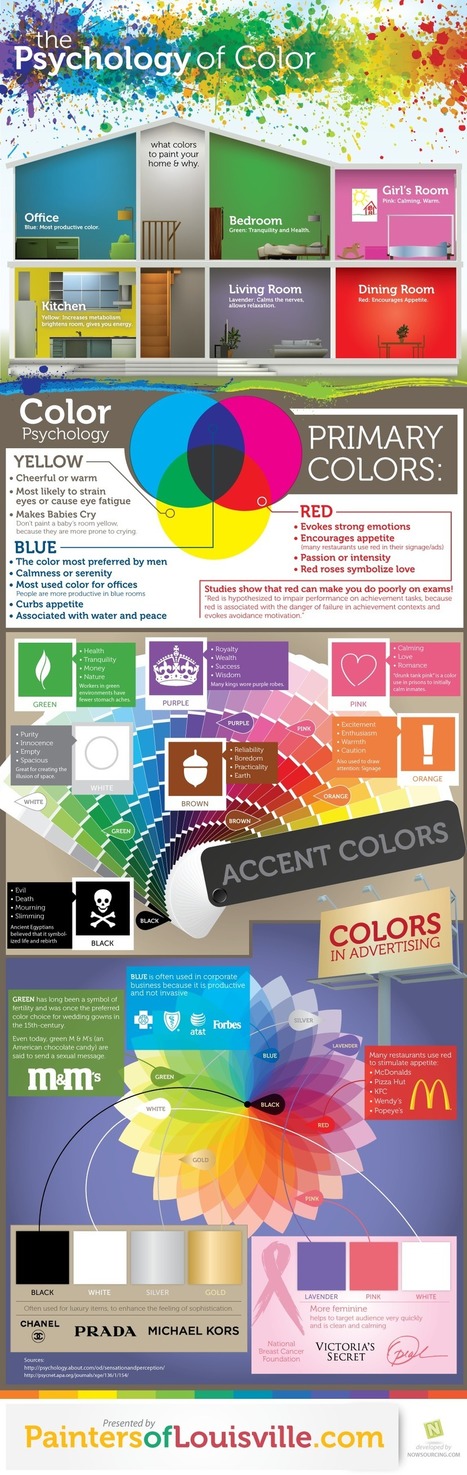
The Psychology of Color [Infographic] | Louisville Painters

The Psychology of Color [Infographic] | Louisville Painters | Design, Science and Technology | Scoop.it
An infographic that takes a creative and interesting look at how color is perceived and how it triggers certain thoughts and emotions.


***** Color as signal, color as nonverbal web communication can't be over estimated. I like white sites with color as accents. A little color can go a long way. This is a great chart to remind you what colors to use for what, when.
Marty


Via Martin (Marty) Smith
No comment yet.
Rescooped by Antonios Bouris from Online-Communities
June 27, 2012 6:37 AM
Scoop.it!

Are You Sharing Too Much Online?

Are You Sharing Too Much Online? | Design, Science and Technology | Scoop.it

As social media's usage has risen, so has people's willingness to share personal information via that medium.

People share so much information now that one study said that 90% of adults think people share too much information online.


But what type of potentially dangerous information is being shared and why do people share this information in the first place?


Many social media users simply don’t understand their privacy options — or the privacy policy they agreed to when they signed up for a particular service. (This is certainly a candidate for simplifying legal jargon) Facebook is notorious for its complex and confusing privacy controls, for instance.

Furthermore, many social media users don’t understand their right to privacy, either.

So much sharing happens by default online; it’s difficult for many to remember what the point of privacy is, or why it should be protected. There are many great arguments for openness and transparency — and not just from the businesses that benefit from each user’s shared information.


Then there are issues with personal information and identity fraud. Where does it stop? How do we benefit from the use of social media, without being overwhelmed by the pitfalls?

Check out this Infographic to learn the answers to those questions and more.


By Michael Lemaire - http://bit.ly/MmYPUd

Source: http://bit.ly/KXf0dV


Via maxOz
No comment yet.
Rescooped by Antonios Bouris from Life @ Work
June 27, 2012 12:39 AM
Scoop.it!

25 New Things to Do Today

25 New Things to Do Today | Design, Science and Technology | Scoop.it

In a rut? Need a shake-up? Or just want something fun and different to do? This list will help you create, connect with people, and have a great time.


Via Barb Jemmott
No comment yet.
Rescooped by Antonios Bouris from Content curation trends
June 27, 2012 12:28 AM
Scoop.it!

Thoughts on The New York Times / Flipboard paywall deal

Thoughts on The New York Times / Flipboard paywall deal | Design, Science and Technology | Scoop.it

"The New York Times has just announced its unprecedented collaboration with Flipboard to deliver "full access to its content" for its digital subscribers" reports TC Sotteck on The Verge.


Read: including articles behind the paywall.


While some obviously didn't like it, I'm not sure news agregation should get in the way of the model publishers want to use. There is obviously technical and marketing complexity in creating a paywall, integrating it with other platforms and educating users to accept it. If the NY Times succeeds in establishing one, it's legitimate to me that they want it to survive other forms of distribution.


But beyond the theoritical legitimacy, I think the bigger problem resides in the complexity of making deals like this. Flipboard and the times must have been through a long negotiation process which meant lost distribution in the meantime.


By insisting on having the paywall integrated, the NY Times makes it harder for the many Flipboard competitors like Pulse, Zite, Feedly, etc... to distribute it. For one Flipboard that can and will do it, many will just pass. They might be smaller but together they might make significant distribution (remember that "Others" section in market studies that usually make the biggest chunk? That's them).


For Flipboard, this also signals to other media that they're ready to do so which will absorb some of their resources and slow them down. This reminds me of the model of the music industry which considerably slowed down adoption of legal music : every new startup in this business had to cut a deal with the music labels and wait patiently for them to have the resources to execute such a deal. 


Bottom line for the music industry 10 years later? Not much growth, I'm afraid.


Via Guillaume Decugis
No comment yet.
Scooped by Antonios Bouris
June 27, 2012 12:24 AM
Scoop.it!

Talk to Me: Design and the Communication Between People and Objects

Talk to Me: Design and the Communication Between People and Objects | Design, Science and Technology | Scoop.it

The ever-expanding definition and cultural role of design in the age of sensors, data, and responsive interfaces.

No comment yet.
Rescooped by Antonios Bouris from About Design
August 10, 2012 3:35 AM
Scoop.it!

Creative Packaging Designs #2 - Make your ideas Art

Creative Packaging Designs #2 - Make your ideas Art | Design, Science and Technology | Scoop.it
The first packages used the natural materials available at the time: Baskets of reeds, wineskins (Bota bags), wooden boxes, pottery vases, ceramic amphorae, wooden barrels, woven bags, etc.

Via Spyros Thalassinos
No comment yet.
Rescooped by Antonios Bouris from Must Design
August 10, 2012 3:33 AM
Scoop.it!

Get Inspired: 27 Great Web Design Galleries To Find Web Design Inspiration!

Get Inspired: 27 Great Web Design Galleries To Find Web Design Inspiration! | Design, Science and Technology | Scoop.it

Where do you go normally when you are planning to start your new web design project and you are curiously finding for a mind blowing web design inspiration or just want yourself to bring up with some amazing creative ideas which can help...

Marty Note
I always start a project wandering around for inspiration, looking at how others are solving the problem gets the creative gears turning. There is nothing more intimidating than a blank canvas, so here are 27 ways to oil the gears and find inspiration from others - where inspiration always starts.


Via Martin (Marty) Smith
No comment yet.
Rescooped by Antonios Bouris from Digital-By-Design
August 10, 2012 3:30 AM
Scoop.it!

Why The Future For Marketers Is In The Cloud

Why The Future For Marketers Is In The Cloud | Design, Science and Technology | Scoop.it

...

Uberflip has released an Infographic about the future of the Cloud, and what these trends mean for marketers, providing insightful facts and figures about the adoption rates of cloud computing, the readiness of different markets, as well as some case studies on companies that have utilized the Cloud to their advantage.

“Cloud-based tools and technology are changing the way marketers reach and engage with their audience, such as the ways in which they can now distribute and store content,” explains Neil Bhapkar, Director of Marketing for Uberflip. “Cloud computing can be secure, allows for multi-device distribution, and ultimately enhances the bottom-line through cost savings and more efficient marketing efforts.”

Key takeaways:

By 2016, over one-third of global digital content will be stored in the Cloud. Average storage per household will grow from 464 gigabytes in 2011 to 3.3 terabytes in 2016. 79% of companies say that cloud cost savings “have been on par with original estimates or even exceeded original estimates.” The global market for cloud computing will grow from $40.7 billion in 2011 to more than $241 billion in 2020.


Data sources for the Infographic include Forrester Research, Forbes, Gartner and Cisco.

Dowlnoad Going-Digital-Uberflip-August-2012 - http://bit.ly/NcOXjz

By Uberflip.http://bit.ly/Tma8ip ;

Source. http://bit.ly/Qk1Ljf


Via maxOz
Adele Marra's comment, August 11, 2012 6:02 AM
prego :-)
Rescooped by Antonios Bouris from Design Thinking- a new way
July 16, 2012 12:56 PM
Scoop.it!

4 Lessons The Classroom Can Learn From The Design Studio | Co.Design

Architectural studio--where we design the places in which we learn, live, heal, and work--to find out what the classroom can learn from these creative environments


Via Danielle Carter
No comment yet.
Rescooped by Antonios Bouris from Design Thinking- a new way
July 16, 2012 12:55 PM
Scoop.it!

Reinventing School. You co-design it, We make it possible - Re-imagine, Reinvent, Rethink, Empathy, Education 3.0, Transform, Revolution, Collaboration, Design Thinking Challenge, 21st Century Skil...

Reinventing School. You co-design it, We make it possible - Re-imagine, Reinvent, Rethink, Empathy, Education 3.0, Transform, Revolution, Collaboration, Design Thinking Challenge, 21st Century Skil... | Design, Science and Technology | Scoop.it
Mission: Encourage life-long learning, promote alternative learning environments and equip you with 21st Century skills...

Via Kay Oddone, Danielle Carter
Monica Gutiérrez's curator insight, February 13, 2014 10:55 PM

#designthinking #eduPLEmooc

Scooped by Antonios Bouris
July 14, 2012 12:49 AM
Scoop.it!

Benjamin Zander - Work (How to give an A)

Teachers TV.Benjamin Zander talking on how simply you can motivate your students to win an A by giving them As right from the begining :)...
No comment yet.
Rescooped by Antonios Bouris from Culture
July 12, 2012 3:15 AM
Scoop.it!

Likes & Dislikes About New Scoop.it UI

Likes & Dislikes About New Scoop.it UI | Design, Science and Technology | Scoop.it

Scoop.it is a favorite curation tool. It has rapidly become my social media hub, the place I organize the rest of my social media curation. This week Scoop.it changed their UI and won some important battles and lost a few. Here is a recap:

Winners

* UI - The new User Interface is more visual and engaging another example of visuals beating textuals and well done.

* Presentation Layer - The Scoop.it magazine format didn't change so what the customer of your curation sees remains the same also well done since changes there could rock the boat.

* SEO Layer - Scoop.it has real SEO strength. I've owned absolute #1 on Curation Revolution for over a year and you thankfully haven't changed anything there (that I can see on a quick pass). Kudos to understanding SEO as well as you do! The SEO advantage of a platform is lost on many, many are selfish about its benefits (FB and Twitter) and you aren't either SEO Stupid or selfish. KUDOS!

* Tool Layout - The functional layout of tools such as the Rescoop button is better, more clear and more visual. Harder now to get one button confused with another.


Overall I would say the behind the curtain admin experience improved with these changes.

Losers

* Trending Topics - No Visitor Counts On My Profile Anymore


Thought this was resolved, but it is not. The number is aggregate and what we need, and used to have, is today's visitor numbers by topic. That number helps manage across the 10 different topics I curate. Without knowing what is trending I might step on my own curation or not know when something is a laggard and I need to move on. Wish you would bring back the Today visitor count.


* Leaderboard - Don't See My Curator Set Anymore, Those With Visitor Numbers Around Me


One of the most motivating things was to see my immediate curation set, curators above and below my current viewer numbers. When you first launched I could see the top of the stack and that was DEMOTIVATING. Seeing how many visitors Robin or Michele have before I woke up can be intimidating and made my curation efforts feel small. I know that is goofystupid, but the human mind works in strange ways espcially regarding numbers. I used the leaderboard as a form of feedback loop too. If my day was down in viewers I checked to see if others in my set were down too. Sometimes the answer to that question was yes such as on a holiday weekend and sometimes I was lagging behind and needed to get going. I thought one of the most intelligent gamification move was showing me the views of the curators above and below as that helped motivate me to get moving without a sense of intimidation or the futility of it all. Removing that feedback has us back to the same place as when you started since My Community now shows the top of the Scoop.it stack (not where I am by far) and so it feels like the community is for uber-curators like Robin and Michele and not the little guys (like me LOL). Hope you can bring back one of the most intelligent leaderboards I've ever seen.


Summary
The fact this post is weighted toward losers is only because it takes more explanation to cover dislikes NOT because the new UI is more negative than positive. The new UI is net positive for sure, but the real time analytics and leaderboard encouragement have been harmed. Hope you can build back since my curation will be less effective and less motivated.

Marty


Via Martin (Marty) Smith, maxOz
Martin (Marty) Smith's comment, July 19, 2012 9:03 PM
Guillaume,
FYI, I just did something I've never done before - I drove a link into my profile page because it is a thing of magazine-like beauty. Figuring out how to get what I wanted in the window took a little figuring (largest image), but now I have it tuned AND I'm changing several aspects of my curation to support your new UI including:

* Shorter headlines as shorter works better in that space below the image (they work better anyway so your new UI helps do the right thing.
* Better visuals and in that 400 x 200 range. At first I was having trouble getting the image positioned where I wanted. Kept testing and found the sweet spot.
* Changed my titles to create an umbrella since now that I can see my Scoop.it sections like a magazine it makes sense to treat each section like a subsection of a larger idea (in my case Revolution).

Two things I wish I could do:

* Wish I could move boxes or create a more clear hierarchy by changing the size of 2 to 4 boxes. When everything is equal in size and the default order is yours then I can't react to the feedback loops I'm getting. This slows down my thinking of my Profile as the master magazine and the subsections, the revolutions, as pliable blocks capable of responding to what I see and what the community tells me. Today I had Mobile Revolution blow up. If I could have moved it to top left I would have pushed traffic to the profile in the hopes of helping it blow up bigger (lol).

* I tied two scoops about Facebook together today by physically moving them. Problem is that doesn't last past the next update. These two scoops form an A and B version of an "article" and need to move together across time. Curation will split them and I have to use tags to pull them back together and I haven't figured out how to use the tags yet (though I suspect there is real power in there). This ability to tie scoops together into linked groups kind of like you can do with a PowerPoint presentation or with a graphics program would help create the threads within the subsections such as:

* Apple or Android within Mobile Revolution.
* Storytelling within Curation Revolution.

These threads form the magazine within the magazine and may, at some point, earn their way out of the subsection to become a section of their own. I would use analytics to know when such a move would increase reach not split it into too many disparate pieces.

Great job with bringing back our beloved features and with this new UI. The benefits are amazing and we are just getting started. Thanks for fixing the issues with your CDN too (those can be a pain, been there, done that). Marty
Guillaume Decugis's comment, July 23, 2012 5:33 PM
Hi Marty. Thanks for the update on the post and the details on how you're using the new UI. I love the fact you're kind of "hacking" it to create additional meaning :-) Great food for thoughts for the team. I'm getting the first suggestion but the second one is unclear to me. Couldn't you do that by linking one post to the other using the permalink?
Martin (Marty) Smith's comment, July 24, 2012 12:56 AM
Guillaume,
Instead of setting the world record for words in a comment box I posted my thoughts to ScentTrail Marketing: http://scenttrail.blogspot.com/2012/07/internet-marketing-secrets-taxonomy-seo.html .

I got into some things I've been thinking about HARD since your new UI. As a Ecommerce Director I always had trouble creating smooth transitions between content and commerce. Facebook is having much the same issue. I think Scoop.it's magazine approach could bridge the commerce / content Rubicon. Shared those thoughts as best as I could this late. Hope they help use see a piece of what I see since ye who solves this particular problem and makes it easy for content and commerce to play together stands to make a few bucks (lol). Night, Marty
Rescooped by Antonios Bouris from "Cameras, Camcorders, Pictures, HDR, Gadgets, Films, Movies, Landscapes"
July 9, 2012 5:22 AM
Scoop.it!

40 Fantastic Examples of Motion-Blur Photography

40 Fantastic Examples of Motion-Blur Photography | Design, Science and Technology | Scoop.it
Motion-blur photography is one that produces amazing effects where moving objects appear blurred or smeared due to the usage of longer shutter speed.

Via Tiaan Jonker, ABroaderView
No comment yet.
Rescooped by Antonios Bouris from "iPads, STEM and Making"
June 27, 2012 6:38 AM
Scoop.it!

Developing A Student iPad Leadership Team In Your School

Developing A Student iPad Leadership Team In Your School | Design, Science and Technology | Scoop.it

Having a team of students that are well trained in iPad support can help build leadership amongst your students, and will help alleviate the stress on both students and teachers as they learn to adopt this new technology ...


Via David Miller
No comment yet.
Rescooped by Antonios Bouris from About Design
June 27, 2012 6:37 AM
Scoop.it!

Inspirational Advertising Campaigns #4

Inspirational Advertising Campaigns #4 | Design, Science and Technology | Scoop.it
Hello and welcome to our inspirational advertisement campaigns series!An advertising campaign is a series of advertisement messages that share a single idea and theme which make up an integrated marketing communication (IMC).

Via Spyros Thalassinos
No comment yet.
Scooped by Antonios Bouris
June 27, 2012 12:29 AM
Scoop.it!

Logic+Emotion: From Islands To Ecosystem: Connecting Social, Digital + Mobile

Logic+Emotion: From Islands To Ecosystem: Connecting Social, Digital + Mobile | Design, Science and Technology | Scoop.it
From Web And Desktop To Anytime, Anywhere. In the early stages of digital, businesses first dipped their toe on the Web by launching brochure like Websites which had to be located initially through a browser "URL" (WWW) followed quickly by...

No comment yet.
Rescooped by Antonios Bouris from Digital Photo Addicts
June 27, 2012 12:25 AM
Scoop.it!

Liquid Sculptures by Markus Reugels | Professional Photography Blog

Liquid Sculptures by Markus Reugels | Professional Photography Blog | Design, Science and Technology | Scoop.it

Via Exit178
No comment yet.