Your new post is loading...
Table of Contents Acronyms v Executive Summary 1 Special Focus 3 Energy 11 Metals 14 Precious metals 15 Fertilizers 15 Agriculture 16 Appendix: Historical comm…
The World Bank monitors how the world is doing in implementing the policies and actions for achieving the Millennium Development Goals (MDGs) and related development outcomes. The Global Monitoring reports, produced jointly with the IMF, are a framework for accountability in global development policy.
Overview of the Migration and Remittances Team An important part of the World Bank's work on migration and remittances involves efforts to monitor and forecast remittance and migration flows, and to provide timely analysis on topics such as remittances, migration, and diaspora issues.
The World Bank monitors international economic and financial trends, regional issues, and major commodities to construct a consistent view for the world economy and the implications and risks to growth in developing countries. The global outlook is released twice a year through Global Economic Prospects. More timely short-term monitoring of developments are issued through Daily Briefs and Focus Topics. The global economy is still struggling to gain momentum as many high-income countries continue to grapple with legacies of the global financial crisis and emerging economies are less dynamic than in the past, says the January 2015 edition of Global Economic Prospects (GEP). Report | Press | Video | Slideshare Forecasts and short-term monitoring Global Economic Prospects 2014 A possible return to health by advanced economies has triggered a rebound in the world economy, although risks lurk from US taper. Developing economies need robust blueprints to sustain growth. Regular economic monitoring Daily, weekly and monthly updates on macroeconomic indicators, analysis of economic news and global trends and review of com-modity price movements. Data and analytical tools Forecast Data Reviews of commodity markets and prices, along with price forecasts, that are important to growth in developing countries. High Frequency Data Updates on high-frequency developments impacting the global environment for growth among developing countries. - Industrial production
- Inflation
- International trade
- Interest rates
- Exchange rates
- Equity markets
Download zipped excel file TOOL: iSimulate A free platform for economic simulations, allowing analysts anywhere in the world to access some of the World Bank's macroeconomic models
The Global Economic Monitor (GEM) provides daily updates of global economic developments, with coverage of developing as well as high-income economies. The Global Economic Monitor (GEM) provides daily updates of global economic developments, with coverage of developing as well as high-income economies. Daily data updates are provided for exchange rates, equity markets, interest rates, stripped bond spreads, commodity prices and emerging market. Data Access Daily data updates on exchange rates, equity markets, interest rates, stripped bond spreads, and emerging market bond indices. Monthly data coverage on consumer prices, high-tech market indicators, industrial production and merchandise trade. Download zipped file For more information, email GEM. Monitoring Prospects Daily Daily updates on key macroeconomic indicators around the world. Prospects Weekly Analysis of main economic news of the week and the impact on developing countries. Global Monthly Monthly in-depth analysis of global macroeconomic trends
may require cleanup to meet Wikipedia's quality standards . The specific problem is: linking to articles on agreements, presentation as tables. improve this article if you can. (November 2011)
This is list of free trade agreements between two sides, where each side could be a country (or other customs territory), a trade bloc or an informal group of countries. Every customs union, trade common market, economic union, customs and monetary union and economic and monetary union has also a free trade area; these are listed on their respective articles and not below. For fully multilateral agreements, see List of multilateral free trade agreements, which are also not listed below. For a general explanation, see free trade area. Operating agreements
List of agreements between two states, two blocs or a bloc and a state. ASEAN Free trade agreements - ASEANhas bilateral agreements with the following countries and blocs:
People's Republic of China Current FTA's Proposed Bilateral/Multilateral FTA's Costa Rica Free Trade Agreements Costa Rica Current FTA's Signed but not ratified Bilateral/Multilateral FTA's - Costa Ricahas bilateral agreements with the following countries and blocs and took effect on (see date):
- Canada (1 November 2002)
- Chile (15 February 2002)
- China (1 August 2011)
- Caribbean Community(CARICOM) (15 November 2005)
- Colombia (5 November 2014).
- Dominican Republic (7 March 2002)
- EFTA(2 May 2014).
- El Salvador Customs union, (1963, re-launched on 29 October 1993)
- European Union (October 1, 2013).
- Guatemala Customs union, (1963, re-launched on 29 October 1993)
- Honduras Customs union, (1963, re-launched on 29 October 1993)
- Mexico (January 1, 1995)
- Nicaragua Customs union, (1963, re-launched on 29 October 1993)
- Panama (31 July 1973, renegotiated and expanded for (1 January 2009)
- Peru (1 June 2013)
- Singapore (16 May 2013).
- United States (1 January 2009)
EFTA Free trade agreements - EFTA[4]has bilateral agreements with the following countries – including dependent territories – and blocs:
- Faroe Islandshas bilateral agreements with the following countries and blocs:
- Georgiahas bilateral agreements with the following countries:
India Current Bilateral/Multilateral FTA's Proposed/Suspended Bilateral/Multilateral FTA's - Indiahas bilateral agreements with the following countries and blocs:
- Iranhas a bilateral agreement with the following country:
- Japanhas bilateral agreements with the following countries and blocs:
- Jordanhas bilateral agreements with the following countries and blocs:
- Lebanonhas bilateral agreements with the following countries and blocs:
- Malaysia has bilateral agreements with the following countries:[17]
Mexico free trade agreements - Free Trade Agreements
- Chile-Mexico Free Trade Agreement
- Colombia-Mexico Free Trade Agreement
- Costa Rica-Mexico Free Trade Agreement
- EFTA-Mexico Free Trade Agreement: Iceland, Liechtenstein, Norway, Switzerland
- European Union (EU)-Mexico Economic Partnership:
- Austria, Belgium, Bulgaria, Cyprus, Czech Republic, Denmark, Estonia, Finland, France, Germany, Greece, Hungary, Ireland, Italy, Latvia, Lithuania, Luxembourg, Malta, Netherlands, Poland, Portugal, Romania, Slovakia, Slovenia, Spain, Sweden, United Kingdom
- Israel-Mexico Free Trade Agreement
- Japan-Mexico Economic Association Agreement
- (NAFTA) North American Free Trade Agreement: Canada, United States
- Nicaragua-Mexico Free Trade Agreement
- Northern Triangle)-Mexico: El Salvador, Honduras and Guatemala
- Panama
- Uruguay-Mexico Free Trade Agreement
- Framework Agreements
- MERCOSUR-Mexico Economic Association: Argentina, Brazil, Paraguay, Uruguay, Venezuela
- Partial Preferential Agreements
- Argentina
- Brazil
- Ecuador
- MERCOSUR
- Paraguay
- Panama
- Peru
- Panamahas bilateral agreements with the following countries:
- Peruhas bilateral agreements with the following countries:
- Serbiahas bilateral agreements with the following countries and blocs:
- Singaporehas bilateral agreements with the following countries and blocs:
- South Koreahas bilateral agreements with the following countries and blocs:
- Switzerland has bilateral agreements with the following countries and blocs:[16]
- Albania (Signed: 17.12.2009: Entry into force: 01.11.2010)
- Canada (Entry into force 01.07.2009)
- Chile (Entry into force: 01.12.2004)
- China (Entry into force: July 1, 2014) [3]
- Colombia (Signed: 25.11.2008. Entry into force: 01.07.2011)
- Cooperation Council for the Arab States of the Gulf (GCC) (Signed: 22.06.2009 Entry into force expected 2nd semester 2012)
- Egypt (Entry into force: 01.09.2008)
- European Community (EC) (Entry into force: 01.01.1973; bilateral CH-EC)
- EFTA-Convention (Entry into force: 03.05.1960)
- Faeroe Islands (Entry into force: 01.03.1995; bilateral CH-Faeroe)
- Israel (Entry into force: 01.07.1993)
- Japan (Entry into force: 01.09.2009. Bilateral CH-Japan)
- Jordan (Entry into force: 01.09.2002)
- Republic of Korea (Entry into force: 01.09.2006)
- Lebanon (Entry into force: 01.01.2007)
- Macedonia (Entry into force: 01.05.2002)
- Mexico (Entry into force: 01.07.2001)
- Morocco (Entry into force: 01.12.1999)
- Palestinian Authority (Entry into force: 01.07.1999)
- Peru (Signed: 24.06.2010 (EFTA) and 14.07.2010 (Peru). Entry into force on 01.07.2011)
- Serbia (Signed: 17.12.2009: Entry into force: 01.10.2010)
- Singapore (Entry into force: 01.01.2003)
- SACU (Entry into force: 01.05.2008)
- Tunisia (Entry into force: 01.06.2006)
- Turkey (Entry into force: 01.04.1992)
- Ukraine (Signed 24.06.2010. Entry into force expected 01.06.2012)
- Thailandhas bilateral agreements with the following countries:
- Tunisiahas bilateral agreements with the following countries and blocs:
The United States FTA in force FTA signed, awaiting ratification
An economic union is a type of trade bloc which is composed of a common market with a customs union. The participant countries have both common policies on product regulation, freedom of movement of goods, services and the factors of production ( capital and labour) and a common external trade policy.
The world economy or global economy is the economy of the world, considered as an international exchange of goods and services. In some contexts, the two terms are distinguished: the "international" or "global economy" being measured separately and distinguished from national economies while the "world economy" is simply an aggregate of the separate countries' measurements.
The world economy or global economy is the economy of the world, considered as an international exchange of goods and services.[4] In some contexts, the two terms are distinguished: the "international" or "global economy" being measured separately and distinguished from national economies while the "world economy" is simply an aggregate of the separate countries' measurements. Beyond the minimum standard concerning value in production, use, and exchange the definitions, representations, models, and valuations of the world economy vary widely. It is inseparable from the geography and ecology of Earth. It is common to limit questions of the world economy exclusively to human economic activity, and the world economy is typically judged in monetary terms, even in cases in which there is no efficient market to help valuate certain goods or services, or in cases in which a lack of independent research or government cooperation makes establishing figures difficult. Typical examples are illegal drugs and other black market goods, which by any standard are a part of the world economy, but for which there is by definition no legal market of any kind. However, even in cases in which there is a clear and efficient market to establish a monetary value, economists do not typically use the current or official exchange rate to translate the monetary units of this market into a single unit for the world economy, since exchange rates typically do not closely reflect worldwide value, for example in cases where the volume or price of transactions is closely regulated by the government. Rather, market valuations in a local currency are typically translated to a single monetary unit using the idea of purchasing power. This is the method used below, which is used for estimating worldwide economic activity in terms of real US dollars or euros. However, the world economy can be evaluated and expressed in many more ways. It is unclear, for example, how many of the world's 7.13 billion people have most of their economic activity reflected in these valuations. In 2015, the largest economies in the world with more than $2 trillion, €1.25 trillion by nominal GDP were the United States, China, Japan, Germany, France, the United Kingdom and India.[6] Economy – overviewCurrent world economic league table of largest economies in the world by GDP and share of global economic growth The following three tables list the twenty-five largest economies by GDP (Nominal) in 2014, twenty-five largest economies by GDP (PPP) in 2014, and the twenty-five economies with the largest shares of global economic growth in 2014. Members of the G-20 major economies are in bold.
Economic Studies To promote exports, many government agencies publish on the web economic studies by sector and country. Among these agencies include the USCS (US DoC) and FAS (USDA) in the United States, EDC and AAFC in Canada, Ubifrance in France, UKTI in the UK, HKTDC and JETRO in Asia, Austrade and NZTE in Oceania. Through Partnership Agreements, The Federation of International Trade Associations publishes studies from several of these agencies (USCS, FAS, AAFC, UKTI, HKTDC), as well as other non-governmental organizations on its website GlobalTrade.net. See also Regional economies: Events: Lists: External linksWikiquote has quotations related to: World economy
|
The Development Prospects Group of the World Bank has developed a broad set of tools for forecasting and policy analysis in the areas of macro-economics, trade, finance, income distribution, and country strategies. The Global Income Distribution Dynamic (GIDD) model, is a global CGE-microsimulation framework that takes into account the macro nature of growth and integrates a microeconomic (that is, individual and household) dimension. By including 121 countries and covering 90 percent of the world population, the GIDD is the first macro-micro global simulation model. The LINKAGE model is a global dynamic computable general equilibrium model which supports global trade policy analysis. - iSimulate is a platform for performing collaborative economic simulations across the internet. It currently hosts a number of experimental World Bank economic models, including a 150+ country global macroeconomic forecasting model, a model simulating terms-of-trade shocks, and a potential output model.
- MAMS (Maquette for MDG Simulations) tool is a dynamic Computable General Equilibrium (CGE) model designed for country-level analysis of medium- and long-run development policies, including strategies for reducing poverty and achieving the Millennium Development Goals (MDGs).
- The ENVISAGE model is designed to analyze a variety of issues related to the economics of climate change
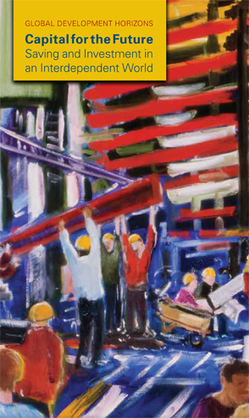
"Very long-run forecasting is a hazardous activity because the uncertainties and imponderables of life have plenty of time to intrude, and bend and buck the charted path. At the same time, to craft policy that is rooted in reason and reality, we need to peer into the future with the best information, statistics, and models that we have." Kaushik Basu, Senior Vice President and Chief Economist, the World Bank Capital for the Future: Saving and Investment in an Interdependent World
May 16, 2013 - "Capital for the Future very clearly highlights the increasing role developing countries will play in the global economy. Seventeen years from now, half the global stock of capital, totaling $158 trillion (in 2010 dollars), will reside in the developing world, compared to less than one-third today. This is undoubtedly a significant achievement. However, to reap in full the benefits of the tectonic shifts taking place, developing countries will need to significantly improve their currently limited participation in international financial markets."
Hans Timmer, Director of the Bank's Development Prospects Group
Link to Report Website More resources The analytical section of this report is no longer produced. However, the Global Development Finance database is available online.
Overview of Commodity Markets The World Bank monitors major commodity markets important to the developing countries. Monthly prices for over 70 series are published at the beginning of each month. Price forecasts for the next 10 years are published on a quarterly basis. A comprehensive review of commodity markets is published four times a year, January, April, July, and October. Featured Products Prices (Pink Sheet) Monthly world prices of commodities and indices Next issue:
May 5, 2015 Historical Data (XLS) Commodity Markets Outlook Review of commodity markets Next issue:
April 2015 Data from Charts Price Forecasts Forecasts of key prices and indices Next issue:
April 2015 Historical Forecasts
The World Bank's Development Prospects Group
The Development Prospects Group provides information and analysis on global trends in the world economy, especially on trade, financial flows, commodity prices, remittances flows, and the impact of these trends on developing countries. The Group's global projections underpin country and regional projection exercises and are central to the Bank's short-term monitoring activities.
Global Macroeconomics Team (GMT)
The team combines expertise in regional issues, market trends (world trade, financial conditions and others) and forecasting methods to construct a consistent view for global economic prospects and the implications for macroeconomic trends in developing countries. The team is responsible for issuing the Bank's outlook on the global economy through Global Economic Prospects as well as timely short-term monitoring of developments in the world environment.
The team monitors major commodity markets important to developing countries and provides forecasts and analysis of short-term price movements, including the Commodity price data (Pink Sheet), which provides monthly prices on 71 primary commodities and 16 price indices.
Migration and Remittances
The World Bank has significantly deepened its work in migration and remittances to support its operational work and undertake new analytical work on emerging topics. The latest migration and remittance data is available through the Migration and Remittance Factbook 2011. This work is undertaken by a team that combined migration expertise from the Development Economics Vice-Presidency (DEC) and the Poverty Reduction and Economic Management (PREM) Network. Led by DECPG, the team leads the World Bank's contribution to the global policy agenda on migration and development and participation in global initiatives such as the Global Forum on Migration and Development, Global Migration Group, the G8 and the G20.
Emerging Global Trends
The Emerging Global Trends team monitors and analyzes medium- to long-term changes in the structure of the global economy, with an emphasis on how these changes affect growth and poverty reduction in developing countries. A report, Global Development Horizons, addresses topics such as the trend toward multipolarity in the global economy, climate change, demography, education, global inequality, and international monetary and trade arrangements.
Global Monitoring Report (Millennium Development Goals)
The Global Monitoring Report is a joint World Bank and International Monetary Fund effort to monitor progress toward achieving the Millennium Development Goals (MDGs) by 2015. The team leads the analysis on MDGs in the report which includes priorities for policy responses by both developing countries and the international community.
Economic Modeling
The team has developed a broad set of tools for forecasting and policy analysis in the areas of macroeconomics, trade, finance, income distribution, and country strategies. These include the development of a new model (MAMS - Maquette for MDG Simulations) to help monitor the progress toward reaching the Millennium Development Goals, international remittances and migration. These methodologies let policymakers analyze policy scenarios and can explain not only what happened as a result of a given policy, program or project intervention, but what would have happened in its absence. An online platform, iSimulate, supports the World Bank's open data and open knowledge drive and lets users perform collaborative economic simulations across the web.
The World Bank is like a cooperative, made up of 188 member countries. These member countries, or shareholders, are represented by a Board of Governors, who are the ultimate policymakers at the World Bank. Generally, the governors are member countries' ministers of finance or ministers of development. They meet once a year at the Annual Meetings of the Boards of Governors of the World Bank Group and the International Monetary Fund. The governors delegate specific duties to 25 Executive Directors, who work on-site at the Bank. The five largest shareholders appoint an executive director, while other member countries are represented by elected executive directors. - World Bank Group President Jim Yong Kim chairs meetings of the Boards of Directors and is responsible for overall management of the Bank. The President is selected by the Board of Executive Directors for a five-year, renewable term.
- The Executive Directors make up the Boards of Directors of the World Bank. They normally meet at least twice a week to oversee the Bank's business, including approval of loans and guarantees, new policies, the administrative budget, country assistance strategies and borrowing and financial decisions.
The World Bank operates day-to-day under the leadership and direction of the president, management and senior staff, and the vice presidents in charge of Global Practices, Cross-Cutting Solutions Areas, regions, and functions.
This is a list of multilateral free trade agreements, between several countries all treated equally. For agreements between two countries, between a bloc and a country, or between two blocs, see List of bilateral free trade agreements; these are not listed below.
merged into List of multilateral free trade agreements . (Discuss) Proposed since February 2015.
Africa Americas Asia Europe Middle East Pacific Proposed See also
Economic globalization is the increasing economic integration and interdependence of national, regional and local economies across the world through an intensification of cross-border movement of goods, services, technologies and capital.
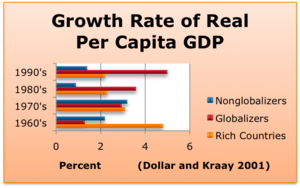
Economic globalization is the increasing economic integration and interdependence of national, regional and local economies across the world through an intensification of cross-border movement of goods, services, technologies and capital.[1] Whereas globalization is a broad set of processes concerning multiple networks of economic, political and cultural interchange, contemporary economic globalization is propelled by the rapid growing significance of information in all types of productive activities and marketization, and by developments in science and technology.[2] Economic globalization primarily comprises the globalization of production and finance, markets and technology, organizational regimes and institutions, corporations and labour.[3] While economic globalization has been expanding since the emergence of trans-national trade, it has grown at an increased rate over the last 20–30 years under the framework of General Agreement on Tariffs and Trade and World Trade Organization, which made countries gradually cut down trade barriers and open up their current accounts and capital accounts.[2] This recent boom has been largely accounted by developed economies integrating with less developed economies, by means of foreign direct investment, the reduction of trade barriers, and in many cases cross border immigration. While globalization has radically increased incomes and economic growth in developing countries and lowered consumer prices in developed countries, it also changes the power balance between developing and developed countries and has an impact on the culture of each affected country. And the shifting location of goods production has caused many jobs to cross borders, requiring some workers in developed countries to change careers.[citation needed] History International commodity markets, labor markets and capital markets make up the economy and define economic globalization.[4] Beginning as early as 4000 BC, people were trading livestock, tools, and other items. In Sumer, an early civilization in Mesopotamia, a token system was one of the first forms of commodity money.[5] Labor markets consist of workers, employers, wages, income, supply and demand. Labor markets have been around as long as commodity markets. The first labor markets provided workers to grow crops and tend livestock for later sale in local markets. Capital markets emerged in industries that required resources beyond those of an individual farmer.[6] By the early 1900s, it was rare[dubious – discuss] to come across a town that was not influenced by foreign markets—whether it be in labor, prices, or any other part of business.[7] With advances in ship and rail transport and electronic communications, trade with other parts of the world became much easier. Towns were no longer limited to what they alone could produce and what nearby towns over could trade with them. These advances in economic globalization were disrupted by World War I. Most of the global economic powers constructed protectionist economic policies and introduced trade barriers that slowed trade growth to the point of stagnation.[8] This caused a slowing of world-wide trade and even led to other countries introducing immigration caps.[9] Globalization didn’t fully resume until the 1970s, when governments began to emphasize the benefits of trade.[10] Today, follow-on advances in technology have led to the rapid expansion of global trade.[11] Three suggested factors accelerated economic globalization: advancement of science and technology, market oriented economic reforms and contributions by multinational corporations.[10] A reduction of transportation and communication costs were a key part of the growth of globalization. Since the 1930s, ocean shipping costs fell by half, airfreight by 85%, and telecommunications by 99%. The GATT/WTO framework led participating countries to reduce their tariff and non-tariff barriers to trade. Governments shifted their economies from central planning to markets. These internal reforms allowed enterprises to adapt more quickly and exploit opportunities created by technology shifts.[12] Multinational corporations reorganized production to take advantage of these opportunities. Labor-intensive production migrated to areas with lower labor costs, later followed by other functions as skill levels increased. The 1956 invention of containerized shipping, increases in ship sizes were a major part of the reduction in shipping costs.[13][14] Irreversibility According to prominent Chinese economist Gao Shanguan, economic globalization is an irreversible trend due to the fact that world markets are in great need of science and information technologies. With the growing demands of science and technology, Shanquan states that with world markets take on an "increasing cross-border division of labor".[10] However, Princeton University professor Robert Gilpin argues that nations' economic policies have mistakenly slowed their own growth by resisting globalization, showing that globalization is not irreversible.[15] Antonio L. Rappa agrees that economic globalization is reversible and cites International Studies professor Peter J. Katzenstein.[16] EffectsEconomic growth and poverty reduction Economic growth accelerated and poverty declined globally following the acceleration of globalization. Per capita GDP growth in the post-1980 globalizers accelerated from 1.4 percent a year in the 1960s and 2.9 percent a year in the 1970s to 3.5 percent in the 1980s and 5.0 percent in the 1990s. This acceleration in growth is even more remarkable given that the rich countries saw steady declines in growth from a high of 4.7 percent in the 1960s to 2.2 percent in the 1990s. Also, the non-globalizing developing countries did much worse than the globalizers, with the former's annual growth rates falling from highs of 3.3 percent during the 1970s to only 1.4 percent during the 1990s. This rapid growth among the globalizers is not simply due to the strong performances of China and India in the 1980s and 1990s—18 out of the 24 globalizers experienced increases in growth, many of them quite substantial."[17]
Growth Rate of Real GDP per capita According to the International Monetary Fund, growth benefits of economic globalization are widely shared. While several globalizers have seen an increase in inequality, most notably China, this increase in inequality is a result of domestic liberalization, restrictions on internal migration, and agricultural policies, rather than a result of international trade.[17] Poverty has been reduced as evidenced by a 5.4 percent annual growth in income for the poorest fifth of the population of Malaysia. Even in China, where inequality continues to be a problem, the poorest fifth of the population saw a 3.8 percent annual growth in income. In several countries, those living below the dollar-per-day poverty threshold declined. In China, the rate declined from 20 to 15 percent and in Bangladesh the rate dropped from 43 to 36 percent.[17] Globalizers are narrowing the per capita income gap between the rich and the globalizing nations. China, India, and Bangladesh, once among the poorest countries in the world, have greatly narrowed inequality due to their economic expansion.[17] Multinational corporations The spread of multinational corporations has accompanied the rise of globalization. One of the many changes they have brought to developing countries is increased automation, which may damage less-automated local firms and require their workers to develop new skills in order to transition into the changing economy, leaving some behind. The necessary education infrastructure is often not present, requiring a redirection of the government’s focus from social services to education.[18] ECLAC states that in order to create better economic relations globally, international lending agencies must work with developing countries to change how and where credit is concentrated as well as work towards accelerating financial development in developing countries.[19] ECLAC further suggests that the United Nations expand its agenda to work more rigorously with international lending agencies and that they become more inclusive of all nations. Key factors in achieving universal competition is the spread of knowledge at the State level through education, training and technological advancements.[20] Economist Jagdish Bhagwati suggested that programs to help developing countries adjust to the global economy would be beneficial for international economic relations.[21] Several movements, such as the fair trade movement and the anti-sweatshop movement, claim to promote a more socially just global economy. The fair trade movement works towards improving trade, development and production for disadvantaged producers. The fair trade movement has reached 1.6 billion US dollars in annual sales.[22] The movement works to raise consumer awareness of exploitation of developing countries. Fair trade works under the motto of "trade, not aid", to improve the quality of life for farmers and merchants by participating in direct sales, providing better prices and supporting the community.[23] Capital flight The Argentine economic crisis of 2001 caused in a currency devaluation and capital flight which resulted in a sharp drop in imports. Capital flight occurs when assets or money rapidly flow out of a country because of that country's recent increase in unfavorable financial conditions such as taxes, tariffs, labor costs, government debt or capital controls. This is usually accompanied by a sharp drop in the exchange rate of the affected country or a forced devaluation for countries living under fixed exchange rates. Currency declines improve the terms of trade, but reduce the monetary value of financial and other assets in the country. This leads to decreases in the purchasing power of the country's assets. A 2008 paper published by Global Financial Integrity estimated capital flight, also called illicit financial flows to be leaving developing countries at the rate of "$850 billion to $1 trillion a year."[24] But capital flight also affects developed countries. A 2009 article in The Times reported that hundreds of wealthy financiers and entrepreneurs had recently fled the United Kingdom in response to recent tax increases, relocating to low tax destinations such as Jersey, Guernsey, the Isle of Man and the British Virgin Islands.[25] In May 2012 the scale of Greek capital flight in the wake of the first "undecided" legislative election was estimated at €4 billion a week[26] and later that month the Spanish Central Bank revealed €97 billion in capital flight from the Spanish economy for the first quarter of 2012.[27] Capital flight can cause liquidity crises in directly affected countries and can cause related difficulties in other countries involved in international commerce such as shipping and finance. Asset holders may be forced into distress sales. Borrowers typically face higher loan costs and collateral requirements, compared to periods of ample liquidity, and unsecured debt is nearly impossible to obtain. Typically, during a liquidity crisis, the interbank lending market stalls. Inequality While within-country income inequality has increased throughout the globalization period, globally inequality has lessened as developing countries have experienced much more rapid growth.[28] Economic inequality varies between societies, historical periods, economic structures or economic systems, ongoing or past wars, between genders, and between differences in individuals' abilities to create wealth.[29] Among the various numerical indices for measuring economic inequality, the Gini coefficient is most often-cited. Of the factors influencing the duration of economic growth in both developed and developing countries, income equality has a more beneficial impact than trade openness, sound political institutions, and foreign investment. [30]Economic inequality affects equity, equality of outcome and subsequent equality of opportunity. Although earlier studies considered economic inequality as necessary and beneficial,[31] some economists see it as an important social problem.[32] Early studies suggesting that greater equality inhibits economic growth did not account for lags between inequality changes and growth changes.[33] Later studies claimed that one of the most robust determinants of sustained economic growth is the level of income inequality.[30] International inequality is inequality between countries. Income differences between rich and poor countries are very large, although they are changing rapidly. Per capita incomes in China and India doubled in the prior twenty years, a feat that required 150 years in the US.[34] According to the United Nations Human Development Report for 2013, for countries at varying levels of the UN Human Development Index the GNP per capita grew between 2004 and 2013 from 24,806 to 33,391 or 35% (very high human development), 4,269 to 5,428 or 27% (medium) and 1,184 to 1,633 or 38% (low) PPP$, respectively (PPP$ = purchasing power parity measured in United States dollars).[35] Certain demographic changes in the developing world after active economic liberalization and international integration resulted in rising welfare and hence, reduced inequality. According to Martin Wolf, in the developing world as a whole, life expectancy rose by four months each year after 1970 and infant mortality rate declined from 107 per thousand in 1970 to 58 in 2000 due to improvements in standards of living and health conditions. Also, adult literacy in developing countries rose from 53% in 1970 to 74% in 1998 and much lower illiteracy rate among the young guarantees that rates will continue to fall as time passes. Furthermore, the reduction in fertility rates in the developing world as a whole from 4.1 births per woman in 1980 to 2.8 in 2000 indicates improved education level of women on fertility, and control of fewer children with more parental attention and investment.[36] Consequentially, more prosperous and educated parents with fewer children have chosen to withdraw their children from the labor force to give them opportunities to be educated at school improving the issue of child labor. Thus, despite seemingly unequal distribution of income within these developing countries, their economic growth and development have brought about improved standards of living and welfare for the population as a whole. Tax havens The ratio of German assets in tax havens in relation to the total German GDP. [37] The "Big 7" shown are Hong Kong, Ireland, Lebanon, Liberia, Panama, Singapore, and Switzerland. A tax haven is a state, country or territory where certain taxes are levied at a low rate or not at all, which are used by businesses for tax avoidance and tax evasion.[38] Individuals and/or corporate entities can find it attractive to move themselves to areas with reduced taxation. This creates a situation of tax competition among governments. Taxes vary substantially across jurisdictions.[39] Sovereign states have theoretically unlimited powers to enact tax laws affecting their territories, unless limited by previous international treaties. The central feature of a tax haven is that its laws and other measures can be used to evade or avoid the tax laws or regulations of other jurisdictions.[40] In its December 2008 report on the use of tax havens by American corporations,[41] the U.S. Government Accountability Office was unable to provide a satisfactory definition of a tax haven, but regarded the following characteristics as indicative of it: nil or nominal taxes; lack of effective exchange of tax information with foreign tax authorities; lack of transparency in the operation of legislative, legal or administrative provisions; no requirement for a substantive local presence; and self-promotion as an offshore financial center. A 2012 report from the Tax Justice Network estimated that between USD $21 trillion and $32 trillion is sheltered from taxes in tax havens worldwide.[42] If such hidden offshore assets are considered, many countries with governments nominally in debt would be net creditor nations.[43] However, the tax policy director of the Chartered Institute of Taxation expressed skepticism over the accuracy of the figures.[44] Daniel J. Mitchell of the US-based Cato Institute says that the report also assumes, when considering notional lost tax revenue, that 100% of the money deposited offshore is evading payment of tax.[45] Tax havens have been criticized because they often result in the accumulation of idle cash[46] which is expensive and inefficient for companies to repatriate.[47] The tax shelter benefits result in a tax incidence disadvantaging the poor.[48] Many tax havens are thought to have connections to "fraud, money laundering and terrorism."[49] Ongoing investigations of illegal tax haven abuse have produced few convictions.[50][51] Lobbying pertaining to tax havens and associated transfer pricing has also been criticized.[52] Accountants' opinions on the propriety of tax havens have been evolving,[53] as have the opinions of their corporate users,[54] governments,[55][56] and politicians,[57][58] although their use by Fortune 500 companies[59] and others remains widespread.[60] Reform proposals centering on the Big Four accountancy firms have been advanced.[61] Some governments appear to be using computer spyware to scrutinize corporations' finances.[62] Red: U.S. corporate profits after tax. Blue: U.S. nonresidential business investment, both as fractions of GDP, 1989-2012. Wealth concentration of corporate profits in global tax havens due to tax avoidance spurred by imposition of austerity measures can stall investment, inhibiting further growth. [63]Voices of developing countries The Economic Commission for Latin America and the Caribbean (ECLAC) has proposed an agenda to support conditions for developing countries to improve their standing in the global economy.[64] However, the advantaged countries continue to control the economic agenda. Lechner and Boli state that the World Bank and the International Monetary Fund must give voice to developing countries.[65] Cultural effects Economic globalization may impact culture. Populations may mimic the international flow of capital and labor markets in the form of immigration and the merger of cultures. Foreign resources and economic measures may impact different native cultures and may cause assimilation of a native people.[66] As these populations are exposed to the English language, computers, western music, and North American culture, changes are being noted in shrinking family size, immigration to larger cities, more casual dating practices, and gender roles are transformed. Yu Xintian noted two contrary trends in culture due to economic globalization.[67] Yu argued that culture and industry not only flow from the developed world to the rest, but trigger an effort to protect local cultures. He notes that economic globalization began after World War II, whereas internationalization began over a century ago.[68] George Ritzer wrote about the McDonaldization of society and how fast food businesses spread throughout the United States and the rest of the world, attracting other places to adopt fast food culture.[69] Ritzer describes other businesses such as The Body Shop, a British cosmetics company, that have copied McDonald's business model for expansion and influence. In 2006, 233 of 280 or over 80% of new McDonalds opened outside the US. In 2007, Japan had 2,828 McDonalds locations.[70] Global media companies export information around the world. This creates a mostly one-way flow of information, and exposure to mostly western products and values. Companies like CNN, Reuters and the BBC dominate the global airwaves with western points of view. Other media news companies such as Qatar's Al Jazeera network offer a different point of view, but reach and influence fewer people.[71] Migration “With an estimated 210 million people living outside their country of origin (International Labour Organization [ILO] 2010), international migration has touched the lives of almost everyone in both the sending and receiving countries of the Global South and the Global North”.[72] Because of advances made in technology, human beings as well as goods are able to move through different countries and regions with relative ease. “The geography of contemporary globalization is related closely to the history of colonialism and imperialism even if this is not usually made explicit in globalization theory”.[73] Colonialism created links between various societies across the world that encouraged some people to leave their original countries to work in another country. “Globalization theories have, by and large, neglected race and ethnicity in their accounts of the making of the new global order”.[73] “International migrants facilitate globalization processes by linking together disparate peoples and places into an increasingly single, shared global political-economic context[74][75][76] Those who are not separated from their families still have a desire to migrate because “knowledge of living standards and social conditions across countries has become increasingly more available, especially through travel; both the real and symbolic reduction of time and distance have created powerful incentives for people to move”.[72] This impacts women the most because “from a gender perspective, we have witnessed the feminization of most migration flows, especially since the 1990s, with profound transformations in the structure of families and gender roles in the international division of labor”.[72] Another reason for individuals to migrate is to make more money. Incomes in developed countries are far higher than in developing countries. See also
|


 Scoop.it!