Mining, Energy, Critical Minerals and Just Transition
3.3K views | +0 today
Your new post is loading...
Scooped by KRII-KROTOASA RESEARCH-INTENSIVE INSTITUTE
May 5, 2015 12:51 AM
Scoop.it!

Oceans rank as the 7th largest world economy - Mashable

Oceans rank as the 7th largest world economy - Mashable | Mining, Energy, Critical Minerals and Just Transition | Scoop.it
According to a report that estimates the value of Earth's oceans' key assets at $24 trillion, they rank as the world's seventh largest economy.
No comment yet.
Scooped by KRII-KROTOASA RESEARCH-INTENSIVE INSTITUTE
April 20, 2015 8:50 PM
Scoop.it!

4 Factors Shaping the Global Economy

In the latest World Economic Outlook, the IMF says that although there is stronger growth this year in advanced economies, lower growth in emerging market and ...
No comment yet.
Scooped by KRII-KROTOASA RESEARCH-INTENSIVE INSTITUTE
April 20, 2015 8:49 PM
Scoop.it!

World Bank President Interview World Economy & Food Crisis and Global Future Economic

World Bank President Interview World Economy & Food Crisis and Global Future Economic.
No comment yet.
Scooped by KRII-KROTOASA RESEARCH-INTENSIVE INSTITUTE
April 20, 2015 8:48 PM
Scoop.it!

Five charts that show what's going on in the global economy right now - Telegraph.co.uk

Five charts that show what's going on in the global economy right now - Telegraph.co.uk | Mining, Energy, Critical Minerals and Just Transition | Scoop.it
From the future of the oil industry to the most recession-prone areas of the world, here's what the IMF thinks will happen to the global economy this year
No comment yet.
Scooped by KRII-KROTOASA RESEARCH-INTENSIVE INSTITUTE
April 20, 2015 8:45 PM
Scoop.it!

World finance leaders see threats ahead for global economy - U.S. News & World Report

World finance leaders see threats ahead for global economy - U.S. News & World Report | Mining, Energy, Critical Minerals and Just Transition | Scoop.it
WASHINGTON (AP) — The world's financial leaders see a number of threats facing a global economy still on an uneven road to recovery with U.S. and European officials worrying that Greece will default on its debt.
No comment yet.
Scooped by KRII-KROTOASA RESEARCH-INTENSIVE INSTITUTE
April 17, 2015 12:43 AM
Scoop.it!

Civil Society - World Bank Publications on Civil Society Engagement

Civil Society - World Bank Publications on Civil Society Engagement | Mining, Energy, Critical Minerals and Just Transition | Scoop.it

Below is the listing of studies, reports, publications, and other materials produced by the World Bank on its civil society engagement work as well as other development topics related to civil society and social development.  These are produced by different regional, network, country, and other units throughout the institution.   Full listing of all World Bank publications.

Highlights:
World Bank - Civil Society Engagement: Review of Fiscal Years 2010 - 2012 
Guidance Note on World Bank Multi-Stakeholder Engagement 2009
Civil Society Consultation Sourcebook


Civil Society Bank Publications 


 Bi-Annual Reviews on WB-Civil Society Engagement

These Reviews provide a comprehensive accounting of Bank – civil society relations across the institution every 2-3 years. It provides detailed information on global consultation processes, examples of operational collaboration, CSO funding mechanisms, and civil society outreach initiatives by region and constituency teams.

World Bank-Civil Society Engagement Review of Fiscal Years 2010 - 2012
World Bank-Civil Society Engagement. Review of Fiscal Years 2007 - 2009
World Bank-Civil Society Engagement. Review of Fiscal Years 2005 and 2006
World Bank-Civil Society Engagement. Review of Fiscal Years 2002-2004
World Bank-Civil Society Collaboration – Progress Report for Fiscal Years 2000 and 2001 

top

General on WB-Civil Society Relations

Civil Society, Public Action and Accountability in Africa (2011) This 68-page paper examines the potential role of civil society action in increasing state accountability for development in Sub-Saharan Africa. It further develops the analytical framework of the World Development Report 2004 on accountability relationships, to emphasize the underlying political economy drivers of accountability and implications for how civil society is constituted and functions.

Issues and Options for Improving Engagement Between the World Bank and Civil Society Organizations (March 2005) The paper assesses the World Bank’s recent relations with civil society organizations, and proposes options for promoting more effective civic engagement in Bank-supported activities and managing associated risks in the future. It analyzes the Bank’s extensive experience over time in engaging CSOs in a broad range of development operations and in policy dialogue at the local, national and global levels.

Working Together. World Bank-Civil Society Relations (2003) This 36-page booklet is composed of two sections.  The first provides basic information on the Bank including its governing structure, project cycle, safeguard policies, and programs such as PRSP.  The second section focuses on the Bank’s civil society engagement work including the rationale and nature of this engagement, civil society staff, and funding mechanisms for civil society.

Engaging Civil Society  (2003) This brochure provides a quick snapshot on the Bank’s civil society engagement work.  It covers the three aspects of why, how, and who carries out these activities in the Bank.  The brochure also has information on how the Bank supports civil society through information, training, and funding.

Non- Governmental Organizations and Civil Society Engagement in World Bank Supported Projects. Lessons from OED Evaluations (2002) This 8-page document summarized findings from previous studies conducted by the Operations Evaluation Department (OED) on engaging civil society. It identified various factors contributing to successful Bank - CSO collaboration, and included recommendations on ways to solidify these relations.

"Government Social Funds in Brazil Bolster Civil Society Grassroots Initiatives" (2001) This 11-page article was written by John Garrison of the Civil Society Team.  It describes the objectives, thematic priorities, operational characteristics, and participatory mechanisms of 14 government-managed social funds financed by the World Bank and valued at over $955 million dollars over a seven year period (1993 - 2001).  The note demonstrates how these "small grants programs" funds in such areas as AIDS prevention, environmental conservation, and rural poverty reduction have begun to significantly change the relations between the government and civil society.

"From Confrontation to Collaboration: Civil Society - Government - World Bank Relations in Brazil " (2000)
This 107-page study written by John Garrison of the Civil Society Team examines the evolving relations between the World Bank, governments, and civil society in Brazil.  The study provides a historic overview of the Brazilian civil society sector, information on the Bank's civil society outreach efforts including its objective and methodology, and examples of civil society involvement in Bank-financed loans.

Nongovernmental Organizations in Bank - Supported Projects (1999) This 87-page  report represented one of the first comprehensive attempts to assess the impact of civil society participation in Bank operations. It was carried out by the Operations Evaluation Department (OED) and analyzed the nature and impact of NGO and CBO participation in 37 in five countries: Bolivia, India, Mali, Brazil, and Kenya. The report presented the findings which were based on desk reviews, staff consultations, and field visits. The document further outlined strategies to influence CSO involvement, and offered recommendations on CSO – World Bank engagement.

Nongovernmental Organizations in World Bank- Supported Projects. A Review (1999) This 4-page paper summarizes the findings of the larger OED report which examined the impact of CSO participation in 37 projects in five countries. Since 1989, when the Bank adopted an Operational Directive to encourage CSO participation in Bank projects, as many as half the projects approved each year have had some form of CSO involvement. But the quality and depth of this collaboration has been uneven. 

"The Challenges of Promoting Participatory Development in the Amazon" (1997) This 11-page note was written jointly by John Garrison, Civil Society Team, and Teresa Aparicio, Social Anthropologist at the Inter-American Development Bank.   The piece provides background information and analyzis on one of the best known and controversial Bank loans to have been funded in the Brazilian state of Rondonia Planafloro.   It provides background information on the region, details the problems plaguing the natural resource project, and describes how the project was re-designed after a participatory process involving local CSOs.

Working with NGOs. A Practical Guide to Operational Collaboration between The World Bank and Non-governmental Organizations (1995) The purpose of this 136-page document was to flag key issues and describe emerging practices in the World Bank's operational collaboration with CSOs, and was intended to guide the reader to enhance its understanding of the benefits and challenges of working together with CSOs. The guide introduced the civil society sector, outlined the potential benefits of working with CSOs, and explained the specific roles they could play at various stages of the project cycle. The guide further identified key issues to successful collaboration with CSOs.  

Involving Nongovernmental Organizations in Bank - Supported Activities. Operational Directive 14.70 (1989) This operational directive provided a framework for involving CSOs in Bank supported activities. It provided Bank staff with guidance on how to engage CSOs in Bank operations. The document described the definition and characteristics of civil society, their strengths and weakness, and various forms NGOs could be involved in Bank-financed projects. It also outlined Bank staff responsibilities regarding CSO engagement.  

top

Consultations Guidelines

Guidance Note on World Bank Multi-Stakeholder Engagement (2009):  As part of the implementation plan to strengthen World Bank Group engagement on governance and anticorruption, the Bank has prepared a Guidance note on multi-stakeholder engagement. This note provides guidance to staff on demand-side good practice and mandate issues vis-a-vis civil society engagement. Part two of this note discusses the applicable legal and policy considerations in more detail. And finally, part three provides guidance on good practice for ensuring the effectiveness of Bank interventions and that they are performed in a manner consistent with the Bank's mandate, with a particular focus on working with media, parliament, and civil society.

Consultations with Civil Society. A sourcebook - Working Document (February 2007) Produced by the Civil Society Team, the sourcebook presents knowledge and expertise of World Bank staff on how to engage civil society and promote participatory development.  Its first version was published in 2001 and produced by the NGO Unit in the Environmentally and Socially Sustainable Development (ESSD) Newtork.  It has evolved and has been revised over time as a result of being presented and discussed over time.

Consultations with Civil Society Organizations. General Guidelines for World Bank Staff (2000)
This first of a kind publication was prepared by the Bank's NGO and Civil Society Unit in an effort to provide more guidance and support in facilitating consultations with CSOs on projects, policy, and investment lending. Although non-mandatory, the guidelines reflect the advice and good practices distilled from experience of many Bank staff.

top

Funding Guidelines 

Guide to Resources for NGOs and Other Organizations of Civil Society (2003) The second edition of the document was prepared in partnership between the Small Grants Program of the World Bank and the International Youth Foundation. The publication is intended as a guide to technical and financial resources for CSOs.

Civil Society Engagement eNewsletter

The Civil Society Engagement eNewsletter is a monthly electronic newsletter produced by the Civil Society Team which provides information on World Bank events, reports, staff appointments, and jobs of interest to civil society.
Sign up for the eNewsletter

Independent Evaluation Group Reports on Civil Society Issues 

An OED Review of Social Development in Bank Activities. February 2004 (PDF, 0.4MB) This report presents the collected findings of several evaluative exercises: a literature review, an analysis of the organization of social development in aid agencies, surveys of Bank staff, and a meta-analysis of the previous and ongoing OED studies related to social development. Separate reports on each of these exercises are available on request.

Toward Country-led Development: a Multi-Partner Evaluation of the Comprehensive Development Framework. June 2003 (PDF, 2MB)  The Comprehensive Development Framework (CDF) - launched by World Bank President James D. Wolfensohn in early 1999 - has become an important influence on the global development agenda. This review is an extended multi-partner effort to evaluate the implementation of the CDF principles, to identify the factors that have facilitated and hindered it, and to assess the extent to which CDF implementation has affected behaviors and outcomes.

"OED Lessons and Practices: Non-Governmental Organizations and Civil Society Engagement in World Bank Supported Projects: Lessons from OED Evaluations" The Bank's Operations and Evaluation Department has undertaken a series of studies on the civil society sector and its interaction with the World Bank.  These include a major study undertaken in 1998 in five countries which sought to identify factors contributing to successful World Bank-NGO collaboration, as well as a number of other OED studies.  This paper draws on that body of work to identify some of the important findings and recommendations that should inform the Bank as it attempts to broaden and consolidate its civil society engagement work. 

"OED Prescis: Non-governmental Organizations in World Bank-Supported Projects" (1999)
This is a summary analysis of a larger study carried out in 1998 by the Operational Evaluation Department on the involvement of NGOs in World Bank supported activities at the country level.   The study focused on five countries (Bolivia, Brazil, India, Kenya, and Mali) and found that while the level of NGO involvement is overstasted and uneven accross the Bank, the majority of projects studied showed potential for success because their preparation and early implementation were characterized by civil society organizations.

top

Other (poverty, social development, etc.)

The World Bank has consolidated its approach to social development into a single Bank-wide Strategy and Implementation Plan, entitled  'Empowering People by Transforming Institutions: Social Development in World Bank Operations", which focuses on efforts to empower poor women and men through enhanced Bank support for social inclusion, cohesive societies and accountable institutions. Social development, is defined as transformation of institutions and as such, promotes better growth, better projects and better quality of life.The paper sets a vision, objectives, and a course of action for the longer term and suggests specific actions, targets, and institutional measures for the next five years. This paper was produced through a three-year effort involving extensive stocktaking, research, consultation.

Voices of the Poor Series: At the turn of the new millennium, the World Bank collected the voices of more than 60,000 poor women and men from 60 countries, in an unprecedented effort to understand poverty from the perspective of the poor themselves. Voices of the Poor, as this participatory research initiative is called, chronicles the struggles and aspirations of poor people for a life of dignity. Poor people are the true poverty experts. Poor men and women reveal, in particular, that poverty is multidimensional and complex -- raising new challenges to local, national and global decision-makers. Poverty is voicelessness. It's powerlessness. It's insecurity and humiliation, say the poor across five continents. The immediate impetus for the Voices of the Poor study was to prepare the World Development Report 2000/01. The research findings have been published for the World Bank by Oxford University Press in a three-volume series: 

Can Anyone Hear Us? analyzes the voices of over 40,000 poor women and men in 50 countries from participatory poverty assessments carried out by the World Bank in the 1990s;
Crying Out for Change pulls together reports on fieldwork conducted in 1999 in 23 countries involving over 20,000 poor men and women; and
From Many Lands offers regional patterns and country case studies.

Moving Out Of Poverty Series: Poverty studies typically focus on people who live below the poverty line. Few studies have examined how people are able to not only move out of but also stay out of poverty. The global Moving out of Poverty study, carried out in 15 countries, is one of the few large-scale comparative research attempts to analyze mobility out of poverty rather than poverty alone. A follow-up to the Voices of the Poor study, Moving out of Poverty seeks to understand the bottom-up factors that unleash poor people’s economic potential and support their transitions out of poverty, through the perspectives of the men, women and youth who have lived through these experiences. In the process, the study also explores people’s definitions and understandings of mobility, freedom, power, democracy and aspirations, and how these concepts link to building assets and creating wealth.The individual studies that form part of the series are below:

Moving Out of Poverty: Cross-Disciplinary Perspectives 
Moving Out of Poverty: Success from the Bottom-Up 
Moving Out of Poverty: The Promise of Empowerment and Democracy in India 
Moving Out of Poverty: Rising from the Ashes of Conflict 
Country Reports 
Moving Up and Out of Poverty: Countries, Communities, and Individuals

top

Mainstreaming Participation in the PRSP This is a report of a study undertaken by Bank staff in the Africa region under the coordination of Paula Donnelly-Roark (Senior Social Scientist - Africa Region) to identify what factors lead to more effective participation by civil society in the PRSPs.  The study was carried out in three countries -- Kenya, Cameroon, and Chad -- and identified a four-point iterative approach to participation which consists of: dialogue, collective analysis, action, and monitoring for feedback.

top

Involving Nongovernmental Organizations in Bank-Supported Activities (1998): This is a piece of advisory that contains  information that World Bank staff may find useful in carrying out the Bank's policies and procedures. It is not necessarily a complete treatment of the subject. This particular piece encourages borrowers and staff members to consult with NGOs and to involve them, as appropriate, in Bank-supported activities, including economic and sector work and all stages of project processing--identification, design, implementation, and monitoring and evaluation.  It was formerly called Good Practices statements (GPs) 14.7.

The Bank’s Relations with NGOs. Issues and Directions (1998) This 20-page report provided an update on Bank- CSO relations, incorporating the findings of the FY 1997 Progress Report. In summarizing the evolution of Bank/NGO relations over nearly two decades of interaction, the paper points to much progress that has clearly been win-win for development. However, concerns have been increasingly expressed by some borrowers that the Bank may be running ahead of its partner governments in its dialogue with NGOs on policy issues, and that some NGOs want even greater dialogue with the Bank, in part as a way to influence borrower governments.    


Last updated: 2013-08-20


Permanent URL for this page: http://go.worldbank.org/WW19KG3KS0
No comment yet.
Scooped by KRII-KROTOASA RESEARCH-INTENSIVE INSTITUTE
April 17, 2015 12:34 AM
Scoop.it!

World Bank Civil Society

World Bank Civil Society | Mining, Energy, Critical Minerals and Just Transition | Scoop.it

The growth of civil society has been one of the most significant trends in international development. This website will provide you with information and materials on the World Bank's evolving relationship with civil society. More 


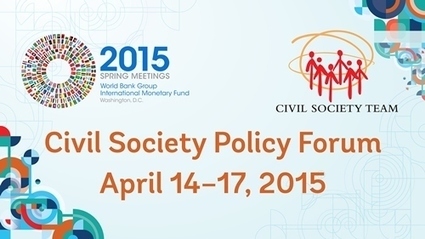
2015 Spring Meetings Civil Society Policy Forum is Here!

The WBG and IMF Civil Society Teams hosts a bi-annual Civil Society Program (CSP) in the margins of the World Bank Group and IMF Spring and Annual Meetings to promote substantive dialogue and an exchange of views between Bank/Fund staff, civil society representatives, government officials, academics, and other stakeholders. The CSP at the Spring Meetings will be held at the WBG and IMF Headquarters from April 14 - 17. It will include: an Orientation Session on the WBG; a CSO Roundtable with WBG Executive Directors; a CSO Reception with Senior Management of the WBG and IMF; and a Civil Society Policy Forum of sessions on topics that cover issues related to the global economy, poverty reduction, inequality and climate change.  Online request for registration for those that intend to attend the forum is now closed.  If you have questions regarding the Forum please contact us by email: civilsociety@worldbank.org.  See more details.

Civil Society Policy Forum Schedule (NEW)

 What's New! 


CLOSED 2015 Spring Meetings: Civil Society Policy Forum – Session Guidelines: The Civil Society Policy Forum will convene from April 14 – 17, 2015 and will comprise of some 50 policy sessions on a wide range of topics.  These sessions are being organized individually by CSOs, Bank, and Fund or jointly in many cases.  Session organizers also followed an inclusive and participatory approach that reflects the diversity of CSO policy concerns.  For more on the guidelines that informed the Policy Forum Sessions, please click here.


CSOs Rate the 2014 October Civil Society Policy Forum: Civil Society representatives surveyed at the end of the October 2014 Civil Society Policy Forum have rated the program as satisfactory. The event that got the highest score was the CSO Townhall with President Kim and Madame Lagarde.  Over 500 participants attended the Policy Forum.  See details of the survey result here.


Review and Update of the World Bank Safeguard Policies: People and the environment are at the center of the World Bank's work. Through the revision of its environmental and social safeguard policies, the World Bank is ramping up its standards to ensure the delivery of an environmental and social framework which is more efficient and comprehensive; includes a strengthened approach to the management of environmental and social risks that will support sustainable development through standards that are clear to those impacted by the projects it finances, those who implements, and those holding the institution to account. Find here details about the ongoing consultations.


Civil Society eNewsletter – April 2015 New!!: This edition is heavily about the 2015 Spring Meetings Civil Society Policy Forum convening from April 14 – 17, 2015.  We also brought you report about the pre-positioning speech by the World Bank Group's President ahead of the Spring Meetings, news on newly launched MOOC on Climate Change, ongoing consultations, report, jobs and regional news.  Read the full web based newsletter and please subscribe.  


Last updated: 2015-04-13


Permanent URL for this page: http://go.worldbank.org/G7NNVSLX30


e-NewsletterApril 2015 - NEWeNewsletter: ArchiveeNewsletter: Sign-up
BlogsGreenhouse Gas Accounting: A step Forward for Climate-Smart AgricultureMore
Issues of InterestPresident Kim's Interactions With CSOs2014 Annual Meetings Civil Society ProgramWhatwillittake to Eradicate PovertyIDA at WorkGlobal Partnership for Social Accountability (GPSA)Open DataClimate ChangeAccess to InformationFood Crisis RoundtablesFinancial Crisis and World Bank Response
New PublicationsWorld Bank – Civil Society Engagement: A Review of Fiscal Years 2010 - 2012Guidance Note on World Bank Multi-Stakeholder EngagementWDR 2013World Bank-World Learning Study on CSO TrainingBIC's Guide to the World BankIFC's Stakeholder Engagement HandbookIssues and Options for WB Engagement with CSOs Consultations with Civil Society. A sourcebook - Working Document (Feb 2007)More WB publications on Civil Society
No comment yet.
Scooped by KRII-KROTOASA RESEARCH-INTENSIVE INSTITUTE
April 17, 2015 12:27 AM
Scoop.it!

World Bank IMF Spring Meeting 2015 fiscal forum

IINNTTEERRNNAATTIIOONNAALL MMOONNEETTAARRYY FFUUNNDD FISCAL FORUM THE POLITICAL ECONOMY OF HIGH DEBT AGENDA IMF Headquarters (HQ2) Washington, DC Sunday, April…
No comment yet.
Scooped by KRII-KROTOASA RESEARCH-INTENSIVE INSTITUTE
April 17, 2015 12:23 AM
Scoop.it!

World Bank IMF 2015 Spring Meetings

World Bank IMF 2015 Spring Meetings | Mining, Energy, Critical Minerals and Just Transition | Scoop.it
Each spring, thousands of government officials, journalists, civil society organizations, and invited participants from the academia and private sectors, gather in Washington DC for the Spring Meetings of the World Bank Group and the IMF. This year’s Spring Meetings events will take place in Washington, D.C., April 17-19, 2015.
2015 Spring Meetings

At the heart of the gathering are meetings of the joint Development Committee and the IMF's International Monetary and Financial Committee, which discuss progress on the work of the World Bank Group and the IMF. Also featured are seminars, regional briefings, press conferences, and many other events focused on the global economy, international development, and the world’s financial markets.

The plenary session of the World Bank Group and the IMF Boards of Governors is scheduled only during the Annual Meetings in the autumn.
About the Annual Meetings

The Boards of Governors of the World Bank Group (Bank) and the International Monetary Fund (IMF) normally meet once a year to discuss the work of their respective institutions. The Annual Meetings, which generally take place in September/October, have customarily been held in Washington for two consecutive years and in another member country in the third year.

The Inaugural Meeting of the Boards of Governors was held in Savannah, Georgia, USA in March 1946. The first Annual Meetings were held in Washington in 1946.

The Annual Meetings occur ahead of the meetings of the International Monetary and Financial Committee, the Development Committee, the Group of Ten, the Group of Twenty-Four, and various other groups of members. At the conclusion of their meetings, the International Monetary and Financial Committee and the Development Committee, as well as several other groups, issue communiqués. The Annual Meetings will include a day of plenary sessions, during which Governors take up matters of business and consult with one another. At the Annual Meetings, the Boards of Governors make decisions on how current international monetary issues should be addressed and approve corresponding resolutions. The Annual Meetings are chaired by a Governor of the Bank and the IMF, with the chairmanship rotating among the membership each year. Every two years it elects Executive Directors. Each year any new members are welcomed into the Bank and the IMF.

Because the Annual Meetings bring such a large number of member country officials together, they provide opportunities for consultations large and small, formal and informal. Numerous seminars are held in conjunction with the meetings, including seminars conducted by staff members for members of the press. The Annual Meetings Program of Seminars is designed to foster creative dialogue among the private sector, government delegates and senior Bank and IMF officials. The Per Jacobsson Lecture on international finance, which is sponsored by a foundation set up in honor of the IMF's third Managing Director, is also given each year in conjunction with the Meetings.
Annual Meetings Outside the United States: 1947—2012
Year Location
1947 London
1950 Paris
1952 Mexico City
1955 Istanbul
1958 New Delhi
1961 Vienna
1964 Tokyo
1967 Rio de Janeiro
1970 Copenhagen
1973 Nairobi
1976 Manila
1979 Belgrade
1982 Toronto
1985 Seoul
1988 Berlin
1991 Bangkok
1994 Madrid
1997 Hong Kong
2000 Prague
2003 Dubai
2006 Singapore
2009 Istanbul
2012 Tokyo
No comment yet.
Scooped by KRII-KROTOASA RESEARCH-INTENSIVE INSTITUTE
April 17, 2015 12:19 AM
Scoop.it!

About Us - Annual & Spring Meetings

About Us - Annual & Spring Meetings | Mining, Energy, Critical Minerals and Just Transition | Scoop.it
Each autumn, the Boards of Governors of the World Bank Group and International Monetary Fund (IMF) hold Annual Meetings to discuss a range of issues related to poverty reduction, international economic development and finance. The Annual Meetings provide a forum for international cooperation and enable the Bank and Fund to better serve their member countries.

The Annual Meetings traditionally are held in Washington two years out of three and, in order to reflect the international character of the two institutions, every third year in a different member country. In addition to the meetings of the Boards of Governors, the Development Committee and the International Monetary and Financial Committee (IMFC) are officially convened. The Development Committee and the IMFC advise the Boards of Governors on issues of global concern, including the world economic outlook, poverty eradication, economic development, and aid effectiveness.

Around these meetings, the Bank and the IMF organize a number of fora to facilitate the interaction of governments and World Bank-IMF staff with civil society organizations, journalists, private sector executives, academics and representatives of other international organizations. Indeed, every effort is made to ensure that the Annual Meetings provide an effective forum for explaining to the public -- directly and through the media -- the activities, challenges and achievements of both institutions. The meetings also aim to open up the meetings to the public through live-streamed events and online conversations on World Bank Live, Twitter and other platforms.

About 10,000 people attend the meetings, including about 3,500 members of delegations from the member countries of the Bank and the IMF, roughly 1,000 representatives of the media, and more than 5,000 visitors and special guests drawn primarily from private business, the banking community and NGOs. In addition, Bank and IMF staff participate in the meetings with officials of government delegations.

At each Spring and Annual Meeting, the joint Bank-IMF Development Committee and the IMF's International Monetary and Financial Committee hold meetings to discuss progress on the work of the Bank and Fund. Also featured are seminars, regional briefings and press conferences, focused on the global economy, international development, and the world’s financial markets. Plenary sessions of the World Bank and the IMF's Boards of Governors are only scheduled during the Annual Meetings in the autumn.
No comment yet.
Scooped by KRII-KROTOASA RESEARCH-INTENSIVE INSTITUTE
April 17, 2015 12:09 AM
Scoop.it!

World Bank cuts global economic outlook

World Bank cuts global economic outlook | Mining, Energy, Critical Minerals and Just Transition | Scoop.it
The World Bank on Tuesday lowered its global growth forecast for 2015 and next year due to disappointing economic prospects in the euro zone, Japan and some major emerging economies that offset the benefit of lower oil prices.

The global development lender predicted the global economy would grow 3 percent this year, below a forecast of 3.4 percent made in June, according to its twice-yearly Global Economic Prospects report.

World GDP growth will reach 3.3 percent in 2016, as opposed to a June forecast of 3.5 percent, before dipping to 3.2 percent in 2017, it said, "The global economy is at a disconcerting juncture,'' World

Bank chief economist Kaushik Basu told reporters, "It is as challenging a moment as it gets for economic forecasting.''

Read More So bad it's good: Why it may be time to buy the euro

The world economy has been more sluggish than expected since the 2007-2009 global financial crisis.

The World Bank said strong growth prospects in the United States and Britain separated them from other rich nations, including members of the euro zone and Japan, which continue to face anemic economies and deflation fears.

"The global economy is running on a single engine, ... the American one,'' Basu said. "This does not make for a rosy outlook for the world.''

Among emerging markets, Brazil and Russia in particular weighed on the bank's global growth predictions, along with China, which is in a managed slowdown as it transitions away from an investment-led growth model.

Read MoreCramer: Countries are reacting positively to oil drop

Basu said India's economic growth should finally catch up to China's next year and in 2017, at a clip of about 7 percent. Like other forecasters, the World Bank predicted the roughly 60 percent drop in global oil prices since June of last year should be a net positive for the world economy, boosting oil-importing countries.

But while the World Bank expected oil prices to stay low this year, it said the positive price shock could take several years to feed into its growth outlook, while increasing short-term market volatility and reducing investments in unconventional oil such as shale and deep sea oil.

The immediate impact of lower crude prices was limited to a 0.1 percentage point boost to the global outlook this year, the World Bank said. Falling oil prices could also depress inflation around the world. Fears of deflation, along with overall gloomier global prospects and stagnant U.S. wages, could encourage the U.S. Federal Reserve to raise interest rates more slowly than anticipated, Basu said.
No comment yet.
Scooped by KRII-KROTOASA RESEARCH-INTENSIVE INSTITUTE
April 17, 2015 12:05 AM
Scoop.it!

The world bank global monthly

Overview ECB’s QE: large footprint on bond and currency markets. On March 9, the European Central Bank (ECB) began its quantitative easing (QE) program …
No comment yet.
Scooped by KRII-KROTOASA RESEARCH-INTENSIVE INSTITUTE
April 17, 2015 12:03 AM
Scoop.it!

Executive summary global economic prospects jan 2015

Global Economic Prospects: Executive Summary Having Fiscal Space and Using It January 2015 Global growth in 2014 was lower than initially expected, continuing …
No comment yet.
Scooped by KRII-KROTOASA RESEARCH-INTENSIVE INSTITUTE
April 20, 2015 8:50 PM
Scoop.it!

IMF on Twitter

IMF on Twitter | Mining, Energy, Critical Minerals and Just Transition | Scoop.it
Lagarde on oil price decline: more winners than losers, overall a plus for global economy #GlobalEcon pic.twitter.com/LeIuFSLbGa
No comment yet.
Scooped by KRII-KROTOASA RESEARCH-INTENSIVE INSTITUTE
April 20, 2015 8:49 PM
Scoop.it!

A new vision for infrastructure will save doomed global economy - The Hill (blog)

A new vision for infrastructure will save doomed global economy - The Hill (blog) | Mining, Energy, Critical Minerals and Just Transition | Scoop.it
We need to shake infrastructure investment loose from the hands of tired financial elites.
No comment yet.
Scooped by KRII-KROTOASA RESEARCH-INTENSIVE INSTITUTE
April 20, 2015 8:48 PM
Scoop.it!

History of World Economy About Full Documentary

world economy world economy 2015 world economy documentary world economy 2015 predictions world economy collapse world economy collapse explained ...
No comment yet.
Scooped by KRII-KROTOASA RESEARCH-INTENSIVE INSTITUTE
April 20, 2015 8:47 PM
Scoop.it!

How China's slowing GDP growth could drag down the global economy - The Independent

How China's slowing GDP growth could drag down the global economy - The Independent | Mining, Energy, Critical Minerals and Just Transition | Scoop.it
China's rise to global economic superpower was accompanied by plenty of scaremongering about what might happen when the West hands over the reigns to the East.
No comment yet.
Scooped by KRII-KROTOASA RESEARCH-INTENSIVE INSTITUTE
April 20, 2015 12:59 AM
Scoop.it!

G-20 Warns of Threats to Global Economic Recovery - Wall Street Journal

G-20 Warns of Threats to Global Economic Recovery - Wall Street Journal | Mining, Energy, Critical Minerals and Just Transition | Scoop.it
The world’s top finance leaders warned Friday that currency volatility, low inflation and high debt levels threaten to undermine an already uneven global economic recovery.
No comment yet.
Scooped by KRII-KROTOASA RESEARCH-INTENSIVE INSTITUTE
April 17, 2015 12:42 AM
Scoop.it!

Civil Society - Improving World Bank - Civil Society Engagement

Civil Society - Improving World Bank - Civil Society Engagement | Mining, Energy, Critical Minerals and Just Transition | Scoop.it

The World Bank's Board of Directors met on January 25, 2005 to discuss a paper entitled Issues and Options for Improving Engagement Between the World Bank and Civil Society Organizations.  The paper was prepared by the Bank's Civil Society Team, comprised of staff from the External Affairs, Communications and United Nations Affairs (EXT), Environmentally and Socially Sustainable Development (ESSD) and Operations Policy and Country Services (OPCS) Vice Presidential departments at the Bank.

Board members were broadly supportive of the paper's analysis of the key lessons and issues that have emerged over the past few years of the Bank's experience of engaging CSOs in development operations and in policy dialogue, and also supported the 10-point action plan aimed at improving the Bank's engagement with CSOs, outlined in the paper.  These points are: 

  1. Establish new global mechanisms for Bank-CSO engagement to help promote mutual understanding and cooperation.
  2. Establish a Bank-wide advisory service/focal point for consultations and an institutional framework for consultation management and feedback.
  3. Pilot a new Bank-wide monitoring and evaluation system for civic engagement.
  4. Conduct a review of Bank funds available for civil society engagement in operations and policy dialogue, and explore possible realignment or restructuring.
  5. Review the Bank’s procurement framework with a view toward facilitating collaboration with CSOs.
  6. Institute an integrated learning program for Bank staff and member governments on how to engage CSOs more effectively, as well as capacity-building for CSOs on how to work effectively with the Bank and its member governments.
  7. Hold regular meetings of senior management, and periodically with the Board, to review Bank-civil society relations.
  8. Develop and issue new guidelines for Bank staff on the institution’s approach, best practices, and a framework for engagement with CSOs.
  9. Emphasize the importance of civil society engagement in the guidance to Bank staff on the preparation of the CAS as well as in CAS monitoring and evaluation.
  10. Develop tools for analytical mapping of civil society to assist country and task teams in determining the relevant CSOs to engage on a given issue, project or strategy.

Board members underscored the imortance of Bank-CSO engagement in improving development effectiveness, contributing to poverty reduction and attainment of the Millennium Development Goals (MDGs). 

Earlier drafts of the paper were reviewed by senior management and staff across the Bank over the course of 2003.  The earlier draft of the paper was posted in October 2003 for public comment, and comments were solicited via an electronic Discussion Forum and a number of face-to-face meetings and video dialogues with CSOs between November 2003 and February 2004.  Annex A of the final version of the paper provides a matrix summarizing the comments received in 2003 and how they were addressed in the subsequent revision of the paper.

Questions about the paper may be directed to: Civil Society Team.


Permanent URL for this page: http://go.worldbank.org/0J8ERX2PL0
No comment yet.
Scooped by KRII-KROTOASA RESEARCH-INTENSIVE INSTITUTE
April 17, 2015 12:33 AM
Scoop.it!

2015 Spring Meetings

2015 Spring Meetings | Mining, Energy, Critical Minerals and Just Transition | Scoop.it

The Registration Office is open for badge pickup daily from 8:00 a.m. to 5:30 p.m., from Monday April 13 — Sunday, April 19.

Attendance to the World Bank Group (WBG) and the International Monetary Fund (IMF) Spring Meetings is by invitation only. All participants must be accredited in advance of the Meetings. To facilitate accreditation and registration, the participants are divided into different categories, described below. Please determine your registration category and submit your registration request accordingly.

Please note that an onsite Registration Desk operates for issuance of participant badges to those who are already accredited. Facilities for onsite accreditation are very limited and onsite accreditation is not guaranteed. Please plan your attendance at the Spring Meetings events in advance.

Participants are strongly encouraged to register as soon as possible to avoid delays.

DelegatesObserversCivil Society Representatives

WBG and IMF Spring Meetings will be held over the weekend of April 17-19, 2015 in Washington, D.C. As in previous years, the Civil Society Policy Forum, a program of policy dialogues for Civil Society Organizations (CSOs), will be held between April 14 and April 17, 2015. Information on the Policy Forum and the schedule of sessions will be posted on the Bank Civil Society website by mid-March.

All CSO representatives interested in participating in the Spring Meetings must obtain individual accreditation. The online registration system to accept applications for civil society registration will open on February 16, 2015 and will close on March 30, 2015. Registration will not be granted after this deadline, thus CSO representatives are encouraged to request early for registration.

Civil Society Organizations (CSOs) include non-governmental organizations, community groups, labor unions, indigenous peoples movements, faith based organizations, professional associations, foundations, think tanks, charitable organizations, and other not-for-profit organizations. If you have any questions about the Spring Meetings and/or are interested in organizing a dialogue session within the Civil Society Policy Forum, please send an email to civilsociety@worldbank.org or ngoliaison@imf.org.

CSO Registration Request >

PressGuests.
No comment yet.
Scooped by KRII-KROTOASA RESEARCH-INTENSIVE INSTITUTE
April 17, 2015 12:26 AM
Scoop.it!

Schedule World Bank Spring Meeting

 Schedule   Time Events Venue   Monday, April 13 8:00 a.m. Press Credentials Pick-Up Opens Press Registration Desk Tuesday, April 14 9:00 a.m. -…
No comment yet.
Scooped by KRII-KROTOASA RESEARCH-INTENSIVE INSTITUTE
April 17, 2015 12:21 AM
Scoop.it!

2015 Spring Meetings

2015 Spring Meetings | Mining, Energy, Critical Minerals and Just Transition | Scoop.it
Each spring, thousands of government officials, journalists, civil society organizations, and invited participants from the academia and private sectors, gather in Washington DC for the Spring Meetings of the World Bank Group and the IMF. At the heart of the gathering are meetings of the joint Development Committee and the IMF's International Monetary and Financial Committee, which discuss progress on the work of the World Bank Group and the IMF. Also featured are seminars, regional briefings, press conferences, and many other events focused on the global economy, international development, and the world�s financial markets.


This page
is safe
Bitdefender Antivirus Plus
No comment yet.
Scooped by KRII-KROTOASA RESEARCH-INTENSIVE INSTITUTE
April 17, 2015 12:12 AM
Scoop.it!

HIGHLIGHTS-IMF, World Bank 2015 spring meetings in Washington on Thursday

HIGHLIGHTS-IMF, World Bank 2015 spring meetings in Washington on Thursday | Mining, Energy, Critical Minerals and Just Transition | Scoop.it
WASHINGTON, April 16

(Reuters) - The following are highlights of the International Monetary Fund and World Bank meetings on Thursday in Washington, where finance ministers, central bankers and other top officials are gathering.

IMF MANAGING DIRECTOR CHRISTINE LAGARDE ON POSSIBLE GREEK PAYMENT DELAYS

"Payment delays have not been granted by the board of the IMF in the last 30 years. And it was eventually granted to a couple of developing countries, and that payment delay was actually not followed by productive results.

"So while ... all options are available to all countries, it is clearly not a course of action that would actually fit or be recommendable in the current situation. We have never had an advanced economy asking for payment delays. Payment delays are actually analyzed as additional financing granted to that country, and additional financing means additional contributions by the international community, some of which are in (a) much dearer situation than the country actually eventually seeking those delays."

ON ADVICE FOR GREECE

"You know, my advice has not changed. My advice is to get on with the work. ... The objective that we all pursue is to actually restore the stability of the Greek economy, but it is not done by a political, last-minute accord.

"It is done by actually looking at measures, committing to reforms, measuring what the outcome will be. It is the tedious work of finance ministers, wherever they are, and the lenders.

"So, certainly what I hope that we can continue doing at a faster pace and certainly more in-depth is precisely that exercise."

ON FED RATE RISE

"What I'm certain is that (Chair) Yellen is going to be very attentive, very careful. She will explain to all what she's doing, how she's doing it, when she's doing it. And I think she's given us a lot of signals as to what she will read... So it's not going to come as a surprise.

"It will create some disruption, because there will be capital flows, certainly. But I don't think we will have capital flows moving as much as took place back at the 'tapering tantrum' moment in May-June 2013. I think countries and central bankers have learned a lesson (from) that point."

ON THE AIIB

"The Asian Infrastructure Investment bank is ... the new kid on the block to actually respond to a massive need that is out there, which is infrastructure financing. People are talking not billions, they're talking trillions needed to finance infrastructure in Asia.

"So if that institution is there to finance vital needs, that will push growth... and we can cooperate. If we can work together, that is excellent news. We are ourselves very supportive of this prospect, and we will happily cooperate and contribute to the extent helpful to this new institution."

ON AIIB SPURRING U.S. TO RATIFY IMF REFORMS

"Where I think the United States can certainly deliver is on the quota and governance reform of the IMF.... And one of (the IMF's) raison d'etre is this legitimacy rooted in the good representativeness of the global economy. And we cannot live with an IMF of 10 years ago, when the world has changed so much...

"If the U.S. does not deliver on the reform, that it so much wanted back in 2010, then we run the risk of seeing other AIIB and others that will eventually offer an alternative to existing institutions, and that would be a very sad development."

ON POSSIBLE INCLUSION OF YUAN IN SDR BASKET

"The Chinese authorities know quite well what is desirable, what needs to be changed and improved in the monetary policy and in the financial sector in China."

"And I believe what the Chinese authorities have actually indicated ... will naturally be conducive to an assessment of whether or not the RMB (renminbi) is freely usable, which is as you know one of the key criteria."

GREEK FINANCE MINISTER YANIS VAROUFAKIS ON ALLEGEDLY BEING REBUFFED IN MEETING WITH IMF'S LAGARDE

"There was no rebuff by Madame Lagarde. You are very badly informed. We had an excellent conversation."

ON NEGOTIATIONS WITH EUROPE

"We are going to compromise, compromise, compromise, without being compromised."

ON WHETHER APPROVAL BY GREECE'S PARLIAMENT OF AN EVENTUAL DEAL IS ASSURED

"If we reach an agreement, it will be approved by Parliament."

ON FRUSTRATION THAT EVERYTHING HAS TO BE ON THE TABLE AT ONCE, IN NEGOTIATIONS:

"My fear is that when you discuss everything, you're discussing about much."

COMMUNIQUE BY G24 GROUP OF DEVELOPING COUNTRIES

"We are concerned about potential spillover effects on EMDCs (emerging markets and developing countries) from monetary policy normalization in the U.S. and divergent monetary policies among advanced economies, with potential for increased exchange rate and capital flow volatility."

RUSSIA'S FINANCE MINISTER ANTON SILUANOV ON ITS HOLDING OF $3 BILLION OF UKRAINE'S DEBT

"We're not going to agree to any restructuring... We will wait for Ukraine to fulfill its obligations. If not, we will seek arbitration."

ON THE MEETING OF BRICS MINISTERS

"We were united in opinion that growth is relatively fragile; that growth is based first of all on growth in the United States and Great Britain. This has to do with the monetary factors of this growth."

"We agreed on the course of action to create the BRICS bank. In July there will be a summit of our leaders, and the bank has to be launched before then."

RUSSIAN CENTRAL BANK GOVERNOR NABIULLINA ON THE ROUBLE

"More or less it (the ruble) is in a balanced position, though even this balance is quite dynamic, because it depends on how the economic situation develops and the balance of payments."

"From the perspective of inflation, of course for us the strengthening of the dollar is a positive, as far as lowering inflation.

"So the ruble appreciation, all else being equal - if there will be no new significant negative factors - will allow us to lower our key interest rate."

ON THE BRICS BANK VERSUS THE AIIB

"These are not alternatives. They rather complement each other. I don't think there's less energy (around the BRICS bank), we didn't feel that. To the contrary, all the representatives of all the countries were very motivated to reach speedy practical results."

BRITISH FINANCE MINISTER GEORGE OSBORNE

Prepared statement to International Monetary and Financial Committee:

"The global recovery remains weak and uneven, with geopolitical and financial risks increasing. Further progress by policymakers is necessary to deliver a strong and sustainable global recovery."

"Accommodative monetary policy to support demand continues to be important. However, low-for-long monetary policy could generate financial stability risks and the use of appropriate macroprudential tools is also necessary to guard against these risks."

GERMAN FINANCE MINISTER WOLFGANG SCHAEUBLE ON HIGH DEBT LEVELS IN GLOBAL ECONOMY

"Debt levels in the global economy continue to give cause for concern ... In China, debt has nearly quadrupled since 2007"

"China's growth appears to be built on debt, driven by a real estate boom and shadow banks."

ON AIIB

"We are discussing things not only among the countries (of G7) who are willing to join, but also with the USA and Japan and also Australia."

ON MONETARY AND FISCAL POLICY

"As the acute crisis has passed, continued expansionary monetary and fiscal policies do not provide permanent solutions, but rather the negative side-effects start to prevail".

"Priority must be given to a solid and stability-oriented fiscal policy, and structural reforms that facilitate a substantial increase of potential growth."

ON RISKS IN FINANCIAL SECTOR

"Risks for stability have increased as the adverse impact of key developments such as the U.S. dollar appreciation and lower commodity prices is concentrated on particular sectors and economies."

"Monetary policy normalization in the U.S. will test the resilience of the financial sector."

ON IMF QUOTAS AND GOVERNANCE

"We welcome that the IMF has started discussions on possible interim steps to achieve a meaningful progress towards the results of the pending 2010 reforms."

"Such steps, however, should not be seen as a substitute for the 2010 reforms. The implementation of the 2010 reforms .... should remain the first priority".

EUROPEAN CENTRAL BANK VICE PRESIDENT VITOR CONSTANCIO ON GREEK BANK EXPOSURE TO GREEK GOVERNMENT SECURITIES

"Not counting loans, but securities, government bonds, it is just about 3 percent of their total assets."

"You have the number for Italy say around 10 percent, Spain is 9, Portugal is 7, so the (private sector involvement) has indeed reduced it (for Greece)."

EUROPEAN CENTRAL BANK EXECUTIVE BOARD MEMBER PETER PRAET ON ECB POLICY

"There is no question now of discussing tapering or the timing of exit (from QE). When the time comes, we will look not only at inflation, but at a batch of indicators. We are not at that stage today."

WORLD BANK PRESIDENT JIM YONG KIM ON CHINESE SHADOW BANKING

"I think we feel overall that the Chinese authorities are very much on top of the current situation of indebtedness, public indebtedness, sub-national indebtedness, the rise of the shadow banks.

"Our own sense going forward is that the Chinese authorities are very well-equipped to deal with whatever might happen.

"We don't think that the risk of a disorderly unwinding or a disorderly event related to the current sub-national indebtedness (in China) or the shadow banks is a high possibility."

ON GLOBAL KNOWLEDGE

"No matter what other banks arise, the fact that we're a global institution that can link global knowledge with lending will always be our hallmark."

ON RELATIONS WITH CHINA AND ASIAN INFRASTRUCTURE INVESTMENT BANK

"China currently has a very strong voice in the World Bank, and indeed, the relationship and the cooperation and collaboration between China and the World Bank Group has only gotten stronger, especially in the last year. China now signaled to us they will be increasing their borrowing quite substantially over the next few years. ... Our expectation is that we will continue to have a very close relationship and that we will work with China to tackle their most complex and difficult issues."

"Our full expectation is that we will be continuing to work with them very closely and that there are many projects that I could foresee either co-financing or working together on going forward."

"We have been in close communication with the Chinese officials from the very beginning of talks (about) the AIIB. ... I suspect that in the early period we'll play a much larger role in project preparation. We have much more technical expertise than the AIIB has right now. But there is no reason why we would not do a lot of the project preparation, for example, through our Global Infrastructure Facility, and then AIIB could be co-investor."

EUROPEAN COMMISSIONER FOR ECONOMICS PIERRE MOSCOVICI ON COMMISSION'S DEALING WITH GREECE:

"Sometimes I'm asked, 'Have you got a plan B?' I say, 'No.' And I forbid everybody in the Commission to work about that. Why? Because the day you think about a Plan B, (it) means that you don't believe in your Plan A. There is only one plan."

ON POSSIBILITY OF A GREEK EXIT FROM EURO ZONE

"It would be a catastrophe for the euro zone ... We believe that this could be contained because first there is the size of the Greek economy, which is the smallest ... And second because we have tools now, banking union ... We could address that kind of financial exit. But politically it is another matter."

ON EURO ZONE MONETARY POLICY

"(The) monetary policy led by the ECB, which I'll say again, I consider as fully appropriate."

BANK OF JAPAN'S HARUHIKO KURODA ON JAPAN'S INFLATION OUTLOOK

"The IMF seems to predict that prices won't rise much, but we think the output gap will narrow significantly and inflation expectations will heighten in the long run. We expect inflation to steadily accelerate toward 2 percent."

INDIAN FINANCE MINISTER ARUN JAITLEY ON RUPEE

"By and large the strength of the Indian economy is also reflected in the fact that (the) rupee has remained relatively within the stable range, and we do believe that the rupee will find its real value and real strength in the international currency market."

ON INDIAN ECONOMY'S ABILITY TO WITHSTAND EXTERNAL SHOCKS

"I wouldn't call it threats or risks if we continue with our own internal ability to carry on with our own reform process ... And as long as we continue that, I think our ability to absorb various international possible scenarios would be reasonably high." (Compiled by Reuters' IMF/G20 team)
No comment yet.
Scooped by KRII-KROTOASA RESEARCH-INTENSIVE INSTITUTE
April 17, 2015 12:06 AM
Scoop.it!

Global economic prospects having fiscal space and using it

© 2015 International Bank for Reconstruction and Development / The World Bank 1818 H Street NW, Washington, DC 20433 Telephone: 202-473-1000; Internet: ww…
No comment yet.
Scooped by KRII-KROTOASA RESEARCH-INTENSIVE INSTITUTE
April 17, 2015 12:05 AM
Scoop.it!

Prospects brief high income macto policy and developing countries

Prepared by Andrew Burns with contribution from Theo Jans van Rensburg and Allen Dennis World Bank Development Prospects Group PROSPECTS BRIEF High-income macr…
No comment yet.