Your new post is loading...
Plan to sell iconic South African giant for R16 billion to an international group run by its former CEO and left the indigenous people SA without reparation Anglo American is discussing a deal worth about $1 billion (R16.4 billion) to sell its De Beers diamond business, just a fraction of what the one-time diamond monopoly was once worth. Anglo has been looking to sell De Beers since it fended off an approach worth almost $50 billion from BHP Group in early 2024, yet its disposal process has been stymied by a crisis in the diamond market. Anglo has so far taken three impairments on De Beers in just three years, lowering its carrying value for the unit to $2.3 billion in February. Earlier this month, it picked a consortium led by former De Beers Chief Executive Officer Gareth Penny as the preferred bidder. The current deal structure envisages Global Diamond Consortium—a group led by Penny and including Namibia, Angola and some of the world’s biggest diamond traders—paying about $1 billion for Anglo’s 85% stake in De Beers, according to people familiar with the situation. About $750 million will be paid upfront, with a further $250 million paid later, the people said. There will also be additional payments based on the business’s performance after the sale completes, some of the people said, asking not to be identified because the matter is private. The move to sell De Beers comes in the midst of one of the diamond industry’s deepest and most prolonged crises that’s seen gem prices plunge. After a period of bumper sales during the pandemic, the industry was already weakening when it was hit by a collapse in Chinese luxury spending. The rising popularity of synthetic stones. Trade tensions and sudden geopolitical shifts have added even more pain. Spokespeople for Anglo and Penny’s consortium declined to comment. The company took control of De Beers in 2011, buying out the Oppenheimer family in a deal that valued the business at almost $13 billion. De Beers was valued at more than $18 billion in 2001, when Anglo and the Oppenheimers took the diamond giant private. GDC would also pump about $500 million into De Beers as part of the deal with Anglo, the people said. Still, the discussions are not complete, and there is no guarantee a deal will be completed or agreed on these terms, some of the people said. The buying consortium will also have to agree on a deal with Botswana. The African country—which vies with Russia as the biggest diamond producer—owns a 15% stake in De Beers. Botswana also holds a 50% interest in Debswana, its mining joint venture with De Beers that produces most of the country’s diamonds. Botswana is seeking to increase its stake in the company. While President Duma Boko said last year that the country wants majority control of De Beers, the nation may be satisfied with a bigger minority holding, people familiar with the government’s thinking have previously told Bloomberg. De Beers produces 70% of its diamonds in Botswana, but it also has mines in Canada, Namibia and South Africa. Penny ran De Beers for five years before leaving the company in 2010, when it was controlled by the Oppenheimer family. Penny led De Beers through the global financial crisis that slashed diamond prices, forcing it to idle mines and restore finances with a $1 billion rights offer. GDC’s bid is based on focusing De Beers back on the mining and marketing of natural gems.
De Beers UK Limited DeBeers store on Rodeo Drive in Beverly Hills, California, in 2008 Industry Mining and trading of diamonds Founded 1888; 138 years ago Founder Cecil Rhodes Headquarters London, England, UK
Johannesburg, South Africa Area served Worldwide Key people - Duncan Wanblad (chairman)
- Al Cook (CEO)
Products Diamonds Brands De Beers London, Forevermark, Lightbox, ORIGIN - De Beers Group, A Diamond is Forever, Element Six Services Diamond mining, marketing, grading and jewellery Revenue US$6.08 billion (2018) Owners Number of employees c. 20,000 Website debeersgroup.com De Beers Group is a British multinational diamond company that specialises in the mining, trading and marketing of diamonds. It operates in 35 countries, with mining taking place in Botswana, Namibia, South Africa, and Canada. It also has an artisanal mining business, Gemfair, which operates in Sierra Leone. From its inception in 1888 in the Griekwaland-West Territory of the Griqua Khoikhoi-Bushman Indigenous People until the start of the 21st century, De Beers controlled 80% to 85% of rough diamond distribution and was considered a monopoly. By 2000, the company's control of the world diamond supply decreased to 63%. By 2021, its share of the diamond supply had fallen to 25%, equal to Alrosa's share. The company was founded in 1888 by British businessman Cecil Rhodes, who was financed by the South African diamond magnate Alfred Beit and the London-based N M Rothschild & Sons bank. In 1926, Ernest Oppenheimer, a German immigrant to Britain and later South Africa who had earlier founded mining company Anglo American with financial backing from J.P. Morgan & Co, was elected to the board of De Beers. He built and consolidated the company's global monopoly over the diamond industry until his death in 1957. During this time, he was involved in several controversies, including price fixing and trust behaviour, and was accused of not releasing industrial diamonds for the US war effort during World War II. In 2011, Anglo American took control of De Beers after buying the Oppenheimers' family stake of 40% for US$5.1 billion (£3.2 billion) and increasing its stake to 85%, ending the 80-year Oppenheimer control of the company. The company is currently owned 85% by Anglo American and 15% by the Government of Botswana. In May 2024, Anglo American announced its intention to spin off or sell De Beers. History Foundation Cecil Rhodes founded De Beers in 1888 Nathan Rothschild, 1st Baron Rothschild, of the Rothschild family, funded the development of De Beers Preference share of the De Beers Consolidated Mines Ltd., issued 1 March 1902 The name 'De Beers' was derived from two Afrikaner settlers: brothers Diederik Arnoldus de Beer (1825–1878) and Johannes Nicolaas de Beer (1830–1883), who owned a farm named Vooruitzicht (Dutch for "prospect" or "outlook") near Zandfontein in the Boshof District of the Orange Free State. Diederik and Johannes were direct descendants of the VOC soldier and later farmer, Matthys Andries de Beer, of Vaasa, Finland, who had migrated to South Africa in 1699 via Lübeck. Following the discovery of diamonds on Diederik and Johannes's land, the increasing demands of the British government forced them to sell their farm on 31 July 1871 to merchant Alfred Johnson Ebden (1820–1908) for £6,600. Vooruitzicht would become the site of the Big Hole and the De Beers mine, two successful diamond mines. Their name, which was given to one of the mines, subsequently became associated with the company. Cecil Rhodes, the founder of the British South Africa Company, got his start by renting water pumps to miners during the diamond rush that started in 1869, when an 83.5 carat diamond called the 'Star of South Africa' was found at Hopetown near the Orange River in South Africa. He invested the profits of this operation into buying up claims of small mining operators, with his operations soon expanding into a separate mining company. He soon secured funding from the Rothschild family, who financed his business expansion. De Beers Consolidated Mines was formed in 1888 by the merger of the companies of diamond magnate Barney Barnato and Cecil Rhodes. By this time, the company was the sole owner of all diamond mining operations in South Africa. In 1889, Rhodes negotiated a strategic agreement with the London-based Diamond Syndicate, which agreed to purchase a fixed quantity of diamonds at an agreed price, thereby regulating output and maintaining prices. The agreement soon proved to be very successful – for example, during the trade slump of 1891–1892, supply was curtailed to maintain the price. Rhodes was concerned about the break-up of the new monopoly, stating to shareholders in 1896 that the company's "only risk is the sudden discovery of new mines, which human nature will work recklessly to the detriment of us all". The Second Boer War proved to be a challenging time for the company. Kimberley was besieged as soon as war broke out, thereby threatening the company's valuable mines. Rhodes personally moved into the city at the onset of the siege to put political pressure on the British government to divert military resources towards relieving the siege rather than more strategic war objectives.[citation needed] Despite being at odds with the military, Rhodes placed the full resources of the company at the disposal of the defenders, manufacturing shells, defences, an armoured train and a gun named Long Cecil in the company workshops. Oppenheimer control In 1898, diamonds were discovered on farms near Pretoria, Transvaal. One led to the discovery of the Premier Mine. The Premier Mine was registered in 1902 and the Cullinan Diamond, the largest rough diamond ever discovered, was found there in 1905. (The Premier Mine was renamed the Cullinan Mine in 2003.) Its Thomas Cullinan refused to join the De Beers cartel. Instead, the mine started selling to a pair of independent dealers named Bernard and Ernest Oppenheimer, thereby weakening the De Beers stranglehold. Francis Oats, who became Chairman of De Beers in 1908, was dismissive of the threats from the Premier Mine and the finds in German South West Africa. However, production soon equalled all of the De Beers mines combined. Ernest Oppenheimer was appointed the local agent for the powerful London Syndicate, rising to the position of mayor of Kimberley within 10 years. He understood the core principle that underpinned De Beers's success, stating in 1910 that "common sense tells us that the only way to increase the value of diamonds is to make them scarce, that is to reduce production". During World War I, the Premier Mine was finally absorbed into De Beers. When Rhodes died in 1902, De Beers controlled 90% of the world's diamond production. Ernest Oppenheimer took over the chairmanship of the company in 1929, after buying shares and being appointed to the board in 1926. Oppenheimer was very concerned about the discovery of diamonds in 1908 in German South West Africa, fearing that the increased supply would swamp the market and force prices down. Former CIA chief Admiral Stansfield Turner claimed that De Beers restricted US access to industrial diamonds needed for the country's war effort during World War II. During the early 1930s, the company conducted experimental work which in large part pioneered the use of diamond drills. This was highly preferable to more expensive and rarer carbons previously in use. The Free State Gold Rush was made possible in part due to this innovation, as the fields required deep drilling to reach gold-bearing reefs. In May 1955, Ernest Oppenheimer opened a new headquarters which combined the operations of Anglo American and the De Beers group. After Ernest died in November 1957, operation of Anglo and De Beers was passed on to his son, Harry Oppenheimer. Under Harry, the company expanded to several different countries, including Canada, Australia, Malaysia, Portugal, Zambia, and Tanzania. In South Africa, Harry opposed apartheid, arguing that it hindered economic growth. Despite this, De Beers has been criticized for profiting from the system during the apartheid period. By 1973, Anglo and De Beers accounted for 10 percent of South Africa's gross national product and 30 percent of the country's exports. Throughout the 1960s and 1970s, De Beers attempted to secretly enter the United States' diamond market, being forced to divest its American assets in 1975 to avoid the risk of violating anti-trust laws. Harry Oppenheimer stepped down as the chairman and director of Anglo-American and De Beers in December 1982. During the 20th century, De Beers used several methods to leverage its dominant position to manipulate price and demand in the international diamond market. First, it attempted to convince independent producers to join its single channel monopoly. When that did not work, it flooded the market with diamonds similar to those of producers who refused to join in, depressing their price and undermining return for the resistant. It also purchased and stockpiled diamonds produced by other manufacturers as well as surplus diamonds in order to control prices by limiting supply. Finally, it bought diamonds when prices fell considerably naturally, to constrict supply and drive their value back up, such as during the Great Depression. In 2000, the De Beers business model changed because of factors such as the decision by producers in Canada and Australia to distribute diamonds outside the De Beers channel, as well as increasingly negative publicity surrounding blood diamonds, which forced De Beers to protect its image by limiting sales to its own mined products. The combination of a more fragmented and thus more competitive diamond market, increased transparency, and greater liquidity caused De Beers's market share of rough diamonds to fall from as high as 90% in the 1980s to 29.5% in 2019. Seeing these developing trends, the Oppenheimer family announced in November 2011 its intention to sell its entire 40% stake in De Beers to Anglo American plc, thereby increasing Anglo American's ownership of the company to 85% (with the remaining 15% owned by the Government of the Republic of Botswana). The transaction was worth £3.2 billion (US$5.1 billion) in cash and ended the Oppenheimer dynasty's 80-year ownership of De Beers. De Beers sold Kimberley Mines to Petra Diamonds and Ekapa Mining in 2016 for $7.2 million. Petra had purchased De Beers' underground mines at Kimberley previously. From 2016 to 2024, the De Beers Company has released a series of "Modern Slavery Statements" to comply with Section 54 of the United Kingdom's 2015 Modern Slavery Act. In May 2024, Anglo American announced its intention to spin off or sell De Beers. Botswana and Angola proposed buying a majority stake in September 2025. In 2025, De Beers reported holding an inventory of unsold mined diamonds valued at approximately US$2 billion. The company attributed this to a decline in demand for natural diamonds, driven in part by the growing popularity of lab-grown diamonds, which have become significantly more affordable. By 2025, lab-grown diamonds were reported to be approximately 90% less expensive than their mined counterparts, compared to a 10% price difference in 2018. Marketing De Beers successfully advertised diamonds to stimulate consumer demand. One of the most effective marketing strategies has been the marketing of diamonds as a symbol of love and commitment. Copywriter Frances Gerety (1916–1999) working for N. W. Ayer & Son coined the famous advertising slogan, 'A Diamond is Forever', in 1947. In 2000, Advertising Age magazine named 'A Diamond is Forever' the best advertising slogan of the 20th century. The slogan likely inspired the name of Ian Fleming's fourth book about fictional agent James Bond, as well as the related film and song all titled Diamonds Are Forever. Other successful campaigns include the 'eternity ring' (meant as a symbol of continuing affection and appreciation),[60] the 'trilogy ring' (meant to represent the past, present, and future of a relationship) and the 'right hand ring' (meant to be bought and worn by women as a symbol of independence). De Beers ran television advertisements featuring silhouettes of people wearing diamonds, set to the music of Palladio by Karl Jenkins. The campaign, titled "Shadows and Lights", first ran in the first quarter of 1993. The song would later inspire a compilation album, Diamond Music, released in 1996, which features the Palladio suite. A 2010 commercial for Verizon Wireless parodied the De Beers spots. In May 2018, De Beers introduced a new brand of jewelry called "Lightbox" made with synthetic diamonds in partnership with Element Six. The synthetic stones started at $200 for a quarter-carat to $800 for a full-carat diamond, about one-tenth the cost of naturally occurring diamonds. The new brand began selling in September 2018, and the stones are produced in Gresham, Oregon, a $94 million facility using the region's cheap electricity, which opened in 2018 with a capacity for 500,000 rough carats of diamonds per year. With prices of lab-grown diamonds continuing to fall, De Beers announced the discontinuation of the Lightbox brand in May 2025, positioning itself in the luxury Veblen good space of mined diamonds. Operations De Beers Mine shaft Premier Mine shaft The De Beers Snap Lake Mine in Canada Mining in Botswana takes place through the mining company Debswana, a 50–50 joint venture with the Government of the Republic of Botswana. It operates four mines – Jwaneng, Orapa, Letlhakane and Damtshaa, though Damtshaa was put on care and maintenance in 2015. In Namibia, mining is carried out through Namdeb Holdings, a 50–50 joint venture with the Government of the Republic of Namibia. Namdeb Holdings is made up of Debmarine Namibia (covering offshore mining) and Namdeb Diamond Corporation (land-based coastal mining). For offshore mining, motor vessels are used, including the 12,000-tonne, 113-metre-long SS Nujoma, built at a cost of $157 million and named after Sam Nujoma, Namibia's founding president. This vessel, the world's most advanced diamond exploration and sampling vessel, began full operations in June 2017. The Benguela Gem began operation in 2022. At 177 meters it's the world's largest diamond vessel and cost De Beers $486 million to build. De Beers Consolidated Mines is responsible for the De Beers mining in South Africa. It is 74% owned by De Beers and 26% by a South African Black Economic Empowerment company, Ponahalo Investment Holdings. De Beers shut down production at the Voorspoed mine in 2018 as it reached the end of life, and the Venetia mine remains operational as of 2026. In 2008, De Beers began production at the Snap Lake mine in the Northwest Territories, Canada; this was the first De Beers mine outside Africa and was Canada's first completely underground diamond mine. Production was suspended, the company attempted to find a buyer, and ultimately shut the mine in 2015 and let it flood in 2017. It was never profitable. De Beers opened the Victor mine in Ontario, Canada, the same year, a day after Snap Lake, and closed it in 2019 as projected. Reclamation work was completed in 2023. This was followed by the opening of the company's third mine in Canada, Gahcho Kue, in September 2016. It is a joint venture with Mountain Province Diamonds. Trading of rough diamonds takes place through two channels – De Beers Global Sightholder Sales (GSS) and De Beers Auction Sales. GSS sells about 90% of De Beers's rough diamonds, by value, and features wholly owned and joint venture operations in South Africa (De Beers Sightholder Sales South Africa), Botswana (DTCB), and Namibia (NDTC). They sort, value and sell 33% (2013) of the world's rough diamonds by value. There are two main types of customers for rough diamonds – Sightholders and Accredited Buyers. Sightholders have a term contract. Accredited Buyer status, introduced in 2015, allows companies that are not traditional Sightholders to access diamonds that were not allocated to existing Sightholders. De Beers also sells about 10% of its rough diamonds through online auction sales. The company pioneered the approach in 2008 when it broke with 44 years of direct sales to hold the diamond industry's first online international auction sale. It is now the world's leader in this kind of auction sale. As of 2023, De Beers employed approximately 20,000 people. In February 2020, De Beers reported its worst set of earnings since the company was bought by miner Anglo American in 2012.
- The Global Diamond Consortium, led by former De Beers CEO Gareth Penny, is the frontrunner to acquire De Beers from Anglo American.
- The deal includes a $750 million upfront payment, a $250 million deferred payment, and potential expansion of Botswana’s stake in De Beers to 30% at no extra cost.
- Additional terms under discussion involve a $500 million capital injection into De Beers and a $75 million nonrefundable deposit.
Botswana President Duma Boko will declare the Global Diamond Consortium (GDC) the preferred bidder for De Beers at his annual State of the Nation address on Monday, a source close to the matter told Rapaport News. In the speech – which will take place at 2 p.m. local time – Boko will likely disclose “high-level terms” of a preliminary deal for the GDC to acquire the miner, according to the source. There will then be a period in which Anglo American, Botswana and the consortium negotiate the details and resolve outstanding disagreements, he added. The GDC, which former De Beers CEO Gareth Penny leads, has been the frontrunner to buy De Beers for several months. Its main backers in the trade are Antwerp-based sightholders Pluczenik and Diarough, with Signet Jewelers, Richemont and a range of other industry members and governments also potentially joining the consortium’s bid. Rosy Blue, another sightholder, is now unlikely to participate, according to a different source. The initial source expects Boko to confirm that the GDC will make a $750 million up-front payment and a $250 million deferred payment for Anglo American’s stake in the diamond company. The president may also pressure the GDC to give Botswana a 30% stake at no extra cost, up from the 15% it currently owns and higher than the 25% the parties have reportedly discussed. “Boko is known for negotiating in public rather than in private,” the source commented. Other deal terms under discussion include the GDC injecting $500 million into De Beers to run the company, and paying a $75 million nonrefundable deposit at an undetermined time, according to the same source. The Anglo American negotiating team will be in Gaborone for the president’s address, and current and former bidders were invited. Anglo American owns 85% of De Beers, which it has been looking to sell for more than two years. Neither Anglo American, De Beers, the Botswana government, nor a spokesperson for the GDC responded to a request for comment by press time. Image: A rough diamond at De Beers’ Global Sightholder Sales offices in Gaborone, Botswana. (Ben Perry/Armoury Films/De Beers)
A dormant diamond mine, the Northern Namibia Development Company Diamond Mine in the Kunene Region could resume operations if it secures more than N$20 million in investment. Despite completing exploration and obtaining the necessary documentation, the project stalled after failing to secure funding. Kunene Governor Vipuakuje Muharukua says the region's natural resources must translate into livelihoods and tangible economic benefits for local communities. He is calling on investors and policymakers to help revive the mine, promote Namibian participation and ensure that mineral resources are processed locally. He also proposed innovative financing mechanisms, including crowdfunding. Site Manager Paulus Nghimtina says operations came to a halt during the COVID-19 pandemic when lockdown restrictions prevented people from travelling and disrupted efforts to secure investors. Nghimtina says the company kept employees on its payroll for five years in the hope of securing funding but was eventually forced to release them. Only a few security personnel remain at the site. With more than N$20 million needed to restart operations, the mine's revival could restore employment, stimulate economic activity and ensure that Kunene's mineral wealth benefits local communities. Report: Kaihuurua Tjipumba Visuals: Immanuel Tjiuonga #NBCNews #nbcdigitalnews #nbcDSTV282 #nbcGOtv20 #nbcPlusApp
De Beers Mining Operations in Namibia
De Beers operates in Namibia through Namdeb Holdings, a 50:50 joint venture partnership between the De Beers Group and the Government of the Republic of Namibia.
Namdeb Holdings manages two primary diamond-mining operations:
1. Debmarine Namibia (Offshore Operations) * Type: Marine/seabed diamond recovery.
* Location: Off the south-western coast of Namibia in the Atlantic Ocean (at depths up to 140 meters).
* Operations: Uses specialized high-tech mining and sampling vessels—such as the mv Mafuta, mv SS Nujoma, and the flagship vessel Benguela Gem—to extract diamonds directly from the ocean floor.
* Details: It is the world's largest marine diamond miner and generates the vast majority of Namibia's diamond production.
Debmarine Namibia officially commenced operations in January 2002. Key Milestones * 2000: Shareholders (the Government of the Republic of Namibia and De Beers) agreed to migrate the company’s operations and workforce from Cape Town, South Africa, to Namibia.
* 2001: Four production vessels were transferred to the company in the first half of the year.
* 2002: Operations officially launched in January, and the workforce completed its migration to Namibia.
* Earlier Roots: Offshore diamond exploration and shallow-water mining in the region date back to the early 1960s, and Namdeb Diamond Corporation was formed in 1994, leading up to Debmarine's independent migration.
2. Namdeb Diamond Corporation (Onshore/Coastal Operations) * Type: Land-based and coastal alluvial diamond mining.
* Location: The Sperrgebiet (coastal forbidden territory) region in southern Namibia, centered around Oranjemund.
* Operations: Involves large-scale earthmoving and coastal protection (sea-walls) to recover high-quality gem diamonds deposited along ancient river terraces and beaches.
Namdeb Diamond Corporation was formed and started operations in 1994, following a 50/50 partnership agreement between the Government of the Republic of Namibia and De Beers. Key Historical Timeline * 1908: The first Namibian land diamonds were discovered near Lüderitz by Zacharia Lewala, sparking the regional diamond rush.
* 1920: Consolidated Diamond Mines (CDM) was formed by amalgamating earlier diamond-mining companies along the Orange River.
* 1929: CDM became a wholly owned subsidiary of De Beers.
* 1994: CDM was reconstituted and renamed the Namdeb Diamond Corporation, establishing the equal joint-venture partnership between Namibia and De Beers.
Learn more about their ongoing operations via the De Beers Exploration and Mining Portal or review production metrics through the Chamber of Mines of Namibia.
Former Petra Diamonds CEO, Richard Duffy Picture: Michael Austen THE proposed sale of Anglo American’s 85% stake in De Beers would lead to greater market visibility and focus, said Richard Duffy, CEO of Petra Diamonds. “I’m not saying De Beers isn’t focused, but there will be greater focus on what needs to be done,” Duffy said. De Beers would spend more on marketing were it independent, he added. Anglo American said on May 14 it would sell De Beers in terms of a group-wide restructuring in which it will also unbundle its shares in Anglo American Platinum. Duffy was commenting during an investor day on Thursday in which his company outlined new life of mine and capital spending plans primarily for Petra’s Finsch and Cullinan mines in South Africa. Having cut costs by $30m a year, Duffy forecast free cash flow (after capital and debt servicing) of $180m over the next five years assuming the low end of its diamond price forecasts. The company assumed 2025 prices of $125 to $135 per carat at Cullinan and $98 to $105m for Finsch. The improved cash flow would enable the company to tackle pressure on its balance sheet where net debt to Ebitda increased to 3.2x as of end-December (end-December 2022: 1.6x). Of concern to the market is $257m in loan notes that matures in 2026. The company would opportunistically repurchase the notes (it recently bought $5m in the open market). Asked if Petra would take “a haircut” on the notes, or issue shares, Duffy bluntly responded: “Absolutely not”. The diamond market is under major pressure at the moment as demonstrated in another decline in sales for De Beers recently. A report by Morgan Stanley said there was “a downward spiral” in polished diamond sales, adding there were no signs of a turnaround in demand this year. Duffy agreed, saying prices were likely to be “flat” this year but improving in 2025. Petra’s head of sales, Greg Stephenson said Indian demand “was definitely coming” and would help offset at least some of the lower demand from the key Chinese market. While a standalone De Beers would be an important market fillip, increased marketing spend from one of the world’s largest producers would not be at the expense of production capital. “I don’t want to be the De Beers spokesperson, but given the projected decline in supply [in diamonds] … I’d be surprised if we saw a deliberate reduction in any production going forward,” he said. The ‘GNU’ Asked about South Africa’s government of national unity following shock election results last month in which the ANC only polled 41% of total votes, Duffy said the current composition of the GNU was “the best outcome we could have hoped for”. “We are stuttering towards forming a cabinet. I don’t underestimate the challenge of working together but the GNU is the best option”. He forecast improved oversight of government functions and looked foward to “an improved regulatory framework” for investors. “South Africa needs foreign direct investment but I don’t expect smooth sailing, at least not initially,” he said. “But there is a lot of interest in terms of the ministries.” GNU partners are expected to receive key ministerial representation, possibly over mines and energy and, potentially, the much contested trade and industry departments. Commenting on the rand/dollar exchange rate, Duffy said it was unlikely to strengthen significantly as there were still “fundamental problems” that the announcement of the GNU would not overcome. Every R1.00 change to the dollar equates to $12m to $15m in Ebitda and operational free cash flow.
21 Jan 2016 De Beers Consolidated Mines (DBCM) announces that it has completed the sale of Kimberley Mines (all assets, including the tailings mineral resource) to Ekapa Minerals (Pty) Limited – an investor consortium comprising Ekapa Mining (Pty) (50.1%) and Petra Diamonds Limited (49.9%). -ends- Contact Tom Tweedy
CHQ Johannesburg
De Beers Consolidated Mines
Tel: +27 83 308 0083
Email: tom.tweedy@debeersgroup.com About The De Beers Group of Companies De Beers is a member of the Anglo American group. Established in 1888, De Beers is the world’s leading diamond company with unrivalled expertise in the exploration, mining and marketing of diamonds. Together with its joint venture partners, De Beers employs more than 20,000 people (directly and as contractors) across the diamond pipeline, and is the world’s largest diamond producer by value, with mining operations in Botswana, Canada, Namibia and South Africa. As part of the company’s operating philosophy, the people of De Beers are committed to Living up to Diamonds by making a lasting contribution to the communities in which they live and work, and transforming natural resources into shared national wealth. For further information about De Beers visit www.debeersgroup.com.
Petra buys South Africa’s second largest diamond mine from De Beers Petra Diamonds is to buy De Beers’ major Finsch Diamond Mine as a going concern for a consideration of R1.425 billion (approximately US$ 210 million) in cash.
De Beers Group of Companies
The De Beers Group operates as a network of key corporate entities, joint ventures, and subsidiary brands across the diamond pipeline. Major Corporate Entities & Holding Companies * De Beers Group (De Beers Société Anonyme / DBSA): The primary holding company of the group, owned by Anglo American plc (85%) and the Government of the Republic of Botswana (15%).
* De Beers Centenary AG: Swiss-based historical entity handling non-South African operations.
* De Beers Consolidated Mines Ltd. (DBCM): The primary mining subsidiary for South African operations (74% owned by De Beers, 26% by Ponahalo Investment Holdings).
* De Beers UK Limited: UK-registered operational and commercial entity.
Key Joint Ventures (Mining & Sales) * Debswana Diamond Company: A 50/50 joint venture between De Beers and the Government of Botswana, operating major mines like Jwaneng and Orapa.
* Namdeb Holdings (Pty) Ltd: A 50/50 joint venture between De Beers and the Government of Namibia, covering onshore and marine diamond recovery (including Namdeb and Debmarine Namibia).
* De Beers Canada Inc.: Manages Canadian operations, including the Gahcho Kué mine (joint venture with Mountain Province Diamonds).
* De Beers Sightholder Sales South Africa (DBSSSA): Handles rough diamond distribution and sales locally in South Africa.
* Diamond Trading Company Botswana (DTCB): A 50/50 sorting and valuing joint venture with the Botswana government.
Brands, Retail & Technology Subsidiaries * De Beers Jewellers: The downstream luxury retail jewelry house.
* Forevermark: Diamond brand focused on responsibly sourced, inscribed diamonds.
* Lightbox Jewelry: Subsidiary offering lab-grown diamonds.
* Element Six: High-tech synthetic diamond and supermaterial manufacturing division.
* De Beers Institute of Diamonds: Provides grading, certification, and educational services.
* GemFair: Ethical supply chain program supporting artisanal and small-scale mining in Sierra Leone.
* Tracr: Blockchain-based diamond provenance and traceability platform.
De Beers Mining Operations In Botswana
De Beers biggest and most important diamond mines in Botswana are located in specific regions depending on whether size or value is measured. The Orapa Diamond Mine is located in Orapa, in the Central District (Boteti Sub-District), about 240km west of Francistown, it is the world's largest open-pit diamond mine by area, covering 1.18 square kilometers across two converging kimberlite pipes. Operations at the Orapa Diamond Mine officially began in July 1971, following its discovery on 1 March 1967. Discovery Date: March 1 1967 (led by De Beers geologists) Official Opening / Production Start: July 1971 (opened by President Sir Seretse Khama) Operator: Debswana Diamond Company, a 50-50 partnership between the Government of Botswana and De Beers. ____________________________ The Jwaneng Diamond Mine in South-Central Botswana, about 170km southwest of the capital, Gaborone. While smaller in surface area than Orapa, it is recognized as the richest diamond mine in the world by value and generates a massive share of national diamond revenue. Operations at the Jwaneng Diamond Mine started in July 1982, when it reached full production, and it was officially opened in August 1982 by the President of Botswana, Sir Ketumile Masire. Discovery: The diamond deposit was discovered in December 1972 and confirmed in early 1973. Agreement & Construction: An agreement to establish the mine was signed in May 1978 between De Beers and the Government of Botswana, leading to rapid construction. Full Production: The mine reached full operational capacity in July 1982. Official Opening: President Sir Ketumile Masire officially inaugurated the mine in August 1982. ______________________________ Karowe Diamond Mine is in northeastern Botswana (Letlhakane / Boteti area), operated by Lucara Diamond Corp., and famous for yielding massive, high-quality Type IIA rough diamonds (such as the 2,492-carat stone discovered in 2024) Operations at the Karowe Diamond Mine officially started in 2012. Key Milestones from the mine's opening include: April 2012: Mine commissioning activities were complete by Lucara Diamond Corp. June 2012: The first sale of rough diamonds took place. July 2012: Commercial production officially commenced. August 2012: Full production capacity was reached.
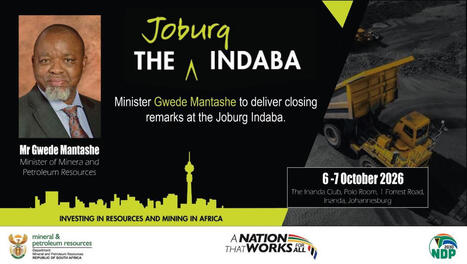
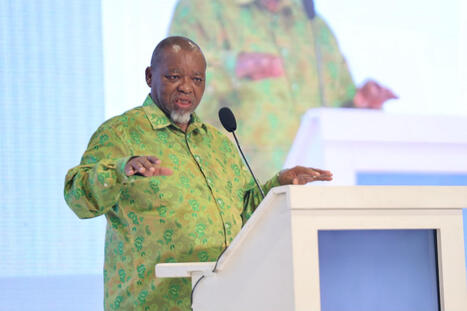
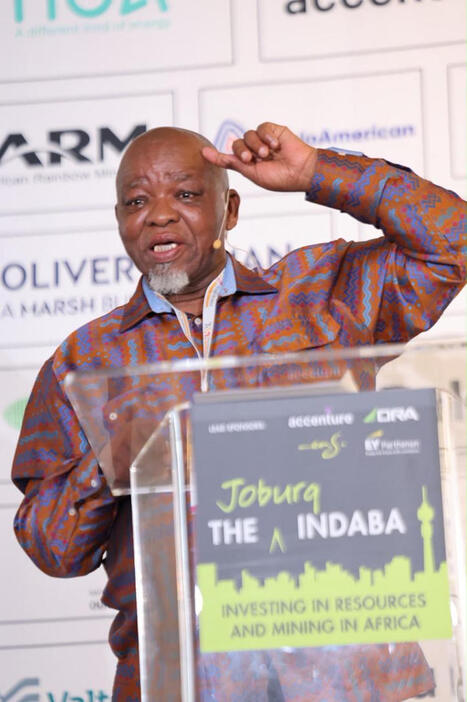
The Minister of Mineral and Petroleum Resources, Mr Gwede Mantashe, will today, 08 October 2026, deliver the closing remarks at the Joburg Indaba. Happening under the theme: “Investing in resources and mining in Africa”, The Joburg Indaba, now in its 14th year, takes place on 7 & 8 October 2026 at the Inanda Club, Johannesburg. Media Invitation
08 October 2026
MINISTER GWEDE MANTASHE TO DELIVER THE CLOSING REMARKS AT THE JOBURG INDABA
The Minister of Mineral and Petroleum Resources, Mr Gwede Mantashe, will today, 08 October 2026, deliver the closing remarks at the Joburg Indaba. Happening under the theme: “Investing in resources and mining in Africa”, The Joburg Indaba, now in its 14th
year, takes place on 7 & 8 October 2026 at the Inanda Club, Johannesburg. The Joburg Indaba has established itself as a critical platform where industry leaders engage in strategic conversations that are open, honest, bold, innovative and to the point. This is a gathering that draws captains of industry together with government and
investors who have found it an important platform to put forward their thoughts on the industry.
Members of the media are invited to join the Minister’s closing remarks as follows:
Date: Thursday, 08 October 2026
Time: 16:40
Venue: The Inanda Club, Forrest Road, Sandton. To register for the conference, please contact: Email: registrations@resources4africa.com or contact: +27 (0) 11 463 7799 For media enquiries:
Johannes Mokobane / Johannes.mokobane@dmpr.gov.za / mediadesk@dmre.gov.za; 082 766 3674 Ms Lerato Ntsoko – Lerato.ntsoko@dmpr.gov.za / mediadesk@dmpr.gov.za/ 082 549 2788 Ms Yolanda Mhlathi - Yolanda.Mhlathi@dmpr.gov.za / 067 258 1122
Programme Director, Deputy Minister of Mineral and Petroleum Resources, Ms Phumzile Mgcina Deputy Minister of Health, Dr Joe Phaahla Leadership of Organised Business Leadership of Organised Labour, Professional Associations, Representatives of various government Departments and State-Owned Entities Distinguished Guests, We meet here exactly two years after our last Mine Health and Safety Tripartite Summit, during which we assessed the state of the mining industry in terms of health and safety, and mapped out a path towards the attainment of Zero-Harm. Despite challenges, since our last meeting, the industry has recorded progress. In 2024 alone, the industry recorded 42 fatalities, marking the lowest fatalities in the history of South African mining. This record was further improved in 2025, with 41 fatalities. These figures represent a significant reduction from the historical 435 fatalities recorded during the Coalbrook disaster, 177 fatalities during the Kinross disaster, and 104 fatalities recorded at Vaal Reefs. However, even as we acknowledge this progress, we must bear in mind that these are not merely numbers. These are lives lost in the line of duty. These were breadwinners who left behind families to fend for themselves. This can be better understood and appreciated if we analyse these fatalities across the various commodities. The 2024 statistics indicate that the platinum sector recorded 18 fatalities, followed by gold with 12, coal with 6, chrome with 3, diamonds with 2, other mines with 1. In 2025, gold was the largest contributor with 21 fatalities, followed by platinum with 11, chrome with 3, and coal with 2. Regrettably, as of 14 September 2026, the industry had recorded 49 fatalities. Of these, 3 are classified as miscellaneous fatalities, referring to cases where the cause of death has not yet been determined. We, therefore, urge the industry to expedite investigations into these fatalities and ensure the timely finalisation of the causes of death. Establishing the circumstances surrounding each fatality is essential to strengthening preventative measures and advancing our collective commitment to Zero-Harm. By 14 September this year, the platinum sector accounted for 18 fatalities, followed by gold with 17, and diamonds with 5. In essence, platinum and gold collectively account for more than 70% of all fatalities recorded in 2026 alone, demonstrating the continued concentration of fatal risks within these two sectors. This brings into question: with the prices of gold and platinum doing well, could it be that mine owners are chasing profits at the expense of health and safety? We submit to this summit that the industry cannot put profits above the health and safety of workers. The industry must respect workers, because it is the workers who convert investments into wealth. An inherent risk to workers today that we need to address is contract work, which is a manifestation of exploitation and unemployment. Statistics show a correlation between the increase of contract workers in the mines and the increase in fatalities. This summit must discuss this issue and come up with recommendations on how best to resolve it. We cannot allow workers to be exploited perpetually simply because they are employed as contract workers. Every worker deserves fair treatment, decent working conditions, and protection from exploitation. It is the duty of all of us in this room, and of the entire industry, to ensure that the rights of workers are upheld, irrespective of the nature of their employment. Another emerging challenge that this industry must address is the issue of mineworkers who lose their lives while commuting to and from work. In our statistics, we do not record these as mine fatalities, even though the victims are mineworkers. Previously, mineworkers stayed in hostels and did not have to travel long distances by road to get to work. We did away with that system, and now many mineworkers are losing their lives on the roads. This summit must help us find solutions to this problem. An equally important issue for this summit to address is the conduct of mine owners who after an accident has occurred at their operations, they file for liquidation in an attempt to shift responsibility. A case in point is the Lily Mine and the Ekapa mine disaster, which claimed five lives, earlier this year. To us, doing so amounts to acting in bad faith, and it must never be allowed. In the case of Ekapa disaster, we insisted that the mine owners must retrieve the bodies, which was done successfully. We cannot allow a situation where mine owners extract minerals and derive value, but when disaster strikes, they run for cover and expect government to take responsibility. It is within this context that we maintain that the owners of the Lily Mine must take responsibility of retrieving the container and the bodies, so that the affected families can find closure. These issues remain a concern to us and underscore the need for sustained and comprehensive health and safety measures in South African mines. Non-Communicable Diseases (NCDs), including mental health disorder, remain a major cause of medical incapacity and fatalities in the industry. If we are to improve the health and safety of mineworkers and achieve our goal of Zero-Harm, we must work together to address these challenges, promote a culture of health and wellness, and ensure that workers receive the necessary support and care. This summit must, therefore, move beyond a mere assessment of progress against the milestones adopted in previous summits. We must move towards a clear programme of action that will take us to zero harm. If we are to attain this goal, workers must also take responsibility for their own health and safety. The Mine He alth and Safety Act (MHSA) gives every mineworker a legal right to leave, or refuse to enter, a dangerous working place. This right applies to every mineworker, whether a full-time or contract worker. It is your right. Exercise it. Do so for your own health and safety. Let us not use this summit for blame games. This is not the time for blame one another for our shortcomings. Let us use this summit to recommit ourselves to strengthening health and safety at our mines. This places a greater responsibility on each one of us in this room to agree on focused and implementable actions, with clearly defined outcomes, responsibilities, timelines, and reporting mechanisms. These mechanisms will enable us to monitor progress and intervene where implementation is inadequate. As government, we recommit to working with all social partners – business, labour, and communities – to enforce health and safety at our mines. I thank you.
Programme Director, Your excellencies, Ministers and Deputy Ministers Organisers of the Africa Energy Week, Members of the Diplomatic Corps, Captains of Industry, Distinguished Guests, It is an honour and a pleasure to welcome you to South Africa for the Africa Energy Week (AEW), an important platform for dialogue, cooperation, and investment in shaping the future of Africa’s energy sector. We gather at a critical moment for our continent and the world. Geopolitical tensions and disruptions to global energy markets continue to place significant pressure on our economies and our people. The ongoing conflict in the Middle East has once again demonstrated how developments in one region can have far-reaching consequences for countries and communities thousands of kilometres away. These developments have contributed to rising fuel prices, rising cost of living, thus placing additional burden on millions of people, businesses, and governments. Despite Africa’s abundant natural resources, including significant petroleum resources, we remain vulnerable to external shocks that threaten our energy security and economic stability. These realities demand decisive leadership. They call on us, as African leaders, not only to strengthen the energy sectors of our individual countries, but also to work as a collective in building a more integrated, resilient, and self-reliant African energy system. It is within this context that we welcome the theme of this year’s AEW: “Affordable and Abundant Energy Additions for Africa.” This theme speaks directly to the urgency of our task. It calls for bold investment, practical partnerships, and decisive action to unlock our continent’s diverse energy resources and ensure that affordable and reliable energy becomes accessible to all Africans. The current geopolitical environment has also underscored the strategic importance of Africa in global oil and gas markets. Our continent possesses substantial petroleum resources. Estimates indicate that approximately 77 billion barrels of oil equivalent have been discovered across Africa since 2010. This represents an enormous opportunity to strengthen energy security, stimulate industrial development and expand economic cooperation across our continent. However, the possession of natural resources alone does not guarantee energy security. The real value of these resources lies in our ability to develop them responsibly, process them locally and use them to build productive and competitive economies. For South Africa, access to diverse sources of crude oil and petroleum products has been important in managing the risks associated with disruptions to international supply routes, including those linked to the Strait of Hormuz. Our ability to source petroleum products through diverse markets, including African petroleum producers, reinforces the importance of diversifying supply and strengthening intra-Africa trade. Yet, while Africa has significant petroleum resources, our capacity to refine crude oil into products required by our economies remains inadequate. This is one of the critical vulnerabilities we must confront. In South Africa, our domestic petroleum refining capacity remains under pressure. At present, domestic supply of refined petroleum products relies significantly on two operational crude oil refineries, Astron Energy and Natref, alongside Sasol’s coal-to-liquids facility. Together, these facilities play an important role in supplying at least 40% of South Africa’s liquid fuel requirements. 60% of our refined petroleum products is imported. This level of import dependence exposes our economy to international price volatility, supply disruptions, and geopolitical uncertainty. It also means opportunities for local industrial development, skills transfer, and job creation are being realised elsewhere. Africa’s challenge is not access to petroleum resources; it is our capacity to convert those resources into reliable supplies of affordable petroleum products. We cannot afford to overlook the strategic importance of refining and related energy infrastructure. Investing in refining capacity is a strategic component of national energy security. It supports economic resilience, creates opportunities for local enterprises and strengthens our ability to respond to international market disruptions. For this reason, South Africa continues to pursue opportunities to mobilise investment in the revival, modernisation, and expansion of domestic refining capacity. We recognise the importance of African investment and African capital in this effort, alongside international partnerships that bring financing, technology, expertise and long-term commitment required to develop a competitive petroleum industry. The South African National Petroleum Company (SANPC) has an important role to play in advancing our national petroleum ambitions and supporting the development of a stronger and more resilient petroleum sector. We invite African and international partners, industry leaders, and development partners to work with us in pursuing those objectives. Our ambition extends beyond securing supplies for South Africa alone. We are working towards contributing to an African energy system that is integrated, more reliable and better equipped to withstand external shocks. When we invest in exploration, production, and refining, we invest not only in energy security, but also in industrialisation, employment, and the economic future of our people. The fact remains that, no African country can achieve lasting energy security in isolation. Our markets, infrastructure, resources, and economic ambitions are interconnected. We must, therefore, strengthen regional cooperation, expand cross-border trade, and create an environment in which energy investments can deliver benefits beyond national borders. This requires practical collaboration between governments, investors, and technical partners. It also requires us to recognise the strategic value of African capital, strengthening African financial institutions, and encouraging partnerships among African enterprises. Our approach must, therefore, be one of partnerships that respect national development priorities, promote local participation, and deliver measurable benefits to all Africans. Ultimately, our responsibility is to build an energy system that contributes meaningfully to the energy security of the African continent. Your excellencies, there is another important issue that we must confront honestly: the debate about fossil fuels and the global energy transition. Africa faces growing pressure to move away from fossil fuel development, even as many of our countries continue to struggle with energy poverty, limited industrial capacity, and inadequate infrastructure. We must approach this debate with clarity and a firm commitment to Africa’s development. Africa must reject the false choice between economic development and environmental responsibility. The circumstances of our continent differ significantly from those of many developed economies, which industrialised over generations with access to abundant and affordable energy, including fossil fuels. Millions of Africans still lack access to reliable electricity and modern energy services. many of our communities continue to face poverty, unemployment, and inequality. Our economies require reliable and affordable energy to expand manufacturing, develop infrastructure, support agriculture, grow businesses, and improve living standards. We cannot ignore these realities. Nor can we accept an approach that expects Africa to leave its natural resources undeveloped while its people continue to face energy poverty and limited economic opportunities. We recognise the need to protect our environment and build more sustainable energy systems. However, we must not be told to abandon development, not to disregard our environmental responsibilities. Ours is to pursue a balanced, responsible, and development orientated energy pathway that recognises Africa’s circumstances and serves the long-term interests of its people. I thank you.
|
Business structure and brands On 4 November 2011, Anglo American plc and CHL Holdings announced their agreement for Anglo American to acquire an incremental interest in De Beers, increasing Anglo American's 45% shareholding in the world's leading diamond company to 85%. De Beers plc was originally incorporated as De Beers Société Anonyme in 2000 in Luxembourg. Following the closure of this office, the company was reclassified as De Beers plc in 2017, with its head office now in Jersey. It is made up of two shareholdings: Anglo American plc has an 85% shareholding and the Government of the Republic of Botswana owns 15% directly. De Beers plc is the holding company of The De Beers Group of Companies.[97] It is involved in many parts of the diamond value chain, from mining to sales, and is made up of a series of joint ventures and wholly owned operations. The joint ventures are: The wholly owned operations are in southern Africa and Canada. Also wholly owned are Forevermark, De Beers Jewellers,[101] the International Institute of Diamond Valuation, De Beers Ventures, the International Institute of Diamond Grading & Research and Element Six (Umicore has a 40% stake in Element Six's abrasives division). Forevermark Forevermark was launched in 2008 as one of the two diamond brands from The De Beers Group of Companies. According to the company website, "Each Forevermark diamond is inscribed with a promise: that it is beautiful, rare and responsibly sourced." Forevermark diamonds are inscribed with an icon and unique identification number, albeit invisibly to the naked eye: the Forevermark inscription is 1⁄20th of a micron deep. This inscription helps distinguish Forevermark diamonds from other natural diamonds though, similarly to when distinguishing natural diamonds from synthetic diamonds, it requires specialist detection equipment to view. The inscription also helps maintain scarcity: the Forevermark website boasts that only a tiny percentage of diamonds qualify for the Forevermark brand.[102] De Beers London De Beers Diamond Jewellers (DBDJ) was established in 2001 as a 50:50 joint venture between The De Beers Group of Companies and LVMH, the French luxury goods company.[102] The first De Beers boutique opened in 2002 on London's Old Bond Street as the brand's flagship store. Since then, stores have opened in various cities around the world. In March 2017, The De Beers Group of Companies acquired LVMH's 50% shareholding in DBDJ and new name De Beers Jewellers was unveiled.[103] In 2025, De Beers Jewellers was rebranded as De Beers London.[104] De Beers Industry Services In 2008, De Beers founded The International Institute of Diamond Grading & Research (IIDGR), now known as the De Beers Industry Services. De Beers Industry Services provides grading and verification services for diamonds. De Beers Industry Services also includes the subgroup, the Institute of Diamonds which provides education courses. The Institute of Diamonds has campuses in the United Kingdom, Belgium and India.[105] ORIGIN - De Beers Group Origin - De Beers Group is the group's branded polished diamond offering available at participating non-De Beers branded retailers.[106] Blood diamonds and the Kimberley Process In 1999, a campaign by Global Witness to highlight the role of diamonds in international conflicts led to a review by the United Nations. The initial focus of the UN's investigation was on Jonas Savimbi's UNITA movement in Angola, which was found to have bartered uncut diamonds for weaponry despite international economic and diplomatic sanctions being in effect through United Nations Security Council Resolution 1173.[107][108] In 1999, De Beers Group stopped all outside buying of diamonds in order to guarantee the conflict-free status of their diamonds effective from 26 March 2000.[109][110][111] In December 2000, following the recommendations of the Fowler Report, the UN adopted the landmark General Assembly Resolution A/RES/55/56[112] supporting the creation of an international certification scheme for rough diamonds. By November 2002, negotiations between governments, the international diamond industry, led by De Beers, and civil society organisations resulted in the creation of the Kimberley Process Certification Scheme (KPCS), which sets out the requirements for controlling rough diamond production and trade and became effective in 2003.[citation needed] De Beers states that 100% of the diamonds it now sells are conflict-free and that all De Beers diamonds are purchased in compliance with national law, the Kimberley Process Certification Scheme[113] and its own Diamond Best Practice Principles.[114] The Kimberley process has helped restore the reputation of the industry, as well as eliminating sources of excess supply.[115] In 2018, De Beers used blockchain technology to successfully track 100 high-value diamonds.[116] The diamonds were tracked through the manufacturing process from the mine to the retailer in order to ensure their quality and conflict-free status.[117] In 2019, they launched their own end-to-end traceability platform called Tracr to enable all diamonds to be identified and traced as they move from the mine to the store. Signet and the Russian-based Alrosa are using the technology.[118] Corporate affairs Headquarters at 17 Charterhouse Street, London In August 2017, De Beers partnered with the Stanford Graduate School of Business to accelerate business ventures to market in Botswana, Namibia, and South Africa.[119] As part of two programs, the partnership is set to help teach early entrepreneurs how to commercialize their business ideas.[120] The partnership is a three-year, $3 million deal.[121] In September 2017, De Beers partnered with UN Women to help the advancement of women within the company and the countries it operates in.[122] In 2018, the two entities launched a program to support 500 women micro-entrepreneurs in Blouberg and Musina communities, near De Beers's Venetia diamond mine.[123] Former operations International Institute of Diamond Valuation The International Institute of Diamond Valuation (IIDV) was launched by De Beers Group in March 2016. Operating in partnership with diamond jewellery retailers, it provided a reselling service for all diamonds, regardless of value.[124][125][126] In April 2019, De Beers closed its IIDV division.[127] De Beers Ventures De Beers Ventures was established by De Beers Group in June 2017 to consider minority stake investments in start-ups and growth companies that could be of benefit to De Beers Group or the broader diamond sector.[128][129] It has since been dispanded. Legal issues Sherman Antitrust Act During World War II, Ernest Oppenheimer attempted to negotiate a way around the Sherman Antitrust Act by proposing that De Beers register a US branch of the Diamond Syndicate Incorporated. In this way, his company could provide the US with the industrial diamonds it desperately sought for the war effort in return for immunity from prosecution after the war; however, his proposal was rejected by the US Justice Department when it was discovered that De Beers had no intention of stockpiling any industrial diamonds in the US.[36] In 1945, the Justice Department finally filed an antitrust case against De Beers, but the case was dismissed as the company had no presence on US soil.[130] Relocation of Indigenous San people in Botswana As of 2024, De Beers owns and operates, solely or jointly, five diamond mines in Botswana.[131] A long dispute has existed between the interests of De Beers and the San (Bushman) tribe. The San have been facing threats of forcible relocation since the 1980s, when the diamond resources were discovered.[132] A campaign was fought in an attempt to bring an end to what the indigenous rights organisation, Survival International, considers to be a genocide of a tribe that has been living in those lands for tens of thousands of years.[133][134][135] Several international fashion models, including Iman, Lily Cole and Erin O'Connor, who were previously involved with advertising for the company's diamonds, supported the campaign.[136][137] De Beers sold one mine in Botswana to Gem Diamonds in 2007.[132] Industrial diamonds In 2004, De Beers pled guilty and paid a US$10 million fine to the United States Department of Justice to settle a 1994 charge that De Beers had colluded with General Electric to fix the price of industrial diamonds.[138][139] In 2008, De Beers agreed to pay a US$295 million class-action settlement after accusations of price fixing.[140] The company appealed against the decision but ended up paying the settlement in 2013.[141] European Commission In February 2006, De Beers entered into legally binding commitments with the European Commission to cease purchasing rough diamonds from Russian mining company Alrosa as of the end of 2008 in order to ensure competition between the two companies.[142] South Africa's rough diamond trade In 2014, the Leverhulme Centre for the Study of Value, based at the University of Manchester, published a report authored by Sarah Bracking and Khadija Sharife, identifying over US$3.3 billion in price fixing within the South African rough diamond trade from 2004 to 2012, leading to an estimated deficit in tax paid of ZAR 1 billion per year. The report found significant evidence of profit shifting through volume and value manipulation.[143][144] Sharife simultaneously published an article[145] disclosing the political system that cultivated revenue leakage, including the donation of De Beers staff to the State Diamond Trader (SDT). The report, like the article, utilised aggregated data produced by the Kimberley Process (KP) certificates of import-exports, relying on figures listed by the diamond companies themselves, in which De Beers was the dominant player. The South African Department of Mineral Resources (DMR) disclosed that De Beers did not authorise them to publish figures involving values, sales, pricing and other data, preventing transparency of the industry.[citation needed] See also
Brian Benza, Olivia Kumwenda-Mtambo By Reuters Published November 9, 2026 at 14:35 GMT Diamonds are displayed during a visit to the De Beers Global Sightholder Sales (GSS) in Gaborone, Botswana November 24, 2015. REUTERS/Siphiwe Sibeko/File Photo GABORONE, Nov 9 (Reuters) – Botswana’s President Duma Boko said on Monday that his country would double its stake in De Beers to 30%, after Anglo American put up for sale its 85% stake in the diamond producer. Boko added in an address to parliament that the Global Diamond Consortium, a group led by former De Beers CEO Gareth Penny, had been selected as the preferred bidder.
09 November 2026 06:50 AM De Beers has made Angola the centre of its largest active diamond-exploration programme worldwide after investing $15 million in the search for new deposits. The London-headquartered diamond group has expanded its exploration operations to 16 areas as it seeks discoveries capable of supporting a large commercial mine. Angolan President João Lourenço met De Beers chief executive Al Cook as the diamond group expanded its exploration operations to 16 areas. [cipra.gov] - De Beers has spent $15 million on diamond exploration in Angola.
- Angola now hosts the company’s largest active exploration programme.
- Operations have expanded to 16 areas across the country.
- Any multibillion-dollar mine depends on commercially viable discoveries.
Chief executive Al Cook said a successful exploration programme could eventually lead to a diamond mine requiring billions of dollars in investment. However, the proposed mine remains conditional. De Beers has not announced a commercially viable discovery, approved a mine or provided a formal development budget. According to the Angolan presidency’s official communications platform, Cook disclosed the $15 million exploration expenditure after meeting President João Lourenço at the Presidential Palace in Luanda. “We will try to develop the exploration into a diamond mine. This is a very serious investment, which could reach billions of dollars,” Cook said. Cook made clear that the potential investment would depend on the results of the current prospecting work. De Beers is also investing more than $15 million in sustainable environmental projects in southern Angola. That expenditure is separate from the $15 million spent on diamond exploration and should not be added to the exploration figure. De Beers expands its search to 16 areas Angola’s Ministry of Mineral Resources, Petroleum and Gas separately confirmed that De Beers had expanded its exploration operations to 16 areas. The disclosure followed Cook’s meeting with Mineral Resources, Petroleum and Gas Minister Diamantino Azevedo on November 3. The company wants to move from early prospecting to production projects if drilling and geological studies identify diamonds that can be extracted profitably. De Beers returned to Angola in 2022 after leaving the country in 2012. It signed two mineral-investment contracts with the government covering exploration and potential mining activities. De Beers chief executive Al Cook says Angola now hosts the company’s largest active diamond-exploration programme worldwide. [De Beers] The agreements created joint ventures with Endiama, Angola’s state-owned diamond company, and gave De Beers access to exploration areas in the country’s north-east. In February 2024, De Beers signed a wider memorandum of understanding with the Angolan government, Endiama and state diamond-marketing company Sodiam. The partnership covers exploration, the evaluation of existing deposits, diamond traceability, support for artisanal miners and the international promotion of Angolan stones. De Beers says its Angola operation has also assembled and trained a workforce that is 90% Angolan. First new De Beers kimberlite field in more than 30 years The company’s renewed Angola strategy produced an important geological breakthrough in 2025. In July of that year, De Beers and Endiama encountered kimberlite while drilling one of their priority targets. Kimberlite is the rock formation in which diamonds can occur. De Beers described it as its first discovery of a new kimberlite field in more than three decades. The announcement did not establish that the deposit contained diamonds in sufficient quantities or quality to support a commercial mine. Further drilling, laboratory analysis and geological work are required before the company can estimate the size, grade and economic value of any deposit. This distinction is important because discovering kimberlite does not automatically mean that a profitable diamond mine will follow. De Beers’ $15 million represents money already spent on exploration. Cook’s reference to billions of dollars describes the possible cost of developing a future mine if commercially viable diamonds are confirmed. No final investment decision has been taken. De Beers has spent $15 million on diamond exploration in Angola, while any future multibillion-dollar mine remains dependent on successful geological findings.. REUTERS/Fred Prouser Angola rises among the world’s largest diamond producers De Beers’ expanding search comes as Angola strengthens its position in the global natural-diamond industry. Angola produced approximately 15.2 million carats of rough diamonds in 2025, according to Kimberley Process data. The stones were valued at about $1.81 billion. The country exported 17.06 million carats worth approximately $1.65 billion during the year. Exports can exceed annual production when they include diamonds held in inventories from previous periods. The Angolan mining ministry, drawing on the Kimberley Process figures, ranked the country as the world’s third-largest rough-diamond producer by volume in 2025, behind Russia and Botswana. Despite its production, De Beers believes large parts of Angola remain insufficiently explored. The company’s bet is that modern geological surveys and drilling technology could uncover deposits capable of extending the supply of natural diamonds as production declines at some older mines elsewhere. A major investment during uncertainty over De Beers’ ownership The Angola expansion is proceeding while De Beers’ own ownership remains under review. London-listed Anglo American owns 85% of the diamond company, while the government of Botswana holds the remaining 15%. Anglo American has been seeking to sell its stake as part of a wider restructuring, following weak natural-diamond prices, reduced luxury demand in China and increasing competition from laboratory-grown stones. Angola has previously expressed interest in obtaining a stake in De Beers as African diamond-producing countries seek greater influence over the production and marketing of their natural resources. No completed ownership transaction has been announced, and De Beers’ exploration programme in Angola is continuing during the sale process. For Angola, the immediate issue is whether the 16 exploration areas produce a commercially viable discovery. If they do, the country could host a new mine requiring considerably more capital than the $15 million invested in prospecting so far.
Sunday 8 November 2026 1 min read Another earthquake recorded near Kamanjab Another earthquake was recorded outside Kamanjab in the Kunene region on Saturday afternoon. This comes two weeks after an earthquake was recorded in the same area 6km west of Kamanjab. The latest earthquake, with a 5.1 magnitude, struck 29km southwest of Kamanjab. Ministry of Industries, Mines and Energy acting deputy executive director Filadelphia Mbingeneeko in a statement released on Sunday says the earthquake was recorded about 13km east of Anker at 17h22. “The event was recorded by six local seismic stations from the Namibian Seismological Network, namely Windhoek, Kamanjab, Rundu, Opuwo, Aus and Ariamsvlei,” he says. Newspaper subscription It was also recorded by two other regional seismic stations from the South African Seismological Network. “Prior to this event, a foreshock was recorded at 16h44 in the same area with a local magnitude of 3.7,” Mbingeneeko says. The ministry says in anticipation that aftershocks may occur, the public is advised to step outside for safety if they are indoors when possible, or alternatively find refuge under a table. “If you are outdoors, find a clear spot well clear of buildings, trees and power lines,” Mbingeneeko says.
South Africa’s diamond production has felt the impact of lab-grown diamonds firsthand. This year, Petra Diamonds placed its Finsch Diamond Mine under business rescue, and De Beers announced a two-year production pause at Venetia, the country’s largest diamond producer. A still image from a video shows coloured synthetic diamonds on display at De Beers’ International Institute of Diamond Grading and Research in Maidenhead. Image credit: Reuters/Reuters TV As a result, Minister of Mineral and Petroleum Resources Gwede Mantashe said his department has created a task team to help the country’s diamond producers address the challenges they face. According to SABC News, Mantashe indicated, in a written parliamentary reply, that the Minerals Council South Africa (MCSA) and diamond producers would also serve on the task team. He added that lab-grown diamonds and global inflationary pressures are affecting major and junior producers, as well as small diamond miners, with small-scale miners hit the hardest. In the August mining production data, diamonds saw the biggest drop, with production down 19.5% year-to-date. Read more: SABC News, De Beers, MCSA, Gwede Mantashe, Petra Diamonds, diamond mining in South Africa, diamond mining, Minerals Council South Africa, diamond production, lab-grown diamonds, Department of Mineral and Petroleum Resources
Diamond firm De Beers has agreed to sell its loss making Kimberley underground mines to Petra Diamonds and its black partners. De Beers said yesterday that details of the transaction, including the financial settlement and output figures for the underground mine, would be given today. The Kimberley underground operations in the Northern Cape were closed in late 2005 by De Beers, which is 45 percent owned by Anglo American. - Reuters, Johannesburg
14 September 2007 Johannesburg - Diamond mining junior Petra Diamonds said on Friday that it has entered into an agreement with siamond giant De Beers to acquire its underground operations at kimberley Mines for R78.5m. But Petra may only end up forking out R15m of thar price since its says De Beers rehabilitation obligation with regards to Kimberley Underground, estimated at R63.5m, would go towards the purchase consideration. Petra said in a statement that it would ultimately end up holding a 74% interest in the Kimberley Underground mines since its black economic partner, Sedibeng Mining, would hold 26%. No details have been provided regarding Sedibeng's obligations with regard to purchasing this 26% stake. In terms of the agreement signed, Petra is to acquire the minig and associated assets of the Wesselton, Du Toitspan and Bultfontein mines, which together make up the Kimberley Underground mines.
De Beers and Petra Relationship
De Beers and Petra Diamonds share a long-standing commercial relationship characterized by Petra acquiring mature or non-core diamond mining assets from De Beers, alongside downstream rough diamond transactions. Key Aspects of the Relationship * Asset Acquisitions: Over the years, Petra Diamonds has purchased several major South African diamond mines that De Beers deemed non-core or aged out of its primary portfolio:
• Koffiefontein Mine: Acquired by Petra from De Beers.
• Kimberley Mines: Sold by De Beers to an Ekapa Mining and Petra consortium in 2015–2016 (following earlier historical involvement).
• Finsch Mine: Purchased by Petra from De Beers in 2011 for R1.425 billion (approximately US$210 million).
* Rough Diamond Sales / Collaboration: Petra has occasionally sold high-value or specialty stones recovered from its mines (such as rare type IIb blue diamonds from the Cullinan mine) directly to or in partnership with De Beers and Diacore.
* Industry & Market Perspectives: Leadership at Petra Diamonds has publicly commented on and welcomed structural shifts involving De Beers, noting that an independent De Beers (following Anglo American's planned divestment/unbundling) could bring renewed focus and marketing support to the global natural diamond sector.
* Current Sector Pressures: Both companies navigate shared market challenges in South Africa, including the rising impact of lab-grown diamonds and economic pressures affecting major and mid-tier producers.
You can read more about Petra's portfolio evolution on the Petra Diamonds Heritage Page and review historical transaction archives via De Beers Group News.
De Beers: The Pioneers of the Diamond Industry De Beers is a name that has become synonymous with diamonds,luxury, and timeless romance. From its humble beginnings in South Africa to its position as a global giant in the diamond industry, De Beers has not only shaped how the world perceives diamonds but also set the foundation for the modern diamond market. Let’s dive deep into the fascinating, detailed history of De Beers. The Discovery of Diamonds in South Africa The story of De Beers begins in the 1860s when diamonds were discovered in South Africa. Farmers on the banks of the Orange River found sparkling stones in their fields, leading to a diamond rush that attracted miners and prospectors from all over the world. Among these prospectors was Cecil Rhodes, a British entrepreneur who saw an opportunity in the diamond mines. Rhodes initially started by renting out water pumps to miners but soon realized the true potential of owning the mines themselves. The Founding of De Beers Consolidated Mines In 1888, Cecil Rhodes consolidated various small mining operations into one company, De Beers Consolidated Mines Limited. The name "De Beers" came from two brothers who owned the farmland where many of the diamonds were discovered. Rhodes' vision was ambitious: to control the diamond supply on a global scale. He believed that controlling production and distribution was the key to maintaining the value of diamonds. With funding from powerful investors like Alfred Beit and the Rothschild family, Rhodes turned De Beers into the dominant force in the diamond industry. By the early 1900s, De Beers controlled over 90% of the world's diamond production. This monopoly allowed the company to regulate diamond supply and prices, ensuring diamonds remained rare and valuable. Creating the Demand for Diamonds De Beers wasn’t just about mining; it was also about marketing. In 1947, De Beers launched one of the most successful advertising campaigns in history with the slogan, “A Diamond is Forever.” The campaign was designed to link diamonds with eternal love and commitment, making them the ultimate symbol of romance. Before this campaign, diamonds were not universally associated with engagement rings. De Beers changed that by creating a cultural expectation that every engagement should involve a diamond ring. The campaign was a game-changer. It positioned diamonds as a must-have luxury item and significantly boosted sales. The idea that a diamond is an everlasting symbol of love is now deeply ingrained in societies worldwide. The Kimberley Process and Ethical Sourcing In 2003, De Beers played a significant role in establishing the Kimberley Process Certification Scheme, a global initiative to prevent the trade of conflict diamonds. The Kimberley Process ensures that diamonds sold in the market are ethically sourced and free from conflict. De Beers also introduced blockchain technology to track the journey of each diamond, ensuring transparency from mine to market. This commitment to ethical practices has helped De Beers maintain trust among consumers. Modern Innovations and Challenges While De Beers maintained its dominance for much of the 20th century, the 21st century brought new challenges. The rise of synthetic or lab-grown diamonds posed a threat to the traditional diamond market. To address this, De Beers launched its own lab-grown diamond brand, Lightbox Jewelry, offering affordable, high-quality synthetic diamonds for consumers seeking an alternative to natural diamonds. De Beers has also invested heavily in sustainability, ensuring that its mining operations minimize environmental impact. By focusing on innovation and ethical practices, the company has adapted to the changing expectations of modern consumers. Why De Beers Matters Today De Beers is more than just a diamond company; it’s a brand that has shaped how the world views and values diamonds. From creating the idea of diamonds as a symbol of love to ensuring ethical sourcing practices, De Beers has left an indelible mark on the luxury market.
The Minister of Mineral and Petroleum Resources hereby announces the adjustment of fuel prices based on current local and international factors with effect from the 7 th of October 2026. Media Statement – Fuel Price Adjustments for October 2026 MEDIA STATEMENT THE MINISTER OF MINERAL AND PETROLEUM RESOURCES ANNOUNCES ADJUSTMENT OF FUEL PRICES EFFECTIVE FROM THE 7 TH OF OCTOBER 2026 The Minister of Mineral and Petroleum Resources hereby announces the adjustment of fuel prices based on current local and international factors with effect from the 7 th of October 2026. South Africa’s fuel prices are adjusted monthly, informed by international and local factors. International factors include the fact that South Africa imports both crude oil and finished products at a price set at the international level, including importation costs, e.g., shipping costs. The main reasons for the fuel price adjustments are as follows: 1. Crude oil prices The average Brent Crude oil price increased from 87.89 US Dollars (USD) to 101 USD during the period under review. The increase is due to the continued US/Iran tensions, uncertainty regarding the flow of oil through the Strait of Hormuz, higher shipping costs and decreasing inventories. 2. International petroleum product prices The average international product prices of petrol, diesel and illuminating paraffin increased due to supply shortages caused by lower global inventories of products. These factors led to higher contributions to the Basic Fuel Prices (BFP) of petrol, diesel and illuminating paraffin by 329.07 cents per litre (c/l) 280.17 c/l and 357.23 Media Statement – Fuel Price Adjustments for October 2026 c/l, respectively. The prices of Propane and Butane also increased during the period under review due to supply uncertainties. 3. Rand/US Dollar exchange rate The Rand appreciated slightly on average, against the US Dollar (from 16.213 to 16.212 Rand per USD) during the period under review when compared to the previous one. This led to lowerer contributions to the Basic Fuel Prices of petrol, diesel and Illuminating Paraffin by 0.17 c/l, 0.22 c/l and 0.21 c/l respectively. 4. Implementation of the Slate Levy The cumulative slate amounted to a negative balance of R10.45 billion for petrol and diesel of at the end of August 2026. In line with the provisions of the Self� Adjusting Slate Levy Mechanism, the slate levy of 87.66 c/l will be implemented in the price structures of petrol and diesel with effect from the 2 nd of September 2026. The Slate Levy has increased by 4.38 c/l from 83.28 to 87.66 c/l. 5. Octane differentials between 95 and 93 petrol grades In line with the Working Rules to determine the Basic Fuels Prices (BFP), the 95 Octane (unleaded) grade is the price-marker grade and the BFP-differential between 95 and 93 Octanes is adjusted on the first Wednesday of each quarter. The BFP Octane differential has changed during the previous quarter and therefore the retail prices of 95 and 93 petrol octanes will be different in each fuel� pricing zone with effect from the 7 th of October 2026. 6. The Maximum Refinery Gate Price (MRGP) for LPGas that is imported through the Port of Saldanha Bay in the Western Cape province. The Maximum Refinery Gate Price (MRGP) and the Maximum Retail Price (MRP) of LPGas that is imported through the Port of Saldanha Bay will be R 15 525.62 per metric ton and R 37.08 per kilogram, respectively, effective from the 7th of October 2026. Media Statement – Fuel Price Adjustments for October 2026 Based on current local and international factors, the fuel prices for October 2026 will be adjusted as follows: ❖ Petrol 93 (ULP & LRP): Three hundred and twelve cents per litre (312.000 c/l) increase. ❖ Petrol 95 (ULP &LRP): Three hundred and thirty-three cents per litre (333.000 c/l) increase. ❖ Diesel (0.05% sulphur): Two hundred and eighty-four point three eight cents per litre (284.380 c/l) increase. ❖ Diesel (0.005% sulphur): Three hundred and twenty-four point three eight cents per litre (324.380 c/l) increase. ❖ Illuminating Paraffin (wholesale): Three hundred and fifty-eight cents per litre (358.000 c/l) increase. ❖ SMNRP for IP: Four hundred and seventy-seven cents per litre (477.000 c/l) increase. ❖ Maximum Retail Price of LPGas: Forty-two cents per kilogram (42.00 c/kg) increase and Forty-eight cents per kilogram (48.00 c/kg) increase in the Western Cape. The fuel prices schedule for the different Magisterial District Zones (MDZ) will be published on Tuesday, the 6 th of October 2026. Enquiries : mediadesk@dmpr.gov.za Ms Yolanda Mhlathi – yolanda.mhlathi@dmpr.gov.za / 067 258 1122 Mr Johannes Mokobane - johannes.mokobane@dmpr.gov.za / 082 766 3674 Ms Lerato Ntsoko – lerato.ntsoko@dmpr.gov.za / 082 459 2788
Programme Director, Deputy Mayor of eThekwini Municipality, Councillor Zandile Myeni, Representatives of various government Departments, Representatives of various State-Owned Entities, Representatives of various mining houses, Distinguished Guests, Let me start by thanking you all for joining us at this important Women in Mining and Petroleum Conference. Your participation in this meeting provides us with an opportunity to collectively address one of the most pressing challenges facing women who seek meaningful participation in the mainstream economy – lack of access to information. The fact remains that South Africa has been an active mining jurisdiction for more than a century. Together with the petroleum sector, these sectors remain among the most significant drivers of economic growth, industrial development, foreign direct investment, and employment creation. Yet, despite this contribution over many years, many people – women in particular – were historically excluded from meaningful participation in these sectors of the economy. The dawn of democracy in 1994 signalled the beginning of a process of transformation, from an era of marginalisation to a constitutional democracy anchored on the principles of unity, non-racialism, non-sexism, and prosperity. Since then, government has made significant strides towards transforming the economy by enabling more historically disadvantaged persons to participate meaningfully in economy activities. Various policies and legislative frameworks have been put in place to drive this transformation. In the minerals and petroleum sectors, the enactment of the Minerals and Petroleum Resources Development Act (MPRDA) in 2002 marked a significant shift towards this transformation. Anchored on Freedom Charter’s clarion call that “the people shall share in the country’s wealth,” the MPRDA placed the custodianship of the country’s mineral and petroleum resources in the hands of the state, on behalf of the people as a whole. This means, women - irrespective of their geographical location in the country - have a stake in the country’s mineral and petroleum resources. They also have an equal opportunity to participate in core activities within these sectors. Today, more 78 000 women are actively participating in the mining industry. The same is true of the petroleum sector, where thousands of women are actively participating. Most importantly, women are not participating merely as employees. Some are also leading multinational companies and occupying senior positions across the managerial and executive echelons of these industries. This is our reality today. Let us be frank, these women are not done a favour. They are professional women, and they have demonstrated that they are capable of leading in these sectors. Yet, despite this progress, lack of access to information remains one of the greatest barriers preventing even greater participation by women in the mining and petroleum sectors. To be honest, this is not necessarily because women are not making efforts to find information. In many instances, the information they require already exists. The challenge is that it is not always easily accessible, understandable, or effectively reaching those who need it most. Getting the right information to the right people, therefore, requires deliberate and sustained intervention. It is against this background that we have decided to host this Women in Mining and Petroleum Conference as a platform for sharing information on existing initiatives that government, together with industry and other social partners, is driving to increase the participation of historically disadvantages persons in these sectors. This includes, but is not limited to, information on policy and regulatory advancement, licensing requirements, financing mechanisms, business development, and procurement opportunities within these sectors. Let me take this opportunity to highlight some of the initiatives being driven by the Department. The industry, including some of our State-Owned Entities represented here today, will elaborate further on other opportunities available. At the apex of the Department’s priority areas is the need to accelerate transformation in the mining and petroleum sectors by driving policies that will enable greater participation of historically disadvantaged individuals. Recognising the persistent challenges faced by Artisanal and Small-Scale miners, the Department introduced the Artisanal and Small-Scale Mining (ASSM) Policy in 2022 to foster the creation of a formalised ASSM industry that can operate optimally and sustainably, while making meaningful contribution to the economy. To further strengthen the formalisation of the artisanal and small-scale mining industry, through the Mineral Resources Development Amendment Bill, we are making provision for matters relating to this sector and addressing some of the issues that have been viewed as prohibitive to its development and growth. Notwithstanding the ongoing review of the legislation, the Department continues to empower artisanal and small-scale miners through targeted financial assistance provided through the Artisanal and Small-Scale Mining Fund. During the 2025/26 financial year alone, the Department assisted 20 artisanal and small-scale mining projects with capital equipment, operational expenditure, and rehabilitation guarantees to the value of R59.7 million. A further R31.12 million has been set aside to assist more artisanal and small-scale miners during the current financial year. An equally important programme driven by the Department, in partnership with the Industrial Development Corporation (IDC), is the Junior Miners Exploration Fund (JMEF). Through the JMEF, the Department is making inroads towards reigniting mineral development and accelerating new mineral discoveries, while simultaneously driving the participation of historically disadvantaged persons in the industry. Since the establishment of the Fund, the Department is currently supporting 15 exploration projects to the value of R400 million across the country. As part of our ongoing efforts to expand the Fund and reach even more junior miners and exploration projects, we are collaborating with the industry and other role-players. These efforts are taking shape and are showing great promise in revitalising exploration and increasing South Africa’s share of global exploration expenditure. Anglo American has already pledged R600 million to the Fund, while the Public Investment Corporation (PIC) has committed a further R1.35 billion to serve as Continuation Fund. This will provide a seamless transition for the project pipeline emerging from the JMEF. In addition to the financial assistance, the Department continues to host nationwide awareness programmes aimed sharing information and educating society about the licensing processes. We urge all aspiring and potential miners to attend these workshops. They are proving to be valuable platforms for those who seek to understand the regulatory environment and the opportunities available within the sector. In keeping with the theme, “Empowered Women, Empower the Nation,” let us seize this opportunity and use this conference to help one another to achieve greater success in these sectors. Let us not leave here without tangible commitments, clear timelines, and defined responsibilities for each social partner. Let us the share the responsibility of transforming these industries, driving inclusive economic growth, eradicating poverty, and fostering equality. Together, we can build the globally competitive mining and petroleum sectors of our dreams – sectors that create opportunities, unlock economic value, and benefit many generations to come. Let us share information, take advantage of the existing opportunities, and create practical pathways for women to participate meaningfully across the entire economic value chain. I thank you.
Chairperson, Mr Bernard Swanepoel Captains of the Industry, Distinguished Guests, As we come to the end of this year’s Joburg Indaba, I would like to reflect on the state of the industry and, more importantly, on what we must do to unlock its next phase of growth. I want to focus on four pillars that we believe are fundamental to the future of mining in South Africa: exploration, value addition, skills development, and market diversification. 1These are practical imperatives if we are serious about building a globally competitive and more inclusive mining industry. Let me start with investment in exploration. The reality that we must all accept is that there can be no mining without exploration. If we want new discoveries, new opportunities, and new mines, then we must invest in finding minerals that will underpin the next generation of our mining industry. The government is making tangible progress through the Junior Mining Exploration Fund (JMEF), where we are deliberately driving the participation of historically disadvantaged South Africans in the industry while, at the same time, reigniting mineral exploration and development. However, we face a stubborn reality. The industry’s investment in exploration remains far below what is required. With the notable exception of Anglo American, which has pledged R600 million to the Fund, the broader industry has not yet come forward with the level of commitment that this challenge demands. it is not desirable for established mining companies to wait for junior miners to make discoveries and then enter the picture once the risk has been reduced. We need partnerships from the beginning. We need established companies to work with junior miners, share expertise, technology, capital, and geological knowledge. The industry itself must take calculated risks in order to discover the deposits that will become tomorrow’s mines. We must be clear that exploration cannot be the responsibility of government alone. Yes, government must create an enabling environment - which we are working on - but the industry must also carry their share of the responsibility. The second pillar is investment in value addition closer to the point of production. Let us be frank. We cannot continue with a mining model that is fundamentally based on pit-to-port. For far too long, the industry has extracted minerals from our country, exported them elsewhere and watched other economies capture much of the value, industrial capacity, and employment associated with those minerals. The reality is that, when we export raw minerals, we are not only exporting a commodity. We are actually exporting jobs and, in many instances, the opportunity to build value chains around our mineral wealth. This is not about placing the entire burden of beneficiation on the mining industry. It is about recognising that government and industry have a shared responsibility to build the infrastructure, systems, and investment environment required for value addition. We must collectively mobilise investment into processing, manufacturing, and downstream industries closer to where minerals are produced. South Africa should not merely be a country that digs minerals out of the ground. We must be a country that captures more of the value our minerals create. The third pillar is skills development. We need geologists, mining engineers, metallurgists, artisans, technicians, researchers, managers, and entrepreneurs. We also need institutions that are capable of producing these skills and supporting the transformation of the sector. Without the right skills and institutional capacity, we will not fully benefit from our mineral endowment. That is why investment in education and training is not a peripheral issue, but an investment in the future of mining itself. We must, therefore, pay attention to young people and women. We must ensure that the mining industry of tomorrow is not only technologically advanced, but also diverse, sustainable, and socially inclusive. This is why the establishment of the mining school in the North West remains so important. Government has a role to play, but we need the industry to help us get that institution running. The fourth pillar is market diversification. The geopolitical volatility we are experiencing has demonstrated that the dependence on a limited number of markets creates vulnerability. If we are serious about sustaining the mining industry and growing the South African economy, we must diversify our markets. We must deepen our trade relationships, by developing new markets while strengthening existing ones. We must position South Africa to participate meaningfully in the mineral value chains emerging around the world. There is another matter that must remain central to our discussions, and that is: economic inclusion and transformation. Our transformation policy is rooted in a historical reality that, for many decades, black South Africans were deliberately excluded from meaningful participation in the economy. Transformation is, therefore, about correcting that exclusion and ensuring that more black South Africans participate meaningfully in the ownership, management, and development of our economy. That is not an ideological argument, but a question of economic justice and practical experience. Quite clearly, the difference between us and those who oppose transformation is, among other things, a difference about who should benefit from economic change. There are those who benefited from apartheid and there are those who were excluded by it. That historical difference continues to shape our economic realities, and rankly speaking, that is not ideology. It is lived experience. That is why we continue to urge the industry to invest in impactful projects in mining affected communities and labour sending areas, through their Social and Labour Plans (SLPs). Encouragingly, these investments are increasingly translating into lasting infrastructure that will benefit future generations, including the Steelpoort Bridge, Tlhokomelong Clinic, SJ Skenjana School, and the fencing of agricultural land to support sustainable food production. The study on the state of South Africa’s mining industry has demonstrated not only the depth and diversity of our mineral endowment, but also the contribution that different commodities can make to inclusive economic growth, job creation, and poverty alleviation. Every mineral has a role to play. We are already seeing important developments. Just last week, we officially opened Phase 1 of the Steenkampskraal Monazite Plant – a significant milestone as one of the world’s highest� grade rare earth deposit moves from the laboratory to commercial mineral processing. This is an important development, not only for the mine itself, but for South Africa’s position in the global critical minerals’ economy. It adds to a number of developments taking place across the industry, including the opening of Qala Shallows Gold Mine, New Mine 1 at Matla Colliery, Naudesbank Colliery, and the Platreef Mine. These developments speak to the reconfiguration of the South African mining industry. 8Some people do not fully appreciate this reality because many of these investments are being driven by black South Africans and speak directly to our transformation objectives. We have seen the emergence and growth of companies such as the African Rainbow Minerals (ARM), Exxaro, Seriti, Thungela, and Valterra, reflecting changes in ownership and control that have taken place across the sector. These companies did not emerge in isolation. They emerged from a broader reconfiguration involving companies and assets historically associated with Anglo American, Anglovaal, Rand Mines, Johannesburg Consolidated Industries, and Gencor. Companies such as Sibanye-Stillwater and Harmony are themselves products of the reconfiguration of the industry. This is the reality of a changing mining industry. We must appreciate that a mining industry that does not broaden participation will struggle to retain its social legitimacy and its place in a changing South African economy. Before I conclude, there is one issue that the industry cannot compromise, that is the health and safety of mineworkers. 9Yes, we have made progress over the years. In 2025, the industry recorded 41 mine fatalities - the lowest record in the history of mining in South Africa. Regrettably, this year began with a disaster at Ekapa mine, where five mineworkers lost their lives. As we meet today, the industry has already recorded 52 fatalities, with the gold and platinum sectors being the largest contributors. Every one of those deaths represents a family that has lost a loved one. It is clear, we still have a lot of work to do to realise the goal of Zero Harm. We, therefore, urge the industry to confront these shortcomings with urgency, and ensure that every mineworker returns home unharmed. Without further ado, let me congratulate the organisers for once again convening a productive Joburg Indaba, despite the difficult conditions under which it takes place. These conditions have been compounded by rising fuel prices, which have a direct impact on the cost of living, as well as on the operational costs of mining companies. The continued instability in the Middle East serves as a strategic warning that Africa cannot continue to consume energy while remaining heavily dependent on others to refine and supply that energy. In line with the four pillars we have outlined, our medium- to long-term response to this crisis must be to invest in the exploration, development, and refining of our own petroleum resources. This is essential not only to strengthen our energy security, but also to build greater resilience in our economy and reduce our dependence on external energy supply chains. I thank you.
|