Succintly written resource guide on the use of web 2.0 tools in education. Great overviews and graphics for such tools as Diigo, Evernote, Ning plus much more.
From Prof Dr Mohamed Amin Embi from the Centre for Academic Advancement @ the Universiti Kebangsaan in Malaysia. Thank-you!
Kindertown is an app and website and an organization committed to more than just helping parents source the best apps. KinderTown has employed early childhood development professionals and have been advised by educators from the beginning. It is the decision to bring in subject matter experts that puts KinderTown in a strong position when curating around apps for the early years. They specifically only target ages 3 to 6 and also provides users with a weekly email that highlights one app, and also provides excellent advice beyond the digital technology.
The school year is now almost halfway over, and the early results are in from the district's implementation. The results are good too: iPads increased the kindergarteners' literacy scores.
But as Damian Bebell, one of the project's researchers argues, we can't just act as though the devices "arrive on parachutes" into a classroom and suddenly and magically students perform better. "It's really about pedagogy and teaching," says Bebell.
Smarty Pants School is a cool new application for the iPad that enables parents and teachers to evaluate children’s basic reading skills according to the recommendations of the National Reading Panel.
In less than 10 minutes, our Smarty Pants Assessment evaluates a child’s early reading skills in five critical areas and then offers a carefully structured series of games and activities designed to bring out the smarty pants (and giggles) in any budding reader.
At the ground level, across the country, our impression is that teaching how to use technology takes precedence over the key critical thinking and ethical skills that youth really need,” said Matthew Johnson, director of education at Media Awareness Network, the not-for-profit group that conducted the research.
Luckily, there are apps for helping you find apps. Thank technology for doing the work for you and saving yourself from the hours it would spend researching and hand-picking. The following 10 apps will help you find the best deals, the best within specific categories, the best for different genders, the best for moms, the best your friends like…. But what’s best about these best-of apps? They’re all free.
Digital Literacy-The third of the four stages of fluency, in which a person possesses the basic abilities that allow for the full use of a technology, but only knows the basics of what to do and how to do it.
Digital Fluency-An ability to reliably achieve desired outcomes through use of digital technology. This ability is helped or hindered by the situational forces and the digital fluency of others. A digitally fluent person knows not just what to do with a technology and how to do it, but also when and why to use it at all.
A PLN (Personal Learning Network) is a way for you to make connections and share ideas and resources. You have one with colleagues that you work with. You can also have one online where you can reach and connect with educators from around the state, country, and world. Talk about a great resource. And, it doesn't cost anything!
Empowering students is not the same as abdicating control of your classroom. The ASCD’s journal Educational Leadership defines student empowerment as “student ownership of learning.” That is a good way to look at it – helping students take control of their own education. But how do you do that?
"Empoderar a los estudiantes no es lo mismo que abdicar el control de su clase." El empoderamiento de los estudiantes alude a la apropiación de la tarea de aprendizaje. "Esta es una buena manera de verlo - ayudar a los estudiantes a tomar control de su propia educación. ¿Cómo lo hacemos?"
"Empoderar a los estudiantes no es lo mismo que abdicar el control de su clase." El empoderamiento de los estudiantes alude a la apropiación de la tarea de aprendizaje. "Esta es una buena manera de verlo - ayudar a los estudiantes a tomar control de su propia educación. ¿Cómo lo hacemos?"
Search is the essential 21st century skill. Developing search literacy in students should be the priority of our education. Teachers and students need the ability, search tools and strategies to effectively mine for information, and evaluate and validate information.
No matter how versatile and potentially powerful a product the iPad is, it is merely an extremely expensive placemat without creative, well planned teaching behind its use. Before committing to an iPad implementation of any size, schools need to thoroughly think through how these technological marvels are going to enhance the teaching and learning process.
With tablets, laptops, apps, and online games, there’s great promise in technology to inspire and excite students to learn with digital tools. But using technology in and of itself is not a silver bullet for motivating children to love learning and doesn’t guarantee they’ll use it for creative and innovative scholarship. A student’s initiative, self-efficacy and ability to set goals are essential.
I believe there are two steps in establishing whether content is of good quality for children and students.this process. Firstly, we need to filter the many and various digital tools and apps available. There are several ways we could do this, but a good way would be to focus on the capacity the technology has to engage, to facilitate learning and to improve children’s skills and knowledge for the 21st Century.
Identifying the kids on either end of the skill spectrum for early literacy allows the teacher to tailor some individual instruction for these kids and decide which kids should spend longer sessions with the iPads. As a volunteer, these assessments, provided by the Smarty Pants School app in particular, have been very helpful in picking other apps for each student.
A growing number of schools in Canada and the United States are using whiteboards and, more recently, iPads to help students with autism. Strong anecdotal evidence suggests that, in cases such as Braeden’s, the access to technology can be life-changing. Researchers have begun to explore whether it can help them learn.
In a single minute there are over 695,000 status updates on Facebook. That's just one example of the mind boggling scale of online activity. The following infographics show a bunch of other incredible things that happen in 60 seconds.
Digital Storytellin is a skill that is being taught in school districts all around the world, and is a key for developing technology literacy. With the recent wave of mobile devices and technologies, a giant step has been taken in how students develop these skills (via touch screen) in a brand new way .
Apps for Kids is Boing Boing's podcast about cool smartphone apps for kids and parents. It is co-hosted with Mark Frauenfelder's 8-year-old daughter, Jane Frauenfelder.
Rhode Island's education commissioner Deborah Gist is a real chief for change. Gist and her team held a digital learning summit in Providence for teachers and administrators. The focus was on the the shift to personal digital learning. Listed here are what excites them about the shift and the stuff we need to worry about. Interesting to compare our own school district's excites and worries!
Students at the Toronto District School Board's Joyce Public School shared their family's respective immigration story in digital comics or graphic novels. The project was part of a collaboration between Joyce PS and the Emergent Multiliteracies Project led by Heather Lotherington in York University's Faculty of Education
This video shows how one inner-city school used technology (laptops and tablets with digital comic-book making programs - these are not specified but similar easy-to-use software can be quickly located online - e.g. Comic Creator on readwritethink.org, or makebeliefscomix.com) to design and share their personal/family histories. It is clear that the project was a resounding success as the students greatly enjoyed and learned from the ability to communicate their stories in a new and interesting technological format. It strikes me as very important to keep in mind that the teacher could easily just have had the children write out their stories (essay style) but this would surely not have been nearly as powerful or entertaining an exercise, and would not have given the class an opportunity to "Visualise, generate, develop and communicate design ideas through describing and drawing" (ACTDEP006). Using this comic-book technology also looks like it would have greatly benefitted the school's many international students (and indeed any student struggling with English) as it allowed stories to be told and complex ideas to be conveyed in a highly visual and graphic manner, which requires less formal grammar/spelling/etc. but still ensures information is clear and understandable to a wide audience. In my eyes, this is an absolutely perfect use of technology to, as ACARA words it, "realise designed solutions" - in this case, solving the potentially tricky problem of sharing immigration stories - as well as integrate this Key Learning Area with English and History.
Learning is most effective when it’s personalised. That happens when people feel they are participants in their own learning, shaping what and how they learn, and able to articulate its value to them.
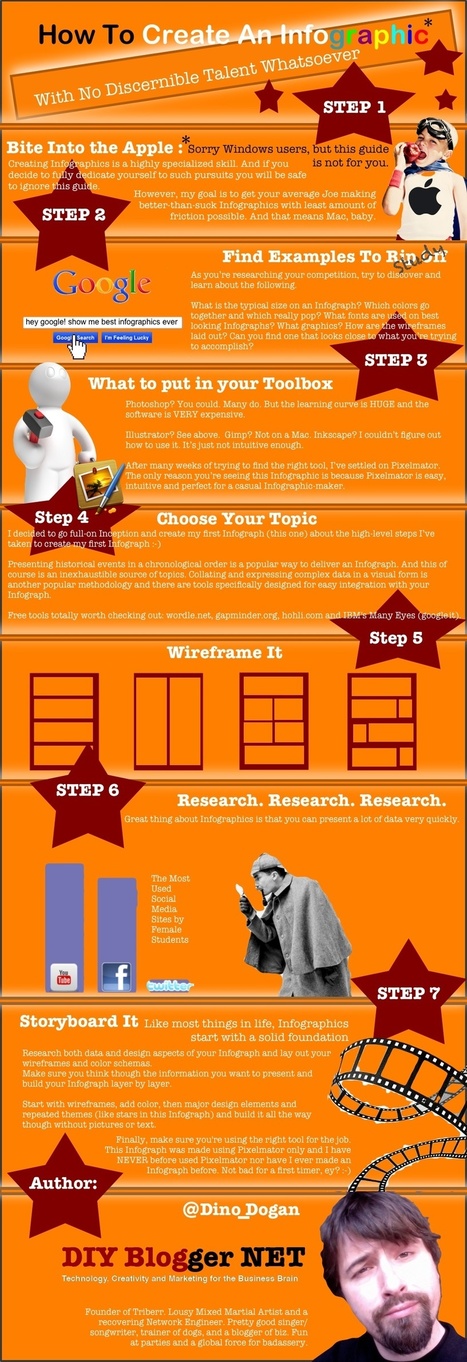
Dino Dogan's DIY Blog where he spent weeks testing various tools and trying to figure out an easy way for non-Designers to create Infographics. Finally, yesterday he stumbled upon a cool little app called Pixelmator that was the answer to both our prayers! Dino claims to have no connection or shares in this particular app.
To get content containing either thought or leadership enter:
To get content containing both thought and leadership enter:
To get content containing the expression thought leadership enter:
You can enter several keywords and you can refine them whenever you want. Our suggestion engine uses more signals but entering a few keywords here will rapidly give you great content to curate.


 Your new post is loading...