Your new post is loading...

|
Scooped by
Roland Schegg
Today, 1:58 AM
|
"Expedia hasn't had this degree of mojo for many years. Can Gorin and team keep it going?
Expedia Group appears to be gaining competitive momentum, with stronger room night growth and improving marketing efficiency in 2025, according to a BTIG research note published Tuesday.
Based on its performance checks, BTIG expects Expedia to report fourth-quarter results showing high-single-digit room night growth, mid-single-digit growth in its consumer segment, and EBITDA margin expansion. The firm also said Expedia is getting more leverage from its marketing spend — particularly in B2C"
|
|
Scooped by
Roland Schegg
January 6, 3:26 AM
|
It's true: SEO is undergoing its most significant evolution in decades. As travelers increasingly turn to artificial intelligence (AI) assistants for booking research, hospitality and hotel marketers face a critical question: How do we ensure our properties appear in AI-generated responses, not just traditional search results?
Working with hotel partners across independent properties and major brand portfolios, we have a unique vantage point on how search behavior is shifting industry-wide. The data we're seeing across this diverse portfolio signals a fundamental change in how travelers discover accommodations.
|
|
Scooped by
Roland Schegg
January 6, 3:18 AM
|
TravelAI Solutions Inc. has built a fast-growing travel business by using AI and large-scale behavioral data to surface trips travelers may not have actively searched for. Operating hundreds of niche travel websites, the company links anonymous user signals across sites to build interest profiles and present highly targeted accommodation options. These curated recommendations are designed to convert casual browsing into bookings via major online travel platforms. Strong growth, fueled by both organic performance and acquisitions of distressed travel assets, has positioned TravelAI as a notable player in AI-driven travel marketing.
|
|
Scooped by
Roland Schegg
January 6, 3:15 AM
|
"Gen Z is rapidly moving away from cash and physical wallets, relying instead on mobile phones and digital wallets for everyday spending. For hotels, this shift is not just about payment methods but about changing guest expectations around speed, convenience, and transparency at every touchpoint. Younger travelers perceive digital payments as safer and more intuitive, while cash increasingly feels irrelevant or even inconvenient. At the same time, new payment behaviors introduce operational risks and revenue considerations that hoteliers cannot ignore.
"
|
|
Scooped by
Roland Schegg
December 31, 2025 3:17 AM
|
Les possibilités de se connecter les uns aux autres n’ont jamais été aussi larges et pourtant, le sentiment de solitude est très répandu au sein de la population. Un phénomène qui serait lié à la digitalisation de nos modes de vie, et qui coûte cher à la société
|
|
Scooped by
Roland Schegg
December 24, 2025 1:45 AM
|
"Model Context Protocol (MCP) is emerging as a key standard that lets AI agents directly understand and interact with travel supplier systems — moving them beyond simple recommendations to real-time booking intelligence. - For hotels, airlines, and other suppliers, MCP represents an opportunity to bypass high-commission intermediaries and reclaim direct business.
- Before MCP, connecting AI like ChatGPT, Gemini, and Claude directly to business databases was a massive headache.
As AI agents increasingly become the interface and checkout moves inside chat, MCP integrations will shape which travel providers are visible."
|
|
Scooped by
Roland Schegg
December 21, 2025 5:03 AM
|
Derrière le succès d’Airbnb, la multiplication des locations de courte durée suscite une grogne croissante des riverains en Suisse, notamment à Genève et dans le canton de Vaud. Nuisances, perte de vie de quartier et pression sur le marché du logement alimentent les critiques.
C'est un site sur lequel beaucoup ont réservé leurs vacances de Noël, mais dont les locations de courte durée suscitent parfois l’hostilité des voisins. Dans plusieurs villes et quartiers suisses, la colère monte face à l’essor des appartements loués via des plateformes de type Airbnb.
Un coup d'œil sur le site Inside Airbnb, qui fournit des données sur le nombre de logements à louer sur cette plateforme leader dans la location de courte durée d'appartements ou de chambres, permet de se rendre compte de l'ampleur du phénomène: plus de 2700 annonces sont recensées à Genève et 5500 dans le canton de Vaud, surtout concentrées à Lausanne et sur la Riviera. Selon le quotidien 24 Heures, qui consacrait une large page au sujet vendredi, le nombre de logements vaudois proposés sur Airbnb a augmenté de 20% en l'espace de trois ans.
|
|
Scooped by
Roland Schegg
December 20, 2025 6:19 AM
|
The shift to travelers using AI tools presents a unique opportunity for both consumers and the hotel industry: a chance to break free from dependence on the large Online Travel Agencies (OTAs).
While AI is poised to transform much of travel planning, AI is limited in its ability to answer traveler questions when information accuracy or detail is critical. To address this limitation, AI companies have begun to forge partnerships and integrations with existing OTAs, who can offer some of the structured, cached data that travelers need to finalize their travel plans. But the unique prices and benefits available when booking directly with hotels are unavailable on OTAs, and OTAs have more limited inventory and availability information than travelers could potentially get from the hotels themselves.
A new AI-native integration layer called the Model Context Protocol (MCP) has created an opportunity for a different path forward. Using MCP, a hotel-aligned aggregator can offer the same advantages to AI companies as OTAs – providing structured, cached, real-time data that travelers need to make decisions and book. And – better than an OTA – such an aggregator can also unify comprehensive hotel inventory across chains and independent properties, presenting accurate Availability, Rates, and Inventory (ARI) data at massive scale. It can also offer prices, offers, and benefits that are only available to those booking directly with hotels, enabling a better AI experience for the 70% of travelers who prefer to book direct.
|
|
Scooped by
Roland Schegg
December 20, 2025 5:57 AM
|
"With the launch of GPT 5, operator, and a slew of Agentic AI tools, the age of booking a hotel or flight with an AI Agent is upon us. For the consumer it accelerates the ability to digest information, discover, and book hotels, but what about from the perspective of the hotel operator?
Past: Complex Human Centric Flow
Today, when a user has the idea of a “family-friendly boutique hotel in Tuscany under $500 a night with vineyard views” it’s a complex human-centric project. You might start with Google with that query, click around for reviews, blogs, hotel websites, OTA listings, and amalgamate that information into an idea of where you’d like to stay for your vacation. It’s tried and true but inefficient and subject to SEO and OTA reliance. Enter the world of AI Agents and explosive use of ChatGPT, what does it look like."
|
|
Scooped by
Roland Schegg
December 20, 2025 5:30 AM
|
There’s no argument: A lot of functions in travel will be replaced by agentic artificial intelligence (AI), and it’s happening already. A new agentic AI-dominated ecosystem is on the horizon, prompting many business leaders to look at what the future holds and ask the question: How can my company excel in this new world?
As agentic AI embeds deeper into travel’s B2B and B2C value chain, the need for answers is intensifying. Recent Phocuswright research found that one in three travelers from Europe and the U.S. were using generative AI to plan or enhance their trip, creating the market for agentic AI to come in and do more.
At the same time, agentic AI continues to get better in areas where it is already amplifying human capabilities while bringing in new functionalities that drive new use cases, replacing more tasks but also creating room for innovation.
|
|
Scooped by
Roland Schegg
December 19, 2025 3:39 AM
|
OpenAI has opened ChatGPT to third-party app submissions, allowing travel brands to build and list chat-native apps directly inside the ChatGPT interface. What were once exclusive integrations for early partners like Booking.com and Expedia are now part of a broader, searchable app directory available to any approved developer.
The move signals the maturation of ChatGPT into a unified ecosystem where live data, recommendations, and actions can surface directly within conversations. For travel brands, competition is shifting from web traffic and clicks to relevance within AI-guided planning moments.
Key takeaways
Open app submissions: OpenAI now allows any approved travel brand to build and list apps inside ChatGPT using its Apps SDK, opening the platform beyond early pilot partners.
In-chat app directory: Approved apps appear in a centralized directory that users can browse or search, with no downloads required and access available across devices.
|
|
Scooped by
Roland Schegg
December 19, 2025 1:31 AM
|
Une nouvelle étude parue dans la revue «Science» montre que les scientifiques qui ont recours aux outils comme ChatGPT produisent davantage d’articles. L’introduction de l’IA pose toutefois de nombreux défis au monde de la recherche
|
|
Scooped by
Roland Schegg
December 18, 2025 12:06 PM
|
Artificial intelligence is changing the way people plan trips—especially among international travelers and women, according to the Global Rescue Fall 2025 Traveler Safety and Sentiment Survey.
More than one in five travelers (22 percent) reported using AI tools to plan a trip, but adoption is notably higher among non-U.S. respondents (30 percent) and women (24 percent) compared to US travelers (20 percent) and men (22 percent). Most respondents (73 percent) have not yet used AI for travel planning, underscoring that while AI use is growing, it’s still emerging among the broader traveling public.
|
|
|
Scooped by
Roland Schegg
January 6, 9:38 AM
|
The travel search and booking process has seen many iterations, with the internet, mobile and voice all expected to turn the ecosystem on its head.
While these technologies provided additional channels for consumers and perhaps improved the experience, chaos did not ensue.
Step forward artificial intelligence (AI), which, depending on who you speak to, will either wipe out online travel agencies (OTAs) or boost their presence and power.
However, analysts following the OTAs do not see AI killing OTAs or the search-based travel model.
|
|
Scooped by
Roland Schegg
January 6, 3:24 AM
|
SEO is undergoing a fundamental shift as travelers increasingly rely on AI assistants to research and plan hotel stays. Data from late 2024 onward shows steady growth in AI-driven traffic to hotel websites, alongside declining organic search traffic tied to zero-click search behavior. As search engines and AI tools deliver answers directly within their interfaces, fewer users click through to hotel websites. This change makes visibility inside AI-generated responses a strategic priority for hotel marketers.
Key takeaways
AI-driven traffic is rising: Hotel websites are seeing consistent month-over-month increases in visits originating from AI assistants, signaling a structural shift in discovery behavior.
|
|
Scooped by
Roland Schegg
January 6, 3:17 AM
|
"Amazon has announced that Expedia will integrate with its next-generation AI assistant, Alexa+, when it launches in 2026. The integration will allow users to search, compare, book, and manage hotels and vacation rentals through voice-based interactions. This move signals a broader shift toward AI-powered, assistant-led travel discovery and booking. It also reflects Expedia’s accelerating investments in agentic and conversational AI partnerships across the travel ecosystem.
Key takeaways
Alexa+ expands into travel booking: Through the integration with Expedia, Amazon’s Alexa+ will support hotel and vacation rental discovery, comparison, booking, and management via voice and AI.
Personalized recommendations at the assistant level: Alexa+ will tailor lodging results based on criteria such as price, room type, and location, shifting personalization from websites and apps to conversational interfaces."
|
|
Scooped by
Roland Schegg
January 5, 9:44 AM
|
"As accessible travel continues to grow, Camilo Navarro, co-founder and COO of Wheel the World, believes that more travelers will start conversations about accessibility with artificial intelligence (AI).
“They're going to need this type of information—accessibility data, for instance,” Navarro said during an interview in the PhocusWire studio at The Phocuswright Conference.
To help users with accessibility needs, Wheel the World, a PhocusWire Hot 25 Travel Startup for 2022, is developing a conversational AI chatbot. According to Navarro, the chatbot will use proprietary data and information from customer profiles throughout conversations.
He also believes other travel brands should be preparing their data and making accessibility accommodations visible for AI.
“AI without data is worthless,” Navarro said."
|
|
Scooped by
Roland Schegg
December 24, 2025 1:48 AM
|
"Google is testing new ad formats for attractions, inserting sponsored links in a booking module with multiple advertisers for the first time."
|
|
Scooped by
Roland Schegg
December 23, 2025 8:01 AM
|
C’est un ingénieur suédois, Anton Osika, qui a l’idée de créer Lovable dès 2023. Il démarre avec un outil d’IA permettant de coder plus facilement, et, voyant son succès, contacte Fabian Hedin pour s’associer avec lui. Quelques mois plus tard, en 2024, ils créent Lovable avec la première plateforme de vibe coding. Depuis, le succès a été fulgurant. Plus de 100 000 projets (sites web et applications) sont créés chaque jour depuis cette plateforme, soit un total de plus de 25 millions de projets en un an. Selon la société, ces sites et applications fabriqués avec ses outils ont à leur tour généré plus de 500 millions de visites ces derniers mois.
|
|
Scooped by
Roland Schegg
December 20, 2025 6:20 AM
|
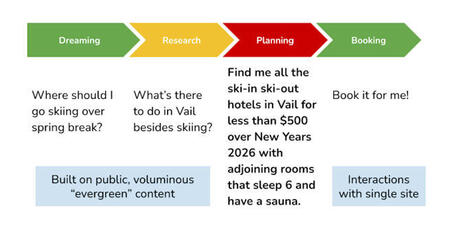
Planning a dream trip to Japan or that long-awaited European adventure should feel thrilling. Instead, many travelers find themselves drowning in a sea of booking sites, conflicting reviews, apps, and endless spreadsheets. When investing potentially thousands of dollars and precious vacation days, the pressure to validate every detail can turn excitement into anxiety.
As an example, travelers choosing a hotel tap into many sources of information – multiple, sometimes dozens of “touchpoints” spread across search, apps, and websites – before making a decision. According to a Google/McKinsey study:
“The data [shows] finding travel accommodations is protracted, complex, and sometimes annoying: an average purchase journey for a single hotel room lasts 36 days; hits 45 touchpoints, distributed among search engines and the sites of intermediaries and suppliers; and involves multiple devices. Travel is a complex, high anxiety purchase.”
|
|
Scooped by
Roland Schegg
December 20, 2025 6:16 AM
|
Artificial intelligence is reshaping how travelers explore, plan, and book trips. The introduction of Model Context Protocol (MCP) promises a direct line for hotels to provide accurate pricing and availability to AI systems. There have been some optimistic claims that MCP could dramatically reduce hotels’ reliance on aggregators like OTAs. And there have been counter claims that the OTAs are poised to increase their dominance by becoming exclusive partners to the most popular AI companies.
We believe that even with MCP, the role of aggregators remains indispensable. This paper explains why aggregation is critical in ensuring scalability, efficiency, and trust in the AI-driven travel ecosystem while also noting that there’s an opening here for a new class of aggregator: one aligned with the hotels themselves.
|
|
Scooped by
Roland Schegg
December 20, 2025 5:43 AM
|
"We’re approaching the first real rewrite of hotel distribution since the OTA boom of the 2000s. AI agents don’t browse websites, they transact. And the systems best positioned to serve them are the ones long ignored because they lived below the funnel.
I’ve written in the past about how hotels can thrive in an agentic AI world as we move from SEO to MCP, as well as the challenges the OTAs will likely face but I wanted to spend some time doing an overview of what technological and product changes the CRS, PMS, and Booking Engine vendors themselves are doing to enable the hotels themselves to take control."
|
|
Scooped by
Roland Schegg
December 19, 2025 3:53 AM
|
Artificial intelligence is beginning to influence how travelers search for and book hotels, with major implications for distribution. Analysts argue that large online travel agencies such as Booking Holdings and Expedia are well positioned to become primary partners for AI-driven booking tools due to their global inventory scale and mature integrations.
For hoteliers, this reinforces the role of OTAs as key intermediaries rather than displacing them in the near term. The article highlights how AI may amplify existing distribution dynamics rather than fundamentally resetting them.
Key takeaways
OTAs remain central to AI booking flows: AI systems need reliable, real-time access to broad hotel inventory, pricing, and availability, which Booking and Expedia already provide at scale.
Inventory aggregation is a strategic moat: Decades of contracting, connectivity, and rate management give major OTAs an advantage that individual hotels or newer platforms cannot easily replicate.
AI is unlikely to bypass intermediaries soon: Fully autonomous booking still depends on structured data, payment handling, and customer support, reinforcing the role of established distribution partners.
|
|
Scooped by
Roland Schegg
December 19, 2025 3:16 AM
|
Generative AI use sophisticated large language models (LLMs) to help hotel teams quickly write, summarise and analyse text, images and data. This application of AI can help staff save time and communicate more effectively. In a hotel environment, this can support content based activity like drafting marketing copy or personalising pre-arrival messages to welcome guests. It can also turn large datasets into simple summaries for managers, assist with multilingual guest communication and help frontline teams access information instantly without searching through manuals or document libraries. When used well, it improves productivity across marketing, operations and reporting by removing repetitive work that adds little value.
However, generative AI does have limitations and should only be used in defined areas of hotel operations. While generative AI outputs can seem a bit like magic, it is not built to make precise pricing or forecasting recommendations, nor does it contain the specialised logic needed for accurate performance analysis. It predicts likely words or images rather than calculating the best commercial decision based on demand patterns or business rules. As a result, it works best as a support layer that enhances human output rather than replaces it.
|
|
Scooped by
Roland Schegg
December 19, 2025 1:25 AM
|
Yes, dreaming up your next getaway can be exhilarating. But booking it? Often less so. For many customers, the thrill of travel risks getting lost in logistics, says McKinsey Senior Partner Jules Seeley. On this episode of The McKinsey Podcast, he joins Global Editorial Director Lucia Rahilly to discuss new research on the rise of AI in the travel industry, including the advent of AI agents that could design end-to-end itineraries, rebook disrupted flights, and tailor recommendations to each traveler’s tastes—changing the calculus for customers and travel employees alike.
|


 Scoop.it!