Your new post is loading...

|
Scooped by
Roland Schegg
Today, 5:03 AM
|
Derrière le succès d’Airbnb, la multiplication des locations de courte durée suscite une grogne croissante des riverains en Suisse, notamment à Genève et dans le canton de Vaud. Nuisances, perte de vie de quartier et pression sur le marché du logement alimentent les critiques.
C'est un site sur lequel beaucoup ont réservé leurs vacances de Noël, mais dont les locations de courte durée suscitent parfois l’hostilité des voisins. Dans plusieurs villes et quartiers suisses, la colère monte face à l’essor des appartements loués via des plateformes de type Airbnb.
Un coup d'œil sur le site Inside Airbnb, qui fournit des données sur le nombre de logements à louer sur cette plateforme leader dans la location de courte durée d'appartements ou de chambres, permet de se rendre compte de l'ampleur du phénomène: plus de 2700 annonces sont recensées à Genève et 5500 dans le canton de Vaud, surtout concentrées à Lausanne et sur la Riviera. Selon le quotidien 24 Heures, qui consacrait une large page au sujet vendredi, le nombre de logements vaudois proposés sur Airbnb a augmenté de 20% en l'espace de trois ans.
|
|
Scooped by
Roland Schegg
December 20, 6:19 AM
|
The shift to travelers using AI tools presents a unique opportunity for both consumers and the hotel industry: a chance to break free from dependence on the large Online Travel Agencies (OTAs).
While AI is poised to transform much of travel planning, AI is limited in its ability to answer traveler questions when information accuracy or detail is critical. To address this limitation, AI companies have begun to forge partnerships and integrations with existing OTAs, who can offer some of the structured, cached data that travelers need to finalize their travel plans. But the unique prices and benefits available when booking directly with hotels are unavailable on OTAs, and OTAs have more limited inventory and availability information than travelers could potentially get from the hotels themselves.
A new AI-native integration layer called the Model Context Protocol (MCP) has created an opportunity for a different path forward. Using MCP, a hotel-aligned aggregator can offer the same advantages to AI companies as OTAs – providing structured, cached, real-time data that travelers need to make decisions and book. And – better than an OTA – such an aggregator can also unify comprehensive hotel inventory across chains and independent properties, presenting accurate Availability, Rates, and Inventory (ARI) data at massive scale. It can also offer prices, offers, and benefits that are only available to those booking directly with hotels, enabling a better AI experience for the 70% of travelers who prefer to book direct.
|
|
Scooped by
Roland Schegg
December 20, 5:57 AM
|
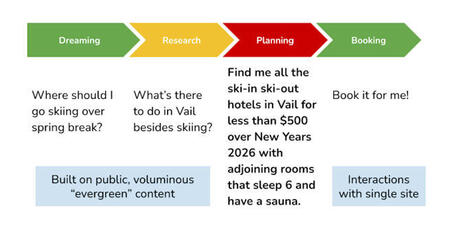
"With the launch of GPT 5, operator, and a slew of Agentic AI tools, the age of booking a hotel or flight with an AI Agent is upon us. For the consumer it accelerates the ability to digest information, discover, and book hotels, but what about from the perspective of the hotel operator?
Past: Complex Human Centric Flow
Today, when a user has the idea of a “family-friendly boutique hotel in Tuscany under $500 a night with vineyard views” it’s a complex human-centric project. You might start with Google with that query, click around for reviews, blogs, hotel websites, OTA listings, and amalgamate that information into an idea of where you’d like to stay for your vacation. It’s tried and true but inefficient and subject to SEO and OTA reliance. Enter the world of AI Agents and explosive use of ChatGPT, what does it look like."
|
|
Scooped by
Roland Schegg
December 20, 5:30 AM
|
There’s no argument: A lot of functions in travel will be replaced by agentic artificial intelligence (AI), and it’s happening already. A new agentic AI-dominated ecosystem is on the horizon, prompting many business leaders to look at what the future holds and ask the question: How can my company excel in this new world?
As agentic AI embeds deeper into travel’s B2B and B2C value chain, the need for answers is intensifying. Recent Phocuswright research found that one in three travelers from Europe and the U.S. were using generative AI to plan or enhance their trip, creating the market for agentic AI to come in and do more.
At the same time, agentic AI continues to get better in areas where it is already amplifying human capabilities while bringing in new functionalities that drive new use cases, replacing more tasks but also creating room for innovation.
|
|
Scooped by
Roland Schegg
December 19, 3:39 AM
|
OpenAI has opened ChatGPT to third-party app submissions, allowing travel brands to build and list chat-native apps directly inside the ChatGPT interface. What were once exclusive integrations for early partners like Booking.com and Expedia are now part of a broader, searchable app directory available to any approved developer.
The move signals the maturation of ChatGPT into a unified ecosystem where live data, recommendations, and actions can surface directly within conversations. For travel brands, competition is shifting from web traffic and clicks to relevance within AI-guided planning moments.
Key takeaways
Open app submissions: OpenAI now allows any approved travel brand to build and list apps inside ChatGPT using its Apps SDK, opening the platform beyond early pilot partners.
In-chat app directory: Approved apps appear in a centralized directory that users can browse or search, with no downloads required and access available across devices.
|
|
Scooped by
Roland Schegg
December 19, 1:31 AM
|
Une nouvelle étude parue dans la revue «Science» montre que les scientifiques qui ont recours aux outils comme ChatGPT produisent davantage d’articles. L’introduction de l’IA pose toutefois de nombreux défis au monde de la recherche
|
|
Scooped by
Roland Schegg
December 18, 12:06 PM
|
Artificial intelligence is changing the way people plan trips—especially among international travelers and women, according to the Global Rescue Fall 2025 Traveler Safety and Sentiment Survey.
More than one in five travelers (22 percent) reported using AI tools to plan a trip, but adoption is notably higher among non-U.S. respondents (30 percent) and women (24 percent) compared to US travelers (20 percent) and men (22 percent). Most respondents (73 percent) have not yet used AI for travel planning, underscoring that while AI use is growing, it’s still emerging among the broader traveling public.
|
|
Scooped by
Roland Schegg
December 18, 1:59 AM
|
Google hat mit der Einführung seines KI-Modus eine tektonische Verschiebung im globalen Such- und Buchungsverhalten ausgelöst. Der Konzern schaltet die neue Funktion in über 40 Ländern frei – darunter Deutschland, Österreich und die Schweiz – und verwandelt die gewohnte Trefferliste in eine dialogorientierte Antwortmaschine. Für die Hotellerie und Gastronomie bedeutet dies nichts weniger als eine Neuordnung der digitalen Spielregeln. Wer nicht konkret erwähnt wird, verliert Reichweite und damit potenzielle Gäste. Die neue Technologie ist bereits in den USA aktiv und basiert auf einer angepassten Version von Gemini Pro 2.5.
Mit dem KI-Modus verschwinden klassische Linklisten zunehmend aus dem Sichtfeld der Nutzer. Google konzentriert sich darauf, komplette Antworten zu liefern – etwa Wochenendplanungen, Reiseempfehlungen oder Restaurantvorschläge –, ohne dass User noch externe Websites besuchen müssen. Eine Suchanfrage wie „familienfreundliches Wellnesshotel im Bayerischen Wald mit großem Spa, veganem Frühstück und Aktivitäten für Kinder“ führt nun direkt zu einer handverlesenen Liste passender Hotels mit Bewertungen, Preisen und Tipps. Gleiches gilt für die Gastronomie: Ein „veganes Restaurant mit Terrasse in Zürich“ erscheint mitsamt Fotos, Besonderheiten, Bewertungen und sofort einordbaren Angeboten. Für viele Betriebe wird der Suchmaschinenriese damit zur zentralen Schnittstelle zwischen Gast und Betrieb.
|
|
Scooped by
Roland Schegg
December 18, 12:21 AM
|
Comme vous devez certainement vous en doutez, l’essentiel des changements à venir tourne autour de l’IA, assurément LE moteur de l’innovation depuis maintenant 3 ans, LE sujet qui éclipse tous les autres, tant les enjeux sont élevés et les craintes / espoirs sont importants.
Afin de ne pas parasiter mes prédictions, je vous propose d’évacuer tout de suite les prévisions génériques sur l’IA.
|
|
Scooped by
Roland Schegg
December 17, 4:58 AM
|
Google says that optimizing for AI-driven search experiences follows the same fundamentals as traditional SEO—a message with direct implications for hotels navigating AI Overviews and AI Mode. In a recent interview, Google’s search leadership emphasized that strong content, clear information, and trustworthy websites remain the foundation for visibility, even as AI answers become more prominent. For hotels, this reinforces that AI search is not a new playbook but an acceleration of existing best practices. At the same time, Google reaffirmed that its core model is still built around sending traffic to underlying sources, not replacing them.
Key takeaways
AI search rewards strong hotel content: Google says AI visibility depends on the same basics as classic SEO, meaning hotels should focus on clear, accurate, and high-quality content across their websites.
Direct traffic still matters: Google positions click-throughs as the core partnership model, suggesting hotels that present compelling content can still capture demand beyond AI-generated summaries.
|
|
Scooped by
Roland Schegg
December 16, 12:48 AM
|
Artificial intelligence is transforming hotel distribution faster than any previous technology shift, collapsing years of change into a single business cycle. Search, comparison, and booking are increasingly handled by AI agents that interpret structured data before travelers ever see an offer. This fundamentally changes how hotels are discovered, compared, and chosen, raising the cost of inaction as systems continuously learn and optimize. In this environment, visibility depends less on brand size or ad spend and more on data quality, consistency, and machine-readability.
|
|
Scooped by
Roland Schegg
December 14, 1:48 AM
|
Across Europe, tourism often peaks during the summer while many destinations remain quiet in the off-season. This imbalance puts pressure on popular sites while leaving others underexplored, which affects both the visitor experience and local sustainability. To address the challenges of peak vs. off-season tourism, the European Travel Commission (ETC) has introduced its Unlock an Unexpected Upgrade campaign, inspiring travelers to explore Europe during quieter months — featuring lesser-known spots, encouraging responsible, eco-conscious tourism, and a more balanced flow of visitors throughout the year.
|
|
Scooped by
Roland Schegg
December 13, 3:43 AM
|
While artificial intelligence (AI) is impacting travel marketing, the best use cases are still being determined.
AI-supported digital travel marketing can work—as long as it still has a human touch, according to Rob Torres, SVP of media solutions and retail partnerships for Expedia Group.
In October, Expedia Group released research that examined which content is driving traveler choice. The company showed participants a mix of non-AI-enhanced, AI-enhanced and fully AI content.
|
|
|
Scooped by
Roland Schegg
December 20, 6:20 AM
|
Planning a dream trip to Japan or that long-awaited European adventure should feel thrilling. Instead, many travelers find themselves drowning in a sea of booking sites, conflicting reviews, apps, and endless spreadsheets. When investing potentially thousands of dollars and precious vacation days, the pressure to validate every detail can turn excitement into anxiety.
As an example, travelers choosing a hotel tap into many sources of information – multiple, sometimes dozens of “touchpoints” spread across search, apps, and websites – before making a decision. According to a Google/McKinsey study:
“The data [shows] finding travel accommodations is protracted, complex, and sometimes annoying: an average purchase journey for a single hotel room lasts 36 days; hits 45 touchpoints, distributed among search engines and the sites of intermediaries and suppliers; and involves multiple devices. Travel is a complex, high anxiety purchase.”
|
|
Scooped by
Roland Schegg
December 20, 6:16 AM
|
Artificial intelligence is reshaping how travelers explore, plan, and book trips. The introduction of Model Context Protocol (MCP) promises a direct line for hotels to provide accurate pricing and availability to AI systems. There have been some optimistic claims that MCP could dramatically reduce hotels’ reliance on aggregators like OTAs. And there have been counter claims that the OTAs are poised to increase their dominance by becoming exclusive partners to the most popular AI companies.
We believe that even with MCP, the role of aggregators remains indispensable. This paper explains why aggregation is critical in ensuring scalability, efficiency, and trust in the AI-driven travel ecosystem while also noting that there’s an opening here for a new class of aggregator: one aligned with the hotels themselves.
|
|
Scooped by
Roland Schegg
December 20, 5:43 AM
|
"We’re approaching the first real rewrite of hotel distribution since the OTA boom of the 2000s. AI agents don’t browse websites, they transact. And the systems best positioned to serve them are the ones long ignored because they lived below the funnel.
I’ve written in the past about how hotels can thrive in an agentic AI world as we move from SEO to MCP, as well as the challenges the OTAs will likely face but I wanted to spend some time doing an overview of what technological and product changes the CRS, PMS, and Booking Engine vendors themselves are doing to enable the hotels themselves to take control."
|
|
Scooped by
Roland Schegg
December 19, 3:53 AM
|
Artificial intelligence is beginning to influence how travelers search for and book hotels, with major implications for distribution. Analysts argue that large online travel agencies such as Booking Holdings and Expedia are well positioned to become primary partners for AI-driven booking tools due to their global inventory scale and mature integrations.
For hoteliers, this reinforces the role of OTAs as key intermediaries rather than displacing them in the near term. The article highlights how AI may amplify existing distribution dynamics rather than fundamentally resetting them.
Key takeaways
OTAs remain central to AI booking flows: AI systems need reliable, real-time access to broad hotel inventory, pricing, and availability, which Booking and Expedia already provide at scale.
Inventory aggregation is a strategic moat: Decades of contracting, connectivity, and rate management give major OTAs an advantage that individual hotels or newer platforms cannot easily replicate.
AI is unlikely to bypass intermediaries soon: Fully autonomous booking still depends on structured data, payment handling, and customer support, reinforcing the role of established distribution partners.
|
|
Scooped by
Roland Schegg
December 19, 3:16 AM
|
Generative AI use sophisticated large language models (LLMs) to help hotel teams quickly write, summarise and analyse text, images and data. This application of AI can help staff save time and communicate more effectively. In a hotel environment, this can support content based activity like drafting marketing copy or personalising pre-arrival messages to welcome guests. It can also turn large datasets into simple summaries for managers, assist with multilingual guest communication and help frontline teams access information instantly without searching through manuals or document libraries. When used well, it improves productivity across marketing, operations and reporting by removing repetitive work that adds little value.
However, generative AI does have limitations and should only be used in defined areas of hotel operations. While generative AI outputs can seem a bit like magic, it is not built to make precise pricing or forecasting recommendations, nor does it contain the specialised logic needed for accurate performance analysis. It predicts likely words or images rather than calculating the best commercial decision based on demand patterns or business rules. As a result, it works best as a support layer that enhances human output rather than replaces it.
|
|
Scooped by
Roland Schegg
December 19, 1:25 AM
|
Yes, dreaming up your next getaway can be exhilarating. But booking it? Often less so. For many customers, the thrill of travel risks getting lost in logistics, says McKinsey Senior Partner Jules Seeley. On this episode of The McKinsey Podcast, he joins Global Editorial Director Lucia Rahilly to discuss new research on the rise of AI in the travel industry, including the advent of AI agents that could design end-to-end itineraries, rebook disrupted flights, and tailor recommendations to each traveler’s tastes—changing the calculus for customers and travel employees alike.
|
|
Scooped by
Roland Schegg
December 18, 11:10 AM
|
"Travel payments are facing a massive overhaul with agentic capabilities—perhaps the largest since e-commerce—as artificial intelligence (AI)-powered, end-to-end travel booking nears.
During a center stage session at The Phocuswright Conference, Gloria Colgan, SVP and global head of product of commercial solutions for Visa, Clara Liang, head of global strategic operations for Stripe, and Jennifer Watkins, director of payments for ARC, shared advice for companies as they prepare for the agentic shift.
According to Liang, jumping in is a good first step.
“If you're not already engaged in the conversation, thinking about how you're going to play in this world, I’d encourage you to get involved now,” she said. “Be a nerd yourself and play with the technologies.”
Visa’s Colgan agreed, suggesting that industry players try out agentic tools in their personal lives and within their professional teams before deciding how and where to deploy the technology."
|
|
Scooped by
Roland Schegg
December 18, 12:41 AM
|
I feel that the scenario is no longer speculative. It is, if anything, the natural extension of where reputation systems are already heading. It is easy to imagine Tripadvisor, Google or any major OTA replacing the old free text box with a short sequence of micro prompts delivered immediately after checkout, when the memory of the stay still retains a degree of clarity.
Imagine this: a guest leaves the hotel, the phone vibrates, and a short questionnaire appears. What worked during the stay, how the night went, whether the staff felt welcoming, and whether the place deserves a future visit. The guest replies, offering only a few words. The LLM absorbs these fragments and turns them into a complete review that matches the platform's expected tone and structure.
The result is a constant flow of synthetic narratives. Volume increases, style becomes more consistent, outliers fade, and moderation becomes easier. Platforms gain cleaner data and a higher review count. Guests experience a process that consumes almost no time. Reputation begins to operate as an automated pipeline in which the human contribution is minimal, and the model handles everything else.
The real question is: are we prepared to inhabit an environment in which reviews are written by AI, moderated by AI, and ultimately evaluated by other AIs that guide ranking and recommendations throughout the travel ecosystem?
|
|
Scooped by
Roland Schegg
December 18, 12:14 AM
|
De plus en plus de voix mettent en doute la stratégie d’OpenAI, voire sa pérennité, face à des concurrents qui se montrent désormais agressifs, tel Google. Ces doutes émergent alors que les craintes d’une bulle IA se renforcent
|
|
Scooped by
Roland Schegg
December 16, 12:51 AM
|
Within months of release, AI platforms became part of everyday behavior and are fast becoming the first place that travelers search, compare, and decide on their next trip. Technologies that once took a decade to filter through from the early-adopting innovators to slow-moving laggards have crossed that divide in a single business cycle.
For hotels, this speed signifies a fundamental break with the way hotel distribution has operated. Search behavior, booking flows, and data interpretation are no longer built around human navigation but around machine reasoning. Every signal a traveler sees, whether that’s a room price, hotel review, or property descriptions, is interpreted first by an algorithm and only then shown to the person planning the trip.
That shift alters the economics of visibility.
The cost of inaction rises with each iteration because these AI systems keep learning from every new data point. In practical terms, hotels that postpone adaptation risk seeing their discoverability decline before they fully understand why.
|
|
Scooped by
Roland Schegg
December 15, 9:54 AM
|
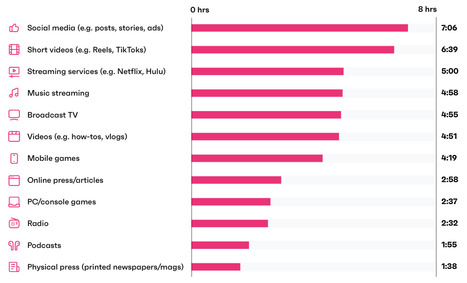
"Chaque année ou presque, on annonce la mort imminente des médias sociaux. Trop de bruit, trop de publicité, trop d’algorithmes. Et pourtant, les données racontent une tout autre histoire. Selon une vaste étude publiée par GWI, les médias sociaux ne sont pas seulement encore pertinents : ils sont devenus le média dominant de notre quotidien, devant la télévision, les plateformes de streaming et la radio réunies!"
|
|
Scooped by
Roland Schegg
December 13, 9:23 AM
|
GPT-5.2 : quelles améliorations par rapport à GPT-5.1 ?
Concrètement, quelles sont les améliorations observées dans GPT-5.2 ? OpenAI liste 7 domaines ayant connu des améliorations significatives. La startup se base sur les benchmarks réalisés en interne, qui confirment que GPT-5.2 (en particulier sa déclinaison Thinking) surpasse 5.1 sur l’ensemble des critères suivants :
Tâches à forte valeur économique : GPT-5.2 Thinking améliore significativement sa capacité à accomplir des tâches intellectuelles complexes (présentations, feuilles de calcul, rapports) avec une qualité comparable aux experts humains, en étant trois fois plus rapide et nettement moins coûteux.
Programmation : GPT-5.2 Thinking excelle désormais à déboguer le code en production et à mettre en œuvre des fonctionnalités, ce qui permet aux développeurs de corriger et de remanier des bases de code complexes avec beaucoup moins d’intervention manuelle. Il surpasse notamment les versions précédentes pour le développement front-end (voir animation ci-dessous).
Véracité : OpenAI éprouve des difficultés à réduire les hallucinations de ses modèles, et GPT-5.1 ne faisait pas exception. Avec GPT-5.2 Thinking, la firme promet que les hallucinations sont réduites de 38 % par rapport à son prédécesseur, « ce qui se traduit par des réponses comportant 38 % moins d’erreurs lors de la recherche, la rédaction, l’analyse et l’aide à la décision ».
Contexte étendu : GPT-5.2 Thinking traite désormais les très longs documents avec bien plus de précision et de cohérence, permettant aux professionnels d’analyser des contrats, rapports et articles complets sans perdre les informations critiques.
|