


Empathy is the ability to imagine yourself in some else's position and to intuit what that person is feeling. It is the ability to stand in others' shoes, to see with their eyes, and to feel with their hearts.

 Your new post is loading...
 Your new post is loading...
Your new post is loading...
 Scoop.it!
Empathy is the ability to imagine yourself in some else's position and to intuit what that person is feeling. It is the ability to stand in others' shoes, to see with their eyes, and to feel with their hearts. 
No comment yet.
Sign up to comment
Scoop.it!
An interview with Daniel Goleman, Psychologist. See how you can use emotional and social intelligence to improve your own and your organization's performance.
Scoop.it!

Here are three ways to help make sure your feedback is compassionate, not just critical:
Scoop.it!

Empathy Training Limited is a fresh, dynamic company focussed on delivering professional, high impact and fun business training and coaching to organisations seeking to improve performance. Everything we do is based on the techniques of Empathy which is all about reading people and changing business fortunes. Here is some of our team who are passionate about making the Empathy ‘magic’ come true.
Scoop.it!

We subconsciously switch our body posture to match that of the other person - mirroring that person’s nonverbal behaviour . .
Scoop.it!
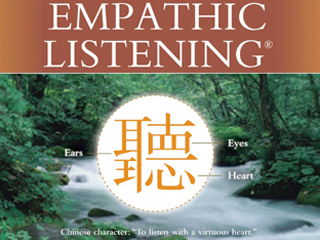
The Key to Communication Communication is said to be the most important skill in life. And effective communication always comes down to one thing - mutual understanding. Participants are given practical tips and specific phrases they can incorporate immediately into their daily conversations to ensure that they are listening with the intent to understand.
Scoop.it!
Seek First to Understand, Then to Be Understood.
Scoop.it!

The 7 Habits of Highly Effective PeopleThe habit to "seek first to understand" involves a very deep shift in paradigm. We typically seek first to be understood.
Scoop.it!

A while back I wrote a blog about resilience being one of the most important qualities for today’s leaders. A number of readers agreed with me, and one went on to point out another very important leadership trait that often gets overlooked – empathy. Most people don’t associate the word “empathy” with effective leadership.
Scoop.it!

The way leadership academics and coaches talk about empathy you’d think it’s the be-all, end-all, and cure-all for leaders and their shortcomings. It’s not. The reason is simple. Before empathy can even enter the picture, first, you have to understand yourself. That, to me, is the primary issue.
Scoop.it!

Retailers can offer great product selection and value, but those who lack empathy for their customers are at risk of losing them, says professor Ananth Raman . ===================== the Cleveland Clinic had lost business solely due to a lack of empathy. ==========
Scoop.it!

WE MAY BE out of money but we have a plentiful natural resource that can help industry revive and thrive. Empathy and human understanding are essential to sustainable modern innovation, and they are valued by leading innovating businesses. ===================== Empathy and human understanding are essential to sustainable modern innovation ==========
|
Scoop.it!

Last week I had the distinct pleasure of co-hosting the weekly tweetchat with Lolly Daskal. The subject of my chat was “The Role of Empathy in Leadership” and I have to say I was gratified by both the level of participation and depth of contributions/insights which arose during the discussion. . Here are the ten questions I asked participants as we discussed the role empathy plays in leadership.
Scoop.it!

He explains how empathy is key to effective collaboration in a rapidly changing world, and the art of listening... At the core of the process of collaboration is empathy and I want Bill to tell me more about it...
Scoop.it!

This training activity focuses on empathy – the ability to see the world from the other’s point of view. The basic premise is that if we can understand others by sharing some of their emotional responses, we are more likely to be able to work with them in collaborative ways. Listening with empathy and communicating empathy, are the two key skills that will be explored in this training activity. Without empathy, people may use their Emotional Intelligence in manipulative and self-interested ways. As such, it is essential in any programme that develops Emotional Intelligence.
Scoop.it!

Here’s my take on empathy in sales situations: Although “personal empathy” often has its place, I believe that it is always a sales professional’s job to demonstrate what I’ll call “business empathy” with clients and prospects.
Scoop.it!

Most people don’t associate the word “empathy” with effective leadership. Business leaders are supposed to be tough, hard-driving visionaries who set a firm course for the company and then lead people in that direction with their charisma and force of personality, right? Maybe in the old “command and control” leadership model. Not so much in the new.
Scoop.it!
"Empathic listening takes time, but it doesn't take anywhere near as much time as it takes to back up and correct misunderstandings when you're already miles down the road; to redo; to live with unexpressed and unsolved problems; to deal with the results of not giving people psychological air."

Hector Escalante's curator insight,
February 2, 2013 6:32 PM
Empathic listening is not easy and it doesn't come naturally. I want to be understood first. It's my nature. But, this technique does work. I use it with my 16 year old who always needs to be understood.
Scoop.it!
Empathic Listening- Video 1
http://www.youtube.com/watch?v=viuFhVd9Okw Empathic Listening- Video 2 http://www.youtube.com/watch?v=kIUCdfhoofQ Empathic Listening- Video 3 http://www.youtube.com/watch?v=mxl8WCcI2TI Empathic Listening- Video 4 http://www.youtube.com/watch?v=_o9ej0mEKS0 Empathic Listening- Video 5-9 http://www.youtube.com/watch?v=cEkCBTMv1RI Empathic Listening- Video 6 http://www.youtube.com/watch?v=l2AwZwIeq8A Empathic Listening- Video 7 http://www.youtube.com/watch?v=ZHkSaAaoS_4 Empathic Listening- Video 8 http://www.youtube.com/watch?v=pE7sjw0QgmA Empathic Listening- Video 9 http://www.youtube.com/watch?v=PygrCv6Fm5Y
Scoop.it!

Empathy is the power to project oneself into the personality of another individual in order to better comprehend that individuals emotions or feelings. With empathic listening the listener lets the speaker know, “I comprehend your issue and how you feel about it, I’m interested in what you’re saying and I’m not judging you.”
Scoop.it!

Summaries of new research suggesting managers with empathy have healthier employees, how social networks can reduce anti-Muslim prejudice, and why it's OK to see your partner through rose-colored glasses. ============= Feeling sick at work? Maybe you need a more empathic manager. ===========
Scoop.it!

This post begins a two-part series on storytelling in marketing. The first looks at empathy as a lens for better understanding and identifying with customer challenges... Persuasive narrative is the engine of effective marketing... =================== One of the critical components of a “sticky” marketing storyline is empathy
Scoop.it!

From
www

The Dark Side of Empathy by Barbara Oakley, the author of Cold-Blooded Kindness: Neuroquirks of a Codependent Killer, or Just Give Me a Shot at Loving You, Dear, and Other Reflections on Helping that Hurts.
Empathy’s dark side has been too long neglected. To truly help others, it’s time to shine a light into the darkness. Barbara Oakley
|




