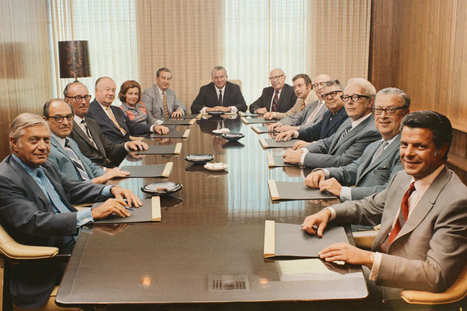
Like this CEO, there are many (often successful) people in organisations who are direly lacking in empathy. Some executives are quite narcissistic. Self-centered as they are, they may find it difficult to put themselves in other people’s shoes. Other executives may have sociopathic traits. They project an air of sincerity, but in reality they feel nothing, and are fine with that. Some people even turn empathy into a destructive force, using their keen sense of a person’s emotional state to manipulate or destabilize him or her. Many more people, like the CEO, are wary of the chaos that might ensue if “personal feelings” were acknowledged. But behaving in these ways in our increasingly network-oriented society comes with a steep price.
Empathic executives are better at managing relationships. They establish safe environments in which people can express hopes and fears. Because it is “contagious,” empathy contributes to better negotiation, collaboration, and conflict resolution.
Empathy plays an important role in effective team formation. When the expression of empathy is part of a company’s culture, its stress level will be lower. All of these advantages lead to a more committed workforce with a greater motivation to perform beyond expectations.
Manfred Kets de Vries, INSEAD Distinguished Clinical Professor of Leadership Development & Organisational Change
It’s tempting to dismiss empathy as the latest corporate buzzword…until you look at the numbers.
Last year, the top 10 companies in the Global Empathy Index—blue-chip firms like Facebook, Disney and Apple—increased in value more than twice as much as the bottom 10 and generated 50 percent more earnings. The connection seems clear: Caring in business is good for the bottom line.
But what does it really mean to be empathetic in business? And, more importantly, how do you cultivate the kind of genuine empathy that gives you a business edge. Here’s my perspective from the front lines of a growing company.
At the core leadership is ultimately about others. It means inspiring them to take actions beyond their capabilities, leading them in a direction that is compelling and inspiring. And empathy is the foundation of those actions.
Here are six simple ways that empathy can make you into the best leader you can be:
Working on and with the web is engaging in that most human of endeavors: Communication. Even so, it’s easy to forget that the people we interact with and those who access and interact with our creations are just that: People. Learn how to make empathy and acceptance driving forces for your interactions and designs to build great informational experiences for everyone.
We found that the lost element – and key to an engaged, happy workforce – is empathy. And so, Businessolver spent the last year studying how empathy – or lack thereof – affects businesses. The end result is our hallmark research, the Businessolver Workplace Empathy Monitor, which we were excited to unveil yesterday at our Vision 20/16 Chicago user conference.
Surveying more than 1,000 leaders, HR professionals, and employees, the Workplace Empathy Monitor gets to the bottom of why empathy matters in the workplace. Just a snapshot of key findings affirms our belief that change is needed:
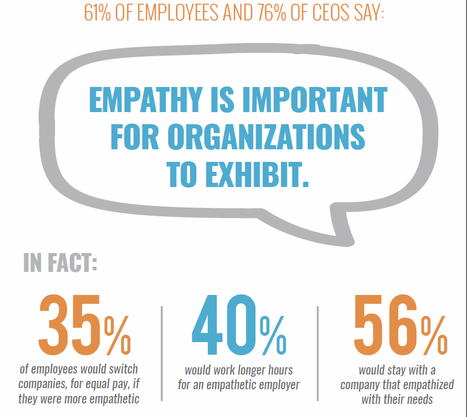
Only 24 percent of Americans believe that organizations are empathetic versus 60 percent of CEOs. 31 percent of employees believe profit is all that matters to their organization, and that their organization doesn’t care about employees. 1 in 3 employees would switch companies, for equal pay, if the other company was more empathetic.
You can’t lead without empathy. Think about the worst bosses you’ve ever had. Chances are they were egotistical, terrible at listening and deeply insecure.
They likely never exhibited compassion for others and were completely self-absorbed. Consequently, they made you miserable and worse at your job.
Ernest Hemingway once stated: When people talk, listen completely. Most people never listen. Great leaders are great listeners. They listen with empathy, sincerely attempting to put themselves in the other person’s shoes.
Concurrently, they build trust, alleviate discontentment and help catalyze solutions to various problems and grievances.
Empathy in leadership is one of the most important factors influencing workplaces today. A lack of empathy in leadership can have dramatic consequences for staff and teams, leading to behaviour that makes the workplace unpleasant.
Given that one of the most common reasons people leave their jobs is because of their bosses, it stands to reason that a lack of empathy in leadership may be behind many of these resignations.
According to the consultancy Development Dimensions International, roughly 20% of employers in the U.S. now offer empathy training for managers, a sizable increase from 10 years ago, reports the Wall Street Journal.
Listening and responding skills outranked all others in producing the most successful leaders, according to a DDI study of more than 15,000 leaders in 18 countries released earlier this year. The 10 top performing businesses from among the 160 included in The Empathy Business’s “Global Empathy Index” generated 50% more net income per employee than the bottom 10 performers.
Companies are responding by including empathy training for managers, teaching listening skills rather than the old-school, hard-charging intimidation tactics preferred by some bosses.
Empathy’s a soft skill, but we’re not talking about warm, fuzzy feelings (though I’m known as a hugger). Teammates who communicate sincerely and authentically can navigate thorny situations like Zen masters, and humans who feel recognized are more willing to do their part
One study found that people are more efficient when they see their work’s positive impacts. We issue a monthly award to employees who deliver “raving fan” service to clients and colleagues.
Team members led by empathetic managers — who listen, hear, and take in what others think and feel — work in more productive, innovative, and satisfying ways.
Empathy leads to power for many reasons. People who attend to others carefully are better able to resolve conflicts, and negotiate in ways that yield better outcomes for the parties involved. Empathy enables people to handle the stresses of social living better. For example, in one study, simply labeling an angry expression with the word anger — the most rudimentary act of empathy — reduced the activation of stress-related regions of the brain usually amped up by perceiving others’ anger.
Perhaps most important, carefully attending to others’ emotions conveys respect: People feel esteemed when they are heard and understood by others, and are more willing to be influenced by such people.
Millions of people want to make a big difference, but can they? Here are 6 critical traits of those who inspire others.
They have deep empathy for others
In my former work as a therapist and now as a coach, I’ve seen that millions of people around the globe have suffered at the hands of narcissists, or from mentally disordered or morally-corrupt individuals — either in their families, upbringing, or in their professional lives.
In my view, the most crushing aspect of narcissistic behavior is the total lack of empathy.
It’s very scary (and damaging) to be in relationship with someone who is totally incapable of empathy, because they’ll do anything to you and against you without remorse. They simply cannot put themselves in your shoes or understand or accept what you feel.
On the flip side, those who inspire us to be better are fully capable of experiencing empathy, and they openly express their ability to understand our personal “stories” and who we really are and what we feel, deep down.
It’s tempting to dismiss empathy as the latest corporate buzzword…until you look at the numbers.
Last year, the top 10 companies in the Global Empathy Index—blue-chip firms like Facebook, Disney and Apple—increased in value more than twice as much as the bottom 10 and generated 50 percent more earnings. The connection seems clear: Caring in business is good for the bottom line.
But what does it really mean to be empathetic in business? And, more importantly, how do you cultivate the kind of genuine empathy that gives you a business edge. Here’s my perspective from the front lines of a growing company.
For many enterprises today, technology is quietly sabotaging the social compact that underpins internal and external success.
Technological innovation and relentless cost cutting have pushed the communication pendulum toward an unhealthy co-dependence with IT, eroding personal engagement, aggravating virtual distance, and undermining strategic alignment.
'The Empathic Enterprise' sounds the alarm around technology overload and provides a roadmap for improved partnering between humankind and machines, tracing their historical, symbiotic relationship and underlining the urgency of achieving better balance.
A new survey from benefits administration tech company Businessolver shows that while 60 percent of CEOs view their organization as “empathetic,” only about a quarter of rank-and-file workers feel the same way.
The online poll of 1,840 U.S. adults found that employees and executives nevertheless agree on what constitutes an empathetic workplace...
There is also a great deal of agreement on the ways in which employers and coworkers can demonstrate respect and empathy for each other. At the top of the list is verbal acknowledgement that you are
Businessolver is excited to announce the launch of our new Workplace Empathy Monitor, which surveyed more than 1,000 CEOs, HR Professionals and Employees. This eye-opening study found that there is a gap between how empathetic leaders perceive themselves to be and how their message and action are perceived by employees.
That gap can lead to decreased satisfaction and lowered engagement levels, not to mention employee turnover and low morale. Employees want their priorities, expectations and needs to be heard and understood by their leadership, and leaders are struggling with what to do and say that shows empathy to their employees.
It turns out, there are significant bottom-line benefits to having an empathetic organization. According to Businessolver's research, employees are more likely to take - and keep - a job at an organization that they perceive to be empathetic (even if that means taking a lower paycheck). Consumers, too, are more eager to do business with an organization that they think is empathetic.
Nathalie Nahai empathy your secret weapon in designing for the web
Behind every screen sits a user waiting to be engaged
Whether you reach them or not will depend on how you make them feel more than anything else In this presentation Nathalie will explore how the primal emotional and rational systems in the brain can be used as a metaphorical model to build persuasive online experiences And show why mirror neurons and empathy.
TEDxLivermore team has chosen empathy as the theme for its 2016 meeting.
Tedx will be held from 8:00 a.m. – 5:00 p.m. on June 25th at Las Positas College in Livermore. Global thought leaders, entrepreneurs, authors, artists, innovators and scientists will present their ideas on the topic: “The Economics of Empathy: Empathy as Currency for Building Community”
TEDxLivermore is supported by ReImagine Science, the Livermore Valley Chamber of Commerce, Innovation Tri-Valley, Common SciSense (Livermore), and i-GATE Innovation Hub.
Corporate empathy may sound like an oxymoron, but more businesses are emphasizing the trait in developing managers and products. Cisco Systems Inc., Breakthru Beverage Group and Ford Motor Co., have invested in empathy training to improve management, retain employees, or guide design decisions.
Individuals who master listening and responding to others are the most successful leaders, and this skill outranks all others, concluded a study released this year by human-resources consultancy Development Dimensions International. The finding reflects assessments of more than 15,000 leaders in 18 countries. A 2011 study of 6,731 managers from 38 countries by the Center for Creative Leadership also uncovered strong performance by empathetic bosses, saying they " effectively build and maintain relationships."
About 20% of U.S. employers offer empathy training as part of management development, up significantly from a decade ago, estimates Richard S. Wellins, a DDI senior vice president. He expects that percentage will double in 10 years.
Corporate empathy may sound like an oxymoron, but more businesses are emphasizing the trait in developing managers and products. Cisco Systems Inc., Breakthru Beverage Group and Ford Motor Co., have invested in empathy training to improve management, retain employees, or guide design decisions.
EMPATHY EXERCISES Tips for practicing empathy at work:
Pay careful attention to colleagues’ emotions, not just their words
Use phrases like “I hear that you’re feeling angry,” to recognize a person’s emotions without being judgmental
Be authentic and sincere even when you disagree with someone’s feelings
Use phrases that both acknowledge emotions and still hold employees accountable
InFocus podcast interview with Dr. Dacher Keltner. Dr. Keltner's research and new book, The Power Paradox, focuses on two questions. First is the biologica
We examine the role empathy plays in improving employee engagement in this video with Amanda Wildman, Director of Emotionally-i-Fit and our former Head of Learning and Development.
Now empathy, if you think about that in the context of leadership development is a critical part of that:
Being able to manage conflict
To resolve challenges in the workplace
Identify the needs of other people
To be able to listen
To be able to walk in their shoes
It's a really important part of emotional engagement.
To get content containing either thought or leadership enter:
To get content containing both thought and leadership enter:
To get content containing the expression thought leadership enter:
You can enter several keywords and you can refine them whenever you want. Our suggestion engine uses more signals but entering a few keywords here will rapidly give you great content to curate.


 Your new post is loading...