Educational Technology News
220.4K views | +20 today
 
Scooped by EDTECH@UTRGV
onto Educational Technology News
April 20, 11:48 AM
Scoop.it!

The Screen Time Debate in Texas Schools: The Conversation Is Changing

The Screen Time Debate in Texas Schools: The Conversation Is Changing | Educational Technology News | Scoop.it
Across Texas, something interesting is happening. School boards are debating device use, lawmakers are asking tougher questions about technology in Explore this and more at TCEA TechNotes Blog, your go-to source for educational technology and teaching innovation.
EDTECH@UTRGV's insight:

"Recent legislation around personal device bans has opened the door to a broader question: How much screen time is happening on school-issued devices—and is it the right amount?"

No comment yet.
Educational Technology News
The latest news related to the meaningful and effective implementation of educational technology and e-learning in K-12, higher education, corporate and government sectors.
Curated by EDTECH@UTRGV
Your new post is loading...
Scooped by EDTECH@UTRGV
February 11, 5:29 PM
Scoop.it!

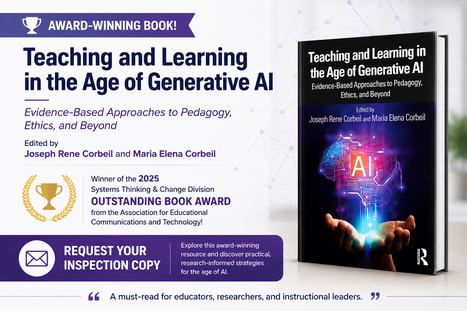
Looking for a Textbook on Generative AI in Education?

Looking for a Textbook on Generative AI in Education? | Educational Technology News | Scoop.it

Teaching and Learning in the Age of Generative AI: Evidence-Based Approaches to Pedagogy, Ethics, and Beyond


Edited by Joseph Rene Corbeil & Maria Elena Corbeil (2025)


🏆 Winner of the 2025 Systems Thinking & Change Division Outstanding Book Award from the Association for Educational Communications and Technology!


If you are designing a course that addresses generative AI in education, this award-winning volume provides a research-driven, classroom-ready foundation. Rather than offering hype or fear, this book helps educators:

  • Ground AI integration in learning theory and research
  • Address academic integrity with thoughtful, practical strategies
  • Redesign assessment for an AI-enabled world
  • Explore ethics, bias, privacy, and institutional responsibility
  • Leverage AI to enhance critical thinking and digital literacy


Bookended by historical and forward-looking analyses of AI in education, the chapters move beyond surface-level discussions to provide evidence-based approaches for real classrooms—K–12, higher education, and professional learning environments.

This text is ideal for:

  • Undergraduate and graduate teacher education programs
  • Curriculum & Instruction courses
  • Educational Technology programs
  • Higher education faculty development
  • School technology coordinators and talent development professionals

Adopting a GenAI textbook for an upcoming semester?

We invite you to request an inspection copy and explore how this resource can support your students in navigating AI with skill, ethics, and informed judgment.

Request your inspection copy today.

EDTECH@UTRGV's insight:

Award-winning "Teaching and Learning in the Age of Generative AI" offers research-based, practical guidance for educators seeking to thoughtfully integrate generative AI into their courses—request an inspection copy: https://www.routledge.com/textbooks/evaluation/9781032688602.

No comment yet.
Scooped by EDTECH@UTRGV
April 28, 12:01 PM
Scoop.it!

When AI does the work, who does the learning?

When AI does the work, who does the learning? | Educational Technology News | Scoop.it
If we design AI systems that shortcut the learning process, we risk undermining the very purpose and value of education.
EDTECH@UTRGV's insight:

"AI is rapidly reshaping education, but not always in ways that support learning. A growing number of AI tools promise to “help” students by doing assignments, writing papers, solving problem sets, or even completing exams automatically.


While these tools may appear convenient, they raise an important question: Are they removing barriers to learning, or removing learning itself?"

No comment yet.
Scooped by EDTECH@UTRGV
April 28, 11:50 AM
Scoop.it!

As AI pushes students to reconsider majors, universities struggle to adapt

"A recent poll shows AI’s increasing role in how students decide on college majors, creating a rapidly developing situation for universities that are still struggling to determine how the technology will shape higher education."

EDTECH@UTRGV's insight:

"Around 16 percent pointed to AI as the reason they changed their field of study."

No comment yet.
Scooped by EDTECH@UTRGV
April 28, 11:41 AM
Scoop.it!

The Screen Time Excuse: Why Blaming EdTech Isn’t The Solution We Are Looking For

The Screen Time Excuse: Why Blaming EdTech Isn’t The Solution We Are Looking For | Educational Technology News | Scoop.it
Something is happening in education right now that should make every serious person uncomfortable.
EDTECH@UTRGV's insight:

"The scapegoats change. The pattern doesn't. We find something to blame, build a reform movement around it, and never quite get around to the harder, less headline-friendly work of actually changing the conditions in which children learn and teachers teach. And now we're doing it again, only this time, the villain is the screen."

No comment yet.
Scooped by EDTECH@UTRGV
April 27, 12:15 PM
Scoop.it!

What AI Will Look Like In 2030 (And What It Means For eLearning)

What AI Will Look Like In 2030 (And What It Means For eLearning) | Educational Technology News | Scoop.it

"[T]he AI trends reshaping eLearning by 2030 aren't coming from EdTech start-ups. They're coming from the raw compute infrastructure being built right now, the same forces powering ChatGPT, scientific research, and software engineering. Those forces are heading straight for your LMS. Let's break down exactly what's coming, and what you need to do about it."

EDTECH@UTRGV's insight:

"AI in 2030 will become the backbone of eLearning, while human roles will have shifted toward strategy and oversight."

No comment yet.
Scooped by EDTECH@UTRGV
April 27, 12:12 PM
Scoop.it!

AI Is Exposing A Capability Problem, Not Just A Technology Shift

AI Is Exposing A Capability Problem, Not Just A Technology Shift | Educational Technology News | Scoop.it

"Most organizations say they are trying to prepare for AI. In practice, many are doing something narrower. They are giving people access to tools, offering introductory sessions, and encouraging experimentation. That may create activity. It does not necessarily create capability. This is the distinction that matters. AI is not just introducing new tools into the workplace. It is exposing whether organizations understand how capability is actually built, supported, and applied under real conditions."

EDTECH@UTRGV's insight:

"AI is exposing a critical gap: access and support are not capability. Organizations must rethink how performance is built, supported, and measured to avoid scaling inconsistency."

No comment yet.
Scooped by EDTECH@UTRGV
April 27, 12:09 PM
Scoop.it!

The AI Bubble Is Deflating, Says One Educator

The AI Bubble Is Deflating, Says One Educator | Educational Technology News | Scoop.it
Educator and author Carl Hooker says AI interest from educators has passed peak levels.
EDTECH@UTRGV's insight:

"AI enthusiasm amongst educators hasn’t evaporated, but it's not as intense as it once was, says Carl Hooker, educator and author."

No comment yet.
Scooped by EDTECH@UTRGV
April 27, 12:06 PM
Scoop.it!

The rulebook for designing AI experiences

"Three of the world’s largest tech companies have published guidelines for responsible Human-AI Interaction. Here’s what they got right, and where the gaps are."

EDTECH@UTRGV's insight:

"When someone is actually sitting in front of an AI-powered product, what makes the experience good? And who, if anyone, has written that down in a way that’s actually useful?"

No comment yet.
Scooped by EDTECH@UTRGV
April 27, 12:03 PM
Scoop.it!

How should universities define AI proficiency?

How should universities define AI proficiency? | Educational Technology News | Scoop.it
AI literacy is increasingly seen as fundamental knowledge for students. How can educators set the parameters that ensure proficient use of artificial intelligence across the institution, regardless of discipline? Junghwan Kim offers advice
EDTECH@UTRGV's insight:

"AI proficiency cannot simply mean 'learning the tool'. Students must develop deep knowledge in their field and learn how AI interacts with that knowledge."

No comment yet.
Scooped by EDTECH@UTRGV
April 24, 9:51 AM
Scoop.it!

When Artificial Intelligence (AI) Becomes the First Source of “Confidence and Trust” in Learning

When Artificial Intelligence (AI) Becomes the First Source of “Confidence and Trust” in Learning | Educational Technology News | Scoop.it
Tools and Trends When Artificial Intelligence (AI) Becomes the First Source of “Confidence and Trust” in Learning March 16, 2026 Tools and Trends During a recent discussion, a colleague asked a retired educator: “What are the two feelings you most want your students to have toward you to be...
EDTECH@UTRGV's insight:

During a recent discussion, a colleague asked a retired educator: “What are the two feelings you most want your students to have toward you to be effective?” The educator answered immediately: “Confidence and trust. Not engagement. Not motivation. Not achievement. Confidence and trust.”

No comment yet.
Scooped by EDTECH@UTRGV
April 24, 9:39 AM
Scoop.it!

From innovation to impact: Three ways school districts can build a sustainable AI framework

From innovation to impact: Three ways school districts can build a sustainable AI framework | Educational Technology News | Scoop.it
School leaders must move beyond experimentation and build AI systems that prioritize governance, purpose, and data integrity.
EDTECH@UTRGV's insight:

"Becoming “AI-ready” isn’t about chasing the newest shiny platform; it requires districts to build intentional systems that guide how AI is evaluated, implemented, and governed."

No comment yet.
Scooped by EDTECH@UTRGV
April 24, 9:31 AM
Scoop.it!

Adults Bring Experience. AI Should Help You Use It.

Adults Bring Experience. AI Should Help You Use It. | Educational Technology News | Scoop.it


"Most trainers say they believe in learner experience. Far fewer actually design for it. They ask for introductions. Maybe they throw out an opening question. Maybe they invite people to “share from their background.” Then they move straight into the deck they were always going to use anyway. That is not learner-centered training."

EDTECH@UTRGV's insight:

"The first rule of AI in training: start with the learner, not the prompt"

No comment yet.
Scooped by EDTECH@UTRGV
April 23, 8:39 AM
Scoop.it!

AI search has a trust problem. Transparency is the fix

"Nearly two out of three American adults have used an AI-powered search tool in the past six months. But here’s the stat that should keep every product builder up at night: only 15% say they trust the results “a lot.” 


That gap between adoption and trust is the defining challenge for the next era of AI search. Consumers are showing up, but they are questioning the results. As product builders, we have to ask ourselves an uncomfortable question: Are we building experiences that earn and deserve consumer trust?"

EDTECH@UTRGV's insight:

"More than half of consumers say AI search feels like a walled garden. Here’s what product builders need to do about it"

No comment yet.
Scooped by EDTECH@UTRGV
April 28, 12:04 PM
Scoop.it!

The future of AI in the classroom

The future of AI in the classroom | Educational Technology News | Scoop.it

Insights about AI in the classroom from three education conferences I attended in California.
EDTECH@UTRGV's insight:

"We all know we’re supposed to check what AI spits out. But Victoria Yaneva, director of data science and AI at the National Board of Medical Examiners, said there’s growing evidence that humans are getting worse at doing so. People who are enthusiastic about AI are more likely to miss errors, she said. AI skeptics are better at catching them."

No comment yet.
Scooped by EDTECH@UTRGV
April 28, 11:59 AM
Scoop.it!

Syracuse University Gave AI Access To 30,000+ Students and Faculty. Here’s What They Learned

Syracuse University Gave AI Access To 30,000+ Students and Faculty. Here’s What They Learned | Educational Technology News | Scoop.it
When used in the right way AI seems to help test scores and save teacher and staff time, say Syracuse University's Jeff Rubin and Andrew Joncas
EDTECH@UTRGV's insight:

"Syracuse University has gone all in on the AI revolution, deploying Claude AI to 30,000+ students, faculty members, and staff. Along the way, school leaders say they've developed effective AI use cases both in the classroom and beyond, ranging from test practice to course schedule management."

No comment yet.
Scooped by EDTECH@UTRGV
April 28, 11:44 AM
Scoop.it!

The forgotten conversation problem in AI chat

"A few months ago I spent an evening with Claude debugging a production cron job. We worked through the timing window, the fix landed, the deployment held overnight. Last week the same class of issue came back. I knew Claude had explained the edge case clearly. I could not find the conversation. I remembered it used a cron job. The native search did not match “cron job” because the words were not in the conversation title, and Claude.ai’s sidebar search only matches titles. The conversation is in there. I have no way to reach it."

EDTECH@UTRGV's insight:

"AI chat is now the largest single layer of new written human thought being produced on the internet. And that layer, across all three major platforms, is barely indexed for retrieval."

No comment yet.
Scooped by EDTECH@UTRGV
April 27, 12:19 PM
Scoop.it!

16 Characteristics Of A Critical Thinking Classroom

16 Characteristics Of A Critical Thinking Classroom | Educational Technology News | Scoop.it
How do you know if your students are thinking critically in the classroom? Here are examples that might be good indicators.
EDTECH@UTRGV's insight:

"What Are Indicators Of Critical Thinking?...Students ask more questions than the teacher. Questions are valued over answers. Questions are revisited, updated, and revised."

No comment yet.
Scooped by EDTECH@UTRGV
April 27, 12:13 PM
Scoop.it!

Bloom’s Revised Taxonomy: All You Need To Know

Bloom’s Revised Taxonomy: All You Need To Know | Educational Technology News | Scoop.it
Explore Bloom's revised taxonomy and learn how it classifies learning goals for modern educational practices.
EDTECH@UTRGV's insight:

"Bloom's revised taxonomy is a guide for classifying learning goals based on how complex they are. It helps teachers and Instructional Designers organize learning from simple recall of facts to higher-order thinking skills."

No comment yet.
Scooped by EDTECH@UTRGV
April 27, 12:10 PM
Scoop.it!

What doctoral programs must change in an AI-saturated research environment

What doctoral programs must change in an AI-saturated research environment | Educational Technology News | Scoop.it

"Generative AI has moved from novelty to a core tool in a remarkably short period of time. Doctoral students now routinely use AI tools to locate sources, summarize literature, generate outlines, and even draft sections of academic writing."

EDTECH@UTRGV's insight:

"In an AI era where text can be generated instantly, judgment, interpretation, and context remain unmistakably human for doctoral programs."

No comment yet.
Scooped by EDTECH@UTRGV
April 27, 12:08 PM
Scoop.it!

Students are becoming AI fluent. Universities aren’t.

Students are becoming AI fluent. Universities aren’t. | Educational Technology News | Scoop.it

"Across higher education, artificial intelligence is too often being governed as though it were primarily an academic integrity issue. It is clearly not just that.


AI is already reshaping how universities teach, advise, recruit, admit, communicate, assess risk, and make decisions. Yet many institutions continue to approach it through fragmented policies, uneven faculty guidance, and conversations narrowly focused on misuse in student work."

EDTECH@UTRGV's insight:

"AI literacy implies awareness and basic competence. Being AI fluent requires judgment, adaptability, and the ability to engage dynamically."

No comment yet.
Scooped by EDTECH@UTRGV
April 27, 12:05 PM
Scoop.it!

The right touch: mapping AI presence to user intent

"In the last piece, I talked about how signals help us understand what users are trying to accomplish, grounded in their Jobs to Be Done (JTBD). Even as generative capabilities expand, users still have real outcomes they’re working toward. Getting the signals right lets systems not only figure out what to generate, but when to adjust or pull back.


That thinking assumes something, though. It assumes we’re working with familiar patterns: structured interfaces, clear entry points, predictable flows.


As AI gets more embedded in the experience, that assumption starts to break down."

EDTECH@UTRGV's insight:

"Knowing what a user wants is only half the problem. The other half is knowing how, and how much, to respond."

No comment yet.
Scooped by EDTECH@UTRGV
April 27, 12:01 PM
Scoop.it!

The Hidden Curriculum of Testing: Multiple-Choice Exam Strategies

The Hidden Curriculum of Testing: Multiple-Choice Exam Strategies | Educational Technology News | Scoop.it
Why do students struggle with multiple-choice exams? Discover simple, research-backed test-taking strategies that improve performance and make the hidden curriculum of testing visible.
EDTECH@UTRGV's insight:

"When students are taught how to navigate exam formats, manage time, and regulate stress, assessments become more accurate and meaningful measures of learning."

No comment yet.
Scooped by EDTECH@UTRGV
April 24, 9:41 AM
Scoop.it!

The pedagogy gap: Redefining the role of faculty and AI in higher education

The pedagogy gap: Redefining the role of faculty and AI in higher education | Educational Technology News | Scoop.it
In higher education, the most pressing challenge is not AI itself, but the underlying pedagogy gap masked by traditional instructional models
EDTECH@UTRGV's insight:

"AI has acted as a catalyst, exposing this pedagogy gap by demonstrating that while machines can replicate the transfer of information with startling efficiency, they cannot replace the structured design required for true education."

No comment yet.
Scooped by EDTECH@UTRGV
April 24, 9:38 AM
Scoop.it!

Designing with AI without losing your mind

"With critical thinking skills on the line I built a real-time AI collaborator, Thia — with vision and voice capabilities to keep early ideas raw, the loop tight, and the thinking mine."

EDTECH@UTRGV's insight:

"The only way to retain critical thinking skills is to use them, by keeping them sharp — that means embracing cognitive friction and not simply rushing to the finish line.”

No comment yet.
Scooped by EDTECH@UTRGV
April 24, 9:29 AM
Scoop.it!

The Questions Students Ask about Micro-Credentials and What They Reveal About Our Learning Systems

The Questions Students Ask about Micro-Credentials and What They Reveal About Our Learning Systems | Educational Technology News | Scoop.it

"Micro-credentials may create added value for students and employers, but students frequently perceive them as traditional credentials repackaged. The questions students ask do more than identify information needs; they also illuminate how effectively our institutions are defining and communicating what micro-credentials are and what they do."

EDTECH@UTRGV's insight:

"What exactly is a micro-credential? When students ask this question, it shows that institutions aren’t being clear about what’s on offer."

No comment yet.
Scooped by EDTECH@UTRGV
April 23, 8:38 AM
Scoop.it!

The Age of AI means we need to throw out our old KPIs and replace them with new ones

"We are living through a fundamental shift in what work is for. As AI takes on more routine cognitive tasks, the uniquely human capacity to imagine, connect, and create meaning becomes the primary source of organizational value. Yet most companies are still measuring performance metrics prioritized for a different era: inventory turnover, cost per lead, and utilization rates."

EDTECH@UTRGV's insight:

"These metrics were designed to optimize extraction. They are poorly equipped to cultivate imagination."

No comment yet.